
Streaking Packers Rediscover Eddie Lacy, Run Game at Perfect Time
As the punishing elements of winter near, the Green Bay Packers are proving they can win in any kind of manner.
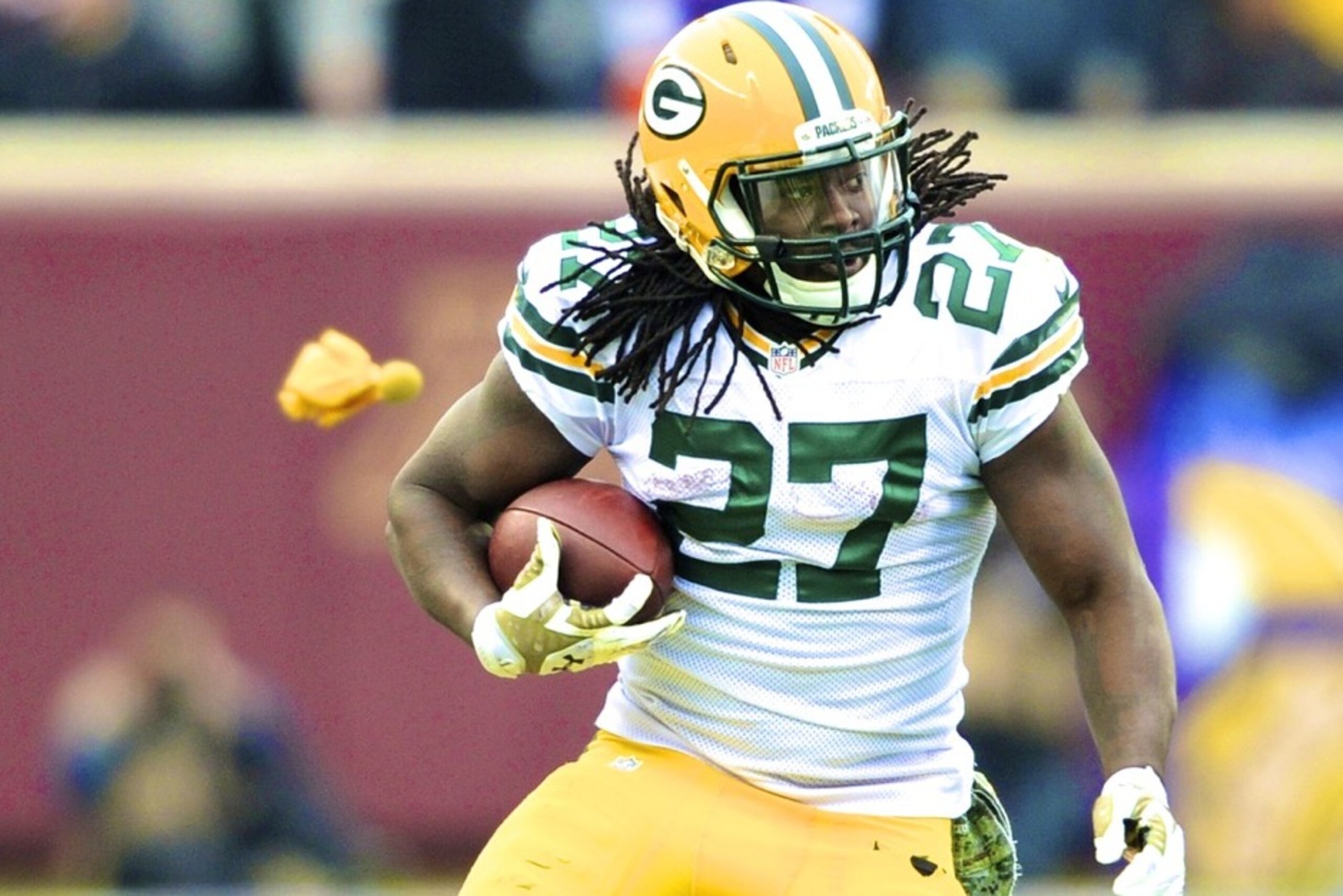
While quarterback Aaron Rodgers played his first meaningful snaps in the fourth quarter in almost a month, it was the hammering style of running back Eddie Lacy that sealed a close win over the Minnesota Vikings for the blowout-happy Packers.
Lacy rushed for a season-high 125 yards, caught a 10-yard touchdown pass in the fourth quarter and delivered two first downs on the final drive to secure Green Bay's 24-21 win, the club's third in a row and seventh in its last eight.
TOP NEWS
Bears' Santos Wanted to Kick 58-Yarder
Picking Each NFL Division Winner 🔮
.jpg?w=2560)
B/R's Expert Week 7 NFL Picks 🔮
The Packers had won back-to-back home games by a combined 74 points, thanks mostly to big plays from Rodgers and an opportunistic defense. On the road against a division rival, Green Bay stuck with Lacy and rode the big back to a grind-it-out win that lacked the aesthetics of the previous routs.
Of the Packers' eight wins in 2014, only three—Sunday's win in Minnesota, a come-from-behind victory in Miami and the home opener the New York Jets—have come within one score.
Instead of Rodgers airing it out, it was Lacy—whose 25 carries were his most since he rushed 25 times in a tie with the Vikings late last November—carrying much of the load.
"It wasn't the prettiest game, but we needed it," Rodgers told Tony Siragusa of Fox Sports on the field following the win.
Style points still count for nothing in the NFL, and the Packers' rediscovery of the run game is a promising sign—both functionally within the offense and in terms of operating in the harshness of the winter months ahead.

Faced with the prospect of a red-hot Rodgers shredding Minnesota deep, the Vikings decided to play mostly a two-high safety shell Sunday. When executed correctly, the look remains the most effective way to slow Rodgers and the Packers' big-play passing offense.
The approach mostly worked for the Vikings. Rodgers threw for just 209 yards and averaged 7.2 yards per attempt—both well below his season averages—and the Packers hit on just two passing plays over 20 yards. Jordy Nelson, whom the Vikings routinely double-teamed, finished with a long reception of just 14 yards.
While the big plays in the passing game were reduced, Green Bay made the most of the football math presented to it up front.
The two-high shell is a defense of sacrifice. By committing both safeties to the deep portion of the field, defensive coordinators are choosing to concede an extra player in the box. And when the math is in your favor in the trenches, the only option becomes to run the football.
"You have to be able to run against those defenses," Rodgers said.
Lacy was up to the task. He plunged in from one yard out to open the scoring in the first quarter and then finished off the game in the fourth quarter with runs of four yards on 3rd-and-2 and 10 yards on 2nd-and-5 to allow the Packers to kill the rest of the clock.
Like all great closers, Lacy was at his best late in the game. In addition to his two late conversions, Lacy rushed for 55 of his 125 yards in the fourth quarter and caught a touchdown off a short shovel pass with eight minutes, 34 seconds left to put the Packers up 11 points.
| 10 | 55 | 5.5 | 0 | 3 |
| 1 | 10 | 10.0 | 1 | 0 |
Against favorable boxes up front, Lacy broke off 11 runs of at least five yards and three of 10 or more. He also had both a 24-yard run and 24-yard reception called back because of penalties. Lacy's 125 rushing yards were the third most of his career.
Any defensive coordinator thinking about playing a mostly two-deep look against the Packers will look back at Sunday's contest and realize Lacy can be as punishing on the ground as Rodgers through the air.
Reestablishing Lacy on the ground should also pay off as the temperature drops and arctic elements come into play.
The Packers' remaining five games include three at Lambeau Field, where the weather this time of year is almost always some shade of awful, and one in Buffalo, a city still digging itself out from this past week's record snowfall. Rodgers is plenty capable of throwing the football in any weather, but the cold and snow do heighten the importance of establishing a presence on the ground.
The Packers' reliance on Lacy, who came into Sunday averaging just under 13 carries a game in 2014, will likely grow.
Last December, the 230-pound Lacy carried 77 times for 356 yards over four games. He averaged 4.6 yards per carry and scored five touchdowns, both highs for any month during his rookie season.
| vs. ATL | 20 | 65 | 3.3 | 1 |
| at DAL | 21 | 141 | 6.7 | 1 |
| vs. PIT | 15 | 84 | 5.6 | 2 |
| at CHI | 21 | 66 | 3.1 | 1 |
| Totals | 77 | 356 | 4.6 | 5 |
There are a number of factors why December was Lacy's best month in 2013, but the most obvious is that it's just not a fun endeavor to tackle a man of his size and momentum when the temperature dips anywhere near freezing. Force equals mass times acceleration, but the physics of football demands a cold variable. The Packers second-year running back typically wins that equation.
Lacy has just 672 rushing yards this season, which puts him on pace for roughly 980 over a full 16 games. He rushed for 1,178 as a rookie. However, Lacy came into Sunday averaging a full six fewer carries in 2014, while establishing a receiving pace that would put him just under 500 yards. His game has evolved.
The Packers offense will always remain Rodgers-oriented, but Lacy proved Sunday that he can still carry an offense if the defense or weather dictates he must.
Rounding into Super Bowl form, the Packers have now retaken first place in the NFC North. Lacy, a bulldozing back tailor-made for busting soft fronts and excelling in the elements, gives Green Bay's offense the edge needed to stay there.
Zach Kruse covers the NFC North for Bleacher Report.