How Erik Spoelstra Is Keeping the Miami Heat Rolling Without LeBron James
The Miami Heat offense has not undergone a serious overhaul with the departure of LeBron James.
Even though James has been the team's offensive focal point for the past four years, part of the Miami offensive genius is its reliance on constant ball movement.
This is a fairly obvious component to any successful scheme. Ball-stoppers disrupt flow, ice out teammates and allow the defense to narrow its focus.
TOP NEWS
Giannis' Warning to NBA ⚠️

NBA Power Rankings Entering Preseason 🔢
Wizards Guard Admits Tanking 😨
But this "pace and space" offense, as named by Heat head coach Erik Spoelstra, takes this concept to an entirely new level.
Ball movement for the sake of ball movement isn't necessarily a good thing though either. Great offenses ping it around at times, but the key is having players who probe with dribble penetration—whether in the pick-and-roll or in random basket attacks.
Side-to-side ball-swings are best utilized as play initiators. Everyone gets touches and everyone has equal opportunity to make plays should they become available.
For Miami, it's helped to smooth the transition to the post-James era. Because Spoelstra has built a ball-sharing culture into his team and his best players (Chris Bosh and Dwyane Wade) have adopted this mantra, it's become a saving grace for a team that now lacks the single best playmaker in the league.

Miami's 105.3 offensive rating ranks 11th in the league, according to NBA.com, and is a solid mark for a team with two key offensive cogs and a rotating cast of average role players. The 11-game sample size is small, but it's only 3.7 points per 100 possessions off Miami's 109.0 offensive rating with James last year.
That's not a huge drop-off considering the magnitude of the loss of James.
The key is that Miami has succeeded in the half court—the more difficult portion of offense in which talent gaps become more accentuated. According to Synergy Sports (subscription required), Miami's half-court offense generates 0.945 points per possession, good for sixth in the league.
Given the loss of James and his devastating finishing ability in transition, we can reasonably assume that much of that decline in total offensive rating stems from Miami's decreased run-outs.
Within the pace-and-space system are various run-of-the-mill offensive sets that Spoelstra uses. He's certainly a wizard at drawing up plays, but like most great coaches he does not want to unveil his bag of tricks this early in the season.
Specific designs are ultimately fruitless without execution, and Miami's willingness to move the basketball quickly enhances the effectiveness of their sets.
Take this big-on-big screening action Miami works with on this play against the Brooklyn Nets. The play itself is on the simpler side, with Chris Andersen screening Bosh's man before Bosh runs in to set the on-ball screen for Norris Cole:
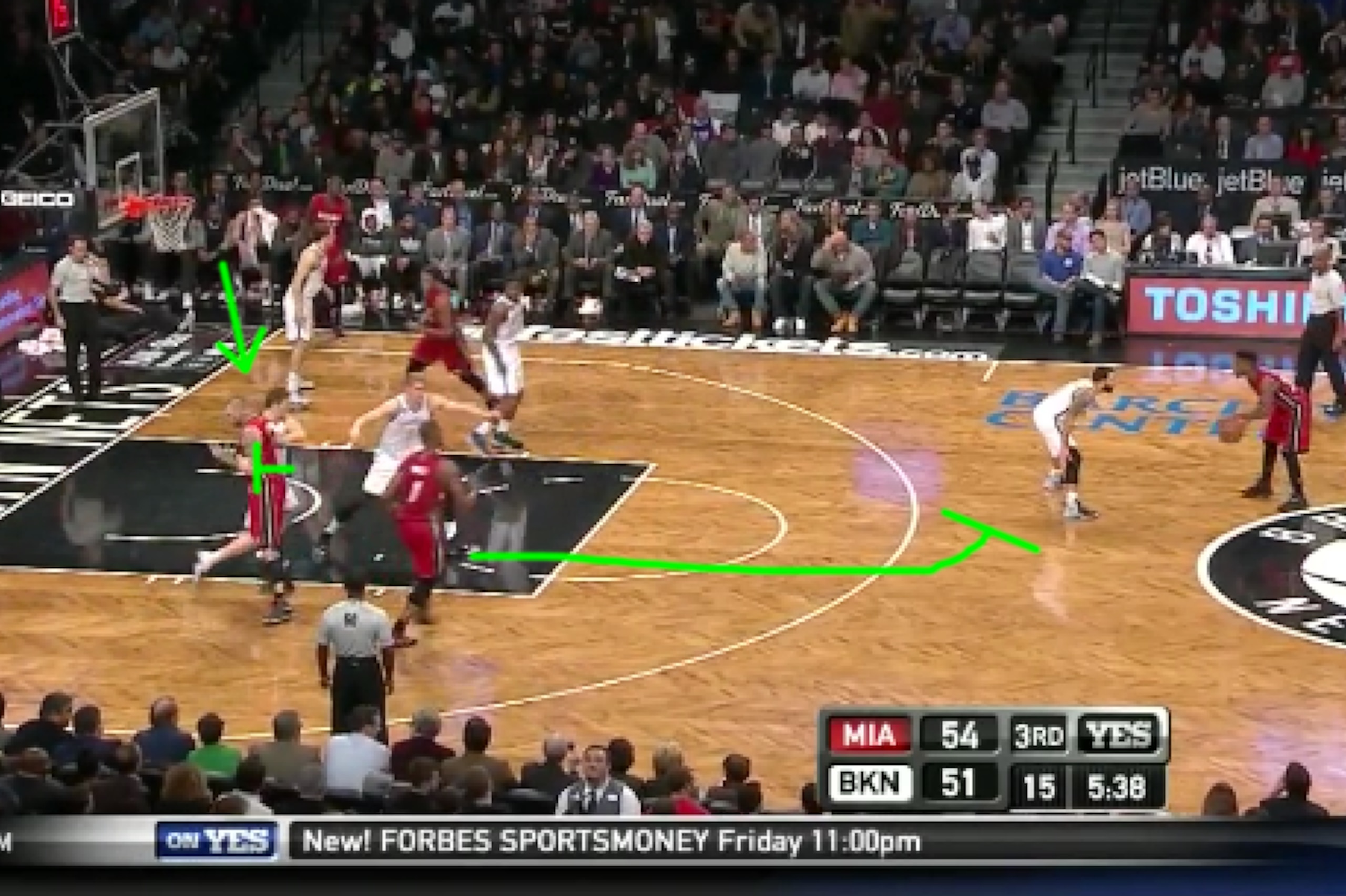
Not all bigs will take this play seriously. They'll be lazy with the pick or not sprint off it into the on-ball screen, undermining the play.
Here, Andersen makes a point of getting a piece of Brooklyn's Mirza Teletovic. This forces Mason Plumlee and Teletovic to switch, which is exactly what Miami wants. Instead of Plumlee hanging down low around the bucket and Teletovic maneuvering on the perimeter, it's reversed.
Both players are in roles they're less comfortable with.
As the play develops, Cole does a nice job of dragging out the screen—which is to say he makes extended and horizontal dribbles to draw two defenders, Plumlee and Deron Williams, toward him. As Bosh pops, he's wide-open:
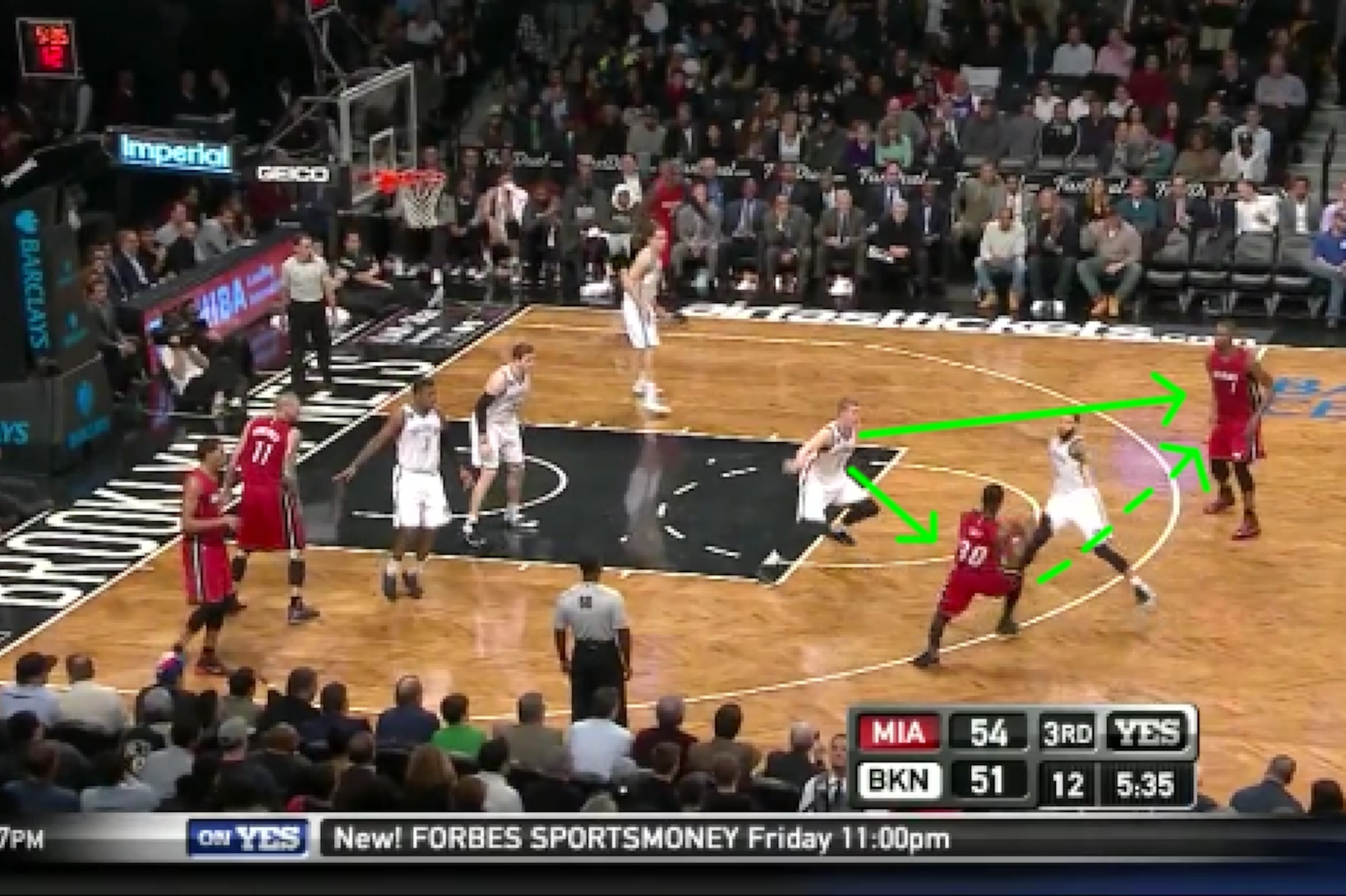
Bosh could shoot here, but a semi-contested three-point shot isn't an ideal look halfway through the shot clock. So he immediately swings the ball to change sides of the floor, forcing Plumlee to chase the ball from the block to the top of the key, then out to one wing and back toward the other.
By the time Bosh follows his pass and runs in for a pick-and-roll with James Ennis, Plumlee has worked his tail off just to stay in position. Given that he's not the most laterally-capable defender, it comes as no surprise that Plumlee gets caught out of position in his pick-and-roll coverage.
Teletovic, meanwhile, is now the last line of defense—a role in which he does not thrive. His contest is marginal at best, and Ennis scores rather easily:
The "pace" in "pace and space" doesn't necessarily refer to the pace of the players or how quickly the team shoots the ball. It's more about decision-making—catching and attacking quickly or swinging the ball immediately. The ball never sticks.
Even if the ball does remain in a single player's hands for an extended period of time, it's usually for a purpose. Rarely will you ever find a Miami player holding the ball and surveying.
Here's an example of that with Mario Chalmers, as he dribbles the ball toward the corner and seemingly into a double-team.
The play starts with a familiar screen-the-screener action, this time with a guard (Cole) getting Bosh.
There's a slight wrinkle this time in that Bosh pops for an elbow catch. After Chalmers hits him, he doesn't walk through the motions with a token cut. He sprints off Bosh for a fake dribble handoff before darting backdoor:
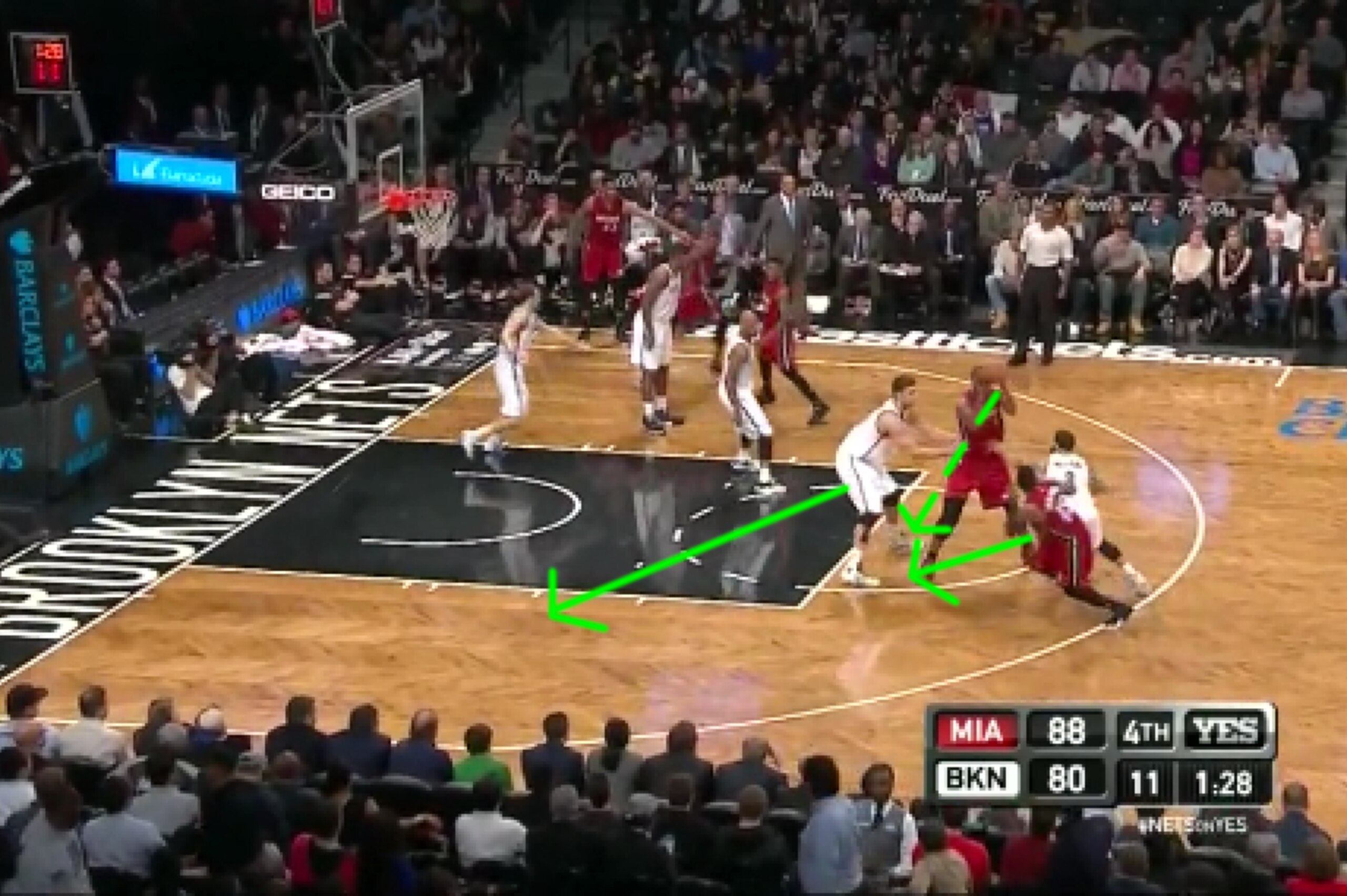
Bosh finds him with a nice over-the-top pass, but Brook Lopez is there as a secondary layer of basket protection. With nowhere to go vertically, Chalmers becomes the one dragging the screen out to draw a double.
Notice how Chalmers takes a second dribble toward the baseline, forcing Lopez to slide one more step away from Bosh:

This makes the throw back to Bosh that much more difficult to cover, and Lopez is nowhere near him as he fires the three-pointer:
No amount of ball-sharing will replace James, but it's a start. At 6-5, Miami is in the thick of the Eastern Conference playoff race and should be there come year's end.
When the game is slowed down in the postseason and half-court offense becomes the key to offensive success, the pace-and-space concept will become especially crucial.
Add that to their experienced roster, and Miami looks to be a team that could outperform its regular-season finish.
.jpg?w=2560 "Every Trade's Best Trade Asset 🔁")
.jpg?w=2560 "Insiders: Cowboys Overpaid for Porter")
.jpg?w=2560 "MHJ's Potential Trade Value 📉")