Matthew Stafford's Tunnel Vision Continues to Hurt the Detroit Lions
One quip I use often in evaluating Detroit Lions quarterback Matthew Stafford is that he's got an A-plus arm, but he is only a C-plus quarterback. There are games where he plays at a B or even an A level, and the Lions frequently win those games. Alas, the consistent excellence just isn't there for the 2009 No. 1 overall pick.
How can he nudge that maddeningly middling grade upward? How can he play at that A level more consistently? One easy way is to learn how to see the field.
OK, perhaps it's not "easy" to unlearn years of bad habits, ones formed in no small part out of sheer necessity. After all, for the vast majority of Stafford's tenure in Detroit he's really only had Calvin Johnson as a viable target. Locking onto the best receiver in the league was often Stafford's only real option.
.jpg?w=2560 "Chargers Mack")
.jpg?w=2560 "Green Bay Steelers Football")
.jpg?w=2560 "Giants Football")
That is not the case with the 2014 edition of the Lions, but old habits die hard for the quarterback. Never was that more evident than in Week 11's 14-6 loss to the Arizona Cardinals.
| Targets | Catches | QB Rating | |
| Calvin Johnson | 12 | 5 | 22.6 |
| Eric Ebron | 4 | 4 | 89.6 |
| Theo Riddick | 6 | 3 | 60.4 |
| Joique Bell | 5 | 3 | 77.1 |
| Golden Tate | 2 | 2 | 118.8 |
| Jeremy Ross | 1 | 1 | 95.8 |
Breaking down those targets a bit deeper, the tunnel vision for Megatron is even more staggering. Stafford started the game spreading the ball around nicely, completing eight of his first 10 passes to Theo Riddick, Jeremy Ross, Golden Tate, Eric Ebron and Johnson. The Lions scored all of their points on drives featuring that diversity.
Of Stafford's next 16 attempts, 11 targeted Johnson. He completed seven of those passes, including all five not thrown toward No. 81.
The Cardinals consciously tried to take Johnson away, yet Stafford continued to try and force the ball to him. If he would have looked around even a little, he would have seen much better opportunities with his other receivers.

This was a fourth-down play late in the game. Stafford has four options on this play. Three of them are in position to secure the first down and have some semblance of a throwing window. The fourth is Johnson, who is well-covered and proceeding at a near-impossible angle to complete the pass. Stafford never looks anywhere but to his right, and the play is easily defended.
The incompletion ended a drive which had crossed midfield and bore the promising potential of a game-tying score. If Stafford had even surveyed the entire field for a half of a second, he would have unearthed better options.
It wasn't the first time against the strong Cardinals defense when Stafford zeroed in on Johnson (split wide to the top) from before he even took the snap.
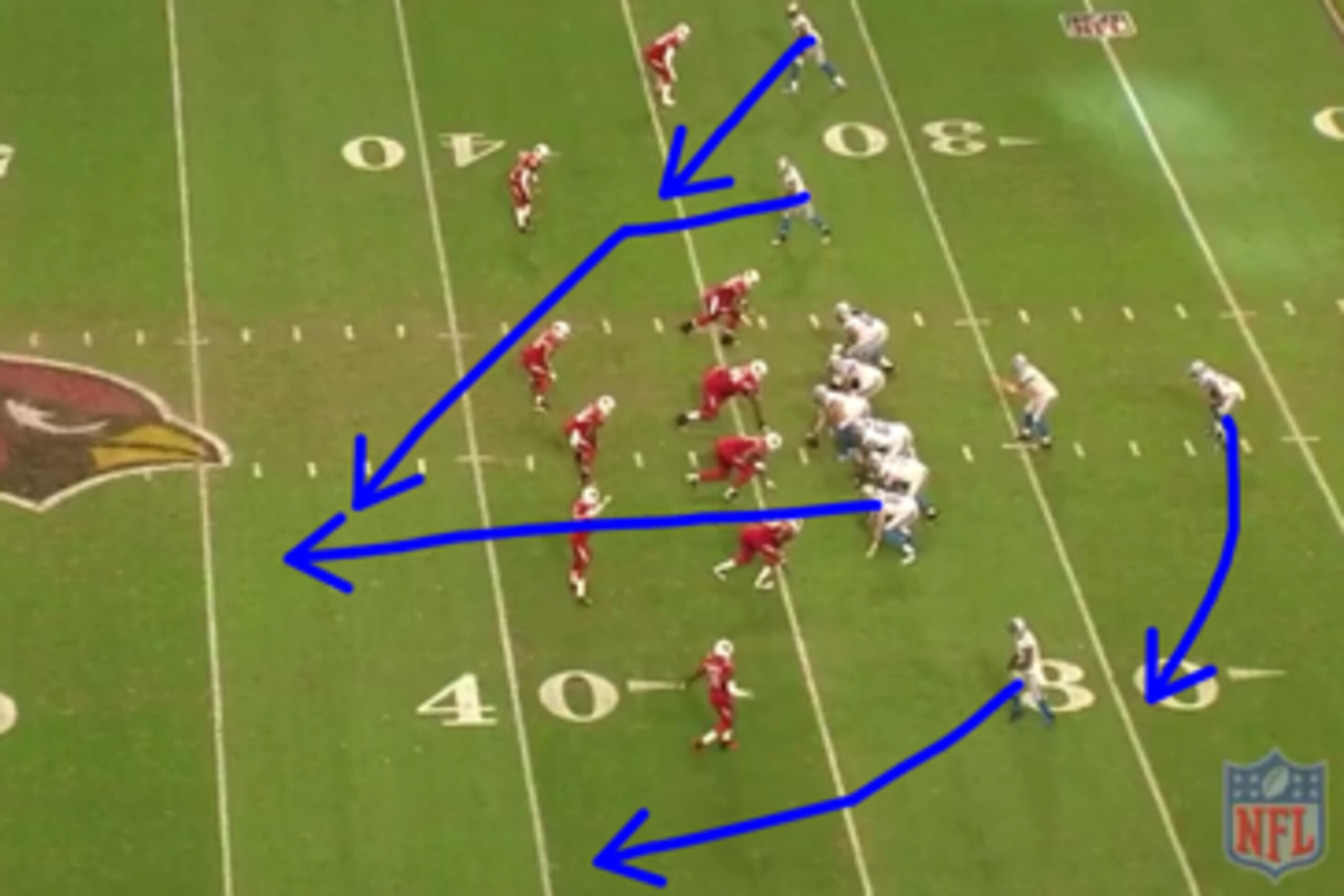
On this play, the Cardinals overplayed Johnson from the get-go. Coverage be damned, Stafford predetermined he was going to his favored target period. Corner Jerraud Powers starts off lined up over Tate in the slot, but he quickly passes him off to the linebacker and jumps the slant route.
Stafford never looks anywhere but directly at Johnson for the entire duration of the play. It's an easy read for Powers, who drops an easy pick-six.
Had Stafford shed his blinders, he would have seen his running back uncovered in the left flat. He also might have seen tight end Eric Ebron streaking past the linebacker down the left seam with no safety help over the top, as Stafford's stargazing at Johnson quickly drew his attention that way.
Missed opportunities like these finally caught up to the Lions' meager offense in Arizona. The underachieving unit had been just good enough to rally back in recent wins, but the string of luck ended against the NFC's top dog.
"Lions went without a TD for the first time in a game since a 20-6 loss to San Francisco on Dec. 27, 2009.
— Tim Twentyman (@ttwentyman) November 17, 2014"
Ironically, that game was Drew Stanton's first NFL start. He came away as the winning quarterback in Sunday's game against his old team, besting Stafford and the talented but sputtering Lions cast.
As noted by Dave Birkett of the Detroit Free Press:
"One of the league's most explosive offenses from 2011 to 2013, the Lions rank 26th in the NFL in scoring at 18.8 points per game and are on pace to score their fewest points since 2009, when they averaged just 16.4 and were coming off the NFL's only 0-16 season.
"
Injuries have certainly played a role. Johnson, the top three running backs, the right side of the offensive line and the trio of talented tight ends have all shuffled in and out of the lineup. Yet the quarterback has to do more with whatever cast is around him.
In reviewing the Lions' games, it calls to mind the old Hall & Oates song, "All I see is missed opportunity."
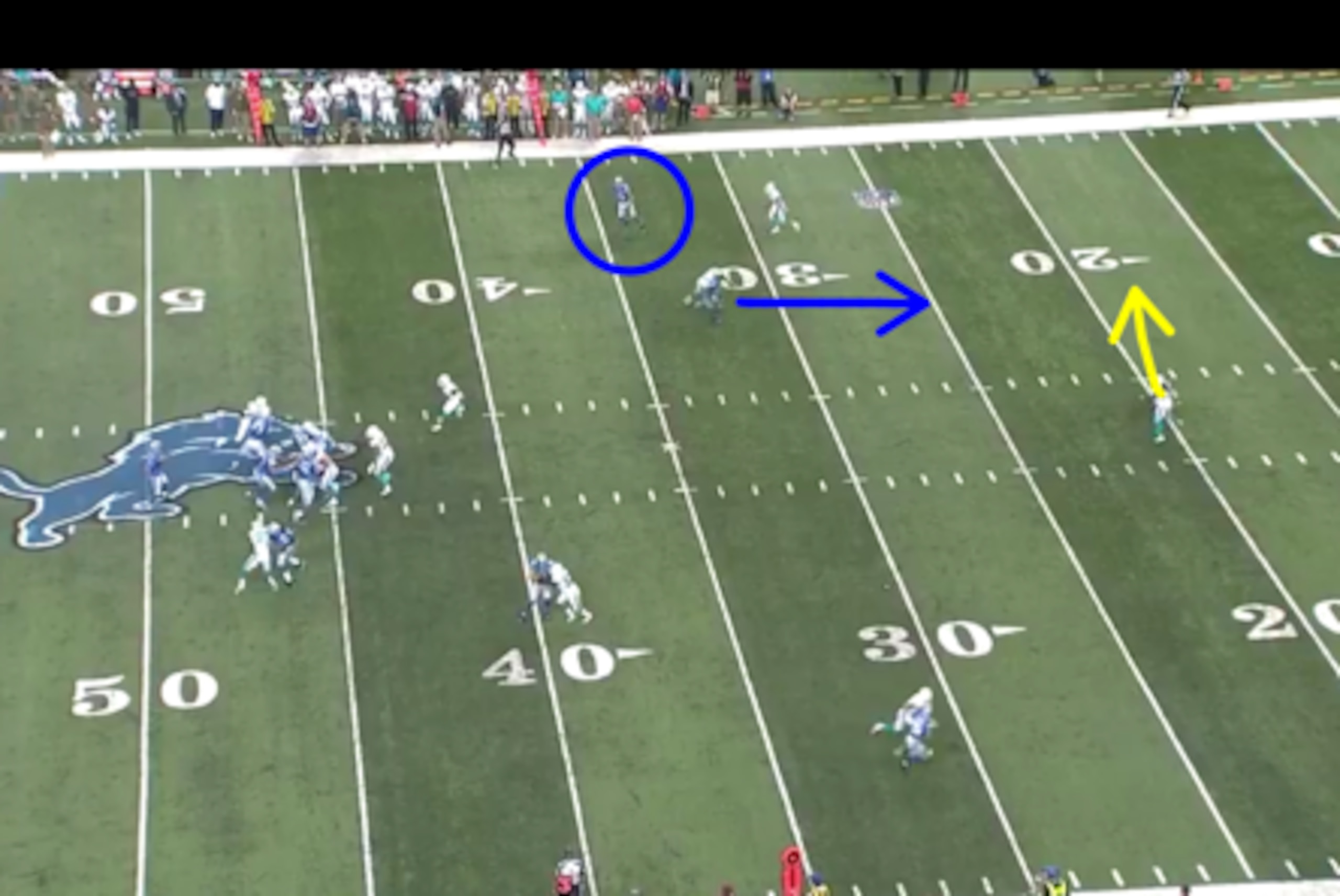
There was this third-down opportunity against the Miami Dolphins, where Stafford forces the ball to a blanketed Johnson (the blue arrow) with safety help quickly closing over the top (yellow arrow) instead of turning his gaze even a few degrees and spotting an open Jeremy Ross (circled in blue) beyond the sticks.
Even on a play where it's hard to fault Stafford for looking Megatron's way, he let six easy points on the board. This play is better known for Brent Grimes' spectacular interception in the end zone. Stafford had the matchup he wanted with Johnson over the top on the much smaller corner, but he underthrew it just a touch.
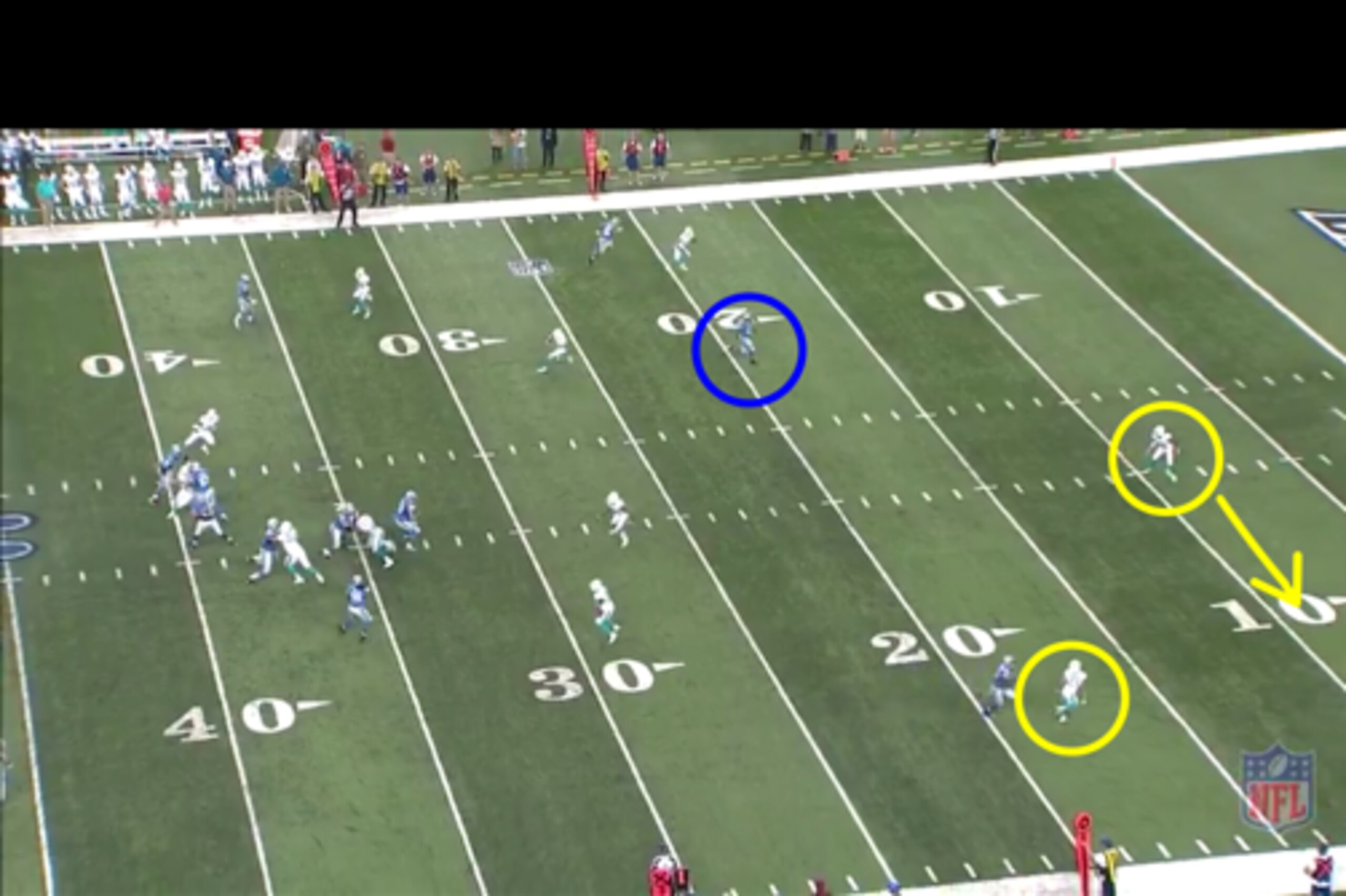
But look at the backside seam. No Dolphins defenders did. Unfortunately, Stafford didn't either or else he had a simple pitch-and-catch (circled in blue) for six points.
While it seems more pronounced with his laser sights on Johnson, he can get tunnel vision with other targets as well. Take this sequence from Detroit's 19-7 thumping of the Green Bay Packers earlier this year:
- Pass short middle to Reggie Bush for 15 yards
- Bush right tackle run for seven yards
- Incomplete short right to Johnson
- Pass short right to Bush for five yards
- Pass short right to Bush incomplete, batted down
Bush is a versatile and talented back, but calling his number four times in five plays got predictable. Clay Matthews picked up on Stafford's staring and nearly picked off the pass.
These are not new problems. The collapse from 6-3 and leading the NFC North to 7-9 and bitter disappointment was squarely on the declining offense. Never was that more glaring than the Monday Night Football loss to Baltimore, where the Ravens won despite not scoring a touchdown.
In this play from that wretched defeat, Stafford once again keyed solely on Johnson and missed an easy potential touchdown. The post route is completely uncovered, but No. 9 never even looks for it as he rolls to his right.
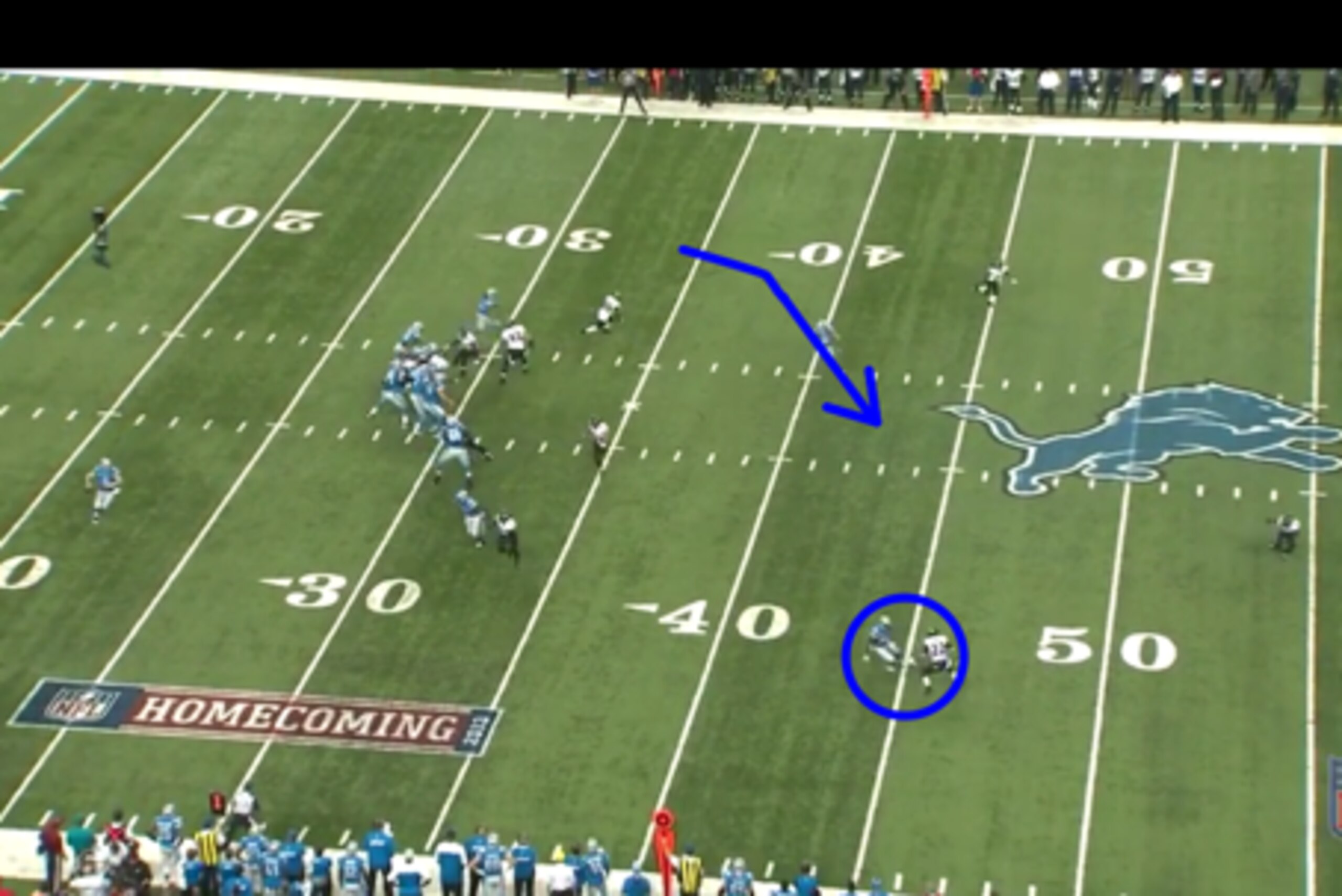
It's clear opposing defenses know Stafford's predilection toward Johnson or his refusal to move off his primary read even when it is clearly well-defensed. While it's maddening, there is real opportunity created here.
Should Stafford even demonstrate the baby step of not predetermining his option before the snap but instead wait a count to evaluate the coverage, he can make the opponents pay for overplaying their own reads. That much is clear from the smattering of plays pictured above.
Perhaps the most frustrating part of Stafford's tunnel vision is that he's proved he can see so much better at times. Take this play against Carolina, where the Panthers overplayed Johnson. Stafford was quick to recognize it and make them suffer the consequences.

Instead of trying to force the ball to Johnson toward the bottom of the picture, he sees Ebron breaking out behind the zone and expertly rifles a strike to the rookie tight end. This fantastic play set up Detroit's only touchdown in that game.
If Stafford wants to be more than a C-plus quarterback, he needs to more consistently display that type of defensive manipulation and field vision. He must improve his understanding of how the defense is going to react to the play.
Detroit's season likely hangs in the balance of how well Stafford can take the blinders off. With the skill-position talent finally getting healthier, it's on the signal-caller to make the smart choices and exploit the mismatches having talents like Johnson, Tate, Ebron, Bell and others inherently creates.
Stafford has proved he can be great. Unfortunately he's also proved that greatness is fleeting and sporadic. The difference between holding on to the No. 2 seed in the NFC or yet another late-season collapse depends in no small part on how often the greatness rears its head from the overall average play of the franchise quarterback.
.jpg?w=2560 "Seahawks Cardinals Football")
.jpg?w=2560 "Commanders Cowboys Football")