Roger Federer's Success at 2014 ATP Finals Shows Old-School Tennis Still Matters
Roger Federer plays so old school that he's pre-school, as in pre-historic. Federer, the elder statesman on the ATP Tour, chose "Throw-Back Thursday" to school Andy Murray on the fundamentals of classic tennis.
Federer defeated Murray 6-0, 6-1 and reached the semifinals of the ATP World Tour Finals in London. Federer faces Kei Nishikori, who defeated David Ferrer in a three-setter.
The win over Murray was as instructive as it was decisive. While admittedly not playing his best, Federer managed to dismantle Murray, a two-time Grand Slam winner.
TOP NEWS
Jaylen Brown Calls Out Tatum 🧢
LeBron on President Trump's Criticism
Bears' Santos Wanted to Kick 58-Yarder
Federer demonstrated that even in this era of endless baseline rallies, racket-and-string technology and courts engineered to slow down play, a good old-fashioned all-court, all-around game can still reign supreme.
Few can conduct clinics like the ones the Maestro has put on during the finals. He has utilized the entire court. He patiently constructs points. Like a blast from the past, Federer continues to serve-and-volley. He uses an almost extinct one-handed backhand. When his opponent hugs the baseline, Federer surprises them with the always handy drop shot.
Federer built his career on an all-court, old-school game. He's proving that even against the best baseline bashers, old-school tennis still works.
Mechanically sound groundstrokes, a reliable serve, soft hands at the net and stealth drop shots can rattle the baseliner. Against the speedster Nishikori, Federer used serve-and-volley. Sometimes Nishikori got passing shots by Federer. However, when Federer broke Nishikori early, it was the baseliner, uncomfortable at the net, who unraveled.
The all-around sound game gives Federer a larger margin for error. When his serve is subpar, he can fall back on crafty shot-making. He did just that against Murray.
Federer told the ATP, "I think I just really picked apart his game...I didn't even really serve that well, but from the baseline I had the upper hand, which hasn't always happened against him."
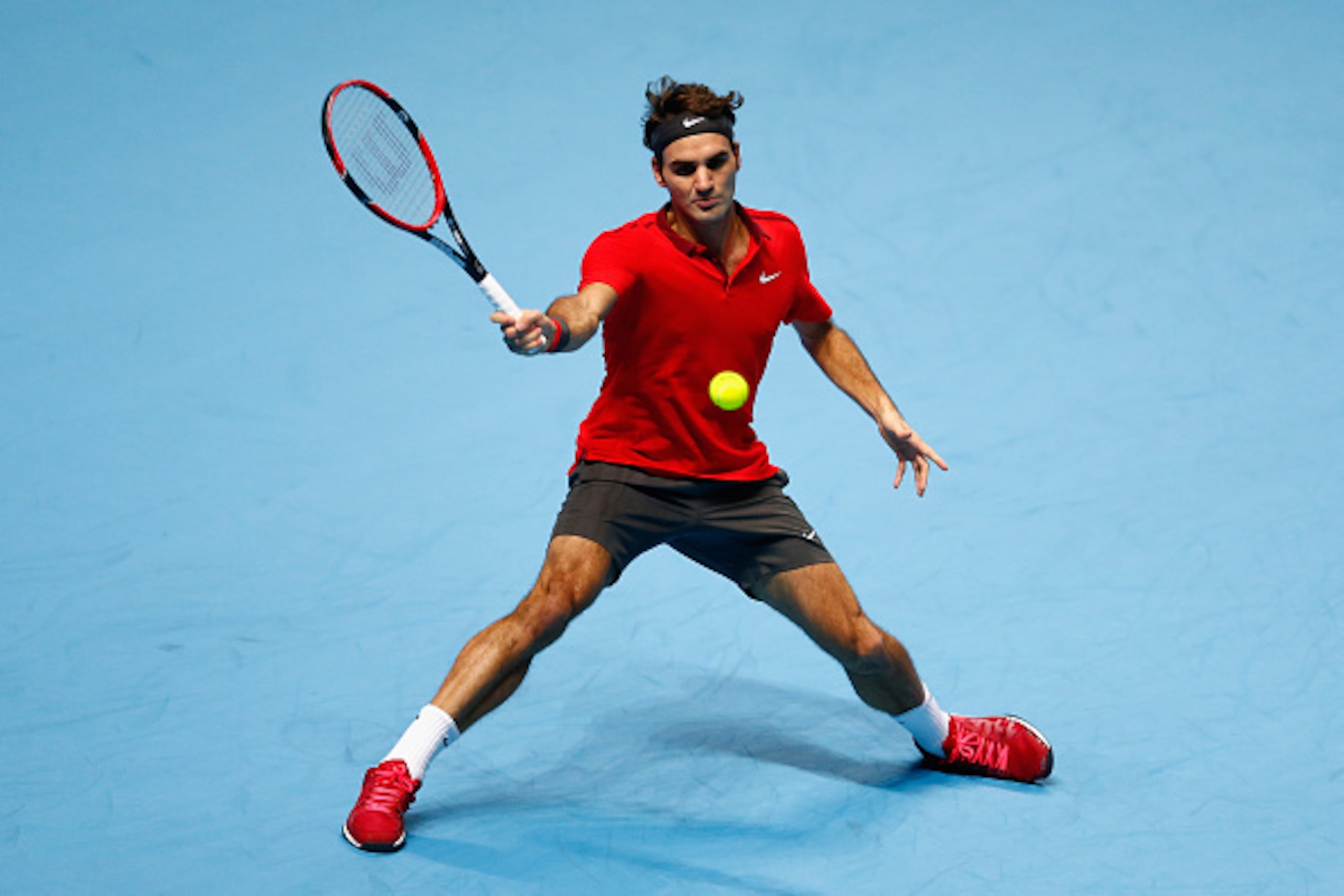
Not that Federer can't hang with baseliners. It's just that was never his style. He entered the game when Pete Sampras, a master at serve and volley, dominated the tour. Perhaps because he hated the thought of the game passing him by, Federer adapted his play to compete with the baseline bombers.
Of course there was Rafael Nadal, the ultra-athletic baseliner who turned stellar defense into offense. Nadal got the best of Federer. Then Novak Djokovic arrived one-upping Nadal in the ability to dash about the baseline hitting winners from both wings.
Djokovic remains No. 1. So why would Federer go back to the throw-back now?
Federer's coach, Stefan Edberg, has something to do with that. Edberg was among the best at serve and volley. Since bringing Edberg aboard in December of last year, Federer has slowly slipped back into his comfort zone.
Federer used serve and volley to help him reach the finals at Wimbledon this year. He came to the net more. During Wimbledon, in an interview with ESPN, Federer acknowledged that changes in the game had changed the way he played. He recalled how the serve and volley helped him win his first Wimbledon titles.
"I serve and volleyed 80 percent on the first serve, 30 to 50 percent on the second serve? It was just normal. I even did some in 2003 when I won first here. Then, every year I started doing less because the game started changing on the tour, really."
No longer content to endure rallies, Federer comes in to end points quicker. If he has to, he can plant himself on the baseline and wait for an opportunity to take a short ball. He's got skills and those old-school skills still matter.