Bills vs. Dolphins: Breaking Down Miami's Game Plan
Week 11 of the Miami Dolphins’ season brings a familiar foe to Sun Life Stadium for Thursday Night Football: the Buffalo Bills. Miami enters the game looking for revenge for a 29-10 Week 2 loss against the Bills.
Each team is 5-4, which is one game behind the current wild-card leader. Despite the NFL culture being a “must-win” environment on a weekly basis, with scrutiny and overreaction hanging on every play, the Dolphins find themselves in a must-win game for the first time in 2014.
If the Dolphins lose against the Bills, they will be one game behind them in the win-loss column but also be at a disadvantage because of the head-to-head tiebreaker. A victory would leave Miami with a much brighter outlook, especially with the opportunity to play the Baltimore Ravens in the coming weeks.
TOP NEWS
Bears' Santos Wanted to Kick 58-Yarder
Picking Each NFL Division Winner 🔮
.jpg?w=2560)
B/R's Expert Week 7 NFL Picks 🔮
Miami’s first prime-time and most important game to date should see the team sharp and ready to execute at a high level early. After Bills’ cornerback Leodis McKelvin guaranteed a win against Miami, and Dolphins’ team leaders said all of the right things.
"When told Bills CB Leodis McKelvin guaranteed a victory, Dolphins O-lineman Mike Pouncey said "You can't talk about it. You got to do it!"
— Omar Kelly (@OmarKelly) November 11, 2014"
Now that the stage is set for an exciting, sweaty palms-type game, let’s address how the Dolphins will walk away Thursday night with a crucial victory.
Win at the Point of Attack
With Branden Albert being out for the season with a torn ACL and MCL, the Dolphins will be at even more of a disadvantage against a terrific Bills defensive line than they were in Week 2. But the theme of “next man up” absolutely applies in this situation, and Ja’Wuan James should fill in admirably for Albert at left tackle.
The questions arise at the two guard spots and right tackle. Veteran left guard Daryn Colledge didn’t practice earlier in the week, according to Barry Jackson of the Miami Herald. If Miami follows the plan they used against the Lions, that leaves Shelley Smith at left guard and Mike Pouncey at right guard.
Smith is a suspect pass protector, lacking the strength and base to be a consistently good anchor against power rushers. That’s an issue against the Bills, who have two excellent rushers in Marcell Dareus and Kyle Williams. Those two combined for one sack and four quarterback hurries in Week 2, according to Pro Football Focus (subscription required).

At right guard, Pouncey has either yet to return to his full capabilities or is just not a good guard and needs to return to center. He played poorly once again in last week’s battle against Ndamukong Suh, allowing one sack, two quarterback hits and four hurries, per PFF.
At right tackle, Dallas Thomas is far from a sure thing. He was playing better at guard recently than he was earlier in the season, but right tackle is a whole different task, especially against Mario Williams. Miami must ensure this game doesn’t go as poorly for Thomas as his preseason game against Tampa Bay tackle Gerald McCoy went.
For Miami to have a productive offense, Bill Lazor needs to give Ryan Tannehill extra protection. If nothing else, we have learned how tough Tannehill is after enduring 58 sacks in 2013 and taking an absolute beating again in Week 10. He’s gotten much better at extending plays and staying composed, but at some point the body breaks down.
Between running backs Lamar Miller and Daniel Thomas, the Dolphins have two backs who are better-than-advertised pass-blockers. If tight end Dion Sims is healthy, he’s another player who can be used to help Thomas at right tackle.
The negative of committing the extra blocker is that more pressure goes on receivers Mike Wallace and Brian Hartline. We’ve talked about Hartline’s poor play before, and although Wallace has played better this season than last, he refuses to fight for the ball and tracks the deep ball extremely poorly, which only exacerbates Tannehill’s deep-ball issues.
But Miami must win the trench battle for the offense to succeed. Tannehill and the running game depend on improved play from Pouncey and at least adequate performances from Thomas and Smith. The Bills’ front four is just too good if those guys don’t bring their best game.
Execute in the Red Zone
On a positive note, the Dolphins average the most red-zone scoring attempts per game with 4.8 trips each week, per TeamRankings.com. This illustrates how well the offense has performed in 2014, and especially compared to 2013, when Miami averaged less than three per game.
The Dolphins’ offense now has to improve finishing in the red zone. It’s a natural step for good teams like Miami to become very good and legit Super Bowl contenders. You cannot win games scoring field goals, which Miami is settling for too often. Miami’s third-from-last in the league with red-zone touchdown percent, scoring six on just 46.51 percent of all trips, per TeamRankings.com.
A few factors cause the offense to bog down. First is the reality that the Dolphins run a spread-type offense. These offenses notoriously struggle in the red zone because of their finesse style and limited spacing within the 20-yard line. Without a more physical offensive line and running back, Miami has to try to go around defenders or throw into very tight passing lanes.
"Tannehill is leading the league with 3 red zone picks (including one today) and he barely missed throwing his fourth to Levy just now...
— Sigmund Bloom (@SigmundBloom) November 9, 2014"
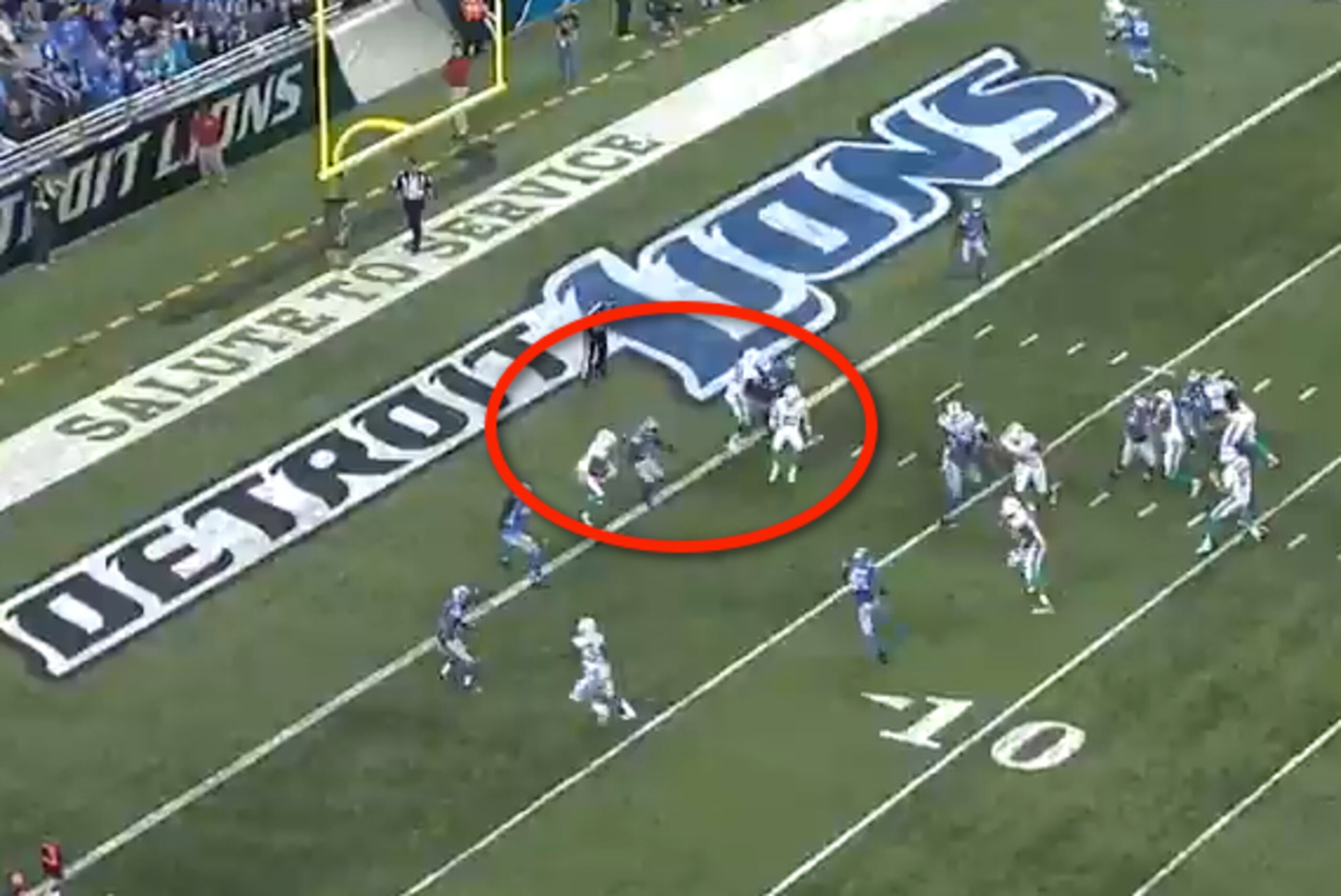
The second issue is Tannehill and his receivers. Tannehill tends to force passes in the end zone to covered receivers, which is somewhat the byproduct of terrible spacing by Lazor’s offensive designs (see side picture).
Going back to the receiver core, Miami doesn’t have a legit red-zone threat in the group. Charles Clay is undersized, and his hands have been suspect this season. Hartline struggles getting open and also has been prone to drops. Wallace has been productive in the red zone, but it takes special designed plays to get him the ball; those are tough tasks.
But someone must step up and deliver touchdowns. Miami is a solid overall team, but the red zone is what’s really keeping them from more wins.
Protect the Middle
The Dolphins’ defense was gashed in Week 2 by deep crossing routes by Sammy Watkins, and gave up a 28-yard gain to Golden Tate against Detroit on a deep-crosser. Miami must do better to win in the middle of the field against the Bills, as they attack that area often with their impressive receiving core.

Miami likes to use Cover 3 for their secondary scheme, which leaves safety Louis Delmas up high and Reshad Jones to attack the line of scrimmage or roam the field. Jones was not on the field in Week 2, so his presence should be a major positive for the defense.
Koa Misi was also out for their last matchup and is a major upgrade over then-starter Jason Trusnik. He’s played well at middle linebacker, showing good play recognition and closing burst on plays behind the line of scrimmage. He isn’t great in coverage, but physically he is more capable than Trusnik.
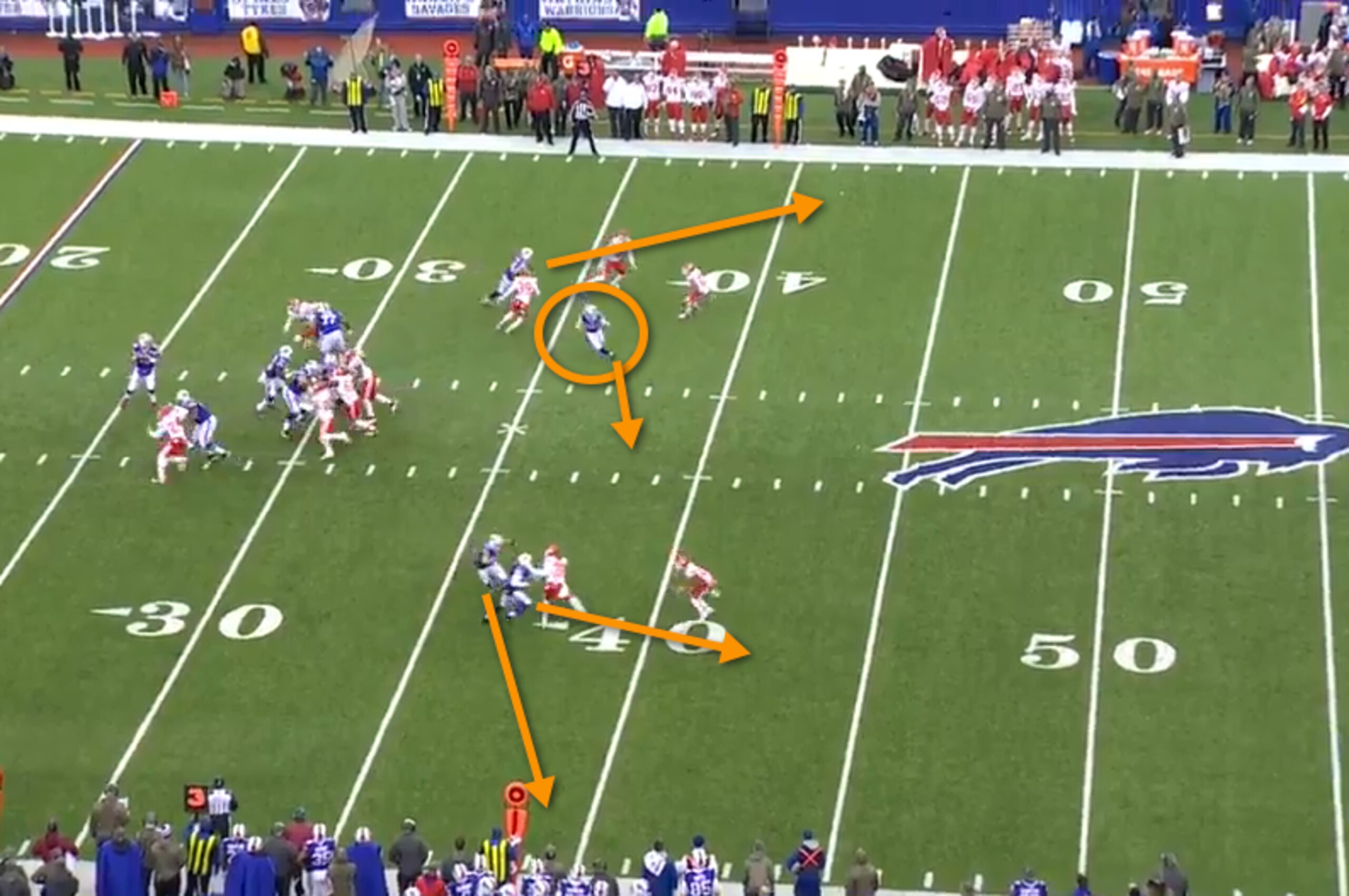
To help the secondary protect the middle of the field, Miami may have to be willing to drop Jelani Jenkins into space more often instead of having him react to the run action. If he can get to proper depth quickly in a zone, he can take away the inside leverage a receiver has on deep in routes.
One player that Dolphins’ fans will recognize for the Bills is Chris Hogan, who was known as “7/11” on the HBO series Hard Knocks because he was always open. He logged a touchdown last week against the Chiefs when he shook press coverage and was wide-open down the seam of the defense. Miami cannot allow this to happen.
Get Off the Field
As good as the Dolphins’ defense has been, they have had one issue show up on occasion: They don’t get off the field quickly. Their inability to stop offenses on third downs is alarming, as the unit allows first-down conversions on 38.76 percent of the 14.3 third-down situations per game, according to TeamRankings.com.
The issue was brought to light again as the Dolphins allowed three drives with more than eight plays in the second half of the Lions game. Each covered 50 or more yards and ate significant chunks of time off the clock, and the final touchdown allowed caused the team to lose.
In their last game against Buffalo, Miami forced just two three-and-outs. Seven drives featured six or more plays, which cannot happen again. The defense must be more disruptive and force drives to stall or get turnovers.
Miami is tied for second (with Buffalo) with 2.1 turnovers per game, and if that’s how the Dolphins take the momentum of the game and get the offense into an advantageous position, that’s even better than forcing punts. Either way, this aspect could be the second-biggest factor in whether or not the Dolphins win this critical game.
It’s an exciting proposition for the Dolphins in Week 11. Win against their nemeses at home in prime time, and the Dolphins set themselves up for a playoff run down the stretch. A loss would be very hard to overcome mathematically, but possible.
If Miami executes in the four key areas above, their statement will be heard loud and clear.
Ian Wharton is a Miami Dolphins Featured Columnist for Bleacher Report, contributor for Optimum Scouting, and analyst for FinDepth.