Finding Perfect Rotation for the Detroit Pistons
The Detroit Pistons have gotten off to a sluggish start, and coach Stan Van Gundy has had mixed results experimenting with their unbalanced roster.
For the second straight year, they have three starter-quality big men for two spots. And while the slew of offseason signings was supposed to strengthen the perimeter, that has yet to fully be realized.
Van Gundy is still figuring out this team, and the roster may need a move to really fit together properly. But in the meantime, he must make these pieces work together to move them up the standings.
TOP NEWS
Jaylen Brown Calls Out Tatum 🧢
LeBron on President Trump's Criticism
Knicks Staff Didn't Get Rings 🤔
Two Point Guards, Too Few Minutes

When D.J. Augustin was signed to a two-year, $6 million deal this summer, it was widely believed that he would serve as Brandon Jennings' backup and occasional backcourt mate.
Instead, through two weeks he has threatened to usurp the starting role and has barely played next to Jennings.
Through seven games, Jennings has averaged just 2.9 more minutes per game than Augustin. And according to NBA.com, the pair has shared the court for less than 11 total minutes. Van Gundy seems content to split the work between the two guards and quite reluctant to let them work together.
This just doesn't seem headed for a happy ending in Detroit.
For one, Jennings is averaging six minutes fewer per game than his previous career low. He's failed to crack the 30-minute mark in four of the seven games, including when he played just 36 minutes combined in their first two games. Mlive.com reported how Jennings reacted to that:
"Afterward, Van Gundy said Augustin 'certainly right now has been the better guy over two games, but it's two games.'
'Then he should start and I'll be the backup, if that's the case,' Jennings said. 'That's all I've got.'
He then left the locker room.
"
Jennings isn't exactly known as the easiest player to deal with, and Van Gundy certainly doesn't have to cater to him. But he is one of the most talented players on the team, and alienating him early in the season just isn't the way to build success. Instead, Van Gundy should be looking to put Jennings in the best position possible to be successful.
In their 97-96 loss to the Utah Jazz, Jennings scored 14 points in the third quarter to give him 23 for the game. Augustin came in for him towards the end of the quarter, like he has nearly every game. It took over nine minutes of game time for Jennings to go back in—a stretch where Augustin went 1-of-3 from the field—and he didn't score a point the rest of the game.
More flexibility by Van Gundy in this situation would have benefited the Pistons.
Augustin and Jennings are two of the most talented players on this roster, and they're currently playing better offensively than anybody on the wing. At this point, both players are seeing too little time on the court, and the only way to get them more run is to let them learn to play together.
If the Phoenix Suns can play two point guards together for most of each game, the Pistons can do it for a couple minutes each quarter.
Wing Struggles
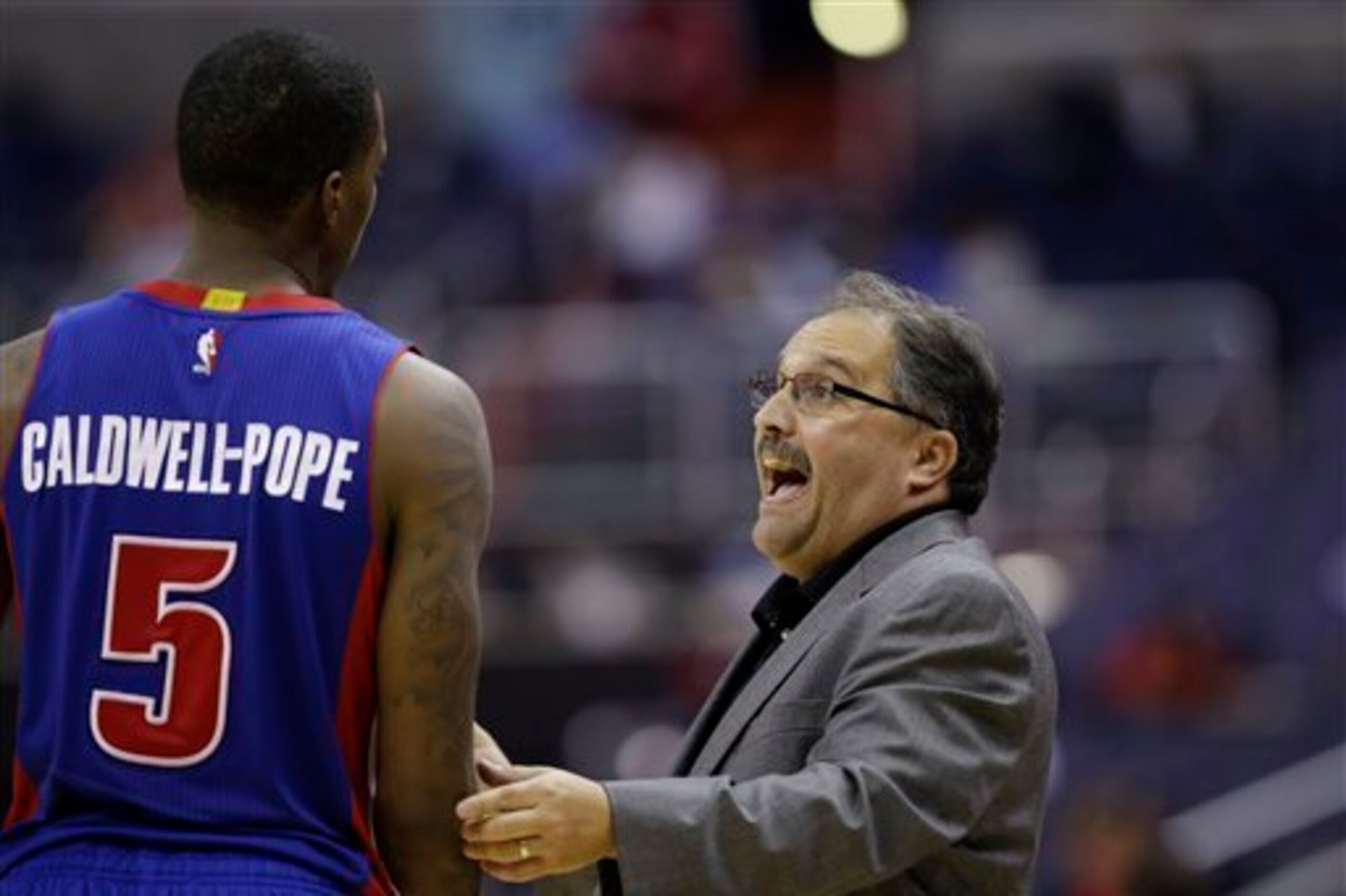
Detroit's biggest problem in the early going has been that it simply cannot get even mediocre output from its wing players.
At the shooting guard and small forward positions, Caron Butler, Josh Smith, Kentavious Caldwell-Pope and Kyle Singler have played the bulk of the minutes. And none has a PER above 13.6 (the league average is 15). Caldwell-Pope and Singler have failed to crack double digits, with miserable marks of 8.3 and 3.9, respectively.
There may not be a way to create a successful rotation with the play Van Gundy is getting out of these four, and things may not get better until Jodie Meeks recovers from his back injury. But there are things that can be done to mask some of their deficiencies.
As previously mentioned, some of their minutes need to be going to Jennings and Augustin. Regardless of the defensive liabilities that would create, it cannot be worse than getting 4.1 points and below-average defense 22.9 minutes per night from Singler.
Some of their wing combinations have been good. The starting lineup—with the three bigs, Caldwell-Pope and Jennings—has outscored opponents by 2.4 points per 100 possessions, per NBA.com. Moving Smith to the post with Greg Monroe and inserting Caron Butler at small forward has been even better: That group has outscored opponents by 10.4 points per 100 possessions.
Though both of those come from small sample sizes, there was one constant: Each had Caldwell-Pope manning the shooting guard position. Without him on the court, the Pistons just lack quickness to cover other teams on the perimeter. The top lineup with Butler and Singler on the wing has been outscored by opponents at a rate of 19.9 points per 100 possessions.
Until Meeks comes back, this will require Van Gundy to lean heavily on Caldwell-Pope as a defensive stopper, though he could use one of his point guards on the wing to at least get some quickness. Otherwise, it's a matter of getting as much as possible out of Butler, because at least he is contributing offensively.
A Full Frontcourt
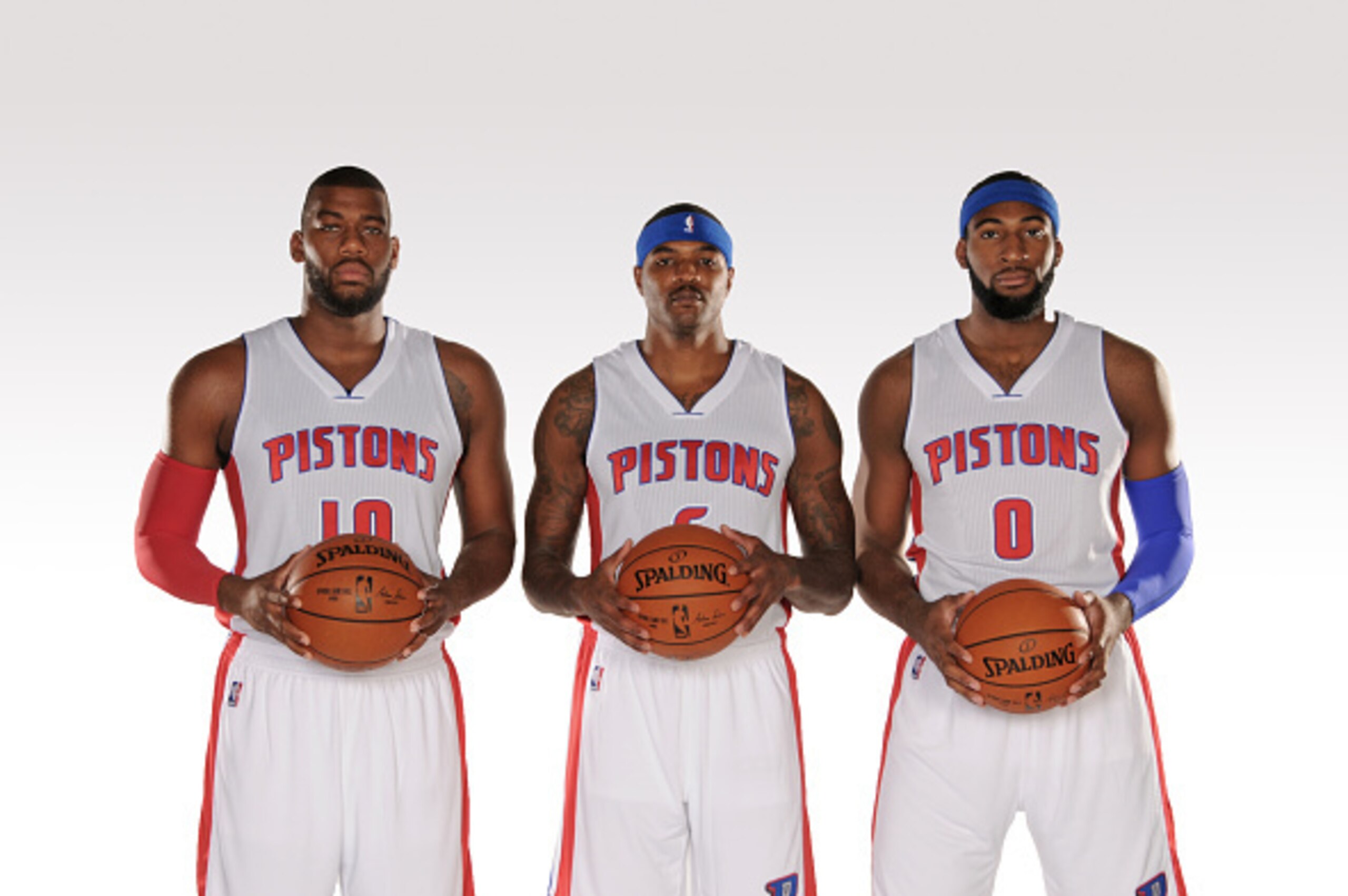
The strength of this team is down low, but they have one too many quality guys there to ever quite work properly.
The fortunate thing for the Pistons early on has been that their three-big lineup has looked much better than it did last season: The starting group has actually outscored opponents. Van Gundy has made a point to force-feed whichever player has a mismatch in the post; against the Jazz, their first six possessions were post-ups for Monroe or Smith, and it resulted in nine points.
While it has worked reasonably well so far, playing the three bigs together isn't the way the Pistons will succeed long term. For one, it encourages Smith's worst habit: shooting three-pointers. He's down to 1.6 per game so far, but that is still too many when it took him seven games to make his first one. Van Gundy should do anything in his power to keep Smith away from the arc.
The three-big lineup also limits the strengths of Andre Drummond. While Monroe and Smith are getting their numbers called for post-ups, Drummond is typically just asked to wait on the weak side until there is a chance for a rebound. While he isn't exactly a polished offensive player, he can still be used in more creative and efficient ways.
By splitting the three of them up as often as possible, Van Gundy can get the most out of their talents. Dividing time up evenly between the two positions allows for 32 minutes per game each—a touch on the low side for their top three players. But playing Smith at the 3 about two minutes per quarter would give them each enough playing time, and it shouldn't give him too many chances to launch triples.
| Andre Drummond | 34 |
| Greg Monroe | 34 |
| Josh Smith | 34 |
| Kentavious Caldwell-Pope | 32 |
| Brandon Jennings | 34 |
| D.J. Augustin | 26 |
| Caron Butler | 22 |
| Kyle Singler | 14 |
| Jonas Jerebko | 10 |
Smith has gotten enough playing time so far, and Drummond has put limitations on himself with foul trouble; he's averaging 4.4 per game. But Monroe has been their best player, averaging 17.2 points and 11.4 rebounds per game. It is not acceptable for him to be playing just 32 minutes a night. Van Gundy needs to keep his best players on the court as long as possible.
This team is still a work in progress, and the rotation Van Gundy imagined this offseason won't become reality until Meeks is healthy.
But for now, he can give more minutes to his point guards and big men. Even if the lineups that he creates are a bit unbalanced, they'll be better than those with players who don't produce. Van Gundy needs to be willing to look past how his players are labeled by position and simply put his most talented guys on the court.
All statistics accurate through Nov. 11, 2014 and are from NBA.com unless otherwise noted.
Jakub Rudnik covers the Detroit Pistons as a Featured Columnist for Bleacher Report.
Follow him on Twitter.