Arsenal Are in Crisis, and the Manager, Defence and Midfield Are All Culpable
At the genesis of the 2014/15 campaign, many an observer would have tipped Arsenal for success and a serious title challenge after encouraging signs the season before. Alas, with the Gunners' recent run of results and capitulations, those expectations have gone seriously awry.
It might not appear that way to the untrained eye, but make no mistake: Arsenal are a football club in crisis, and you can lay the blame in a myriad of places.
After 11 games, you would expect supposed title challengers to be right up in the mix at the Premier League summit. To the contrary—the Gunners are 12 points off the pace set by leaders Chelsea, a mammoth figure considering it's only November. Arsenal boast just four wins in the league and have dropped plenty of points in questionable circumstances in both European and domestic competition.
TOP NEWS
Alex Morgan Announces Birth of 3rd Child 👶

Final Men's Ballon d'Or Rankings 📊
Most to Blame at Man Utd? 😡
Their last two fixtures—the 3-3 collapse against Anderlecht in midweek and the 2-1 loss at Swansea on Sunday—are symptomatic of this overarching profligacy plaguing the team.
The result: Arsenal sit in sixth position in the Premier League, and their preseason ambitions look nowhere near attainable.
Arsene Wenger, his defence and his midfield are all culpable.
On these three fronts, reasons why the Gunners are in this rut can be found.

Arsene Wenger's Naivety
Arsenal's manager has been labelled as naive by ex-player and pundit Alan Shearer with regard to his tactical errors against Swansea, via Gerard Brand of the Daily Mail, and the ugly truth is these mistakes are a recurring complication.
The key snafu at the Liberty Stadium in Shearer's eyes was Arsenal's positioning, as they lost possession late in the second half.
Leading 1-0, the Gunners ceded possession in the hosts' territory—with the entirety of their five-man midfield deep in the Swans' half. Scrabbling to get back, Kieran Gibbs fouled the onrushing Modou Barrow—which culminated in Gylfi Sigurdsson's majestic free-kick to restore parity.
For the second time in two games, these positional flaws cost Arsenal the desired result.
Hosting Anderlecht in midweek, the Gunners were often caught out without the ball. Predictably, a glut of midfield players too far up the pitch cost their helpless, outnumbered defence.
Matters are further complicated when considering Wenger's inefficiency when making proactive substitutions to try and shore up fortifications after taking a lead. In both fixtures over the last week, Wenger demonstrated questionable examples of tactical changes after conceding twice.
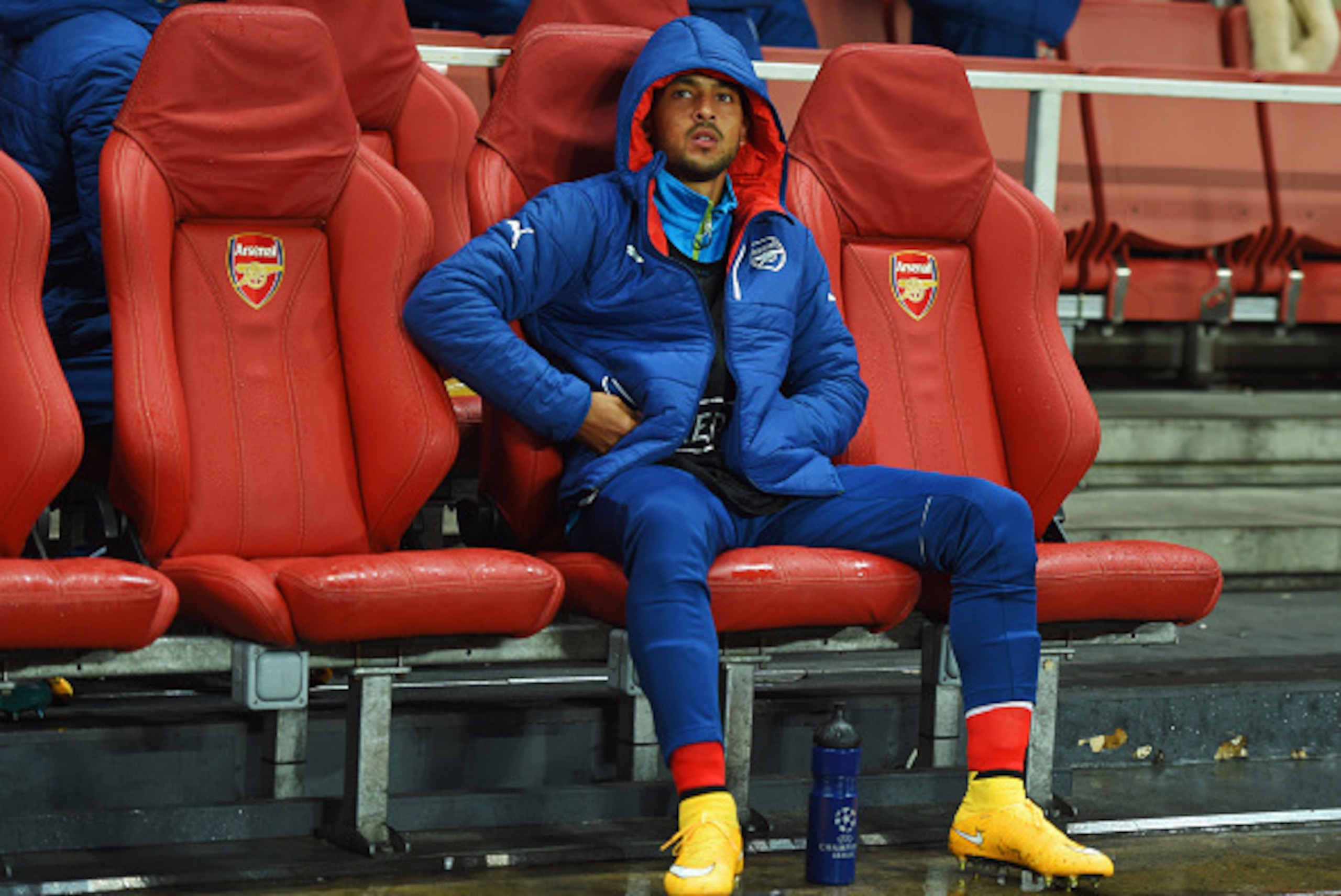
On Sunday, he threw on Jack Wilshere and Theo Walcott once Arsenal had conceded twice in an attempt to get back in the game—his only defensive replacement available was full-back Hector Bellerin.
Similarly, at home to Anderlecht, he introduced Tomas Rosicky and Lukas Podolski. However, at that point, the score was 3-2, and yet again Bellerin was still available to provide much-needed freshness to the defence.
It's not just the scoreline Wenger seems unable to react to correctly—it's the flow of the game as well.
The Guardian's Michael Cox highlighted a pertinent problem for Arsenal against Swansea, one that Wenger had the ability to impact:
"The most threatening player throughout the game was Swansea’s Jefferson Montero, an old-fashioned outside-left with a trick and a determination to dribble down the wing.
He caused the Arsenal right-back Calum Chambers problems throughout – the youngster has a tendency to stick too tight and get turned, which happened on multiple occasions.
"
Indeed, Chambers was frequently outwitted and outpaced by the excellent Ecuadorian. Yet with Bellerin on the bench, a speedster in his own right, Wenger had a chance to give Chambers some respite and force Montero against a different opponent.
It didn't happen—and Montero continued to best Chambers, which led to Swansea taking the lead.
This tactical naivety is a recurring problem, and until Wenger faces up to that reality and fixes it, Arsenal are doomed to struggle.

Arsenal's Defence Lets the Side Down... Again
This section begins with a disclaimer of sorts.
Yes, Arsenal's defensive corps is small in size and weakened through injury. That's a problem that could have been rectified in the summer through reinforcement in the transfer window—but that's something that's been discussed at length before.
Wenger has been forced into fielding a back four that features players who are inexperienced or out of position, with little room to manoeuvre.
The last two fixtures have seen an out-of-sorts Per Mertesacker partner a brutally exposed Nacho Monreal in the centre of defence. This is Arsenal's vital weakness right now.
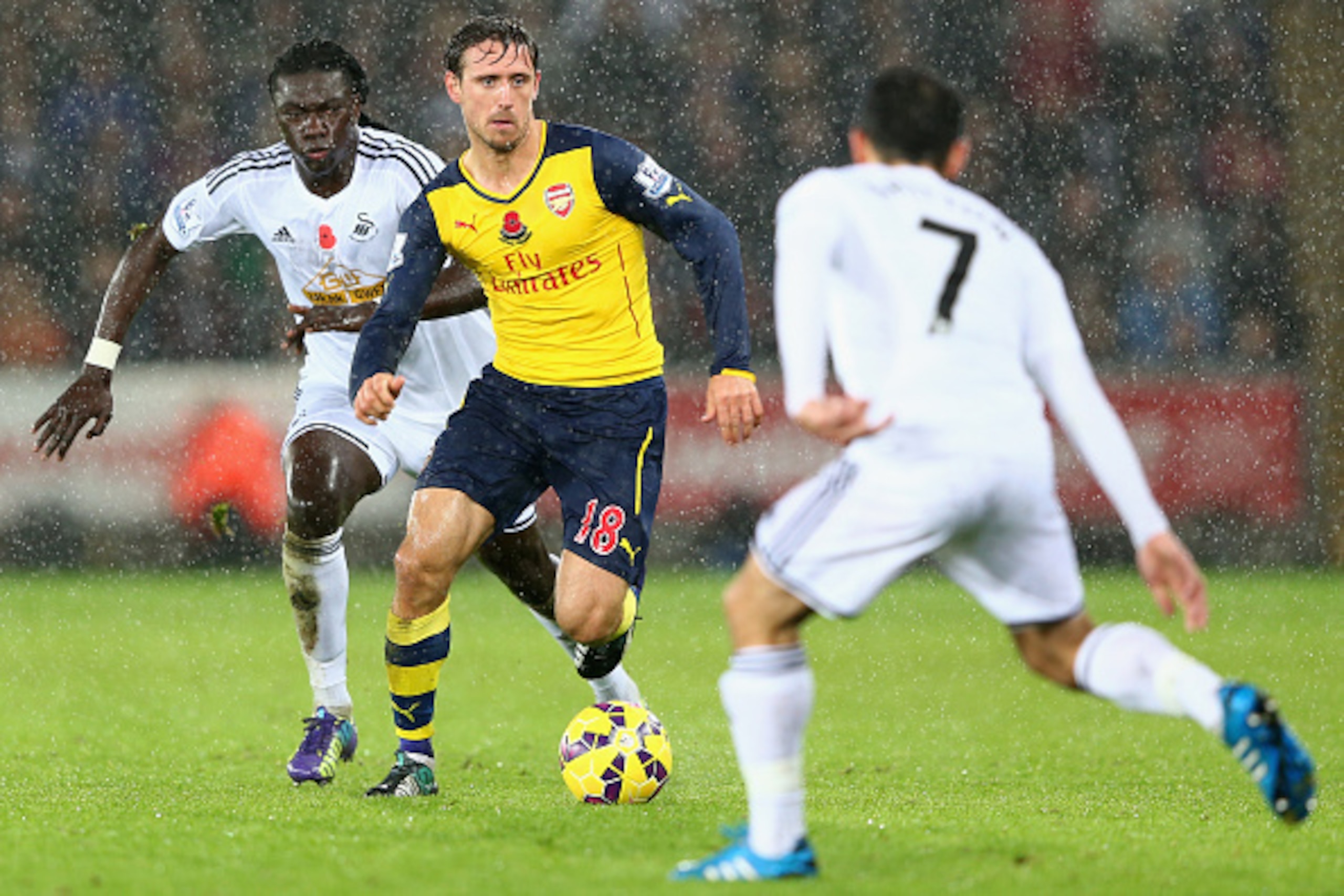
Monreal's drawbacks as a player have been shunted into the spotlight this week, and it's obvious he's uncomfortable at centre-back. His poor positional play and man-marking was to blame for Bafetimbi Gomis' goal against Swansea and also contributed to his poor anticipation of play that led to his conceding Anderlecht's penalty.
Aerially, too, he offers little fight, leaving Arsenal more vulnerable than usual from set pieces—an area in which they are notoriously liable at the best of times.
This view was endorsed by Sky Sports' Sarah Winterburn:
"There has been plenty of evidence (the 3-3 v Anderlecht, the 2-2 v Hull) that Monreal is no centre-back and yet Wenger persisted with the Spaniard against a team with height and physicality up front.
Swansea had not scored from a header this season in the Premier League before Sunday; they had not played against Monreal in the Premier League before Sunday.
"
He has given some fine contributions on his favoured left side of defence, that's for sure—but in this role, he is Arsenal's Achilles heel.
Beside him, Mertesacker is all at sea without the injured Laurent Koscielny as his trusty partner.

The German and the Frenchman work well together because Koscielny's agility and anticipation can cover for any lapses Mertesacker suffers. With the disconcerting, alien presence of Monreal as his partner, Mertesacker is exploited by quick attackers making darting runs, which weakens the entire back four.
This scenario is far from ideal and was capped off on Sunday by Chambers' performance, in which he was continually attacked by Montero as aforementioned.
Arsenal's back four are not performing to the level expected of Premier League challengers, shipping goals at vital moments that negatively impact the momentum of the game for their side. Wenger has work to do to change that, but he needs the effort from his players in return. Until he gets that, this crisis of Arsenal's will be ongoing.
Arsenal Missing Consistency and Reliability from Midfield
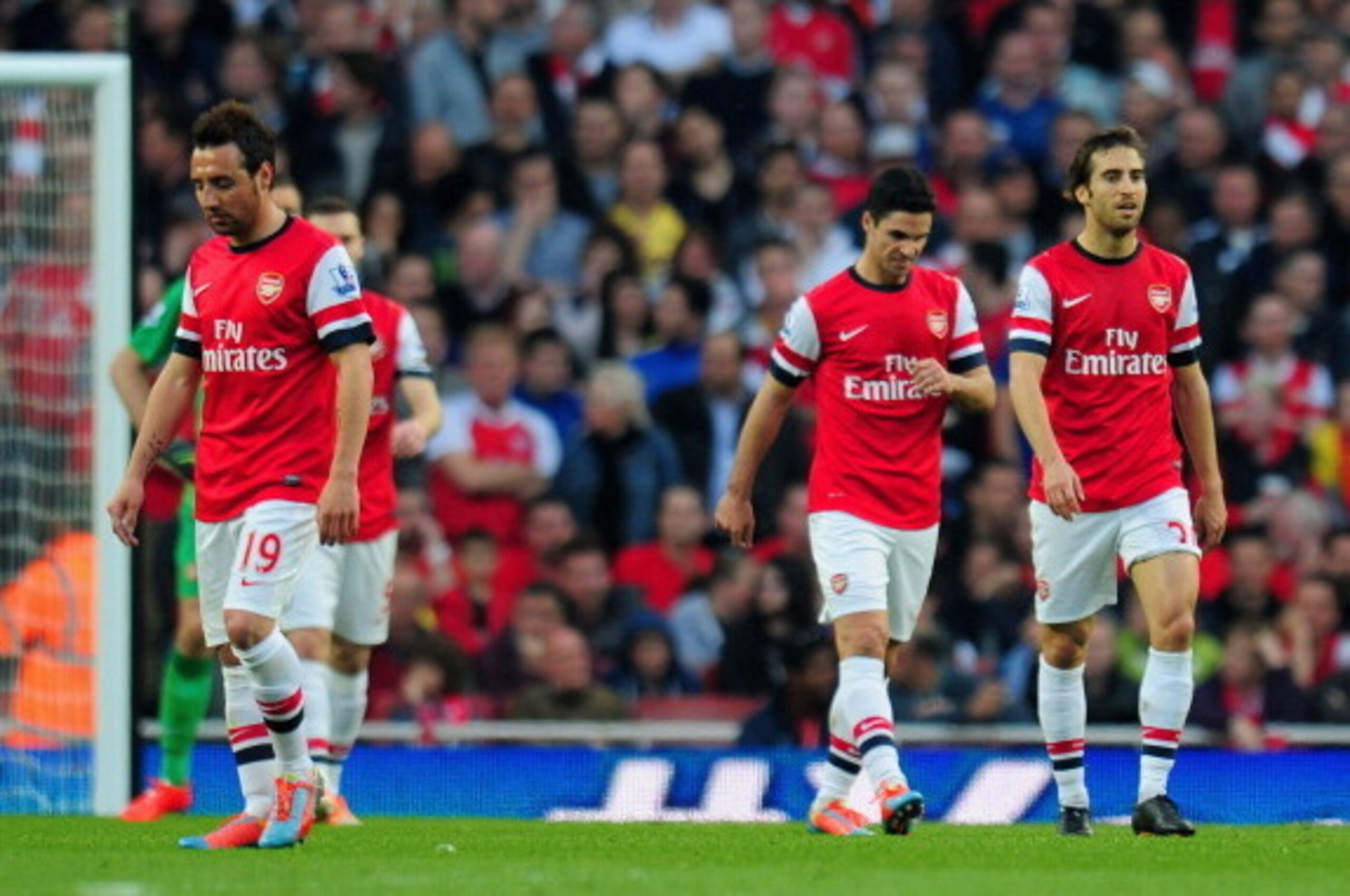
The final third of this conundrum is found upfield. It may be a slight generalisation, but for the most part, the following rings true: Arsenal's midfield is unreliable, inconsistent and disconnected from their defence.
The root of this problem is at "defensive midfielder"—a role that is ill-defined within Wenger's side.
In the five-man Arsenal midfield, there is one player who sits deeper than his colleagues. However, depending on who that is, the entire midfield acts differently.
When Mikel Arteta takes the field, the skipper not only creates and develops play from the back but also boasts the mentality and temperament of a classic holding player, breaking up play and protecting his back four.
At 32, he lacks the athleticism to shield his defenders as proficiently as the league's best holding midfielder, Nemanja Matic. But the defensive mindset is there.

Yet if Arteta is absent—as he was on Sunday—and Mathieu Flamini deputises, the entire midfield is weakened, and the connection between defence and midfield is strained.
Flamini's passion for the game and for his team is clearly visible on matchdays, yet as vital a component as that is for morale, his striking lack of discipline and communication with his defenders was costly on Sunday.
The Frenchman struggles to signal what either his defenders or fellow midfielders must do to stop the flow of an opponent's attack and too often takes matters into his own hands with a reckless, poorly timed challenge.
Without Arteta, the disconnect between midfield and defence is at its greatest—but even with the skipper, even if the danger is seen, it can't always be combated.
The figures align with this school of thought. Per Squawka, Arteta's greater pass-completion rate of 95 percent and his total absence of defensive errors reflect his ability as a creator as well as a blockade. Flamini boasts more interceptions and tackles won per game, reflecting his physical superiority, but is the more error-prone of the two.
On top of this, the manager himself has identified errors and missed tackles as a key cause of the Swansea defeat, via Sky Sports: "I think it's difficult to explain how we lost the lead as we were in control and they didn't give up. I thought we lost some decisive challenges in the middle of the park in the last 20 minutes and we paid for that costly and that's where we lost the battle."
Further forward, Arsenal's creative midfielders are struggling for form and are desperate for a run of consistency.
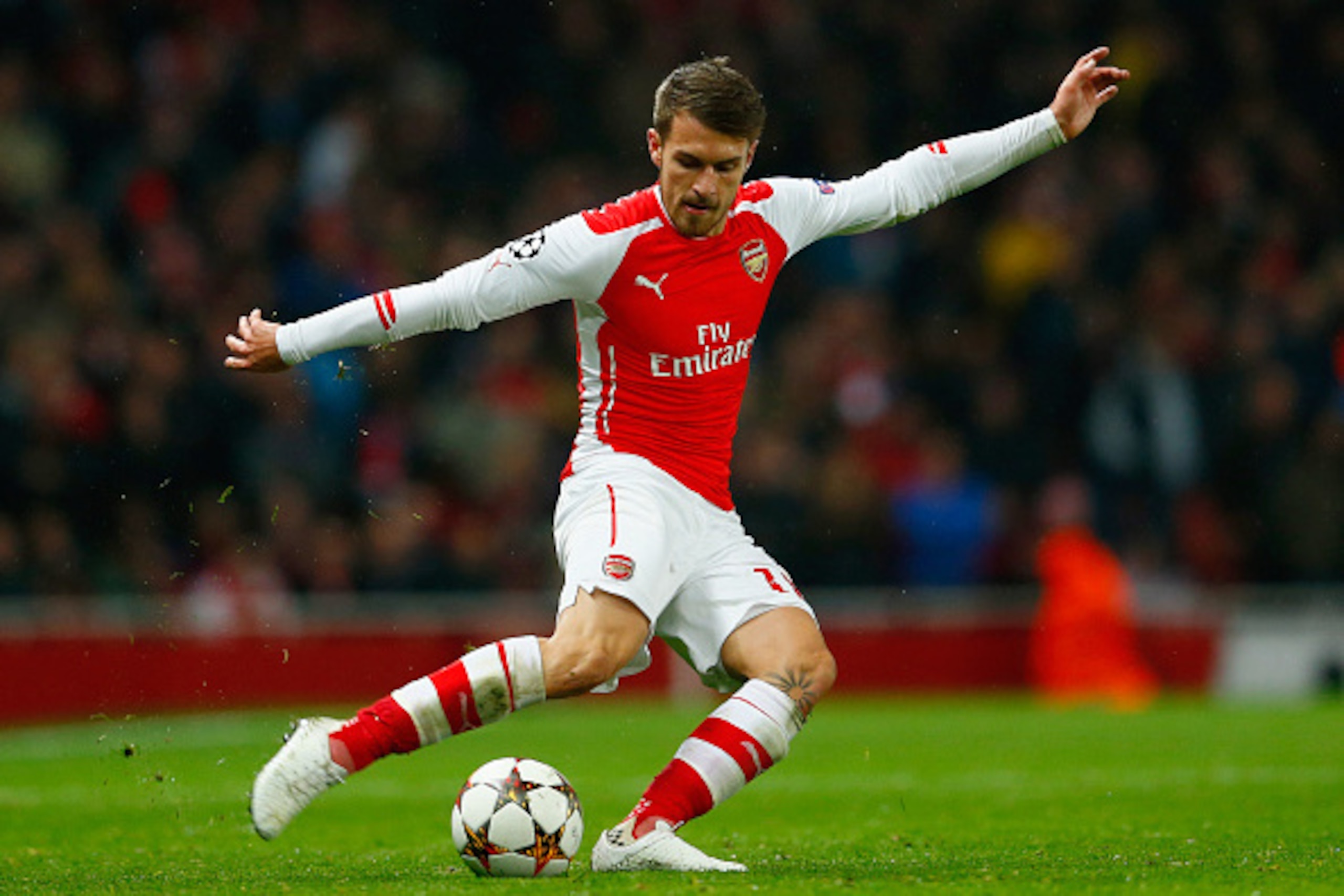
Aaron Ramsey was rightly crowned Arsenal's player of the season in the summer after a glorious 2013/14 campaign, but that vein of form is mostly absent from the Welshman's efforts thus far this term.
His pass-completion rate is similarly strong (86 percent on the year, via Squawka), yet he won more tackles and made fewer defensive errors per 90 minutes last season (0.05 errors per 90 last year, as opposed to 0.29 this term). He's struggling to chain great performances together as he did last season.
It's clearly visible on the pitch: Ramsey is not at his mesmeric best, and Arsenal are worse off.
Peer closer, and it's not just Ramsey. Also blameworthy is Santi Cazorla, who has struggled for consistency all year. In fact, it's almost impossible to name an Arsenal midfielder who hasn't shown the irregular, erratic form that typifies the entire team this season.
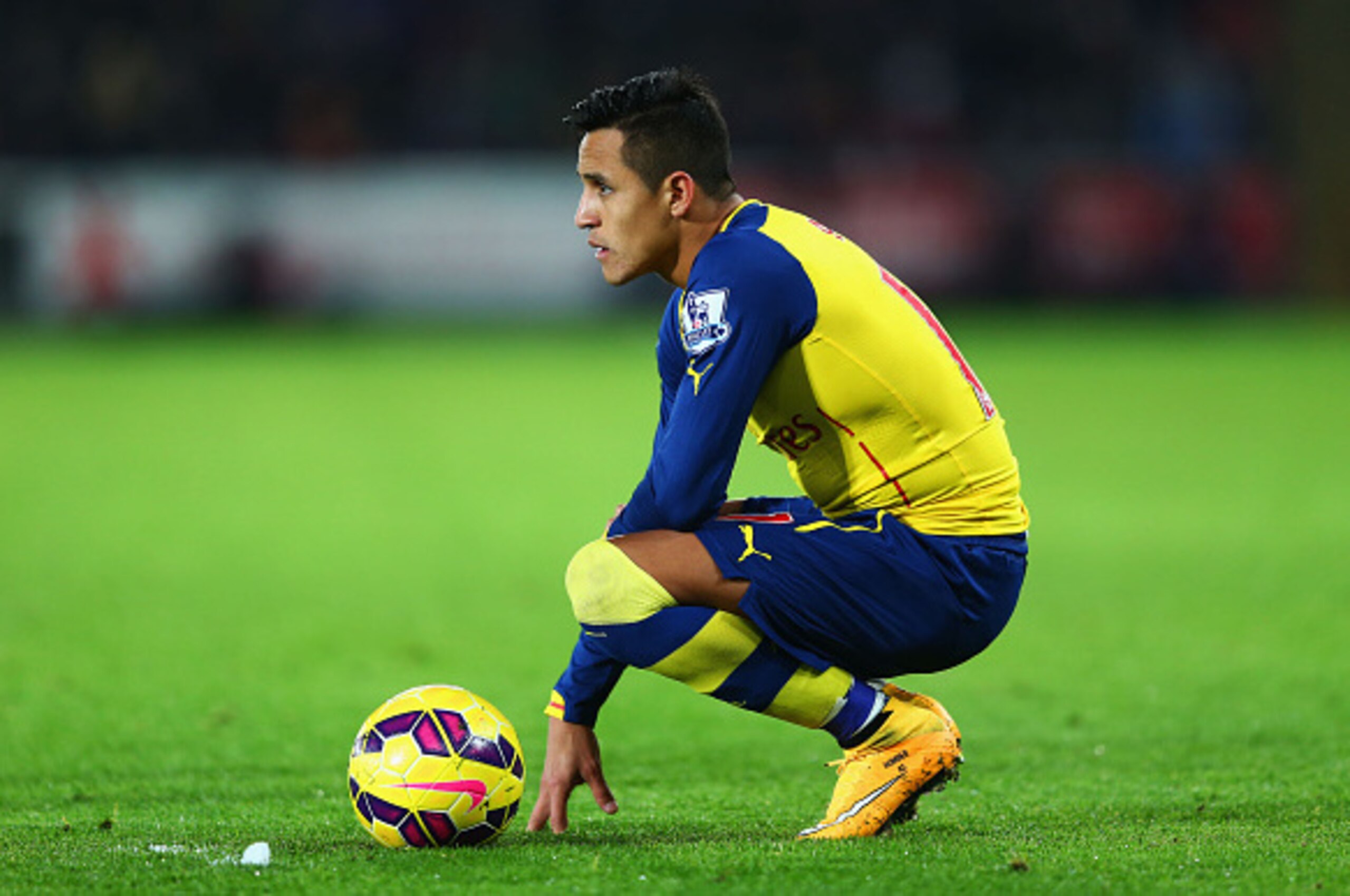
Observers have to mark Alexis Sanchez down as the team's best midfield asset, hands down. Yet even he has his lacklustre moments, despite his goals and work rate carrying the side in plenty of games.
This dearth of consistency has led to an unreliable midfield corps from top to bottom who are unable to establish a bond of communication with the defence. They can work tirelessly for over an hour to keep opponents at bay and engineer opportunities for their colleagues, but if defensive organisation falls to bits in the dying stages, what's the point?
It's not a new headline by any stretch of the imagination. But until Arsenal find an option in midfield that's reliable and consistent, capable of combating and adjusting to whatever it faces—and that may not be until the transfer window opens in January—this crisis is bound to be a prolonged one.
That last thought rings true for the defence and the manager as well. It might not be until January, when Wenger is able to introduce reinforcements to shore up these struggling sections of his squad, that true improvement will be seen and felt in the side.
Of course, there's a difference between what the manager is able to do and what he will do. If early reports of intentions to sign Barcelona's versatile attacker Pedro are anything to go by, per Anthony Chapman of the Express, then he might well be blind to his own team's greatest needs.
Whatever happens, Arsenal are truly underachieving, and there's no clear path to changing that right now.
What do you make of Arsenal's struggles this term? Let us know with a comment below, or alternatively start the debate on Twitter.