Minnesota Timberwolves Must Figure out Who Zach LaVine Is While Ricky Rubio Sits
The Ricky Rubio ankle injury stinks big time, but it did create a pretty meaningful opportunity for one of the team's most prized young assets. We now get to see what type of NBA shape Zach LaVine takes on.
LaVine was a lottery pick in 2014 based strictly on potential as opposed to production or a resume of accomplishments. It was his blend of 6'5" size, superhero-like athleticism and ball skills that fueled his appeal—not the 9.4 points per game, 1.8 assists or 13.95 Player Efficiency Rating he put up off UCLA's bench.
He actually took some heat for leaving school early, given how little he'd shown, not to mention that 180-pound frame and spaghetti arms. Only one other Division I player taken in last June's first round had a smaller usage rate in college, and that was the No. 29 pick Josh Huestis, a glue guy who played four years at Stanford.
TOP NEWS
Giannis' Warning to NBA ⚠️

NBA Power Rankings Entering Preseason 🔢
Wizards Guard Admits Tanking 😨
Few even expected LaVine to see the NBA floor in 2014-15, never mind start at point guard six games into his career.
There's just so much uncertainty surrounding his game and outlook as an NBA prospect. And that's what makes this opportunity for LaVine a must-follow for fans and management.
The first game after Rubio's injury, coach Flip Saunders made the aggressive move to start LaVine at the point. It's an interesting decision, considering the availability of Mo Williams and LaVine's questionable feel for the position.
Up to this stage, other than showing he's got a handle, LaVine hasn't exactly sold himself as a point guard. Obviously, it would be pretty cool if he was able to make that transition from off-guard to floor general, given the mismatch he'd present when you factor in his height and explosiveness.
But LaVine rarely got the chance to facilitate at UCLA and averaged more turnovers than assists in both summer league and preseason.

With LaVine, we just haven't seen the natural passing and playmaking instincts typically shared by most guys who run their offense.
However, though wired as a shoot-first guard with a scorer's mentality, you gotta admit—the experimental setting in Minnesota isn't all that bad. It's not as if he'll be under pressure with the team expected to compete for lottery position once again.
And LaVine isn't exactly alone in the driver's seat up there. He's got some pretty strong options alongside him to lean on in the half court.
Besides, playing next to established, credible scorers like Kevin Martin, Thaddeus Young and Nikola Pekovic, you'd like to think LaVine would be less inclined to launch up fall-away, one-on-one jumpers.
"It definitely helps for the first game to have that veteran leadership to calm you down, to tell you where to go, to do this, do that,” LaVine told Jerry Zgoda of the Star Tribune. “So that helps. … You’ve got to trust it, and you’ve got to earn your trust."
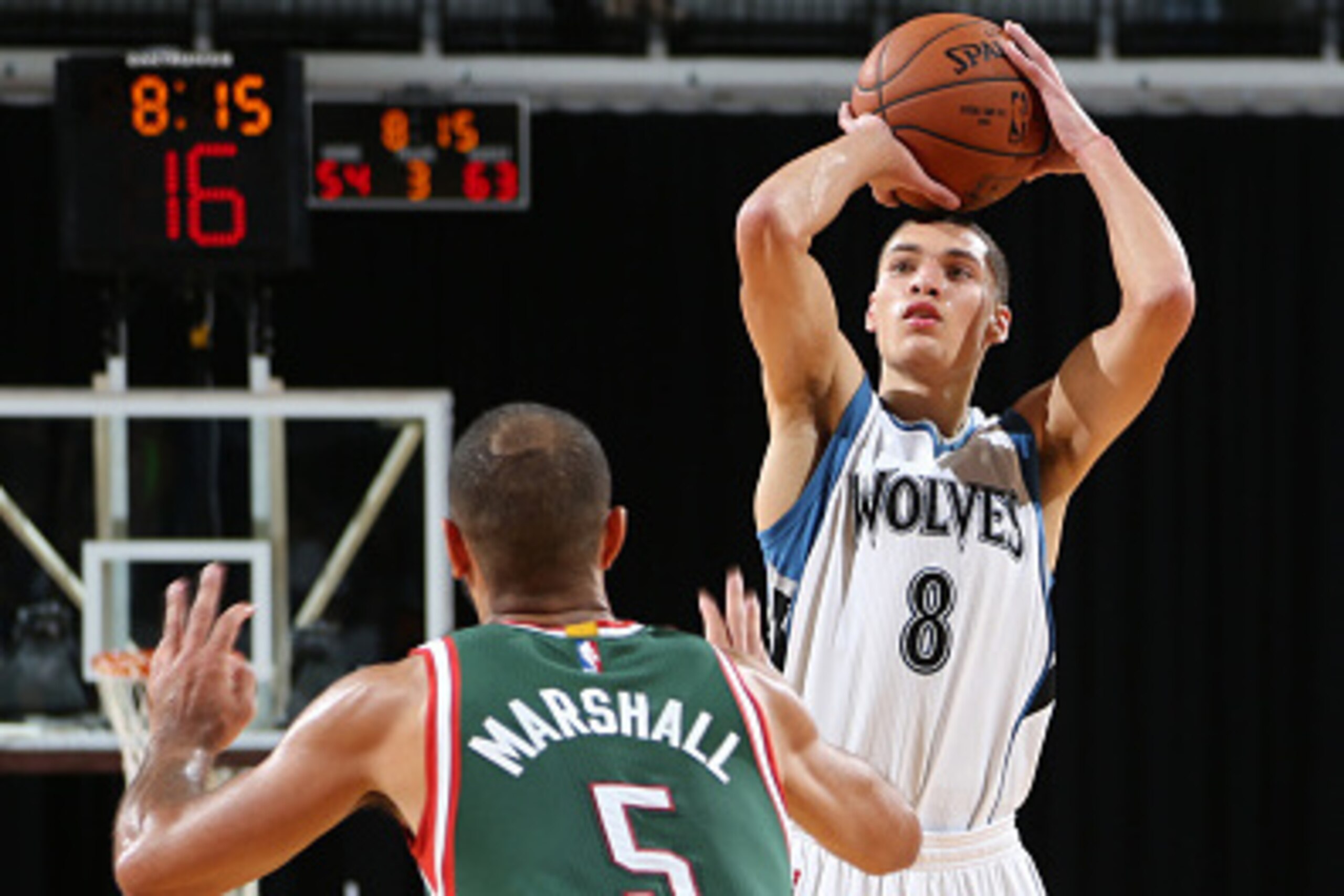
In his starting debut against the Miami Heat, LaVine dished out four assists and took just five shots in 26 minutes. He at least appeared to know his role, which called for him to prioritize setting up teammates over hunting for personal offense.
But though it was a promising sign, this isn't about developing LaVine's point guard skills as much as it's about figuring out how and where he holds the most value to the organization.
It's obviously a lot easier to build a roster when you know what type of blocks are already in place.
Assuming Saunders sticks to his guns and continues to give LaVine regular minutes over the next month or two, we should end up with a pretty good sense for where he stands in terms of his playmaking strengths and weaknesses.
Maybe we learn LaVine works best as a microwave sixth man off the bench—Jamal Crawford style. Or that he'd eventually seem like a fit between Rubio and Andrew Wiggins at the 2.
Or maybe we find out that LaVine does indeed have a future at point guard. If that's the case, he might hold more value to the team as a trade chip after the Wolves extended Rubio four more years.

Bottom line—this is a good chance for the Wolves to figure out what they have in LaVine, who, at just 19 years old, has loads of upside. Only we don't quite know what form or shape it's coming in.
Hopefully over the next few months, we'll all have a better understanding of LaVine's true NBA identity.
As long as everyone can accept the bumps likely to follow, these early minutes should benefit both him and the Wolves' management.
.jpg?w=2560 "Every Trade's Best Trade Asset 🔁")
.jpg?w=2560 "Insiders: Cowboys Overpaid for Porter")
.jpg?w=2560 "MHJ's Potential Trade Value 📉")