Tale of the Tape for NFL Week 10
Throughout the 2014 regular season, former NFL defensive back Matt Bowen will bring you an X's-and-O's look at the pro game. Here are his five key plays from the Week 10 Sunday NFL schedule.
49ers Convert Critical Fourth Down to Save Their Season
With an opportunity to close out the San Francisco 49ers in a critical fourth-down situation late in regulation, the Saints allowed Colin Kaepernick to escape the pocket, extend the play and toss the ball over the top of a busted coverage in the secondary to wide receiver Michael Crabtree.
TOP NEWS
Bears' Santos Wanted to Kick 58-Yarder
Picking Each NFL Division Winner 🔮
.jpg?w=2560)
B/R's Expert Week 7 NFL Picks 🔮
Let’s break this down with a focus on the coverage responsibilities in the secondary on a play that allowed the 49ers to extend the game and eventually pick up a road win in New Orleans.
Personnel: Posse/11 (3WR-1TE-1RB)
Formation: Doubles Wing Gun Near
Offensive Concept: Fade/Curl
Defensive Scheme: Cover 2
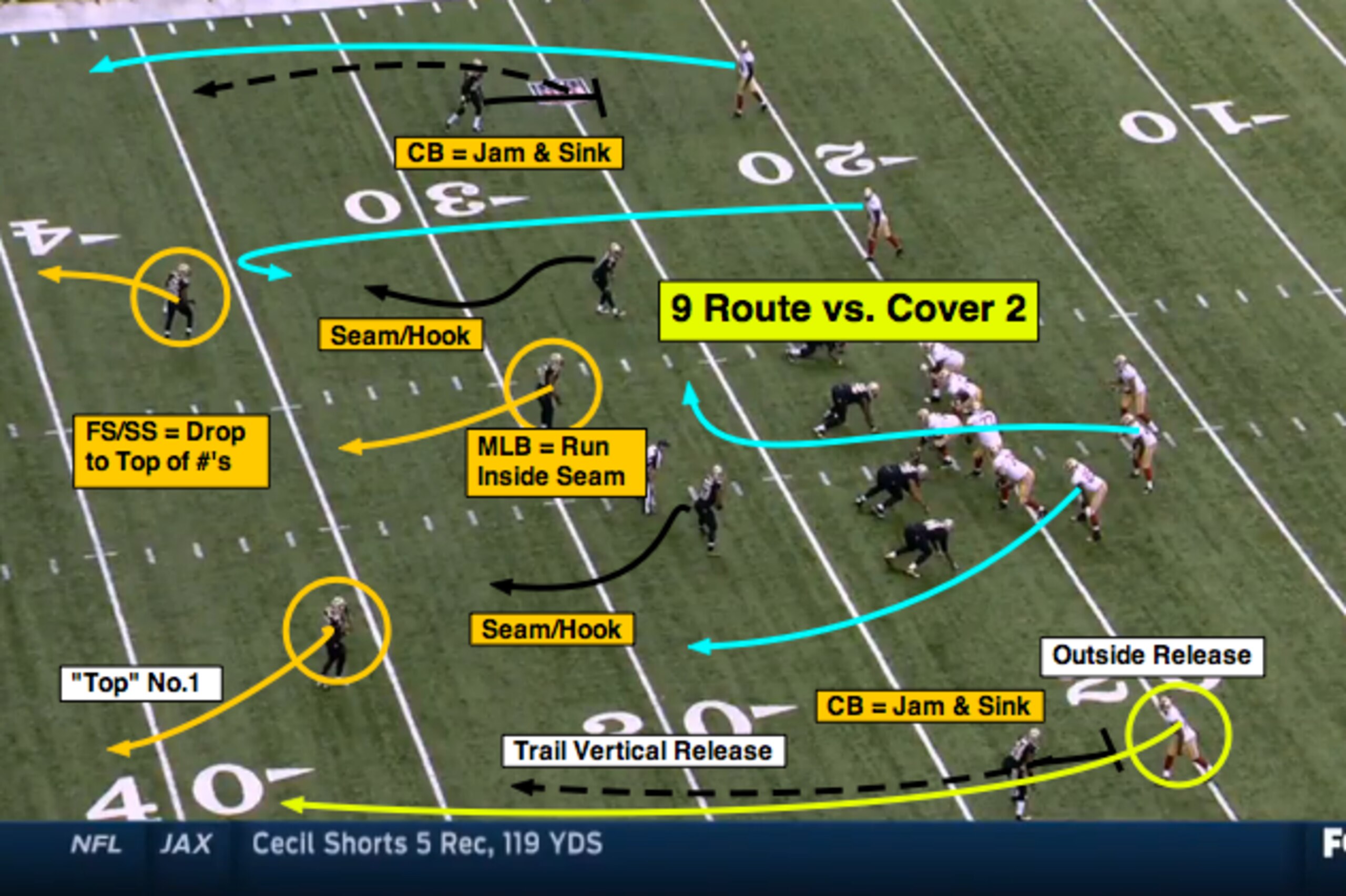
Before we get into the issues with the Saints secondary on the eventual “scramble drill,” check out the coverage drops and responsibilities in the Cover 2 shell.
As you can see here, the cornerbacks will jam and sink versus the No. 1 receivers with two seam-hook defenders underneath, the middle linebacker running the pipe (carry inside vertical) and both safeties getting to the top of the numbers in the deep half.
That allows the Saints to play (or take away) four verticals, flat-7, three-level sail, deep dig, etc. while forcing Kaepernick to dump the ball underneath.
Here, the 49ers are running two outside verticals (or 9-routes) with Anquan Boldin on the intermediate curl to the open (weak) side of the formation and tight end Vernon Davis releasing up the seam after chipping on the defensive end.
This is a solid call, given the game situation and Kaepernick's ability, as the Saints will have seven defenders getting to landmark drops with their eyes on the quarterback.
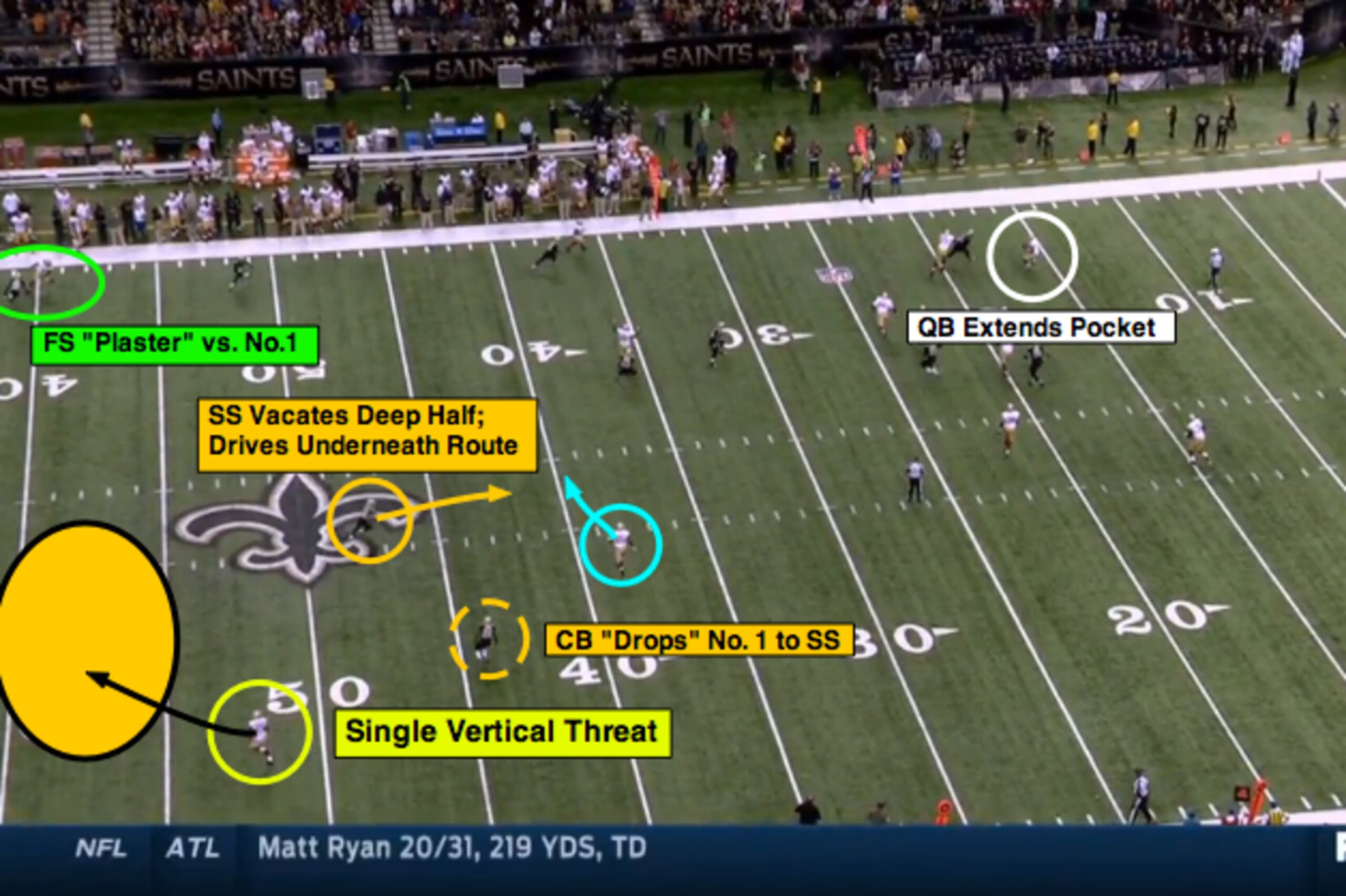
Where do the Saints first get into trouble? They lose contain versus the quarterback. That allows Kaepernick to extend the play and work outside of the pocket with receivers now in a position to convert routes (find open holes in the zone).
In this situation, defensive backs are taught to “plaster” to their coverage. That means they “buy” the receiver in their zone (like we see with the free safety up top versus the 9-route).
However, to the closed (strong) side of the formation, the Saints bust the coverage as strong safety Kenny Vaccaro drives downhill on an underneath concept, despite the vertical threat outside of the numbers.
Even with cornerback Corey White sinking underneath the outside release of Crabtree (coached to trail the route in Cover 2 with no threat in the flat), the deep-half safety has to move with the quarterback and “top” his coverage.
As a coach would say in this situation, play as “deep as the deepest."
This vacates the deep half of the zone coverage and allows Crabtree to continue down the field with no help over the top.
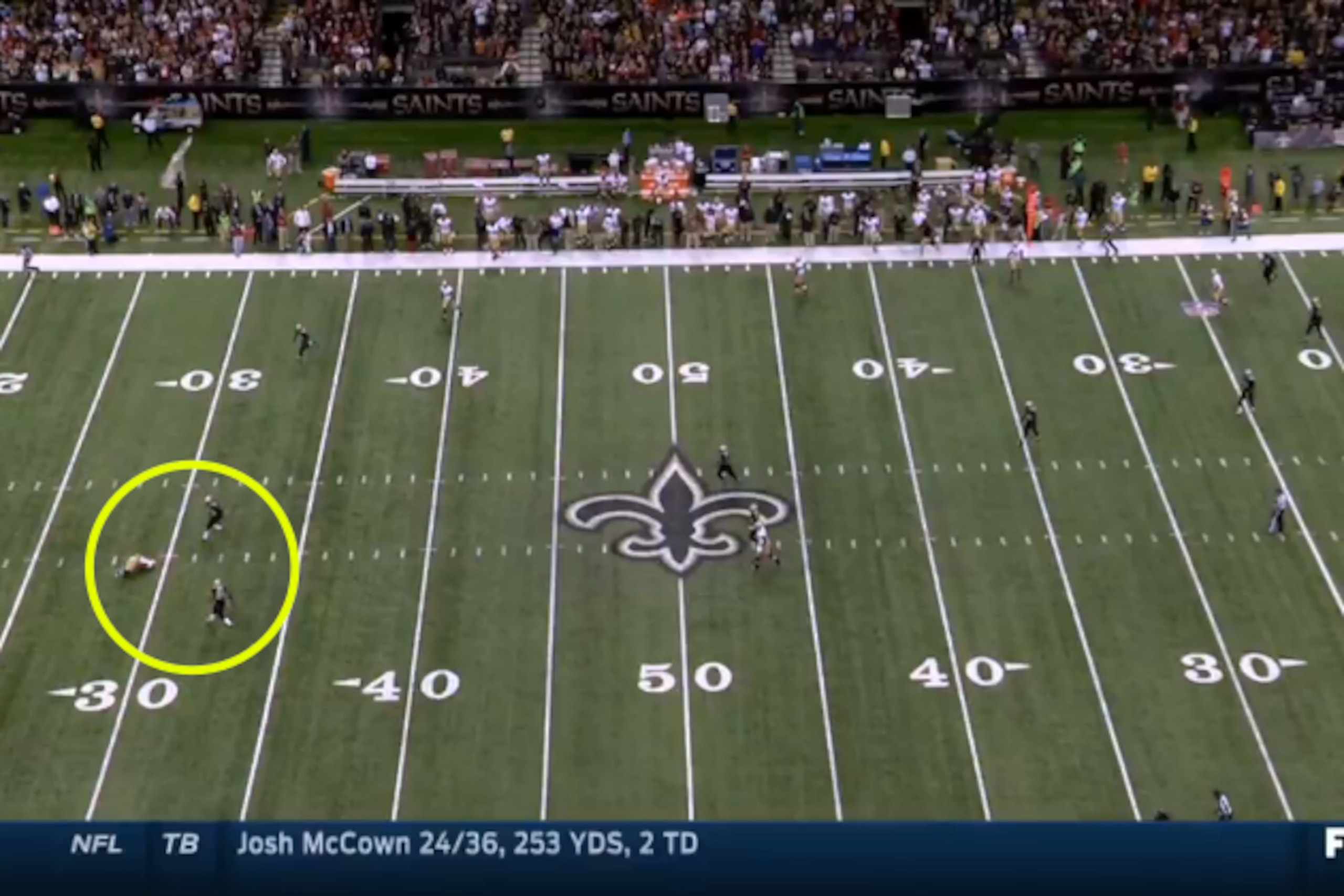
Kaepernick throws this ball 60 yards in the air (from the opposite side of the field) as Crabtree secures the catch to set the 49ers up for a game-tying field goal before getting the win in overtime.
Could there have been communication issues in the Saints secondary? Of course. Are there receivers open underneath? No doubt. But when you allow the quarterback to escape contain up front and extend the play, things break down in the back end of the defense and receivers find open holes in the zone.
And the 49ers took advantage of that to make a key play on Sunday while essentially saving their season.
Alex Smith, Chiefs Produce Game-Winner on the Zone Read
With the ball inside of the red zone, Alex Smith and the Chiefs executed the zone read (off a packaged play) to put the ball across the goal line for the game-winning score versus the Buffalo Bills.
Here’s a look at the scheme, the initial read for Smith off the mesh point and the arc block from tight end Anthony Fasano that created a running lane for the Kansas City Chiefs quarterback.
Personnel: Posse/11 (3WR-1TE-1RB)
Formation: Slot Open Gun Near
Offensive Concept: Zone Read (Packaged Play)
Defensive Scheme: Cover 1
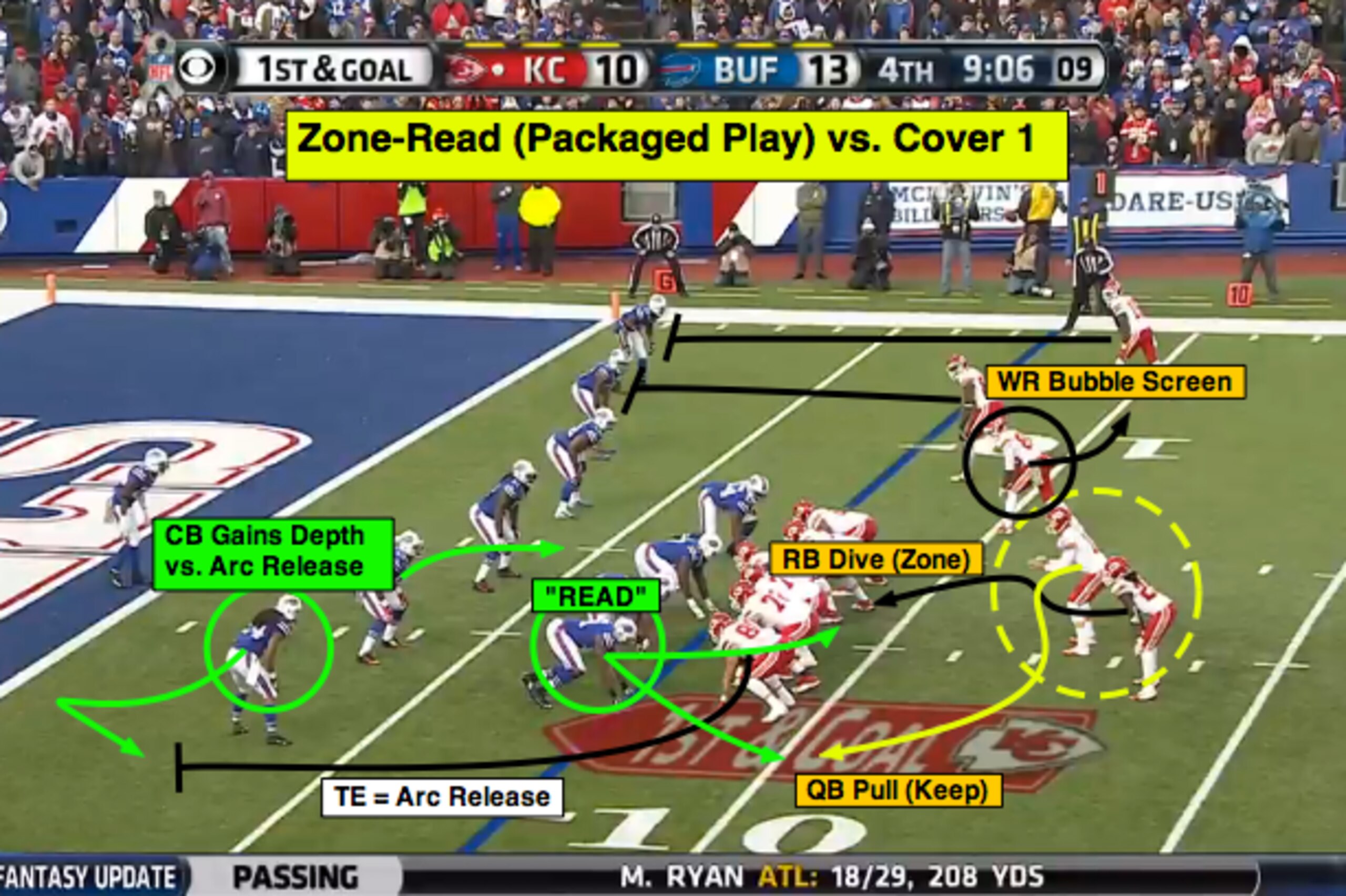
This is a packaged play (run/pass option based on the number of defenders in the box) with the Chiefs showing the bubble screen to the trips look. But we want to focus on Smith and the mesh-point action to the closed side of the formation.
Here, Smith will read the initial path of defensive end Manny Lawson. If Lawson stays up the field, Smith will give the ball to Jamaal Charles on the dive (inside zone). However, if Lawson crashes inside on the dive, Smith can pull the ball and get to the edge with Fasano on the outside arc release.
This forces the defensive back in coverage, Stephon Gilmore, to honor the outside release of the tight end (pass read) while giving ground or gaining depth. That softens the edge and allows the tight end to fit up on the cornerback at the second level.
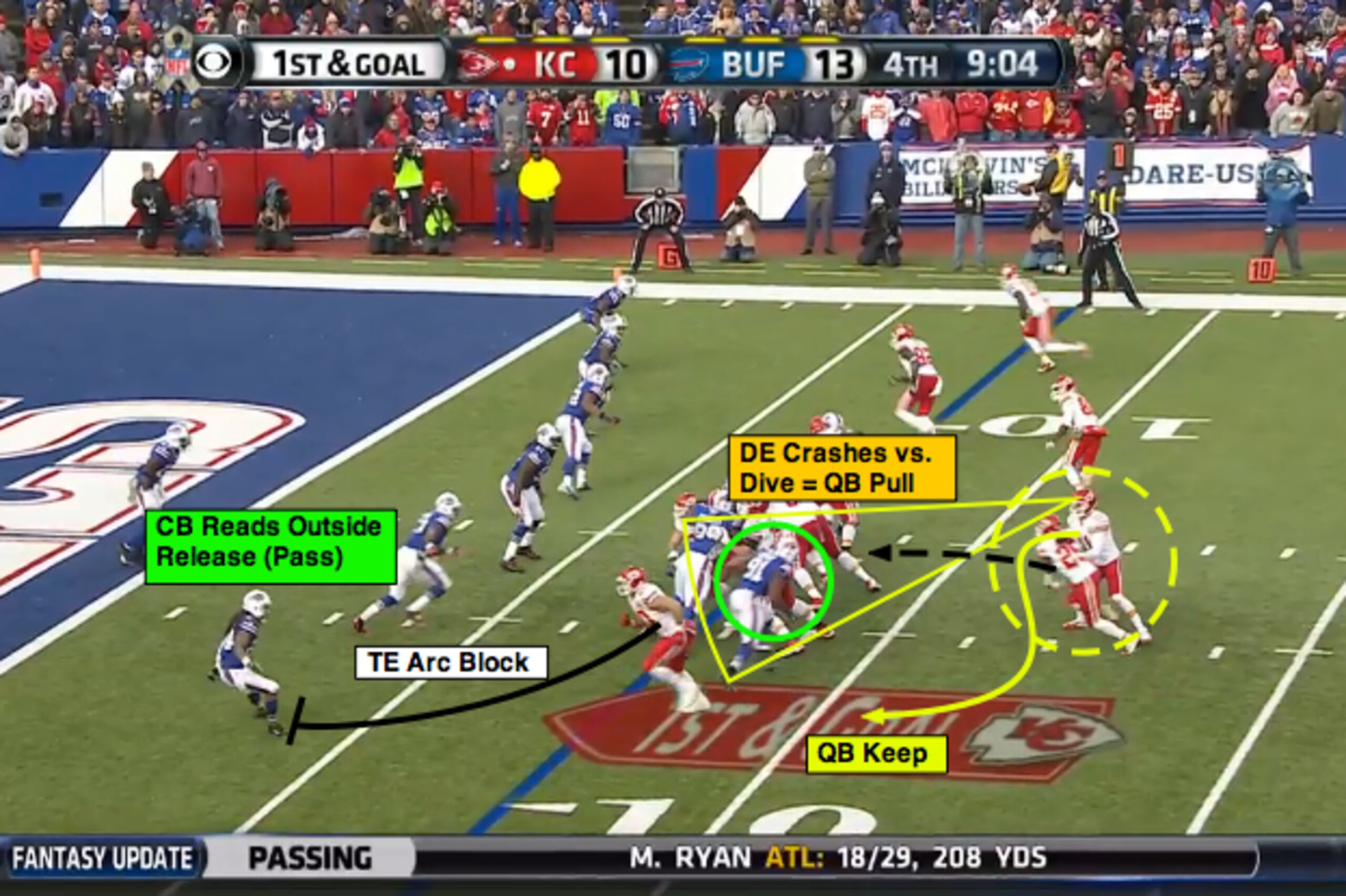
With Lawson crashing inside at the snap to play Charles on the dive, and no inside scrape from the linebacker position, Smith can pull the ball and get outside.
This is where we see that running lane start to develop as Gilmore gains ground in his pedal versus the outside release of Fasano, leaving no primary run support for the Bills on the edge of the defense.

Once Gilmore identifies the zone-read concept, he must attack the block of Fasano and work to squeeze the inside running lane. That creates an opportunity for the free safety, Aaron Williams, to run the inside alley versus the quarterback.
However, with Gilmore widening on contact versus Fasano, Smith can now press the ball outside and force Williams to adjust his angle (flatten to the ball).
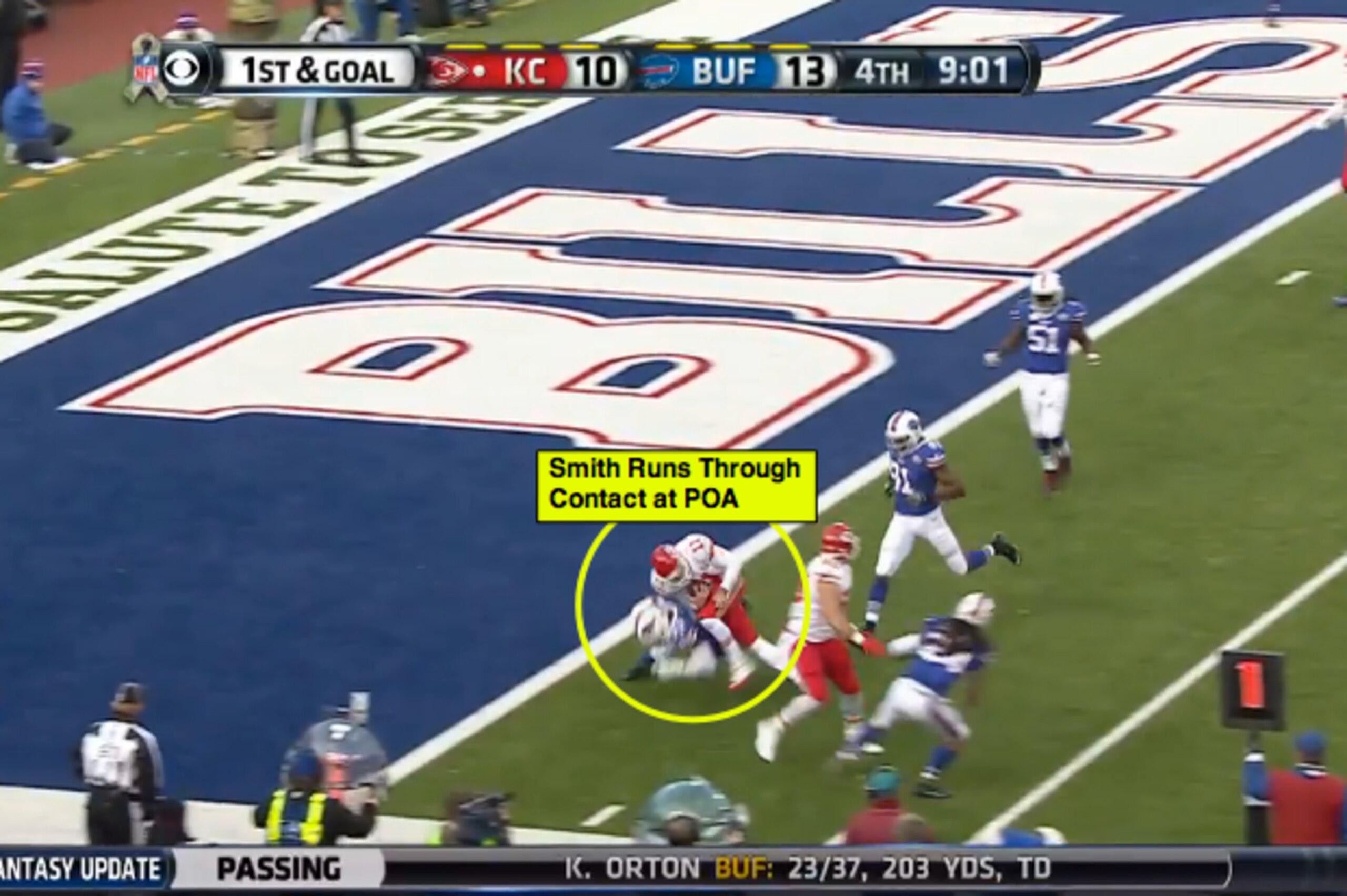
I love the finish from Smith as he drops the shoulder versus Williams and runs through the contact to put this ball in the end zone.
This goes a long way in the locker room when your quarterback invites contact and is willing to make a play on the road in a crucial game situation. Players respect that.
Matthew Stafford Makes a Big Play to Beat the Dolphins
Late in the fourth quarter, Stafford showcased his ability to throw the ball from multiple angles/release points as he dropped down to deliver a touchdown pass to Theo Riddick with the game on the line in Detroit.
Let’s take a look at how Stafford found Riddick in the end zone after the running back converted a base "flat" route up the field for the six points in the Lions' 20-16 victory.
Personnel: Ace/12 (2WR-2TE-1RB)
Formation: Doubles Gun Near
Offensive Concept: Hi-Lo Crossers
Defensive Scheme: Cover 1 Combo

With the Lions running a "Hi-Lo Crossers" combination inside, Riddick releases to the open-side flat versus safety Reshad Jones. This isn’t a primary target for Stafford with a two-level read in the middle of the field.
However, with the Dolphins only rushing three, Stafford steps up, slides in the pocket and finds room to break contain. That allows Riddick to convert the flat route to a "rail (or wheel)" concept by stemming up the field versus Jones.
And with the open-side deep third cleared out because of the Hi-Lo concept (cornerback removed), Riddick now has a true one-on-one match to exploit.

Jones sticks his eyes in the backfield once he gets to the inside hip of Riddick on the flat route, and that creates an opportunity for the running back to separate up the field on the rail. With Riddick now in a positive position to stack on top of Jones, the Lions quarterback targets the rail route in the end zone.
And it’s the release point on the throw that stands out.
Stafford opens his shoulders and drops his arm level down (like a second baseman turning a double play) to deliver this ball to Riddick. Unconventional? No question. But given the game situation, and the angle to make this throw, Stafford adjusts his release point to target the rail route.

Jones has time to recover in the end zone, and that’s why this ball has to be on the up-field shoulder of Riddick (away from the defender).
This is an outstanding throw from Stafford and an example of the quarterback going out and making a play for his team to get a win.
Drew Stanton Comes Off the Bench to Produce for the Cardinals
When veteran starter Carson Palmer left the field with an ACL injury, Stanton came into the ballgame and went after the top of the St. Louis Rams secondary to target rookie wide receiver John Brown on the "scissors" concept.
Let’s break down the route, discuss the coverage in the secondary (zone pressure) and look at the ball placement from Stanton on the 48-yard touchdown pass that produced a fourth-quarter lead (and another win) for the Arizona Cardinals.
Personnel: Posse/11 (3WR-1TE-1RB)
Formation: Doubles Slot
Offensive Concept: "Scissors" Route
Defensive Scheme: Nickel Zone Pressure
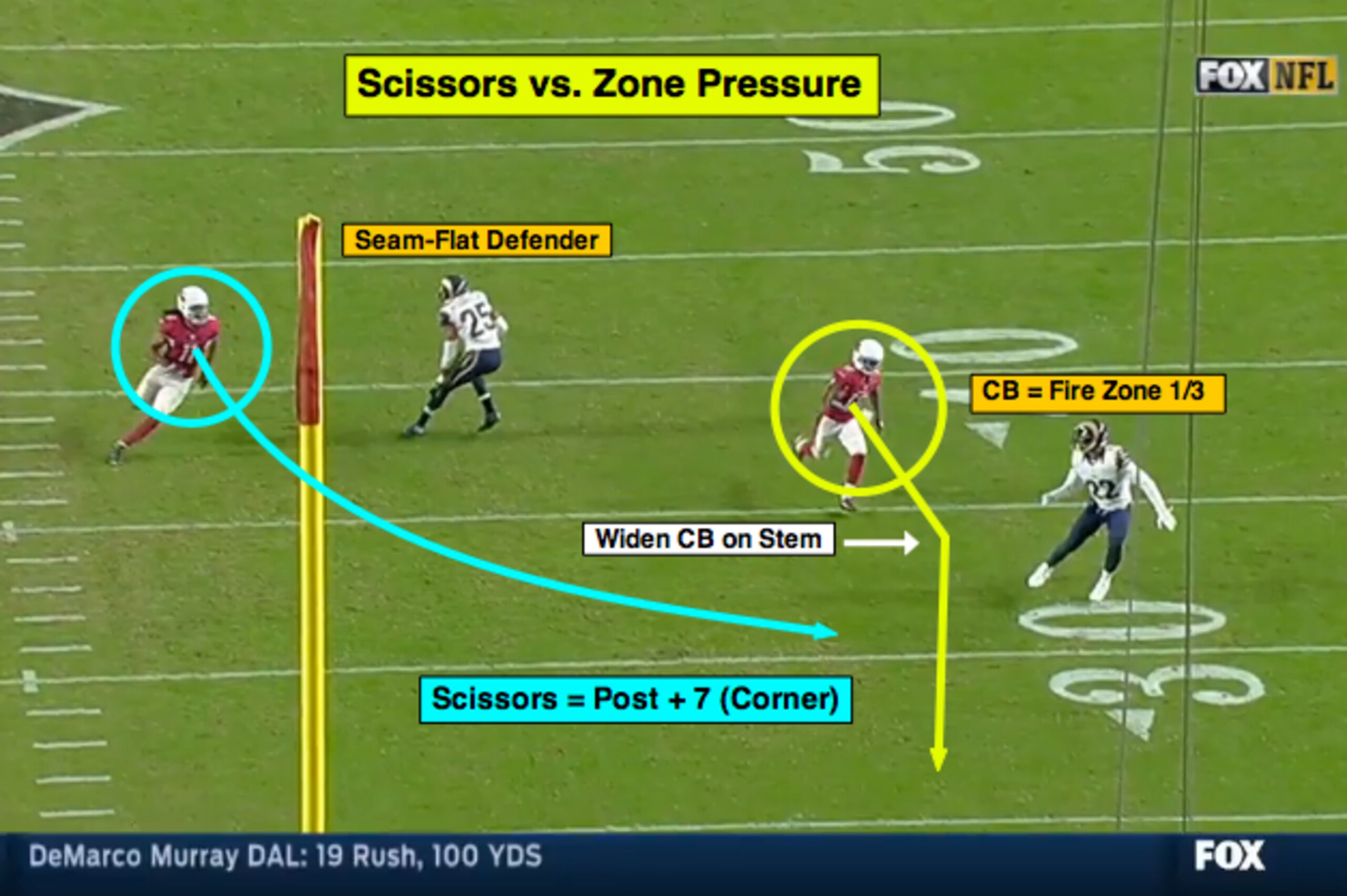
In the scissors concept, the outside receiver runs a post with the inside receiver breaking on the 7- or "corner" route. This puts stress on the secondary to pass off routes or match with the proper leverage to defend the top of the defense.
The Rams are sending five-man zone pressure with the seam-flat defender underneath (match to No. 2) and the cornerback, Trumaine Johnson, playing a fire-zone-third technique (match to the vertical release of No. 1).
With Brown using a slight outside stem (widen the cornerback on the post), and Larry Fitzgerald running the 7-cut, Johnson can carry the post or pass it off the free safety in the deep middle of the field.
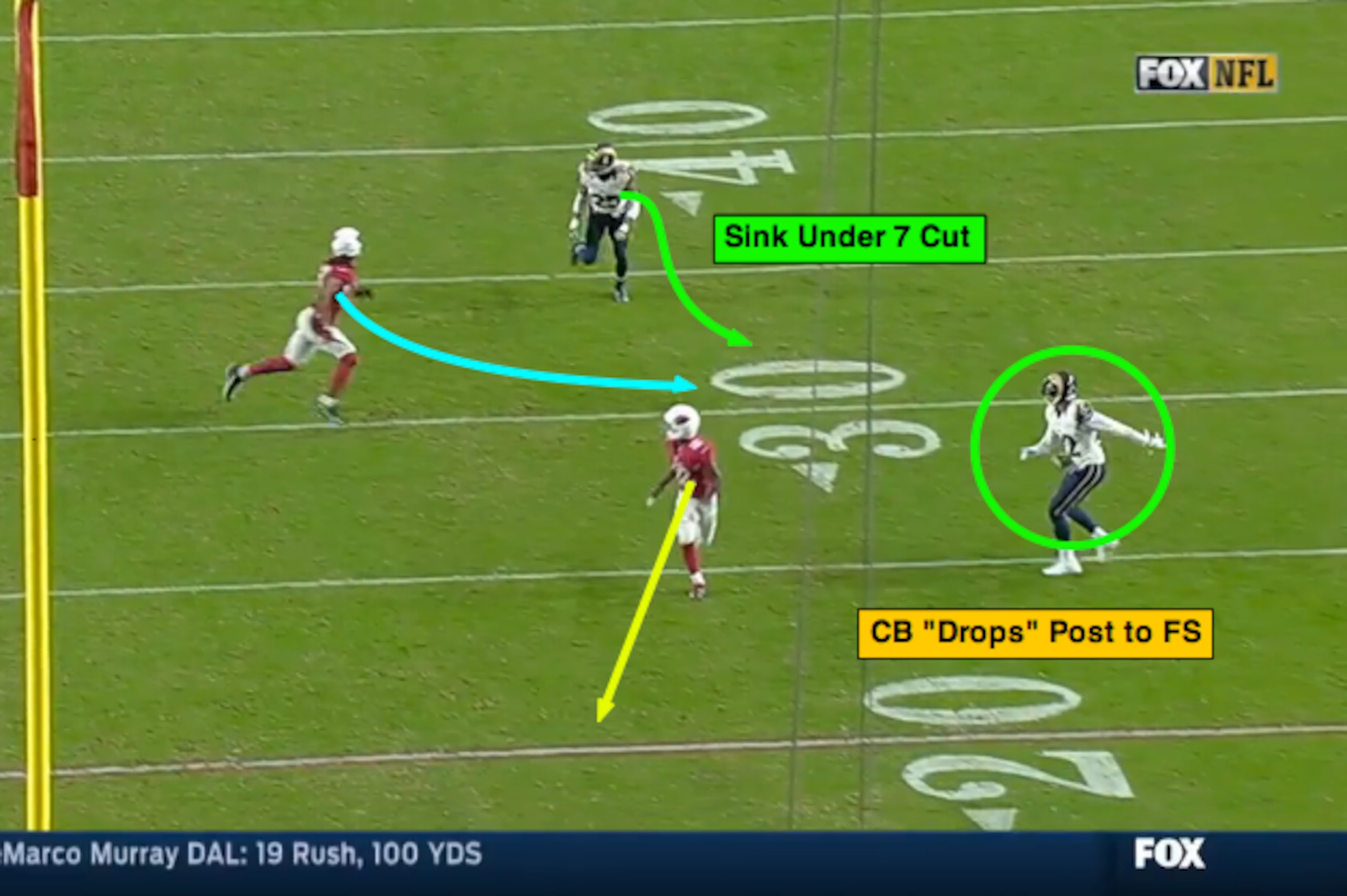
Once Brown breaks to the post, Johnson drops the receiver and widens to play over the top of Fitzgerald on the 7-cut. This allows the Rams to take away Fitzgerald with Johnson in a position to drive on the throw and the seam-flat defender sinking underneath.
However, if the Rams want to pass off the post, the free safety has to be in a position to play top-down versus the route to eliminate the deep-ball opportunity.
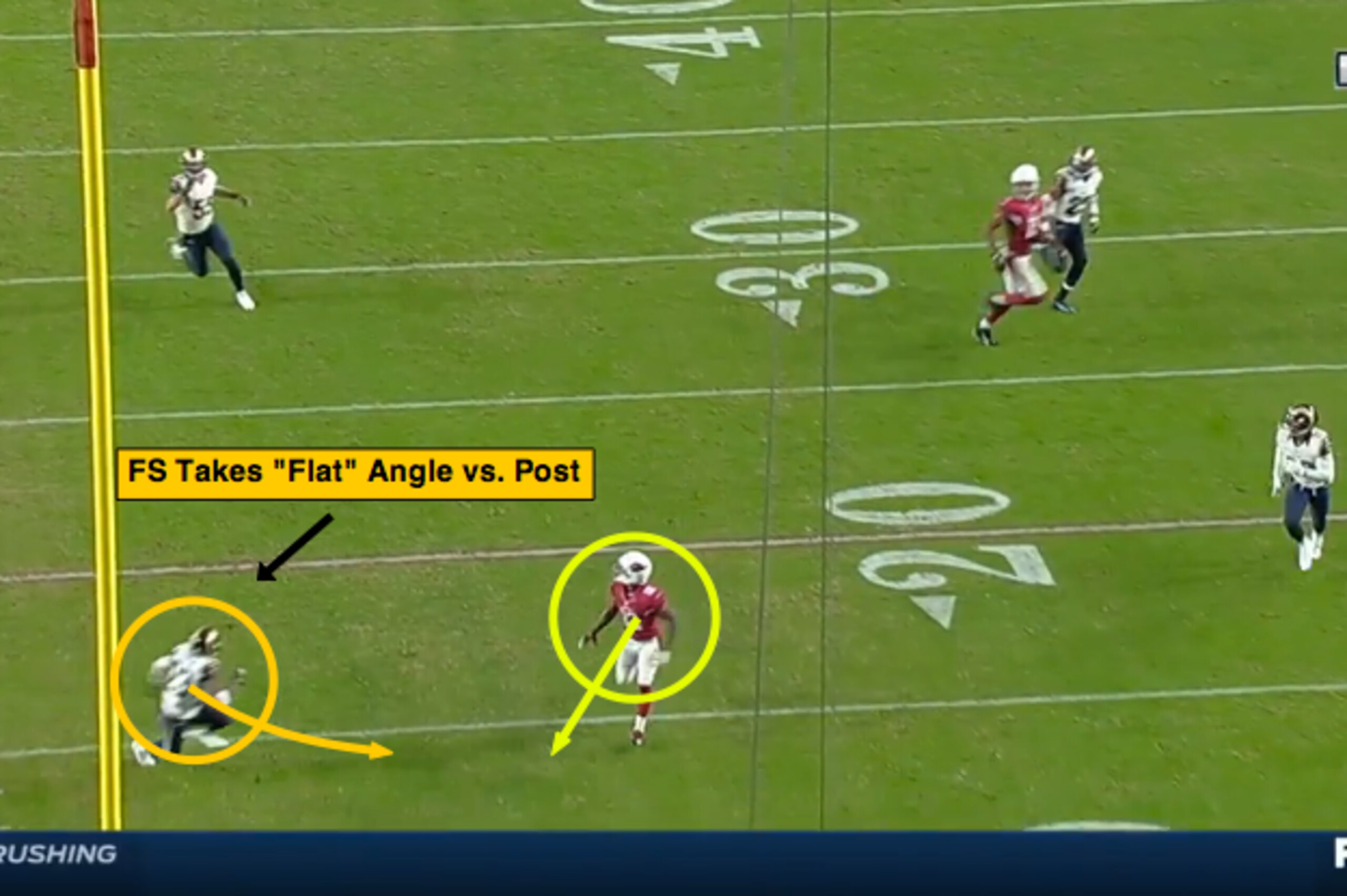
Check out the angle from free safety Rodney McLeod. Instead of taking an angle to the up-field shoulder of the receiver (downhill angle), McLeod flattens out to the ball.
That creates an opportunity for Brown to get on top of the free safety (lack of depth in the middle of the field) with Stanton in a position to target the post.

This is a great ball from Stanton and an excellent catch from Browns as the rookie extends to finish this play for six points.
Stanton can win games for the Cardinals. But can this team win a championship without Palmer? That’s the question I have.
Marshawn Lynch, Seahawks Run Through the Giants
The New York Giants had no answer for the Seattle Seahawks' power and zone-read schemes on Sunday as Pete Carroll’s team ran for 350 yards in the 38-17 win out in Seattle with Lynch producing four touchdowns.
Let’s take a look at Lynch’s final touchdown run of the day with a focus on the personnel and alignment that created a soft run box for the Seahawks to execute the zone read.
Personnel: Jet/10 (4WR-1RB)
Formation: Doubles Orange Flex Gun Near
Offensive Concept: Zone Read
Defensive Scheme: Cover 1 Pressure
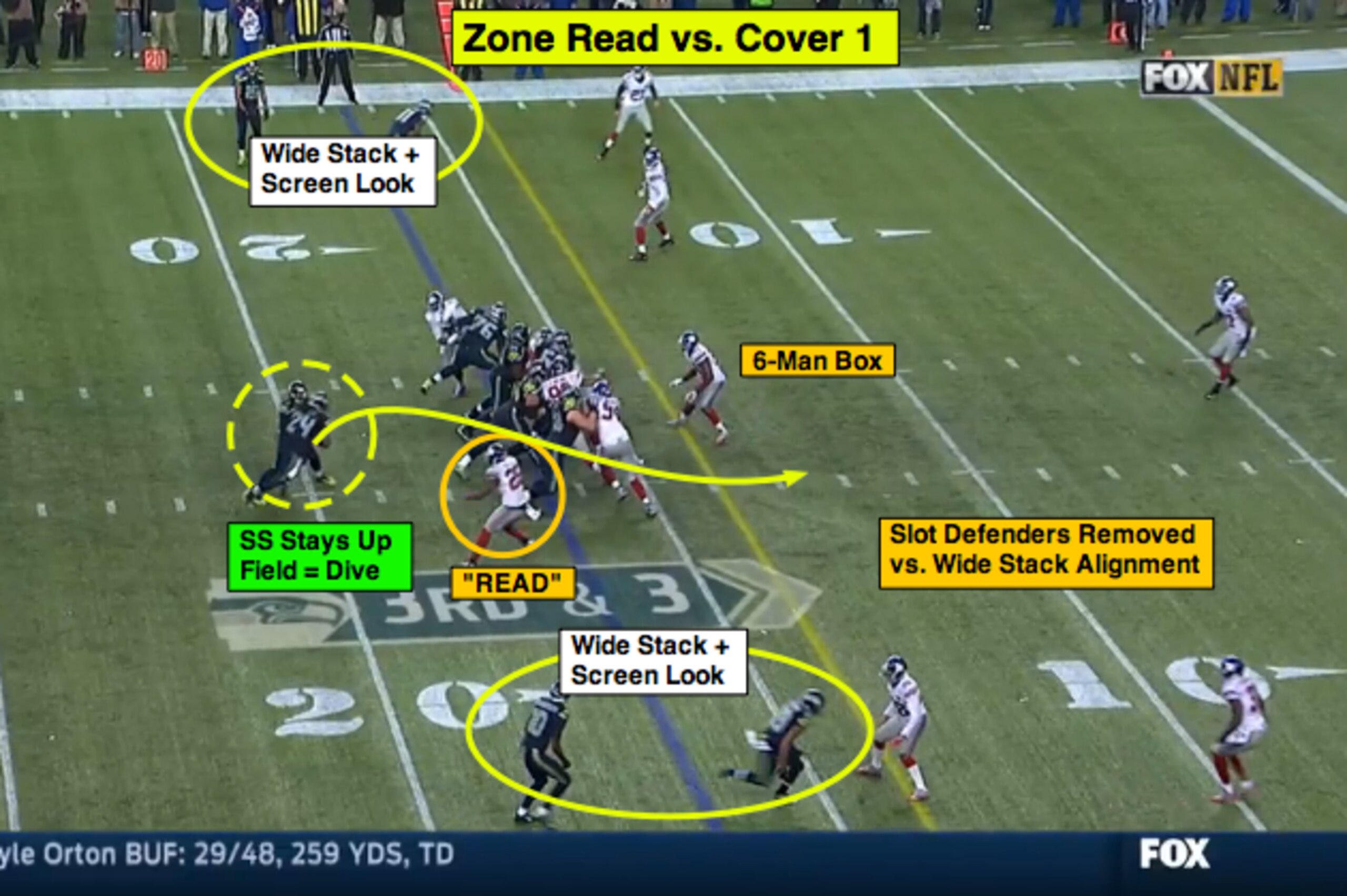
This is a base, one-read scheme for quarterback Russell Wilson off the mesh point, but it’s the spread look from the Seahawks that generates an opportunity for Lynch to get up the field.
Check out the wide, double-stack look from the Seahawks with Jet/10 personnel on the field. That forces the Giants' slot defenders to vacate the middle of the field with the Seahawks showing the wide receiver screen action to both sides of the formation.
That leaves only six defenders in the box, with Wilson reading Antrel Rolle to the closed-side edge.
The Giants safety takes a path to Wilson versus the mesh point, and that allows the quarterback to hand the ball off to Lynch on the dive (inside zone).
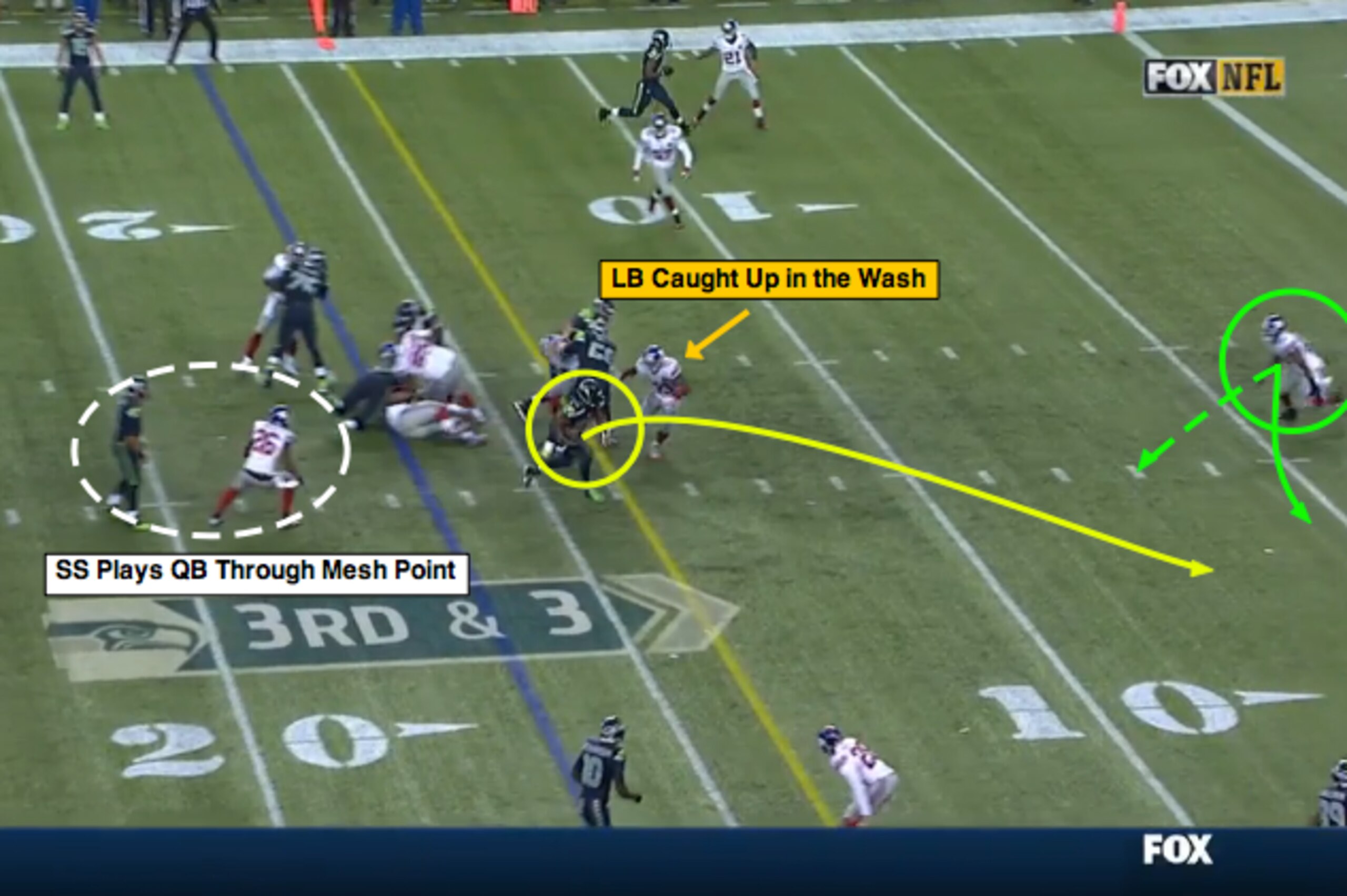
With Rolle now removed versus Wilson, and the linebacker caught up in the wash as he attempts to scrape to the dive, Lynch has a clear running lane to push this ball up the field.
That creates open running room for Lynch with the free safety in the deep middle of the field and the slot defender removed in coverage versus the wide-stack look.

In my opinion, the Giants defensive backs made a “business decision” at the goal line as Lynch worked through some light contact to get this ball into the end zone.
There was an opportunity here to put a hit on the Seahawks running back, but I didn’t see much effort to keep Lynch out of the end zone for the fourth time.
Seven-year NFL veteran Matt Bowen is an NFL National Lead Writer for Bleacher Report.