Breaking Down the Different Elements of Miami Dolphins' Dominant Defensive Line
When the Miami Dolphins comprehensively beat the San Diego Chargers last weekend, much of the spotlight was consumed by the two quarterbacks.
Dolphins starter Ryan Tannehill sustained his impressive recent play by completing 24 of 34 passes for 288 yards, three touchdowns and zero interceptions. He also added 47 rushing yards on four carries. Chargers starter Philip Rivers was receiving attention for the wrong reasons, as he endured his worst game of the season.
Rivers completed just 52.2 percent of his passes for 138 yards, zero touchdowns and three interceptions.
TOP NEWS
.jpg?w=2560 "Chargers Mack")
Every Trade's Best Trade Asset 🔁
.jpg?w=2560 "Green Bay Steelers Football")
Insiders: Cowboys Overpaid for Porter
.jpg?w=2560 "Seahawks Cardinals Football")
MHJ's Potential Trade Value 📉
Although Rivers was sacked just three times, the pressure from the Dolphins' defensive line was one of the emanating storylines from this game. A storyline that should have played a more prominent role over the course of the regular season.
Over eight regular-season games, the Dolphins defense has registered 25 total sacks. 19.5 of those sacks came from the defensive line.
2012 All-Pro and six year veteran Cameron Wake has been the leader of the group, notching 6.5 sacks and three forced fumbles. While his sack numbers aren't as impressive as they've been in the past, Wake is quietly having a season worthy of contending for defensive player of the year.
Wake is the kind of pass-rusher who forces the offense to adjust to his presence either with specific play calls or additional attention from blockers.
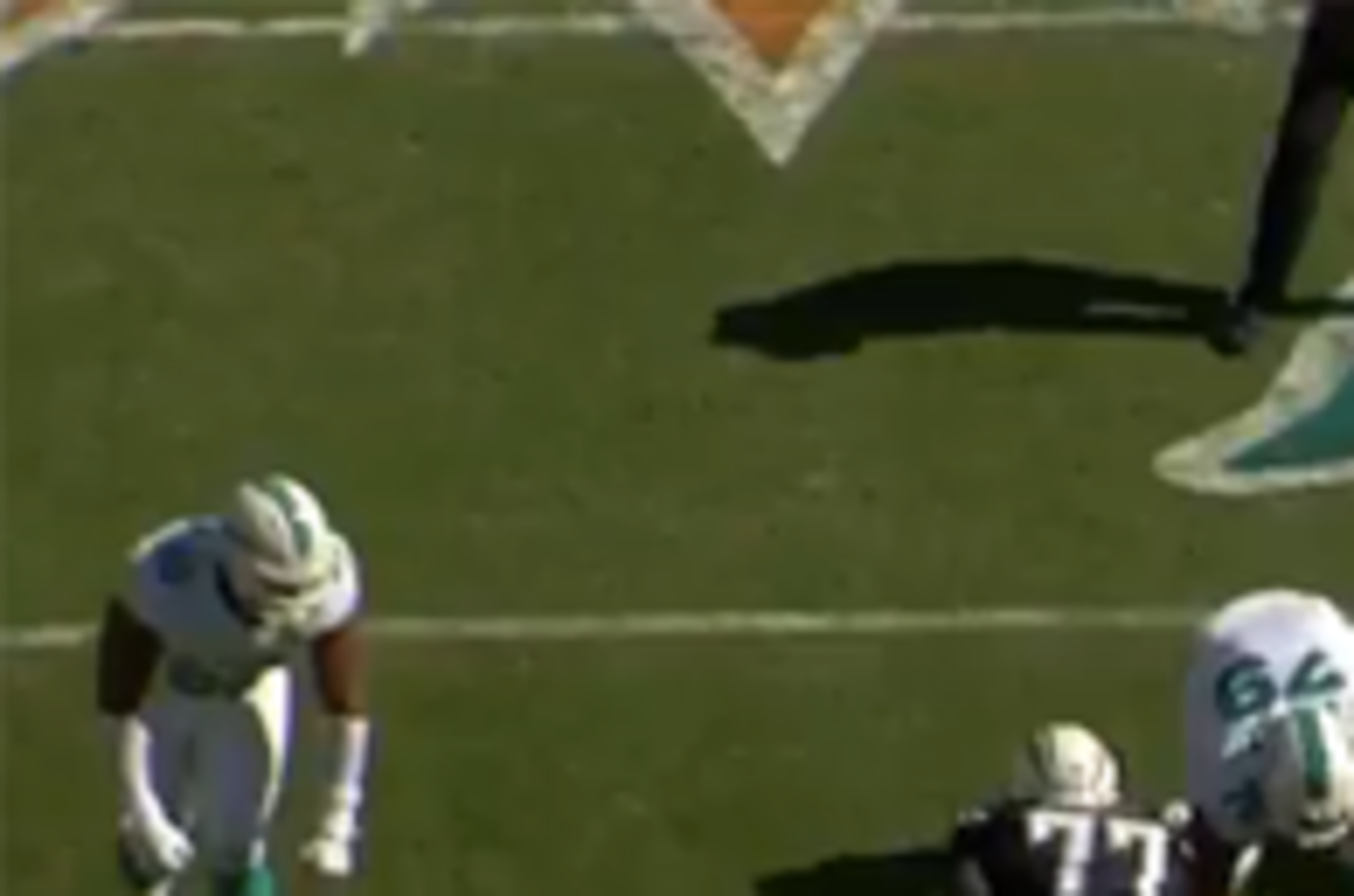
On this 3rd-and-4 play late in the second quarter, the Chargers offense is set up at its own 36-yard line. Wake is lined up in his usual left defensive end spot, facing off against young, but reputable, right tackle D.J. Fluker.

Wake's greatest strength has always been his burst off the line. Even at 32 years of age, he doesn't need to anticipate the snap in order to get an advantageous position on the offense. Fluker, while talented, is better using his strength than his quickness.
The offensive tackle gets into a good position to counter Wake's first move, but the defensive end is able to use his hands to knock him out of the way.
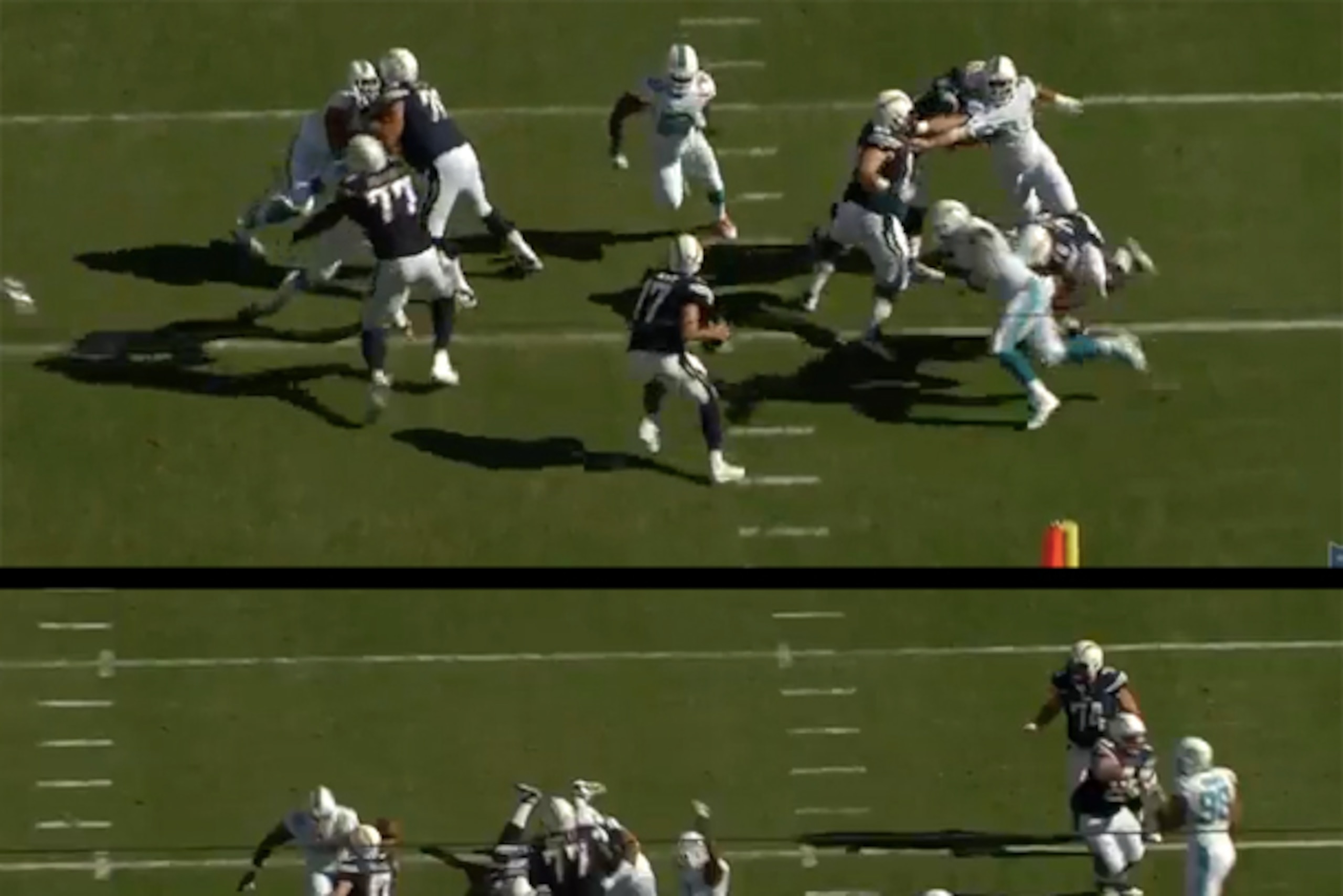
With the combination of his speed and hand usage, Wake was able to sweep past Fluker with haste. That gave him a free route to the quarterback to take him down, forcing the Chargers to punt the ball away. That play set up a field-goal drive for the Dolphins to extend their lead to 23-0.
For as long as Wake has been in Miami, he has never truly had a consistent and effective complement on the other side of the defensive line. Jason Taylor is the most notable complement that Wake has ever played with, and neither player was in his prime when the pair shared a locker room.
Olivier Vernon was a third-round pick of the 2012 draft. His production and overall impact was limited during his rookie season as he played a bit-part role in the defense's rotation upfront.
During his second season, Vernon enjoyed a breakout campaign notching 11.5 sacks in 14 starts. However, while Vernon was breaking out, Wake was limited by various ailments that both sidelined him and hampered his ability when he was on the field.
Wake and Vernon hadn't truly seen the best of each other as the former wasn't at 100 percent and the latter hadn't fully developed before this season. Through eight games this year, they have combined for 11 sacks and five forced fumbles.
One of Vernon's forced fumbles came last week against the Chargers.
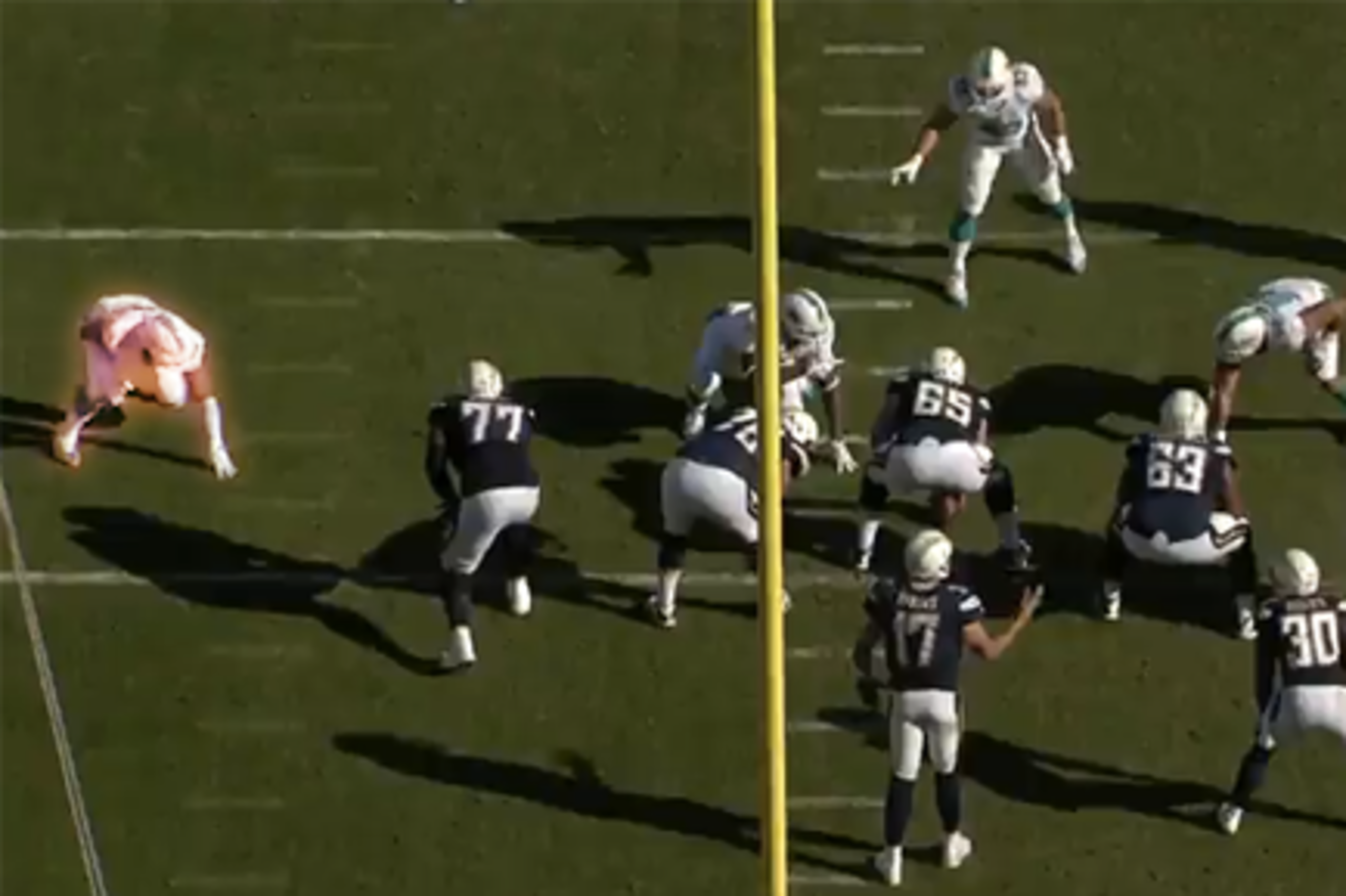
Lined up on the right side of the defense, Vernon faced King Dunlap. Dunlap is a veteran player with good athleticism, but he's not one of the better left tackles in the NFL. At this stage of his career, Vernon would expect to beat Dunlap with relative ease.

Vernon is a relatively well-rounded pass-rusher. He doesn't possess the same burst off the line that Wake boasts, but he isn't slow to close toward the pocket either. On this play, he beats Dunlap with hand placement and power rather than speed.
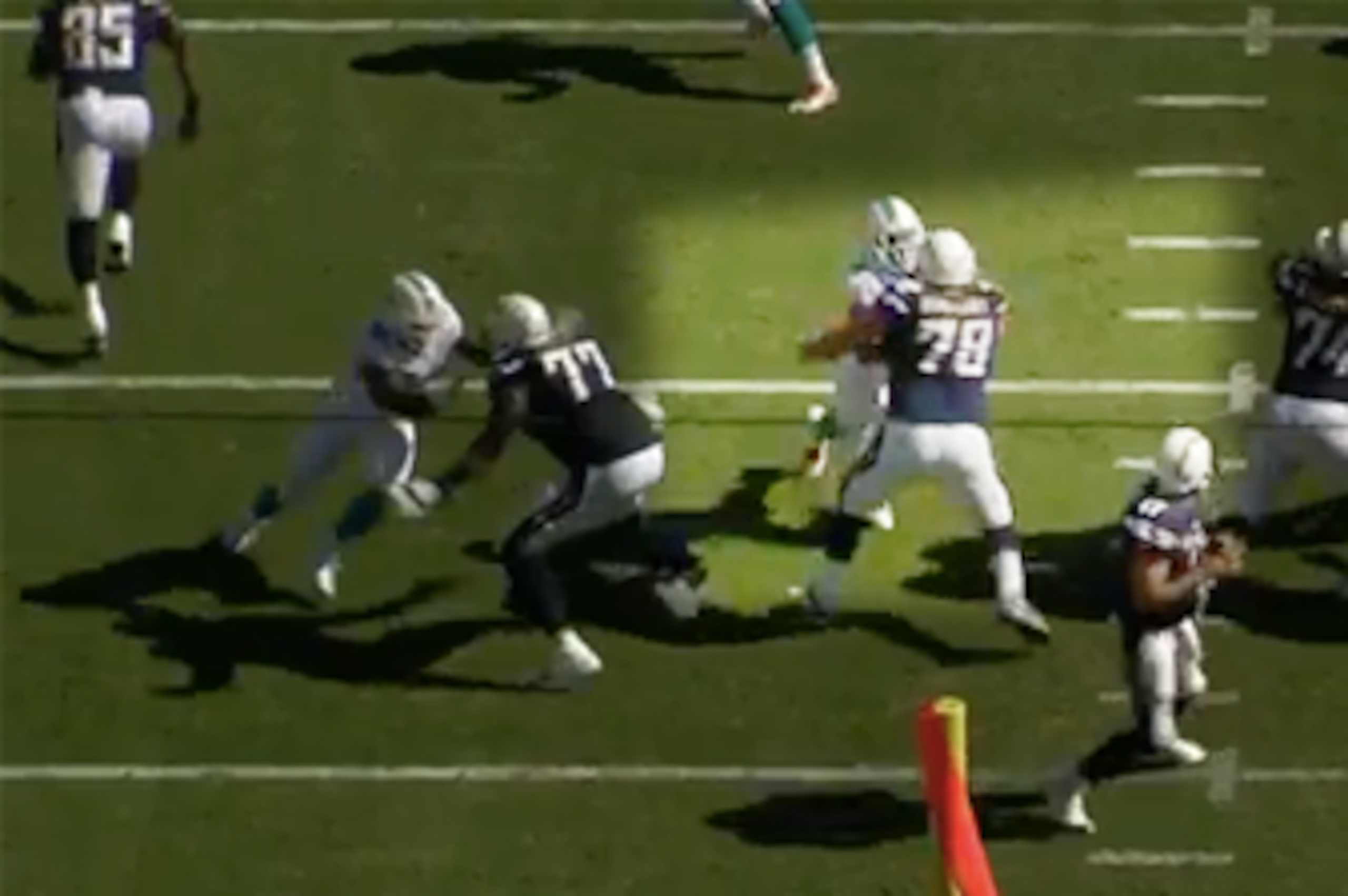
The defensive end is able to engage the left tackle in such a way that his outside arm is on Dunlap's shoulder. This allows Vernon to rip the left tackle backward before bringing his left arm to create an effective swim move.

Dunlap is completely taken out of the play, but Rivers is quick enough in the pocket to climb forward and force Vernon to alter his angle. Vernon is able to do that, and Rivers' movement actually puts Vernon in the perfect position to force a fumble from the blind side.
That forced fumble sets the Dolphins offense up deep in Chargers territory. It essentially ended the game as Rivers never returned to the field.
Effective edge-rushers are typically easier to spot than dominant interior defensive linemen simply because they play in space, and their explosiveness is put on show. Nonetheless, interior defensive linemen are often more important than edge defenders because it's tougher to scheme away from them.
When the Miami Dolphins signed defensive tackle Earl Mitchell to a sizeable contract during the offseason, it initially appeared like an odd move. Mitchell was set to replace Paul Soliai, a more reputable player who moved on to the Atlanta Falcons.
Since Mitchell and Soliai have arrived in their new workplaces, it's become very clear as to who's the better player.
Mitchell has proven to be a very valuable run defender for the Dolphins. He brings balance to the unit with his size and discipline to help the defense as a whole rank eighth in the NFL against the run by DVOA, per Football Outsiders. Mitchell offers that balance without taking away from the team's pass rush.
A pass rush that helps the team's pass defense rank first by DVOA.
Rivers has been arguably the best quarterback in the NFL at negating pressure. He doesn't do this by being athletic or extending plays by surpassing their original design, instead he does it by quickly getting rid of the ball. Therefore, when he holds onto the ball, the defense has to get home.
The best way to force Rivers to hold onto the ball is to avoid blitzing and only rush four defenders. However, this puts pressure on Mitchell to be effective because he is likely going to be left in a one-on-one situation because of his skill set.
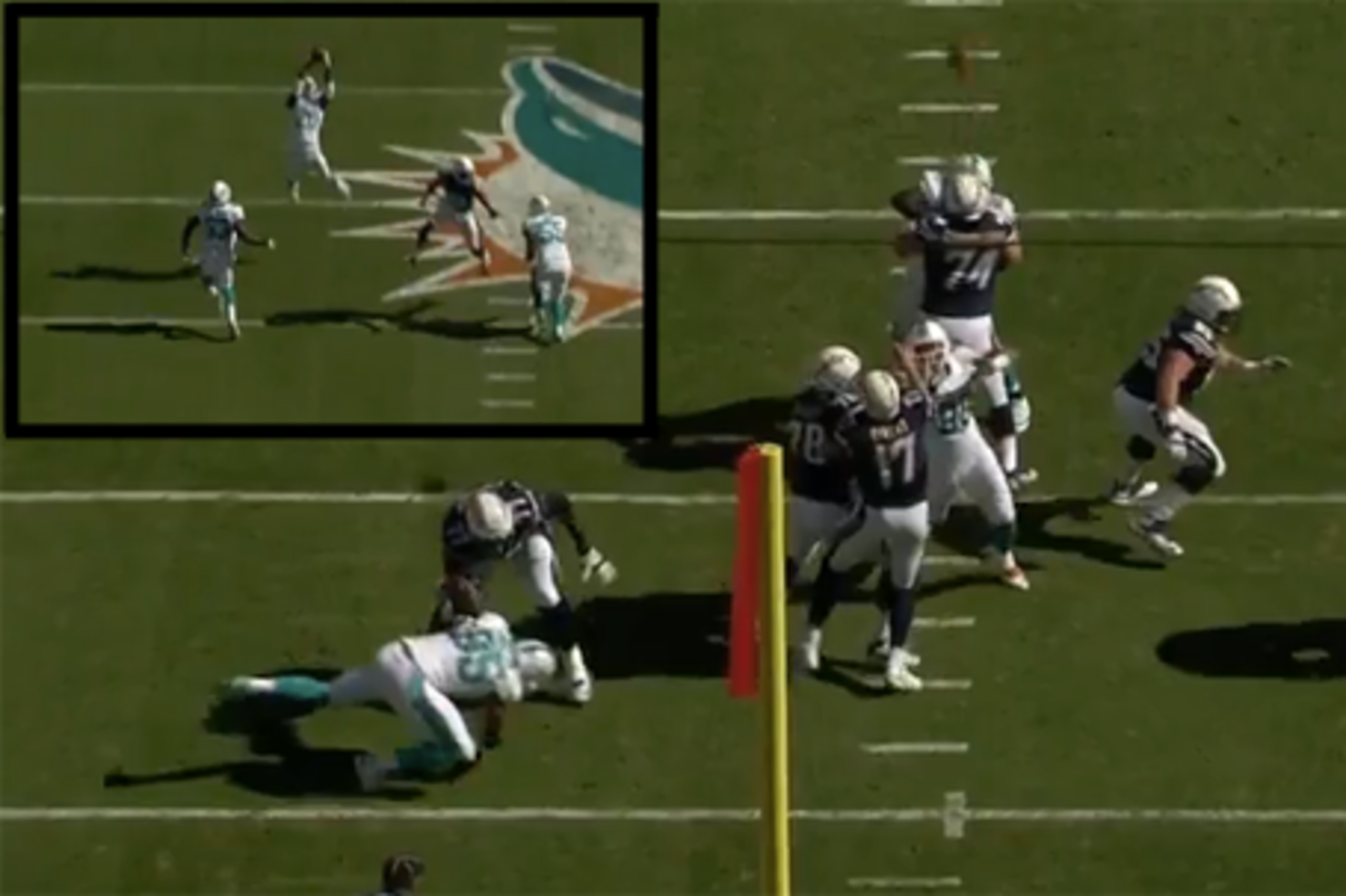
From the very start of the play, Mitchell gets his hands into the left guard's chest. He is able to immediately start pushing him backward in the direction of the quarterback. Because of the four-man rush, Rivers doesn't have a quick option.
As he holds the ball, Mitchell is able to push his blocker into the quarterback. Rivers isn't sacked, but his pass down the field floats into a defender's hands because he can't step into his throw.
Because Mitchell's primary skill is as a run-stuffing nose tackle, he doesn't have to be a dominant pass-rusher. He just needs to consistently take advantage of situations like this one. To this point in the season, he has been able to be effective enough to help the defensive line be dominant for stretches.
Alongside Mitchell on the inside, the Dolphins have Jared Odrick and Randy Starks as the more well-rounded options. Odrick plays more than the other two and has proven to be one of the better defensive tackles in the NFL this season.
Odrick only has one sack on the season, but he has consistently put himself in the right position to make plays both against the run and against the pass this season.
The Dolphins have a strong rotation on the interior of their defensive line, but they lack much depth at defensive end. Derrick Shelby derailed his season somewhat earlier this year when he was suspended, but his play on the field has left a lot to be desired also. Dion Jordan has a similar story, but he has been even more disappointing when he's seen the field.
Much like the Carolina Panthers last season, the Dolphins' defensive line is top-heavy. That isn't necessarily a negative if the group of players can stay healthy.
The Dolphins don't have outstanding linebacker play or outstanding defensive back play. The defensive back play has been much-improved over expectations entering the season, but that is largely because of how low expectations were for a unit adding Louis Delmas and Cortland Finnegan.
If the Dolphins are going to make a trip to the playoffs this year, quarterback Ryan Tannehill will need to lead the offense, while the Dolphins' defensive line will need to lead the defense.
.jpg?w=2560 "Giants Football")