Dissecting the 49ers' Pass Protection Problems
The San Francisco 49ers' offensive line has been downright awful over the past two games.
In Weeks 7 and 9, San Francisco's O-line has given up a total of fourteen sacks to the Denver Broncos and St. Louis Rams.
There is an obvious disconnect within this unit—a problem that has plagued the 4-4 49ers over almost the entirety of the 2014 season.
TOP NEWS
Bears' Santos Wanted to Kick 58-Yarder
Picking Each NFL Division Winner 🔮
.jpg?w=2560)
B/R's Expert Week 7 NFL Picks 🔮
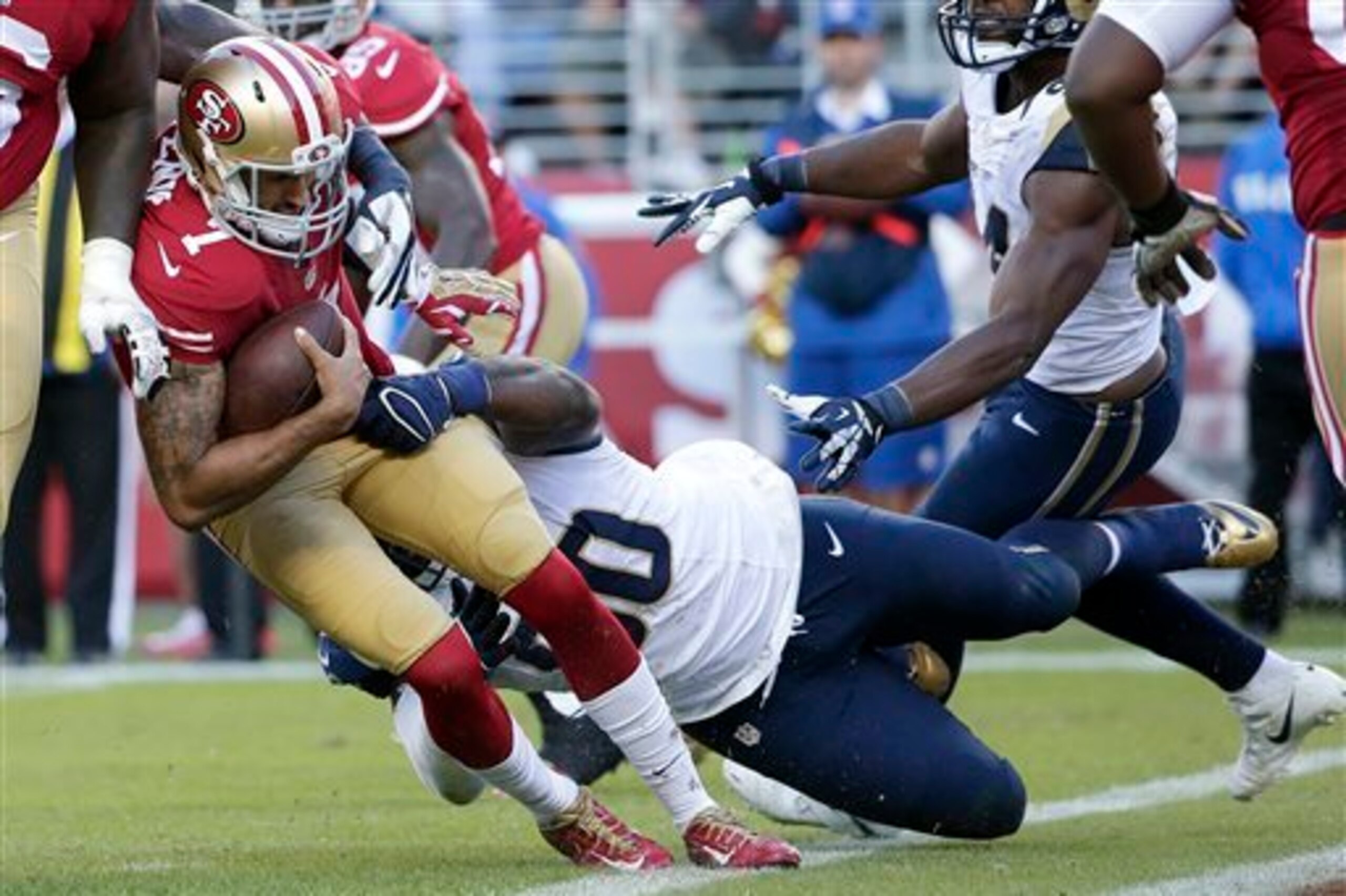
Quarterback Colin Kaepernick is under pressure frequently. In last week's 13-10 loss to the Rams, Kaepernick was sacked a total of eight times—more than doubling the season total St. Louis had prior to the game (six)—and was hit seven times.
Pass-rushing All-Pro Robert Quinn led the Rams with two of these sacks and made 49ers left tackle Joe Staley look bad in the process. Rookie center Marcus Martin also had a forgettable NFL debut as he was responsible for two of St. Louis' sacks on the day.
What exactly is the problem?
San Francisco's O-line was supposed to be a formidable force entering this season. This unit was supposed to be a vital portion of what was to be a vaunted 49ers offense in 2014.
So far, it has been anything but.
Let's take a look at what resides behind the 49ers' pass-protection problems and try to evaluate specifically why this unit has struggled so much over the course of the season. Are there any fixes to this issue?
We'll try to answer that.
Breaking Down the Numbers
The 49ers have given up a total of 27 sacks over eight games thus far. Fourteen of these have come over the last two games on San Francisco's schedule. Those 27 sacks rank as the third-most for any NFL team in 2014.
In contrast, San Francisco's pass-rushers have generated just 13 sacks on the season—a far cry from the ever-growing number opponents are putting up against the 49ers.
Let's take a look at the week-by-week sack totals San Francisco has given up:
| Week 1 | @ Dallas Cowboys | 1 | 9 |
| Week 2 | vs. Chicago Bears | 4 | 16 |
| Week 3 | @ Arizona Cardinals | 1 | 9 |
| Week 4 | vs. Philadelphia Eagles | 4 | 29 |
| Week 5 | vs. Kansas City Chiefs | 3 | 15 |
| Week 6 | @ St. Louis Rams | 0 | 0 |
| Week 7 | @ Denver Broncos | 6 | 53 |
| Week 9 | vs. St. Louis Rams | 8 | 54 |
| Total | 27 | 185 |
This is an inherent problem. But is it something really that new?
Here's a perplexing thought: From 2011 to 2013, the 49ers gave up a total of 124 sacks (11th-highest over that span) despite the fewest passing attempts during that stretch per Eric Branch of SFGate.com.
These numbers force us to rule out that the O-line is simply coughing it up this season. In reality, it has been relatively consistent with what we have seen.
The only difference is that San Francisco is passing much more frequently in 2014 than in years prior. What was once known as a run-first, run-often offense has now relied heavily on the passing game. The 49ers now have 265 passing attempts compared to 231 rushing attempts.

This stands in stark contrast to the 417 and 505 pass/rush attempts from a year ago.
Such stats lead us to a relatively simple conclusion: The 49ers are passing more, therefore, Kaepernick is getting sacked more. This conclusion is reinforced by the notion that perhaps San Francisco's O-line is not quite what we once thought it should be.
But why?
It's hard to fathom this unit struggling so much despite having three former first-round draft picks within its ranks. One would think such problems would befall upon a line far inferior to what the 49ers are rolling out week to week.
Film Study: Breaking Down the Evidence
Let's take a look at some specific examples of the 49ers' woes last Sunday.
As stated earlier, the Rams had a total of eight sacks during the contest and sadly have far too many choices from which to dissect. But we can at least break down those that best reveal exactly what is going wrong.
The first is from Rams linebacker Eugene Sims at the 0:19 mark of the second quarter. Sims' highlight can be viewed in real time by watching the following video:
But let's break the play down a little further.
With one timeout remaining, Kaepernick has a chance to take a shot towards the end zone, or at least stage a play that would move kicker Phil Dawson much closer for a late-half field goal.
We see Sims (red circle on the right) lined up across from guard Mike Iupati. Iupati will be assisted by Martin in blocking Sims. Note the edge pressure that will be brought from the left side of the screen. This will ultimately be the pressure that forces Kaepernick out of the pocket.
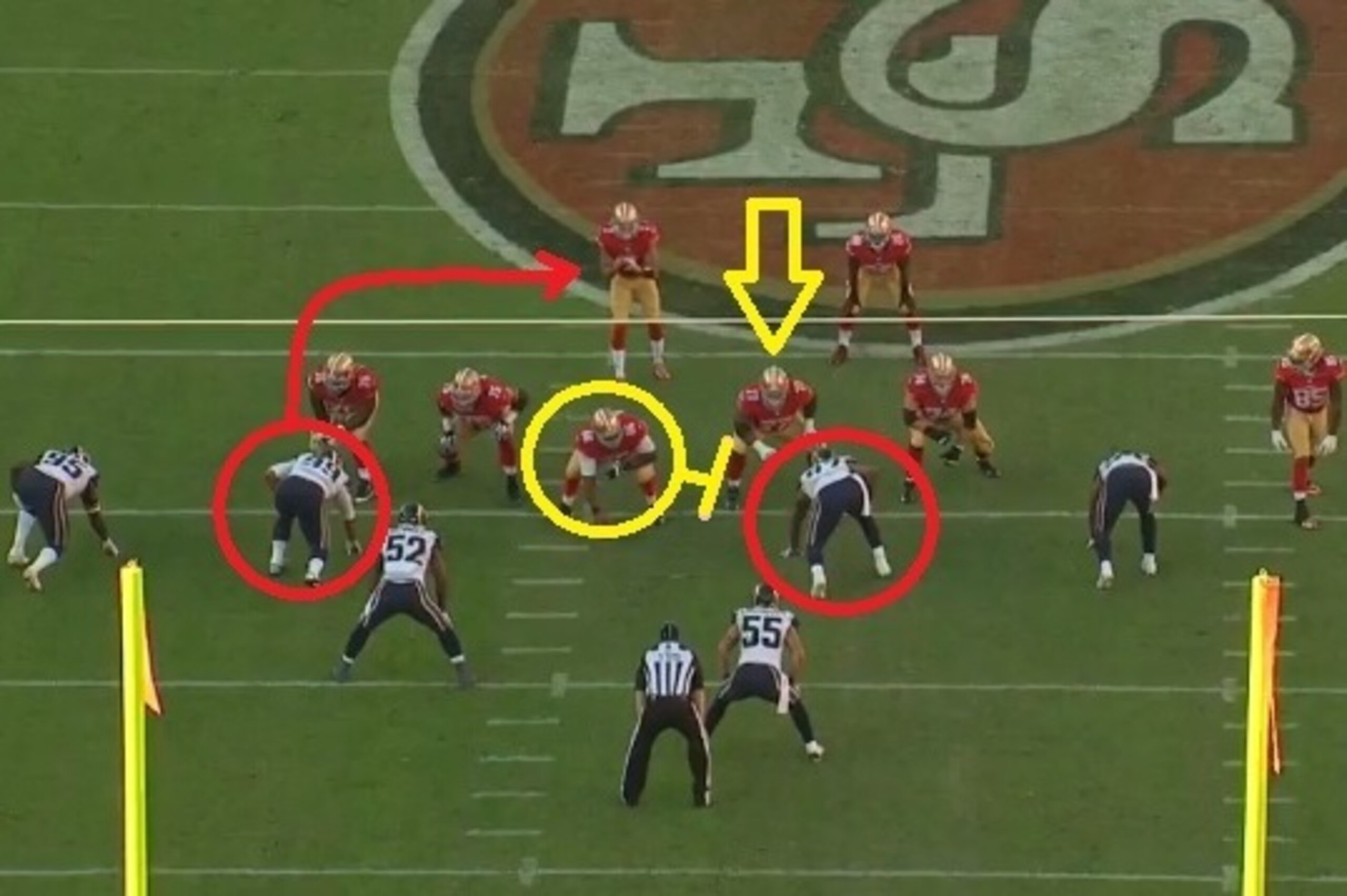
Kaepernick reads through his progressions to his right but also notices the exterior pressure from St. Louis' defensive front. He'll move forward, then cut to his left. You can also notice the combination of Iupati and Martin on Sims.

In this frame, we see Iupati break off coverage, which leaves Martin alone to block out Sims. Kaepernick does have an open lane to his front (white triangle), but chooses to break off to his left. Had he rushed forward, it is feasible that he would have picked up a few yards (Rams defenders were in the area). This would have at least set up a better shot for a Dawson field-goal attempt.

Martin losses his man right at the moment where Kaepernick cuts to his left. Sims brings him down for a three-yard loss. Note the Rams defender who would have closed on a straight-forward QB rush.

There are a few mistakes here.
The first of which is that Martin got beat in a man-on-man blocking scheme, plain and simple. Hindsight would lead us to believe that Iupati should not have abandoned Martin out in the open. Had he continued his block against Sims, who knows what would have happened.
St. Louis' edge pressure on San Francisco's right also forced the situation. What if Anthony Davis had been able to hold his block a little longer?
Lastly, we can place some blame on Kaepernick. He did have a rushing lane directly in front of him, which feasibly could have picked up five or six more yards, making a Dawson field-goal try much easier. Instead, the choice to move to his left was the final cog in this broken play.
San Francisco suffered even more of a disastrous sack earlier in the quarter—a play that resulted in a fumble, which was subsequently recovered by the Rams.
Here we see Quinn (in red at the right side of the frame) lined up just outside of Joe Staley (circled in yellow). Quinn will use outside technique to get around Staley. Note right guard Alex Boone and how he will receive pressure from St. Louis' pass rush.

Quinn starts to get around Staley, but the rest of the O-line continues to hold their blocks.
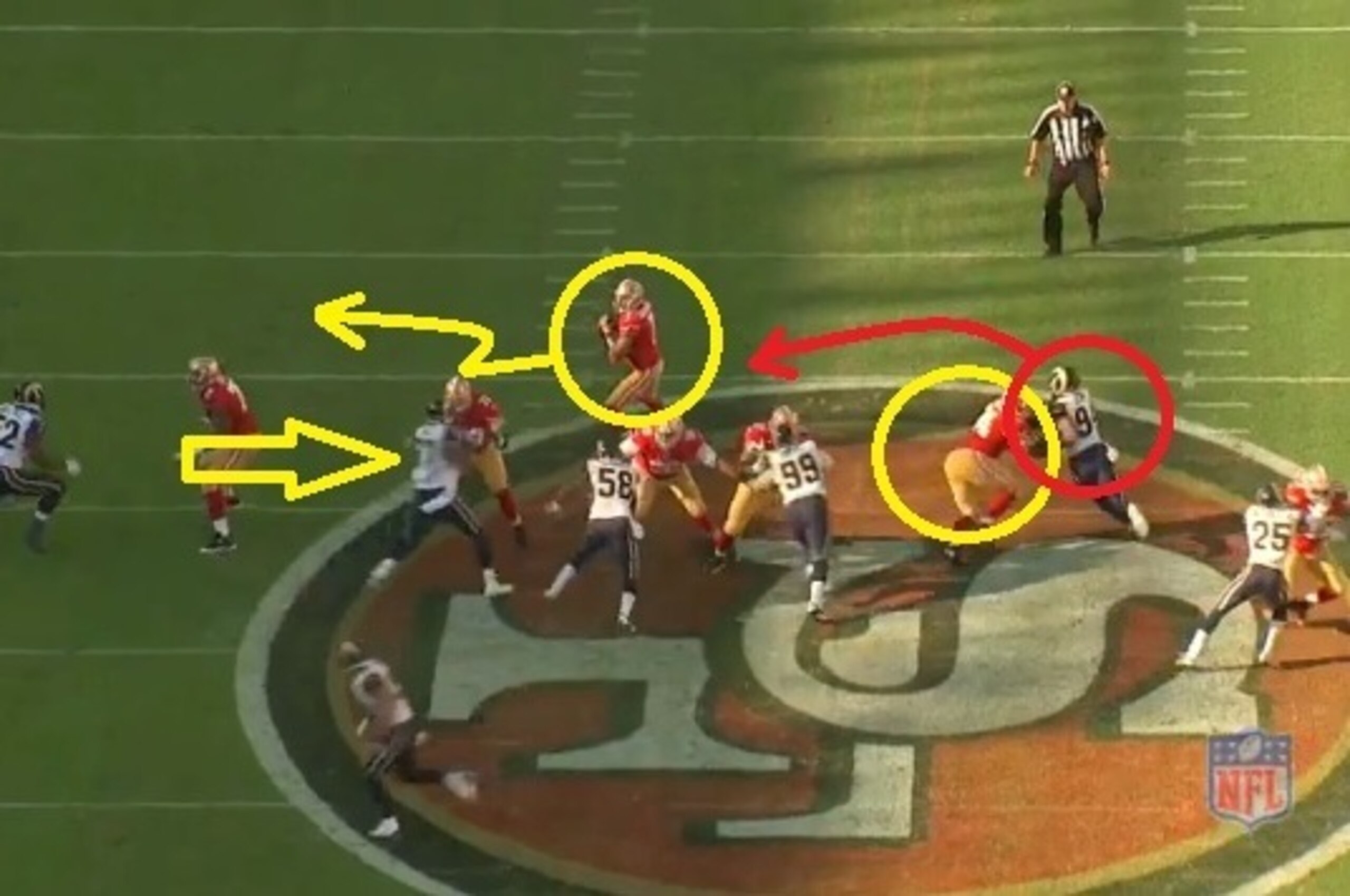
At this point Staley loses Quinn, who is free to attack Kaepernick's blind side. Kaepernick attempts to evade the pressure, but is run into by Boone. This slows down Kaepernick and allows Quinn to converge.

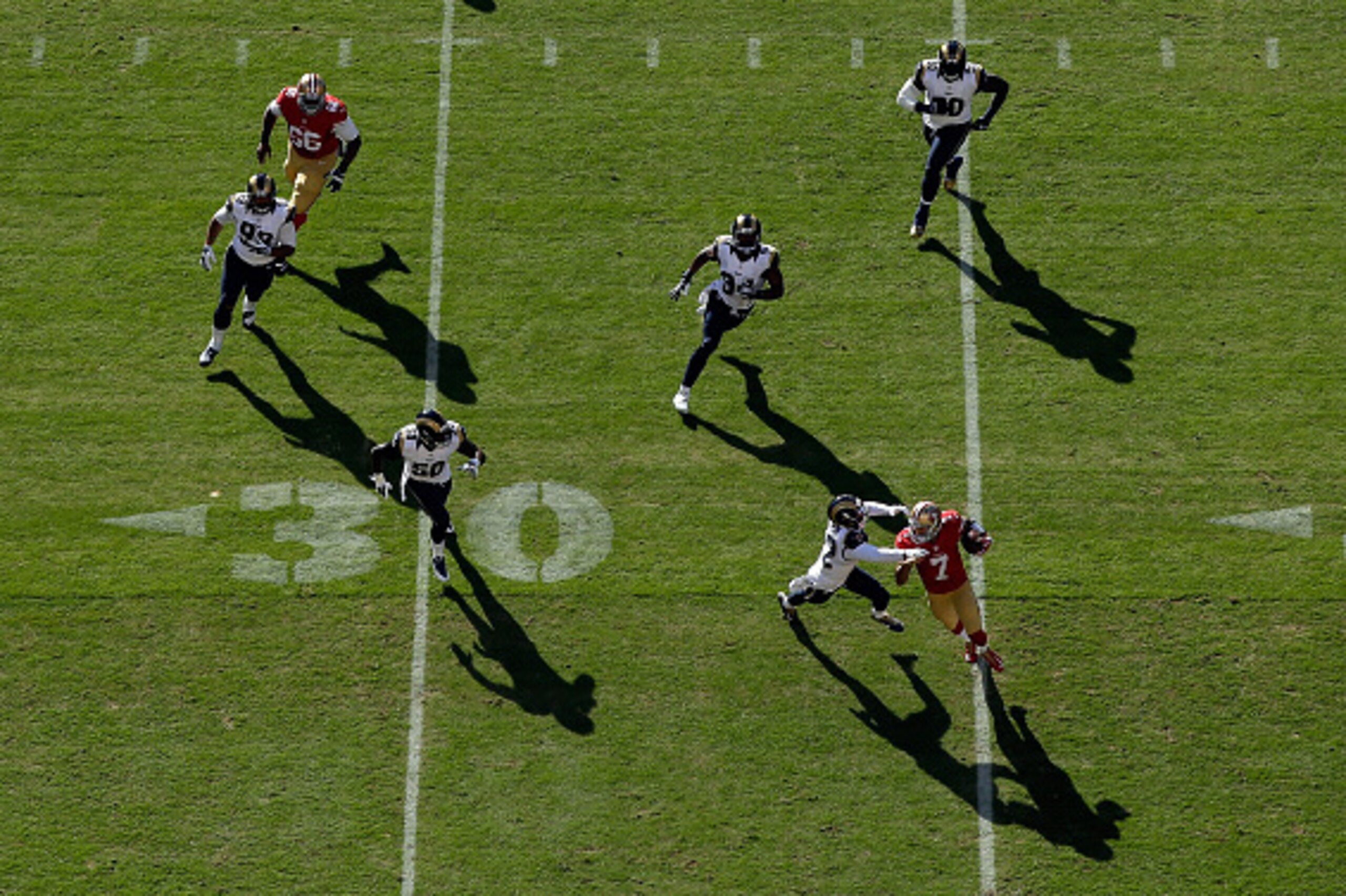
Here is a look from the top. We can see how Boone knocking into Kaepernick gave Quinn enough time to close the gap, forcing a fumble in the process.

The sack went for a 10-yard loss, and the subsequent fumble ended up being recovered by Sims. On the next drive, Rams quarterback Austin Davis was able to find wide receiver Kenny Britt for a 21-yard touchdown reception.
Points off turnovers are killers.
So what went wrong here?
First, Staley got burned. It was one thing to call out Martin, a rookie, who was making his NFL debut. But for Staley to look as bad on this play reveals a significant problem.
"This season, Joe Staley has given up 21 pressures, including 4 sacks. In 19 games last year, he gave up 26 pressures, 4 of which were sacks.
— #49ers Stats (@49ers_Stats) November 4, 2014"
On top of that, Kaepernick running into Boone didn't help much either. We can't totally blame Boone here given pass protection almost always gets pushed backwards as the play develops. But this gaffe did slow down any attempt for Kaepernick to evade pressure.
Lastly, we can fault Kaepernick for not being able to evade the pressure and/or break free long enough to throw a pass out of bounds. The last frame does reveal an open 49ers receiver at the bottom of the screen, so we can add that to the multitude of mistakes.

Identity Crisis?
Perhaps the biggest issue facing this 49ers squad is an apparent lack of identity on offense. Exactly who are they? Is this still a run-first team that relies on its ground game to power over defenses over a 60-minute period?
Or, given the run/pass-play ratio, is San Francisco trying to do something vastly different this season?
Branch elaborates on this further:
"This, of course, gets back to what has been the most popular question surrounding the 49ers this season: What is their offensive identity?
With Kaepernick in his second full season as a starter, they clearly want to lean more heavily on him. And that makes sense given Kaepernick’s skills and supporting cast, which includes the best collection of pass catchers he has had since becoming the starter midway through the 2012 season.
A problem with the shift in philosophy is that the players up front are at their best when playing bully ball. The offensive line is adept at carrying out the team’s complex run schemes, but less accomplished at protecting Kaepernick.
"
This theory gets back to what we argued earlier. San Francisco's O-line is much more capable of run blocking than it is in pass protection. Given the numbers stated previously, we can see that pass protection has not exactly been one of this unit's strengths.
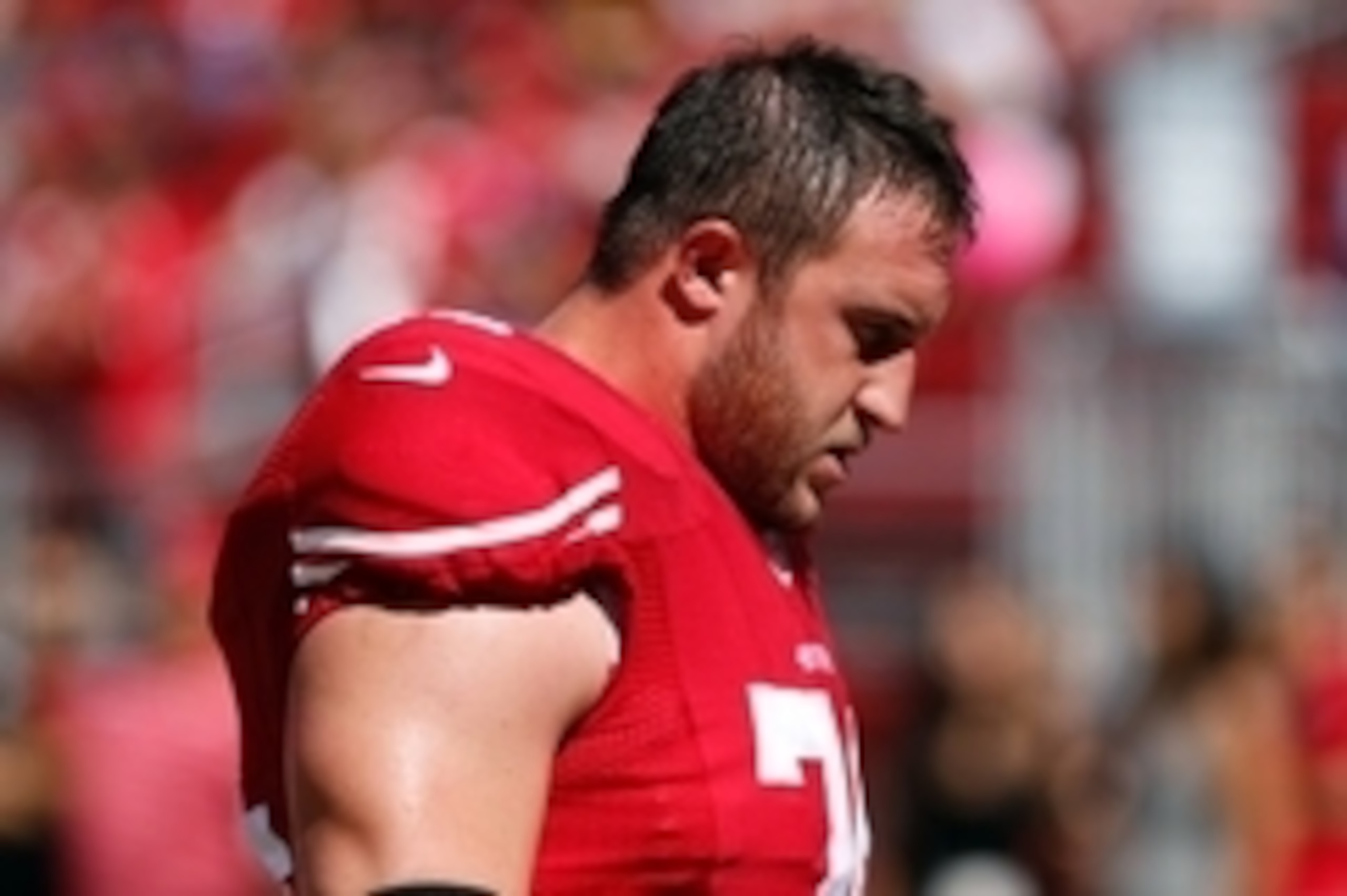
Still, it is hard to fathom just why the O-line's struggles have continued considering the talent contained therein.
ESPN NFL analyst, and former 49ers QB, Trent Dilfer offered up his thoughts on the guys up front when he appeared on 95.7 The Game (h/t Branch):
"I don’t know what the disconnect is, but they’re not getting the most from those players. Part of that burden is on them, part of that burden is on the coaching staff and part of it probably falls into trying to do too much offensively.
"
Even Staley was critical of the team's efforts.
“We’ve got all the talent in the world,” left tackle Joe Staley said via Branch. “We were doing some dumb stuff and they took advantage of it."
Staley used an expletive to describe the Rams' blitzing efforts, suggesting the primary reason behind the multitude of sacks was due to St. Louis bringing extra pressure.
If one were to take a look at the game via NFL Game Rewind (subscription required), one would see that only two—perhaps three—of the Rams' eight sacks were due to blitz packages.
With this in mind, we are led to believe one of three conclusions:
- An offensive shift in philosophy, thanks to the play-calling efforts of Greg Roman, plays opposite to the strengths of the incumbent members of the O-line.
- The lack of identity and problematic schemes are preventing this unit from jelling in such a way that benefits the offense.
- The O-line simply is not living up the expectations being placed upon this unit. In a nutshell, the guys up front are basically getting over-muscled and outworked.

Perhaps all three are true to varying extents.
What is known is this: San Francisco's O-line has suffered from a lack of continuity this season—a far cry from nearly the same group of players who started each game together in 2012. Davis has missed time, as has Iupati. Boone's holdout could have had some negating effects.
Daniel Kilgore is lost for the year with a leg injury, meaning Martin will likely continue to get the nod as San Francisco's No. 1 center.
Barring injury, this will be the line the 49ers utilize over the remainder of the season. First-half results have not been pretty. Regardless of what the problem is (identity, scheme, etc.), this unit must figure out a way to generate the type of effectiveness necessary for San Francisco to bounce back.
Perhaps this means a return to run-heavy approaches on offense that, in turn, set up play action and the various other passing schemes the 49ers have used thanks to having set up the running game.
Whatever the fixes may be, San Francisco will not be a playoff team if the O-line's struggles continue. Blame the coaches, blame the schemes or blame the players all you want. The actual results are presented on the field.
Such results have been anything but pretty.
All statistics, records and accolades courtesy of Pro-Football-Reference.com and ESPN.com unless otherwise indicated.
Peter Panacy is a featured columnist for Bleacher Report, covering the San Francisco 49ers. Be sure to check out his entire archive for 49ers news, insight and analysis.
Follow him @PeterPanacy on Twitter.