Rummenigge Should Face Reality: Bayern Munich Will Never Be the 'Good Guys'
Bayern Munich came back from a goal behind to beat Borussia Dortmund on Saturday, winning a highly entertaining fixture 2-1.
The result of the match also billed as "Der Klassiker" left the Bavarian giants four points clear in first place in the Bundesliga table and saw BVB slip into the relegation zone, already 17 points behind their so-called rivals.
The media build-up to Saturday's match was not that which would be expected from a clash of the titans and focused on a mismatch. Bayern chairman Karl-Heinz Rummenigge spent most of the week prior to the game making excuses for his club's recent transfer activities and justifying his proclaimed interest in Dortmund's Marco Reus, almost apologizing for the gap in power between his club and the fallen Ruhr side.
TOP NEWS

Alex Morgan Announces Birth of 3rd Child 👶

Final Men's Ballon d'Or Rankings 📊
Most to Blame at Man Utd? 😡
Before the game, Rummenigge wrote in Bayern's club magazine, via Reuters, that the then 15th-placed Dortmund are still heavyweights. On the topic of Reus, he recently asserted to Sport1 (h/t Goal.com) that Bayern are "obliged" to pursue any Germany international of the Dortmund man's caliber and wrote in Bayern's matchday program, per the Daily Star, that his club's policy is not to weaken rivals but instead to strengthen itself.
Speaking to SID (h/t Goal.com), he also added that any gripe from Dortmund over Bayern's possible pursuit of Reus would be hypocritical, given that the Ruhr side activated a buy-out clause in order to sign the Germany international from Monchengladbach in 2012.
When faced with a slew of questions over his club's intentions, Rummenigge always had an answer. But an objective look at recent events betrays a reality he'd be wise to embrace.
The questions Rummenigge faced and the answers he gave were not the type that should be associated with what was billed to be the marquee match of the Bundesliga campaign. None of the pre-match rhetoric was about the implications of the game on the course of the season; instead, it was only about Bayern trying to prop up their relegation-battling, so-called rivals as a force to be reckoned with while simultaneously justifying their pursuit of the same club's best player. This bears no commonality with Spain's Clasico, and to make that comparison by labeling Bayern vs. Dortmund a "Klassiker" is, frankly, quite farcical.
What Rummenigge needs to accept is that Bayern Munich will never be the Bundesliga's "good guys"—and that's ok.
For Rummenigge to deny that Bayern tried to hurt Dortmund with their signing of Mario Gotze and Robert Lewandowski over the last two summers is for him to deny his own rational instincts as a businessman. Any company that feels threatened by another has every right to do whatever possible to quash the competition. And just about any company that has overcome adversity has been ruthless in handling its opposition.
As recently as the summer of 2012, some were asking questions of whether Bayern would face long-term competition from Dortmund for their traditional status as Germany's strongest football club. BVB had come from nearly nowhere, their success stemming from sources that have become increasingly unlikely in the modern game: a charismatic coach, talented and impressionable young players spurred on by passionate fans and an infectious ethos of "echte liebe" (true love).
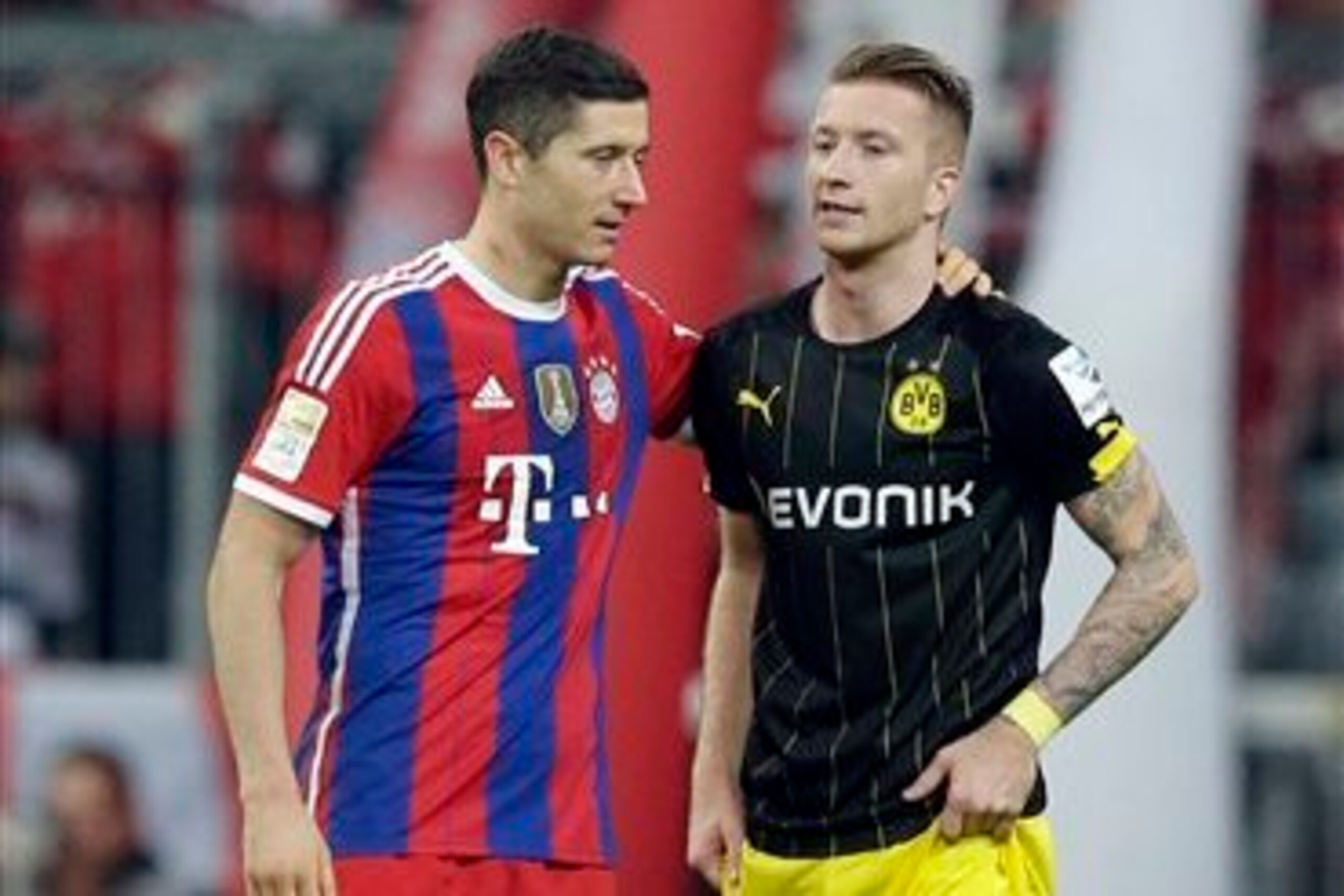
For the nature and meteoric rate of their rise, Dortmund were extremely dangerous. They were achieving success in a different way from Bayern. And on a different playing field that they did not control, the Bavarians were rightly concerned.
Ethos meant everything to Dortmund and, for a time, some believed in romanticism. Rather than being picked apart as Atletico Madrid were this summer, BVB managed to prevent a player exodus by convincing their stars to commit to long-term contracts. And despite a trickle of star players out the door, they managed to remain a top-two Bundesliga team for four seasons.
In the interest of restoring their dominance, Bayern had to act. So a year after Gotze turned down a transfer in order to pen a contract extension at BVB, he signed a deal with Bayern worth (per German source SportBild) a joint-club-high €12 million per season.
The move was, perhaps not by coincidence, leaked on the eve of Dortmund's semifinal with Real Madrid in the Champions League, a tournament in which Bayern had traditionally held the Bundesliga banner high but that season faced serious domestic competition for the headlines.
Bild later revealed that, despite already having Ballon d'Or candidate Franck Ribery as their primary creator of play in the attacking third, Bayern had issued an ultimatum to Gotze, claiming they would sign the more direct Neymar or Draxler if he turned them down. The now or never stipulation of their offer, per The Sun, was later confirmed by Jurgen Klopp.
It took tremendous financial investment and every bit of negotiating leverage they could muster, but in signing Gotze, Bayern inflicted the fatal blow upon echte liebe and restored the status quo. Since then, when it was also all but confirmed that Lewandowski would follow within a year, the miracle of winning the Bundesliga in 2011, the double in 2012, scoring twice in the closing moments of a Champions League knockout round and reaching the final of Europe's elite club tournament have become inimitable. Echte liebe, the philosophical centerpiece of Klopp's Dortmund, is dead.
Rummenigge later admitted, per Yahoo, that Neymar was actually Pep Guardiola's preferred choice, but in a unique decision, the Bayern board had vetoed the coach's foremost request.
Germany's youngest international player since Uwe Seeler and one of the greatest talents the country ever produced, according to Bayern sporting director Matthias Sammer, via The Telegraph, Dortmund academy graduate Gotze was a player Bayern could not stand to have at another club. Even if that meant not bringing in a more needed type of player like Neymar, who—like Guardiola—would have brought more name recognition and increased Bayern's appeal overseas.
Gotze was the kind of player who Germany coach Joachim Low might send onto the pitch in the World Cup final with the orders "show the world you're better than [Lionel] Messi." Sure enough, per The Guardian, Low did just that and Gotze did not let him down. Imagine the implications on the balance of power in the Bundesliga and within Germany's national team if the Dortmund academy graduate had done the same while still playing at the club where he learned his trade and developed into a big star.
Lewandowski followed a year after Gotze, with Bayern discarding a hero in Mario Mandzukic to sign the BVB man during a summer in which a host of other highly qualified strikers also changed clubs. A free transfer, the price was right for Bayern. But it's nonsensical to accept Rummenigge's words at face value, that Bayern didn't even consider it a benefit that they would maintain their hegemony atop the Bundesliga if they were to weaken their rivals.
It's foolish to believe the Bayern board would not feel satisfaction that the best striker in the Bundesliga could no longer score goals against them.
The truth is, the Bundesliga has for a very long time been Bayern's to win when they want. They weren't always the favorites and didn't even participate in the league's first season, but in the last few years especially, the Bavarians have solidified their status as the supreme power of the German top flight.
With 68 percent more revenue than Dortmund, 2.2 times Schalke's income and and at least 3.2 times the turnover of any other German club, per Deloitte, Bayern's spending power for wages and transfer fees simply trumps all.
Few German clubs can offer just one player even half the wages that Bayern pay the likes of Gotze and Franck Ribery, and none can offer the name and international clout of the Bavarians. The other 17 clubs serve merely as farm teams to develop the rich club's next generation. Bayern don't have to look abroad because domestic talent is affordable and of the highest quality.
In spite of his best attempts to paint a picture of competition, Rummenigge has again and again suggested that the Bundesliga is indeed structured as a feudalistic system. A year ago, per Goal.com, he went so far as to say that Gotze was only "loaned" to Dortmund, as though his transfer to Bayern was inevitable. He also spilled the beans to Bild (h/t International Business Times) on Reus' €25 million buy-out clause in August, despite it being taboo to discuss contract details of players from other clubs. Then again, by his perspective, Reus may only be "on loan" at Dortmund anyway.

Speaking to Oliver Kay of The Times, Rummenigge recently took credit for the success of Bundesliga teams in international tournaments as he tried to justify the gap between his side and the rest, claiming "[Bayern's] strength reinforces the whole league." Yet Bayern don't pay any more than they have to for transfers; their academy doesn't produce stars for Leverkusen or Wolfsburg. It's hard to take his words seriously when his club doesn't offer much to the rest of the league but instead reinforces itself with players signed from the league's more ordinary teams.
Perhaps the most wild of Rummenigge's assertions is his claim that it is Bayern's "obligation" to pursue a player like Reus, as though it were some kind of patriotic duty. It's a common argument that stars of lesser Bundesliga teams are desperate to leave for bigger sides, so they might as well move to Bayern so that the league can retain its star players. That claim is both faulty—Klopp, per Goal.com, revealed that Gotze's primary reason for moving to Bayern and not elsewhere was Pep Guardiola having joined the club—and nonsensical.
If Bayern are worried about international perception of German football, bringing in foreign stars, such as Guardiola, is the tried-and-true way of improving the way the league is seen abroad (see England). In fact, Bayern's continued poaching of players from what cannot be accurately described as domestic rivals is now perhaps the biggest factor in turning neutral fans away from the Bundesliga.
It's not that Bayern cheated their way to riches or took any shortcuts like Manchester City or Chelsea. Their supporters can be proud to back a club that has enjoyed a relatively organic rise to prominence. But the situation in the Bundesliga, in which one team dominates the whole league by such a margin in financial and sporting terms, is unique among top European leagues. It's not a healthy situation—even for Bayern; in the absence of any domestic competition, the team can end up suffering on the international stage.
For example, complacency after they ripped the greatest Leverkusen squad to shreds in the early 2000s soon led the Munich giants to relative anonymity in Europe that would last for half a decade. Even during that time, Bayern remained a dominant force in the Bundesliga and only ever failed to win when they let themselves go.
In fairness to Bayern, they are stuck between a rock and a hard place in the Bundesliga. They aren't responsible for creating competition and have every right—and even the duty to their fans and sponsors—to quash any challengers as soon as they emerge. They aren't responsible for the myth of the Klassiker. It's for that reason, though, that it's rather silly for Rummenigge to try to call both sides of the coin. Bayern can't play a twisted game of whack-a-mole with the Bundesliga while also painting themselves as the "good guys," and frankly, they don't have to justify themselves as "good."
Fans don't support Bayern because they do the right thing but because they're good at football. Sponsors back them because they win. And they haven't been indicted for breaking the rules, so Rummenigge really doesn't have to try to prove anything.
Similarly, the serf clubs below Bayern can't be expected to stand by and smile as their best players are allowed to develop to a point before being systematically harvested. They have every right to be angry and lament the hegemony of the Bundesliga, and it would be wise for Rummenigge to leave them to that.
On the topic of Reus, the excuses and borderline apologies are unnecessary and patronizing. Rummenigge should just come clean and call a spade a spade: Bayern want Reus because he's a world-class player, they can't stand to let that caliber of player represent another Bundesliga club and because signing him would further destroy the ethos upon which Dortmund built their temporary success, enforcing a culture in which the money that Bayern has in abundance can trump any differences in personal affinity for one club or another. And like it or not, that's nothing for which they can be faulted.