Why Are Europe's Biggest Clubs Stockpiling Top-Quality Goalkeepers?
Those who can’t do, teach; those who can’t teach, teach gym. And those who can’t play football are goalkeepers.
Anyone who has ever played a five-a-side football game knows how the position of goalkeeper is sorted out. That one player who can’t run so well or take a good first touch gets stuck in nets. And for generations, the same was assumed of the professional game.
The position has long been the domain of the loner, the eccentric and the outsider. Perhaps it is the time for contemplation and reflection in an otherwise frantic sport that draws such compelling—and often intellectual—characters to goalkeeping.
TOP NEWS
Live World Football Moments 🍿

Final Men's Ballon d'Or Rankings 📊
.jpg?w=2560 "NFL Paris Football")
NFL House in Paris Closes for Protests

Albert Camus, the Nobel Prize-winning novelist, played goalkeeper for Algeria in the 1930s. Even Pope John Paul II had been known to pull on a pair of gloves from time to time.
Yet despite this outside interest in the position, those in the sport always jettisoned goalkeeping as a priority. For all the tactical flexibility soccer coaches have to play with in the outfield, their influence on the goalkeeping of their team was very much incremental. One team, one goalkeeper.
In that sense, goalkeepers are like Formula One drivers in that only a handful of active places are on offer at the top level. Yes, you could join Ferrari but prepare to only see the light of day in practice. At least second-choice soccer goalkeepers get the luxury of Carling Cup and pre-season friendly games. Oh how F1 drivers must crave an equivalent.
So with this in mind, why are Europe’s top clubs stockpiling goalkeepers? Bayern Munich signed Pepe Reina to support Manuel Neuer in their squad over the summer. Chelsea have Petr Cech and Thibaut Courtois, while Manuel Pellegrini bought Willy Caballero to compete with Joe Hart for the No. 1 jersey at Manchester City.
Real Madrid played last season alternating between two exceptional goalkeepers in Iker Casillas and Diego Lopez. And while Lopez may have been shipped out, they only went and bought Keylor Navas, arguably the best shot-stopper at the World Cup this summer and were even rumoured to be on the trail of Cech, as reported by Matt Barlow of the Daily Mail. Europe’s top clubs are hoarding 'keepers.

How do these clubs plan on satisfying so many world-class goalkeepers when only one can play at any given time? To answer that question, we must consider what the role of the goalkeeper is in the modern game.
In the age of ProZone analysis, heat maps and passing statistics, goalkeepers were always somewhat overlooked. The position was the final frontier for soccer’s Moneyballers.
However, this is changing. The goalkeeper is still in essence a different kind of football player who requires a different kind of skill set, but there has never been a greater willingness to understand their true worth to the team.
Goalkeepers were once players of a different sport. Their teammates played with their feet, yet those in gloves played—almost exclusively—with their hands. No longer.
The evolution of the goalkeeper as we now know them can be traced back to the introduction of the back-pass rule in the 1990s. It forced goalkeepers into playing with their feet. It forced them to become football players.
“Everything has changed really apart from you’ve still got to stop the ball going in the net,” explained English goalkeeping legend Ray Clemence, as per the FA, who is now in charge of the FA’s goalkeeping division.
“In the modern game the goalkeeper has the ball more at their feet than they do in their hands. A lot of time has to be spent on the training ground ensuring goalkeepers are comfortable with the ball at their feet.”
Why was Manuel Neuer so effective as Germany’s No. 1 at the World Cup in Brazil? Because he was as much of their passing rhythm as any of their outfield players. It could even be argued that without Neuer starting moves from his poised position on the edge of his own box, there would have been no rhythm at all.
Is this recent trend, in which top European clubs are stocking up on goalkeepers, illustrative of how the role of football’s gloved man has changed over the past decade or so?
Perhaps Europe’s best coaches are seeing goalkeepers for their individual assets, much like they do with outfield players. Would the best all-rounder necessarily be the best option in the centre of midfield or on the wing? No. It depends on the game and the opponent.
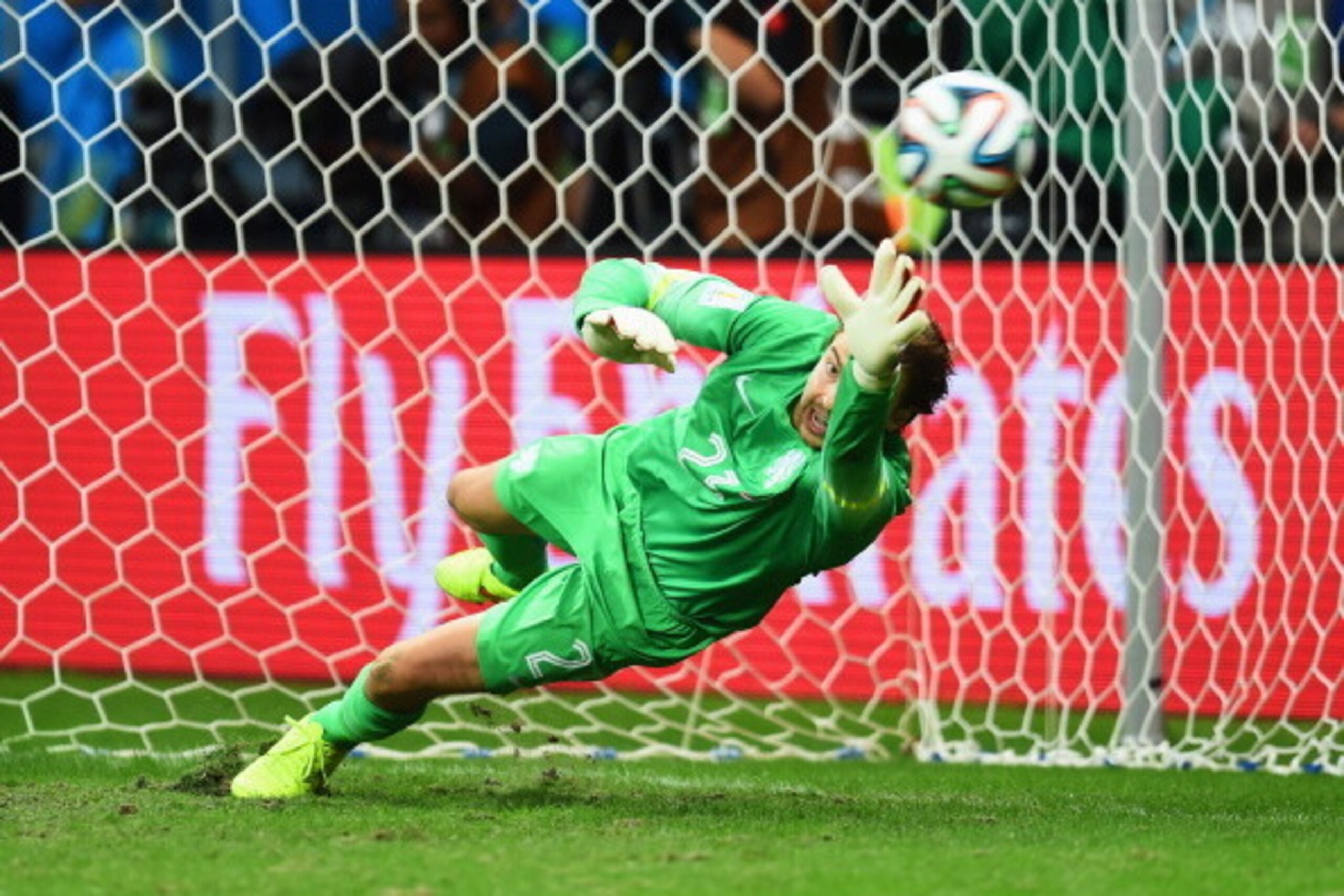
Look at the way Netherlands boss Louis Van Gaal handled his top two 'keepers, Jasper Cillessen and Tim Krul, at the World Cup. Van Gaal’s 3-5-2 formation put added emphasis on the ball-playing capacity of the goalkeeper, and so Cillessen started every game.
But when the Oranje found themselves in a penalty shootout, he called on the superior shot-stopper, Krul. Is there a chance that we will get to a stage whereby a goalkeeper’s comfortability on the ball is regarded as a greater quality than their skill at keeping the ball out of the net? It’s not such a far-fetched prediction.

The goalkeeper is the player a manager has least control over. For instance, when David Moyes was fired by Manchester United, his goalkeeping coach, Chris Woods, remained at the club. Because, after all, Moyes had little to do with the good form of David de Gea.
Managers were once employed on the basis of their innate understanding of the game, the belief being that they could see things the rest of us couldn’t. But now, organizations like Opta and ProZone chart every pass, shot, yard covered and even save.
Such data can tell you that, statistically, Sunderland’s Vito Mannone was the best 'keeper in the Premier League last season, with a saves-per-game average of 4.52, according to FourFourTwo.com. You’d also find out that Mannone’s average increased to 5.13 per match on the road, a desirable trait in any No. 1.
Managers are no longer the only ones who can explain the inner workings of the game, and in no position is that accentuated as much as it is in goals.
Football was originally a sport played without a goalkeeper. All 11 players could handle the ball anywhere on the field. It was then decided that only one player could use their hands and only within their own box.
Goalkeepers tended to spend the entire game on their line, almost never venturing outside the six-yard box. They had no part in the game. It may have taken more than 100 years, but finally the goalkeeper is being reintegrated back into football.
The knock-on effect is that one top-tier 'keeper is no longer enough for Europe’s best teams.

.jpg?w=2560 "Seahawks Chiefs Football")