

Film Focus: Previewing Germany vs. Armenia
On Friday, the German national team will take on Armenia in Mainz's Coface Arena as they run through their final test ahead of the FIFA World Cup in Brazil.
Coach Joachim Loew will have plenty to run over throughout the course of the 90 minutes, following a number of injuries to his first-team squad and a rather dismissive 2-2 draw with Cameroon last Sunday. It's here that we pick up where Germany left off and begin deciphering the problems that continue to puzzle coach and fans alike.
The Bundestrainer is likely to continue pushing his new striker-less system, which involves playing Mario Gotze up front on his own while Mesut Ozil plays off him like a second striker. Yet so far this has caused more trouble than it would apparently be worth.

The concept of playing Gotze as the lone striker seemed to work wonders for Germany in the first few minutes of the game, as their natural exuberance and momentum drove them on and almost forced the side to play the ball through the Bayern player and Ozil.
In this opening chance for the Arsenal playmaker, as he's played through by a clumsy pass from Jerome Boateng, we can see just how effective this new German front line can be when used properly.
The figures circled in blue are the two wide players—Marco Reus and Thomas Mueller— while the two central strikers are Ozil and Gotze. Both are indistinguishable from each other and playing off the last Cameroonian defender.
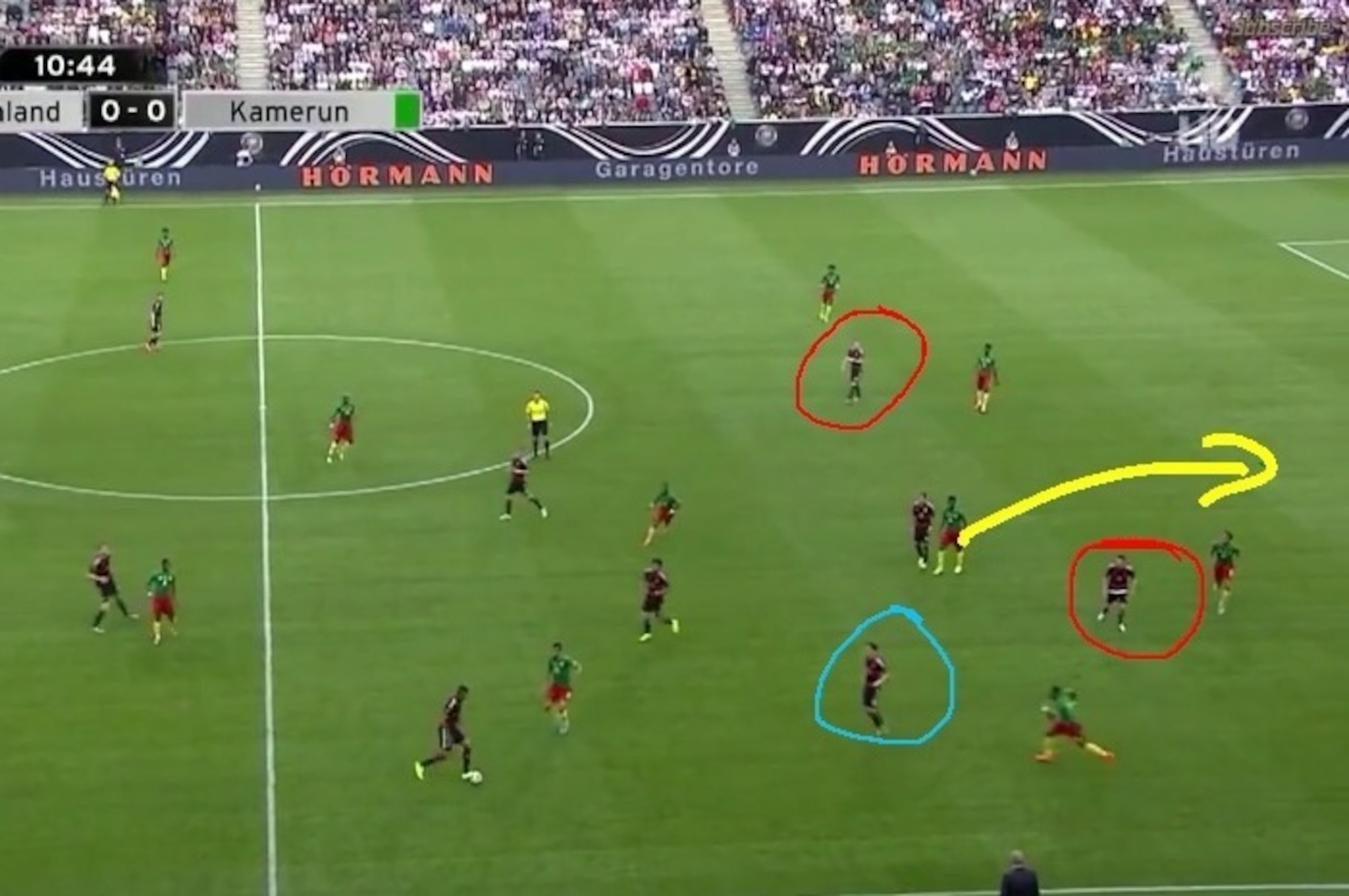
The second-most effective use of this system came not soon after in the 11th minute, when Boateng played a pass through to Mueller, who then managed to flick the ball on to Gotze. As we can see from the shot of the play above, the most important aspect of this move's initiation was the positioning of the four attacking players across the pitch.
Again, Mueller and Reus—who we can see on either wing in the red circles— are pushed way up the park, beyond Ozil or Gotze, who are represented by the blue circle and the yellow arrow respectively.
This play worked and almost lead to a goal because Germany were not only very fluid in rotating the ball but most importantly were direct in how they attacked their opponents. Cameroon were never given a chance to stick men behind the ball, so Gotze was able to pull away from his marker and run into space behind the defensive line.
Yet even in this move and the one we've referenced before, the German front line were all facing the ball with their back to goal, something that makes spontaneous runs and effective through balls much harder to produce.
What we saw throughout this testing affair for Germany was a constant struggle for Loew's side to handle the concept of directly attacking their opponents' box. Ozil and Gotze generally offered very little in that respect, and it was only once Mueller pushed up front that we finally saw some results for Die Mannschaft.
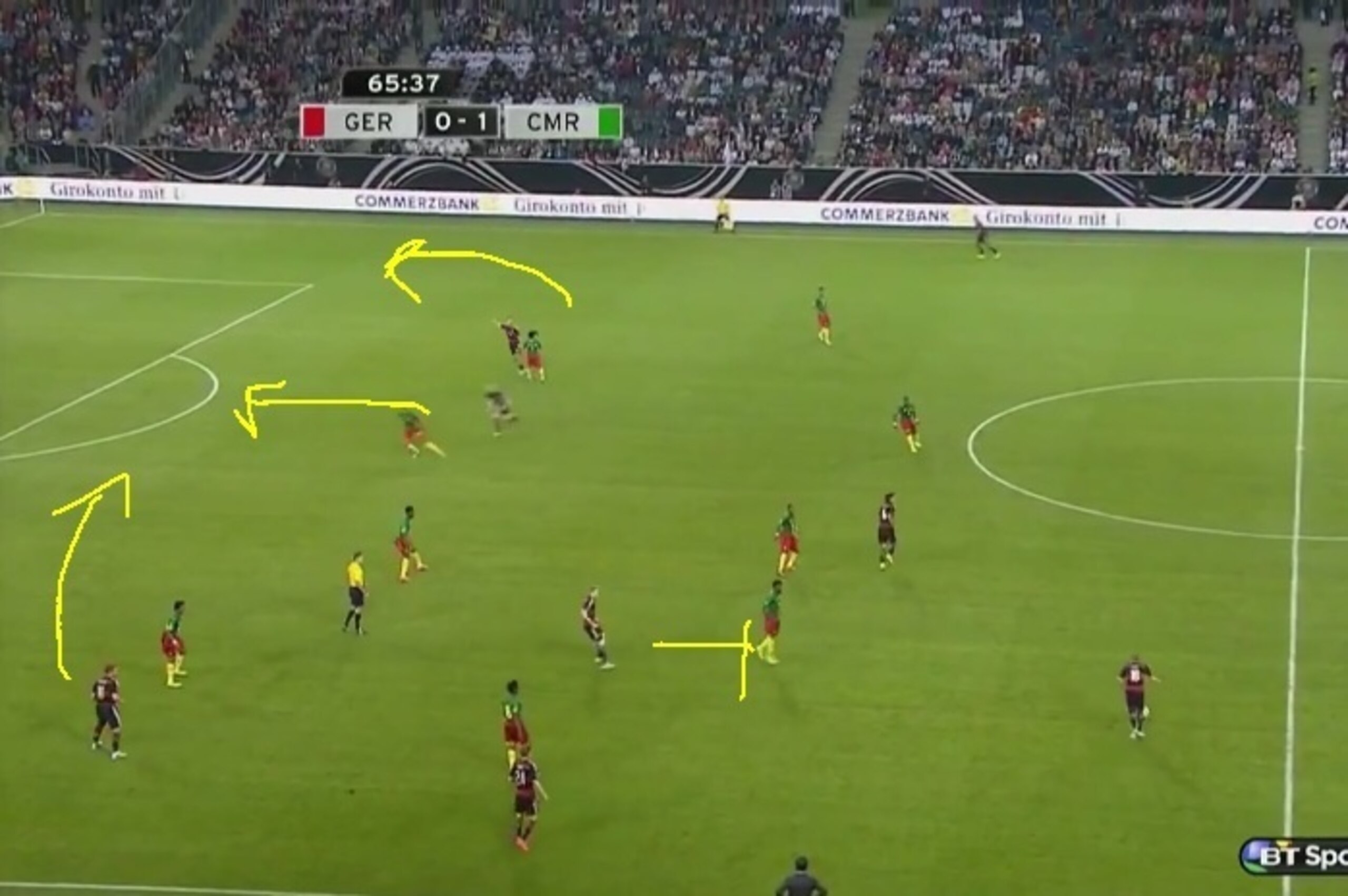
We take our next play from the 66th minute of the game with Cameroon a goal ahead, one which shows the moments leading up to Germany's opening goal of the night.
What's most noteworthy in this image is the change in shape compared to what Germany's front line looked like in the first half with Ozil and Gotze up front. By this point in the match Loew had brought Andre Schurrle and Lukas Podolski on for the previous pair to sit on either wing, while Reus and Mueller both moved into the centre of the pitch.
As Toni Kroos prepares to strike the ball at the bottom right-hand corner of the image, note how Mueller, Reus and Podolski are all offering space for the Bayern central midfielder to pass into, with only Schurrle pulling back to offer the short, safer pass.
It's this direct passing—almost akin to a Hail Mary pass in American Football—that Germany clearly benefit from when they have quick, powerful players like Reus and Mueller who can pester any defence in the world.
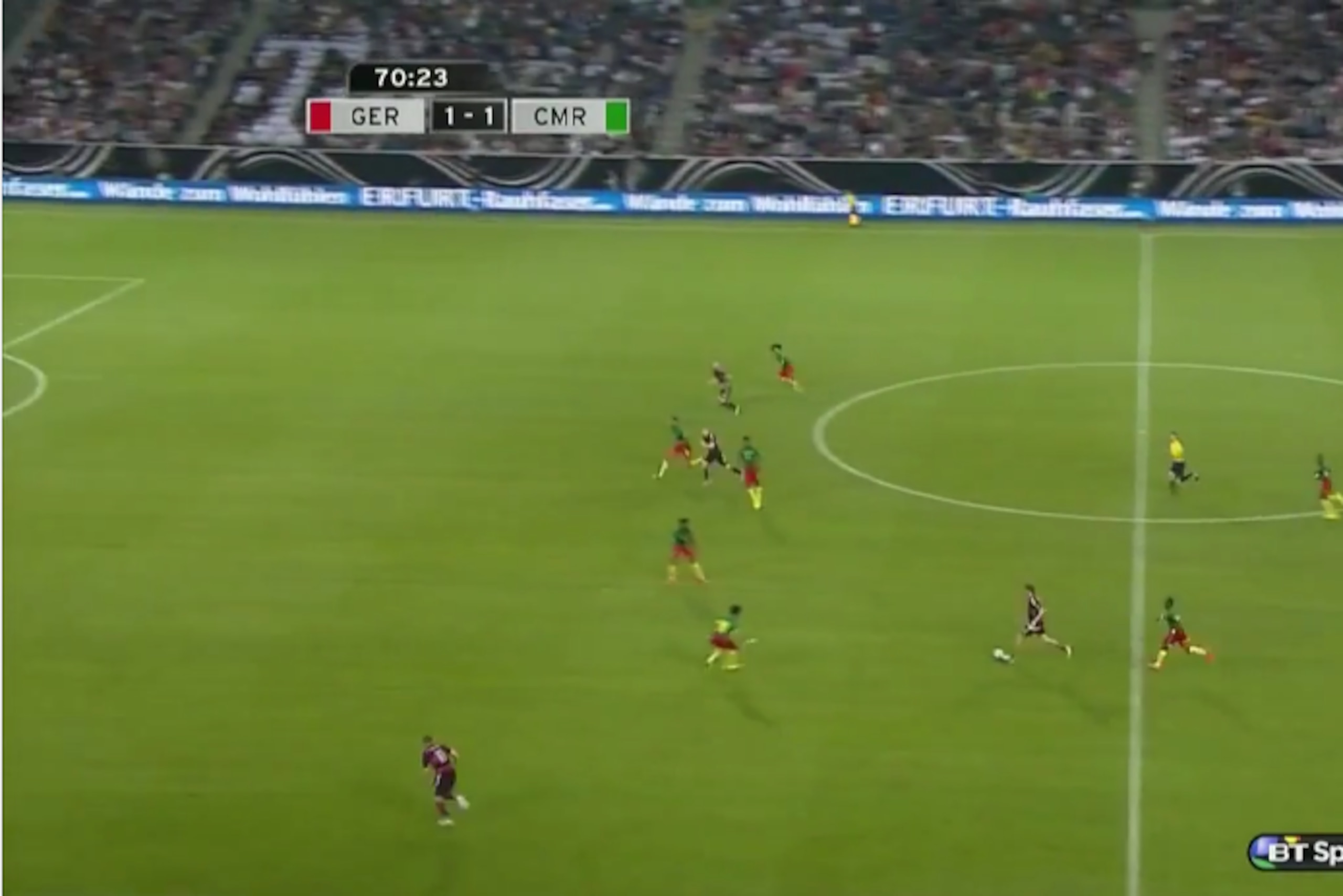
When we take a look at Germany's equaliser from Schurrle just four minutes later we see a similarly direct method proving incredibly effective.
For the sake of balance, it is worth noting that Cameroon had just attacked, and in the image above we see Germany counter-attacking. Yet even from such a spontaneous play we can clearly see how much easier it is for Loew's side to find space and bodies behind the opposition's defence.
Where the German attack spent the first half with their backs to goal and passing the ball around, we now see all three forwards running at goal with pace and intent whilst trusting their midfield to make the difficult passes over the top of the Cameroonian back line.
As Loew goes into his final game on Friday, it will be worth noting just how chooses to play his attacking line. Whether he opts to persevere with Gotze and Ozil, bring in Miroslav Klose or indeed revert back to the system that scored him two goals in the last match, it's clear to see which method is currently bringing him results.




.jpg?w=2560 "Dak to Stroud: Get Some Wins 💯")
.jpg?w=2560 "5 NFL Players Getting Trade Buzz")



.jpg?w=2560 "NFL Won't Fine 'Beverage' Celebrations 🍻")