Rafael Nadal and Roger Federer: Battling for Dominance
After he was able to counter five match points against Nalbandian in round 16 at the BNP Paribas Masters in Indian Wells, there were no more problems for Rafael Nadal in the first Masters tournament of the season.
In the final three rounds of the tournament, against the top 10 players, Juan Martin del Potro, Andy Roddick, and Andy Murray, he lost no sets. He won his second title of the year and of this tournament (he previously won in 2007)—his 33rd and already his 13th Masters Series title. Only Roger Federer and Andre Agassi have more Masters Series titles than him (14 and 17 respectively).
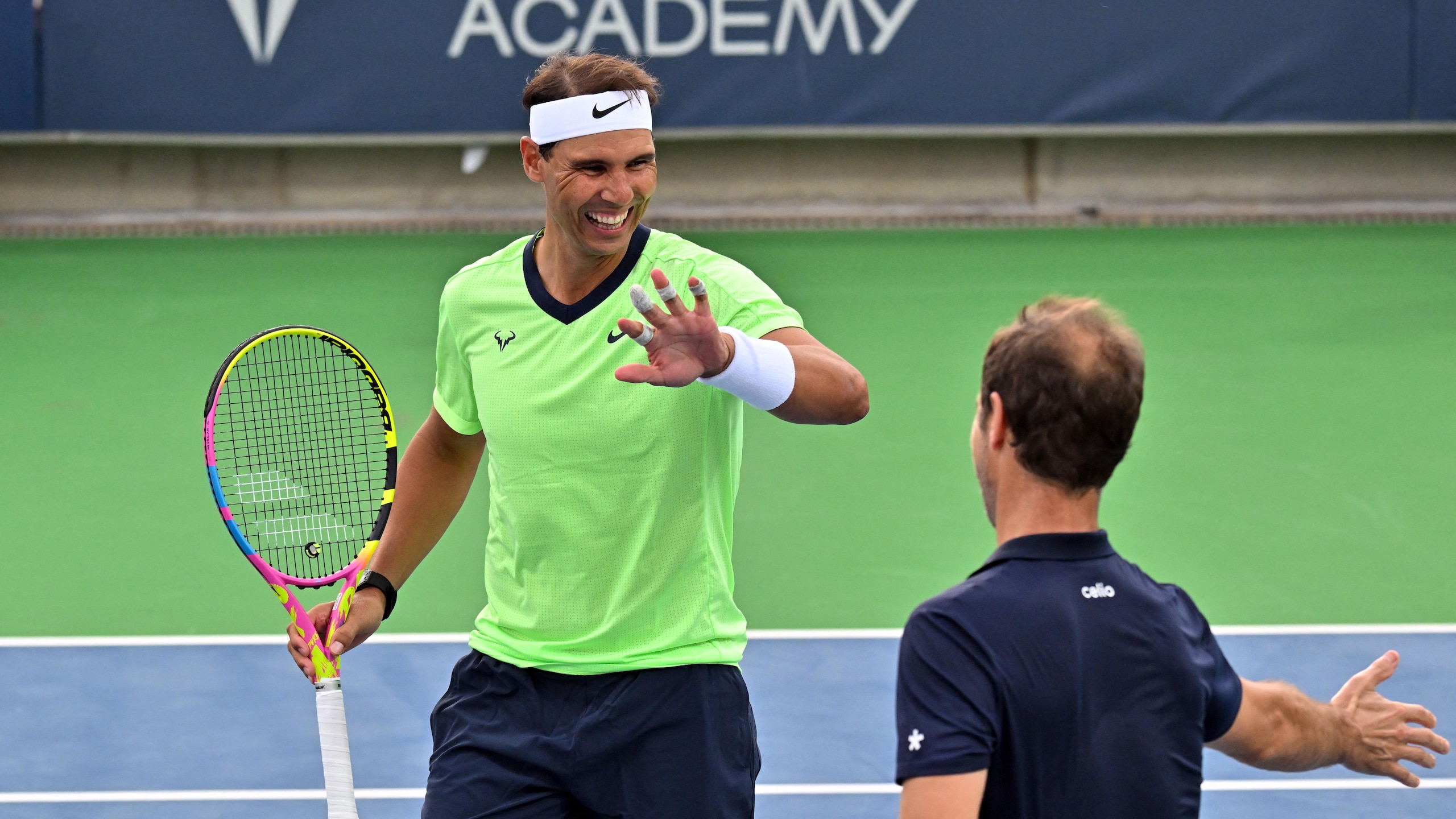

In extremely strong winds, the final for the left-hander was an easy task. He beat Murray, who had eliminated Federer in the semi-final, 6-1, 6-2. The Scot received his clearest defeat for one and a half years.
Murray was the only player that he had not beaten previously in 2009—so, for Nadal, this victory was even more important.
Nadal received $605,500 in prize money for this victory—almost $100,000 less than Vera Zvonereva, the victor in the adjacent WTA tournament at Indian Wells.
However, more important to Nadal, was his prize of 1000 world ranking points, thanks to which his position at the peak of men's tennis is much more assured.
His points total has reached a new height of 14990—likewise his advantage over Federer has grown. The gap between the world No.1 and No. 2 in the week beginning 23rd March 2009 is 4080 points—equivalent to more than two Grand Slam titles.
Nadal's prospects are looking good for the next few months too; without a large amount of pressure, he could attempt to become the seventh player to accomplish the Indian Wells-Miami double (the last player to achieve this, in 2006, was Federer).
Then, following this hard-court swing, is the clay season, in which he has been in a class of his own since 2005.
Federer could certainly improve on his situation with a good performance in Miami. He was knocked out in the quarterfinals in 2006 by Roddick, meaning a good chance to improve on the gap between him and Nadal.
Nadal, reaching the finals of this tournament last year, has many points to defend.
However, because Federer is only participating in two events on clay before Roland Garros (the compulsory Masters 1000 events in Rome and Madrid), he will have to give up 1050 points for his victory in Estoril and final appearance in Monte Carlo last year without a struggle.
Consequently, many say that Federer is currently moving ever further away from his goal of recapturing the No.1 position. Nevertheless, in the six months following his US Open victory in September, he reached only two finals and only won the Swiss Indoors tournament in Basel (not to mention his weak performances in the American hard-court tournaments in Canada and Cincinnati prior to the Olympic Games and the US Open).
Arguably, there are many points for Federer to gain later in the year.
Additionally, Federer can take solace in the fact that the points difference between him and Novak Djokovic (currently No.3 in the rankings) has expanded from 20 points in November 2008, to 2490 points today. The world's No. 3, who lost his 2008 Australian Open and Indian Wells titles to Nadal this year, could be knocked into fourth position as early as this coming week in Miami, making Murray the new No. 3.
Federer's "crisis" is currently the biggest subject flying about tennis circles; bigger even than Nadal's strengthening and Djokovic's dropping in the rankings.
Worldwide experts are constantly speculating if it is possible that Federer could break his series of defeats against Nadal (0-5) and Murray (0-4).
Equally, where is his previous mental strength hiding, which he used to so often call upon in decisive moments? Unfortunate evidence: in Melbourne, he lost the final set in the Australian Open final against Nadal 6-2, and the final set in Indian Wells in the semifinals against Murray 6-1.
Still, he was able to counterbalance his fight back, despite back problems, against Murray at the 2008 Tennis Masters Cup, going down 4-0 in the final set, coming back to level the set but then eventually losing 4-6, 7-6, 7-5.
Once again, bits of advice are coming, appearing from all sides—commentators, analysts, coaches, managers—he must train harder, he must find a coach, etc.
All in all, it is absolute that Federer cannot lose to a player five times in succession, when he ultimately has the better shots at his disposal. Something must change.


.jpg?w=2560 "Latest Peyton-Colts Rumors")