
How Will Extra MLB Wild-Card Team Affect the Division Series?
As you've no doubt already heard by now, Major League Baseball's postseason is going to be a little different this year.
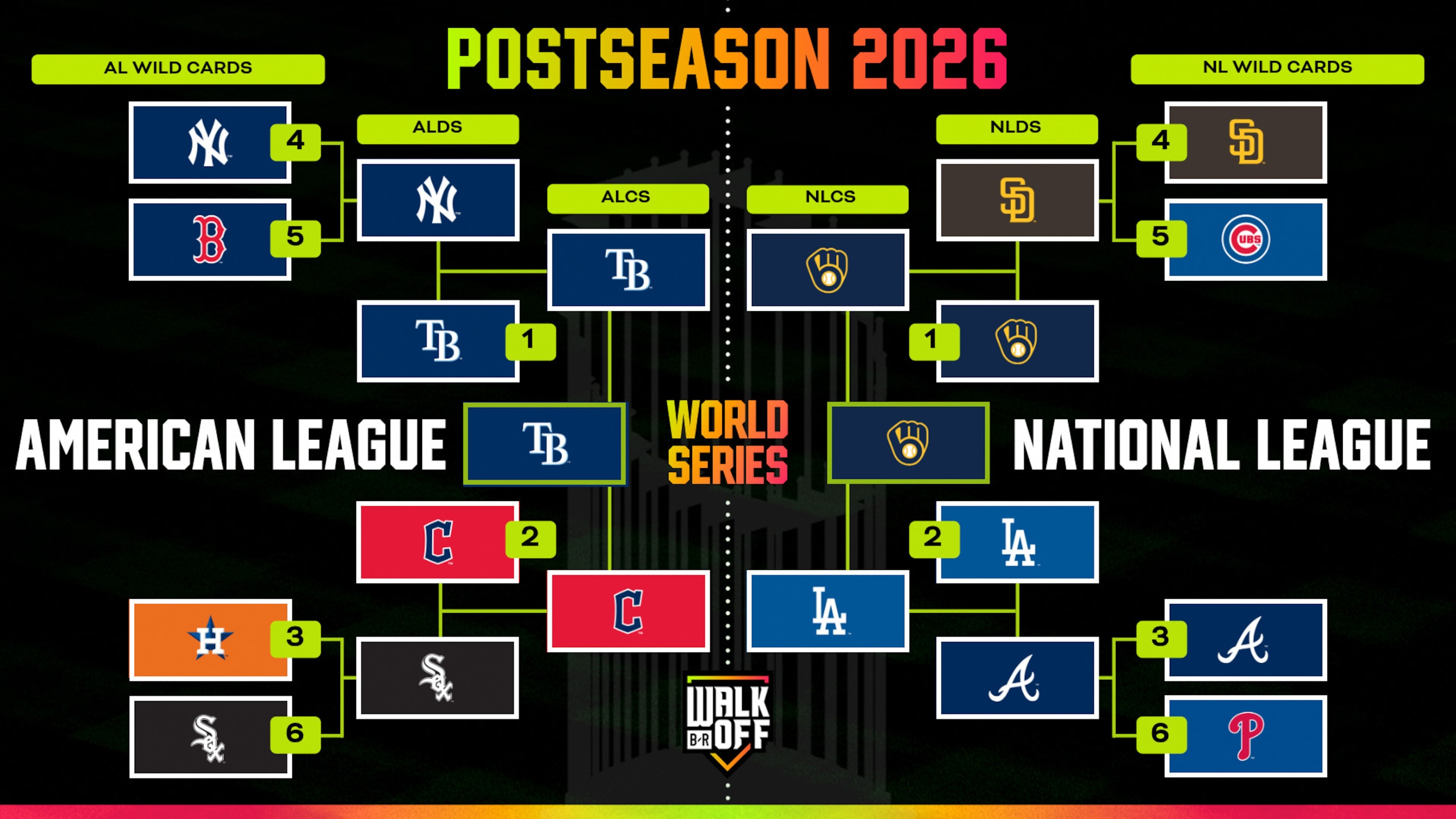
The big change, which was announced earlier this year, is the addition of an extra wild-card berth in each league. Instead of four playoff teams in both the American League and National League, there will be five playoff teams in the AL and NL.
All of the changes were outlined by Barry M. Bloom of MLB.com soon after the announcement was made. The two wild cards in either league will play what is essentially a play-in game: A one-game playoff to determine which team gets to advance to the division series.



That's simple enough. What isn't so simple is the fact that the division series has also gotten a shakeup.
Here's a rundown of what you need to know and what it will mean for the teams that actually make it to the division series.
The Changes
In the past, MLB used a 2-2-1 format for the division series in either league: two home games for the high seed, two home games for the low seed, and a fifth and deciding game at the high seed's home park (with Games 4 and 5 being "if necessary," of course).
For this year only, MLB will be using a 2-3 format for the division series, and it's a format that switches things up a bit.
Instead of the higher seed opening with two home games, it will be the lower seed opening with two home games. We could very well see the team with the best record in one of the two leagues open up on the road against a third-place team to start the postseason.
The tradeoff, obviously, is the three-straight home games after Games 1 and 2 on the road. Because no travel is required, there will be no "off day" for travel in between Games 4 and 5 (if necessary).
There will, however, be a travel day in between Games 2 and 3.
These changes will only be used in 2012. In 2013, the division series will revert back to the 2-2-1 format that teams, players and fans are used to.
The format change was necessary for this season because MLB made the decision to expand the playoffs after the 2012 schedule was set in stone, and it was the only way to make the expansion work without changing things around.
Lastly, there are no rules prohibiting teams from the same division meeting in the division series. All matchups will be based on seeding, and that's it.
Why the Changes Help the Wild-Card Teams
It should be obvious. The fact that wild-card teams get to start the division series with two home games as opposed to two road games is a pretty huge change.
Spotting them with two home games to start the division series gives the wild cards a chance to get off to a hot start, thus giving them an increased chance of pulling off an upset.
Keep in mind that it's not like wild-card teams really needed the extra help. Since the wild card was first introduced in 1995, a total of 10 wild cards have made it as far as the World Series. Five have managed to win it.
So, wild-card teams already have a history of surpassing expectations. This season's changes will make it even easier for them to do so. All it will take is two wins at home and then one win on the road.
Why the Changes Help the Division Winners
Having to start the postseason on the road is a raw deal for the division winners. They'll technically have home-field advantage in the division series, but there's no guarantee that they'll get to play at least two games at home.
However, division winners do have one big advantage over wild-card teams in this situation: rest.
The wild card play-in games will be played the day after the end of the regular season, meaning both wild-card teams will have to go straight from the regular season into the postseason without a letdown period. There will be no rest for the weary.
Division winners, on the other hand, will have two days to rest, regroup and, most importantly, line up their pitching.
Ideally, division winners will get to have their two best pitchers start Games 1 and 2 on the road. Wild-card winners won't have that luxury unless they get lucky and the schedule works out in their favor, which is unlikely. They may be forced to use their two worst pitchers against their opponent's two best pitchers to start the division series.
In the event that a division winner does fall into an 0-2 hole on the road, the end of the world will not be nigh. As opposed to going on the road down 0-2, the division winner would get to go home down 0-2.
Winning three straight games at home is not exactly an improbable feat (see below).
History Tells Us...
Major League Baseball used the 2-3 format for the division series for three years from 1995 to 1997. How did that work out?
With information courtesy of Baseball-Reference.com, here's a quick look:
1995
In the ALDS, the wild-card champion New York Yankees took on the AL West champion Seattle Mariners and won the first two games at Yankee Stadium. The Mariners then won three straight to advance to the ALCS.
In the NLDS, the NL East champion Atlanta Braves won Games 1 and 2 on the road against the Colorado Rockies and would ultimately win in four.
1996
The AL wild-card champion Baltimore Orioles won the first two games of the ALDS against the Cleveland Indians, and they ended up winning in four.
The NL wild-card champion Los Angeles Dodgers got swept by the Braves.
1997
The Yankees won the wild card once again and split the first two games of the ALDS at home against the Cleveland Indians. The Indians ended up winning the series in five.
The Florida Marlins won the NL wild card, and they ended up sweeping the San Francisco Giants.
So in these three seasons, three wild-card teams managed to win the first two games of the division series but only two managed to advance. And only the Marlins went on to win the World Series.
The success of wild-card teams from 1995-1997 was therefore pretty mixed.
And this is a good thing. The last thing Major League Baseball wants is for its postseason to be predictable. No noticeable trends developed when MLB was using the 2-3 format back in the mid-'90s, so there's no reason to expect that the division series will go according to some plan this season.
If you don't like it anyway, just remember this: it's only temporary. The division series will be back to normal in 2013.
If you want to talk baseball, hit me up on Twitter.

.jpg?w=2560 "Mahomes Told Teammate to Leave Meeting")
.jpg?w=2560 "5 Teams Eyeing Jonathan Taylor")
.jpg?w=2560 "Baker Gets Glove From Rays 🧤")


.jpg?w=2560 "NFL investigating Eagles")
.jpg?w=2560 "🚨 Week 8 AP Top 25 Poll")
.jpg?w=2560 "Steelers Roll Saints in Paris 🇫🇷")
.jpg?w=2560 "Jonathan Taylor Landing Spots 📍")