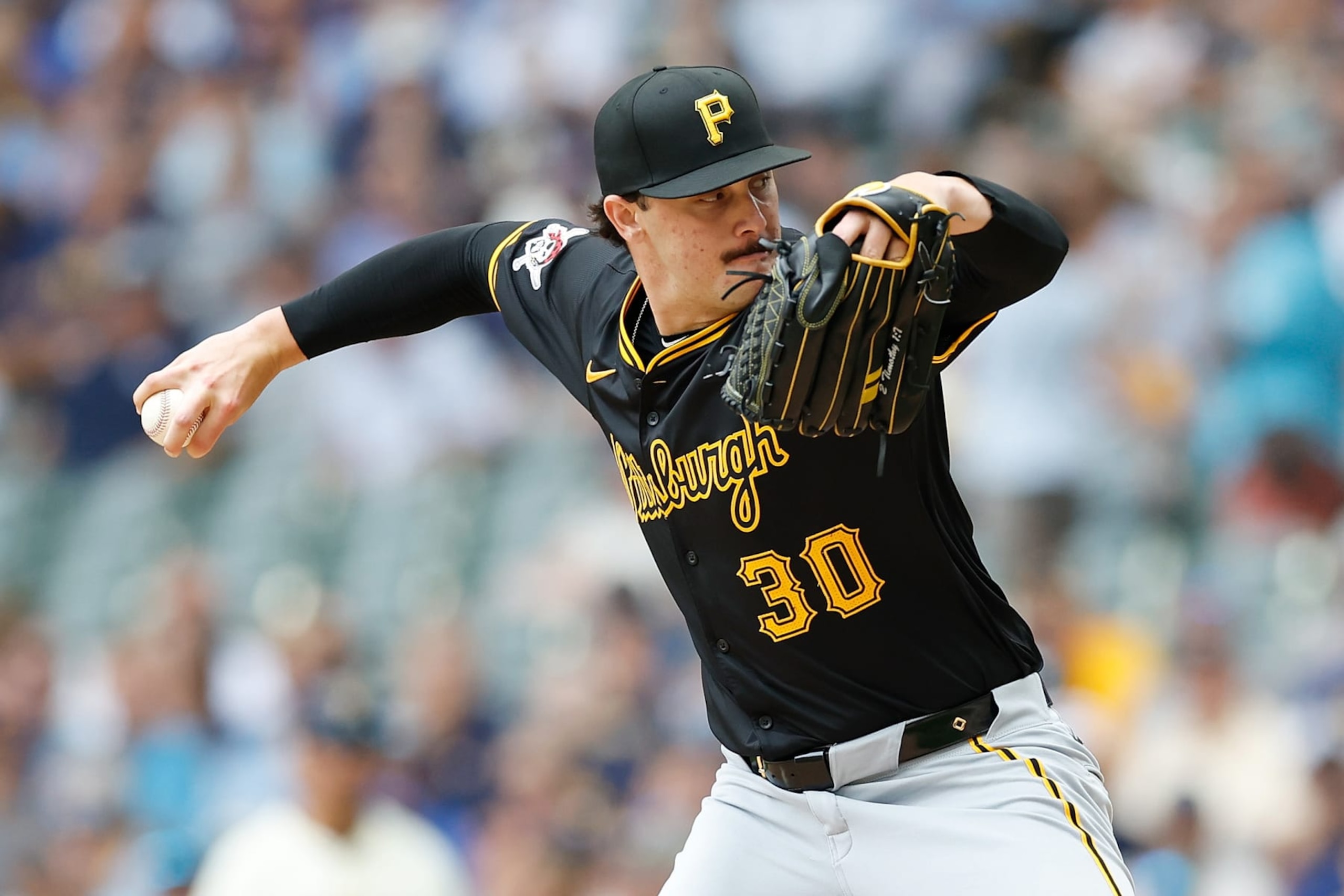


It didn't take long at all for Pittsburgh Pirates ace rookie Paul Skenes to become Major League Baseball's primary source of must-see television.
While the No. 1 overall picks from the drafts in 2020 (Spencer Torkelson), 2021 (Henry Davis) and 2022 (Jackson Holliday) are presently languishing in Triple-A, last year's No. 1 pick really should be the starting pitcher for the National League at next week's All-Star Game.
In 11 career starts (nine quality starts) over the past two months, Skenes has a 1.90 ERA, a 0.91 WHIP, a 12.1 K/9 and a mustache-wielding swagger that made him a fan favorite in the City of Pierogi Love before he ever threw a pitch in the majors.


Every time he steps to the mound, there's a chance something special is going to happen.
However, during Thursday's masterpiece against the Milwaukee Brewers, the fact that he wasn't given the chance to finish something special almost broke the internet.
After going seven hitless innings with 11 strikeouts, Skenes was pulled from the game at 99 pitches.
Two pitches later, the no-hitter was gone.
(Pittsburgh did still win the game 1-0, for what it's worth.)
That exact situation isn't terribly uncommon in baseball's current state of pitch count and load-management hysteria.
In May alone, it happened three times, with Ben Brown (93 pitches), Kyle Bradish (103 pitches), and Max Fried (109 pitches) each getting the hook after seven no-hit innings.
In each of those three cases—and with Skenes on Thursday—the manager had to make a tough decision.
If you send the starter back out to start the 8th inning, you're unofficially committing to leaving him in until he either gives up a hit or finishes the job. This means letting him throw possibly 125 or more pitches in an era where even the workhorse starters rarely reach 110.
The vast majority of managers would do exactly what Derek Shelton did.
"It didn't have anything to do with pitch count…. It was about trusting your eyes," Shelton told reporters after the game.
Because he is a rookie sensation, though, this particular instance struck a serious nerve.
What's noteworthy in this hullabaloo is that, up until Thursday, Pittsburgh had been surprisingly liberal with Skenes' workload.
He pitched a grand total of just 34 innings in the minors before getting the call to the big leagues, yet he racked up 100 pitches—in six no-hit innings with 11 strikeouts, by the way—in the second start of his career.
On June 23, he went seven innings for the first time, hitting 102 MPH on the radar gun on his 98th and final pitch of that game. He proceeded to throw 102 pitches his next time out and tallied 107 pitches last Friday. It was his fourth time in triple digits through 10 starts.
Conversely, AL Rookie of the Year favorite Luis Gil has reached 100 pitches just once in his 18 starts.
Yet, here we are, ready to burn Shelton at the stake for letting load management get in the way of possible history.
Though I feel he made the right decision to pull Skenes, it's a bit hard to argue with the fans up in arms right now, because here's the worst-kept secret about load management:
It ain't f****** working.
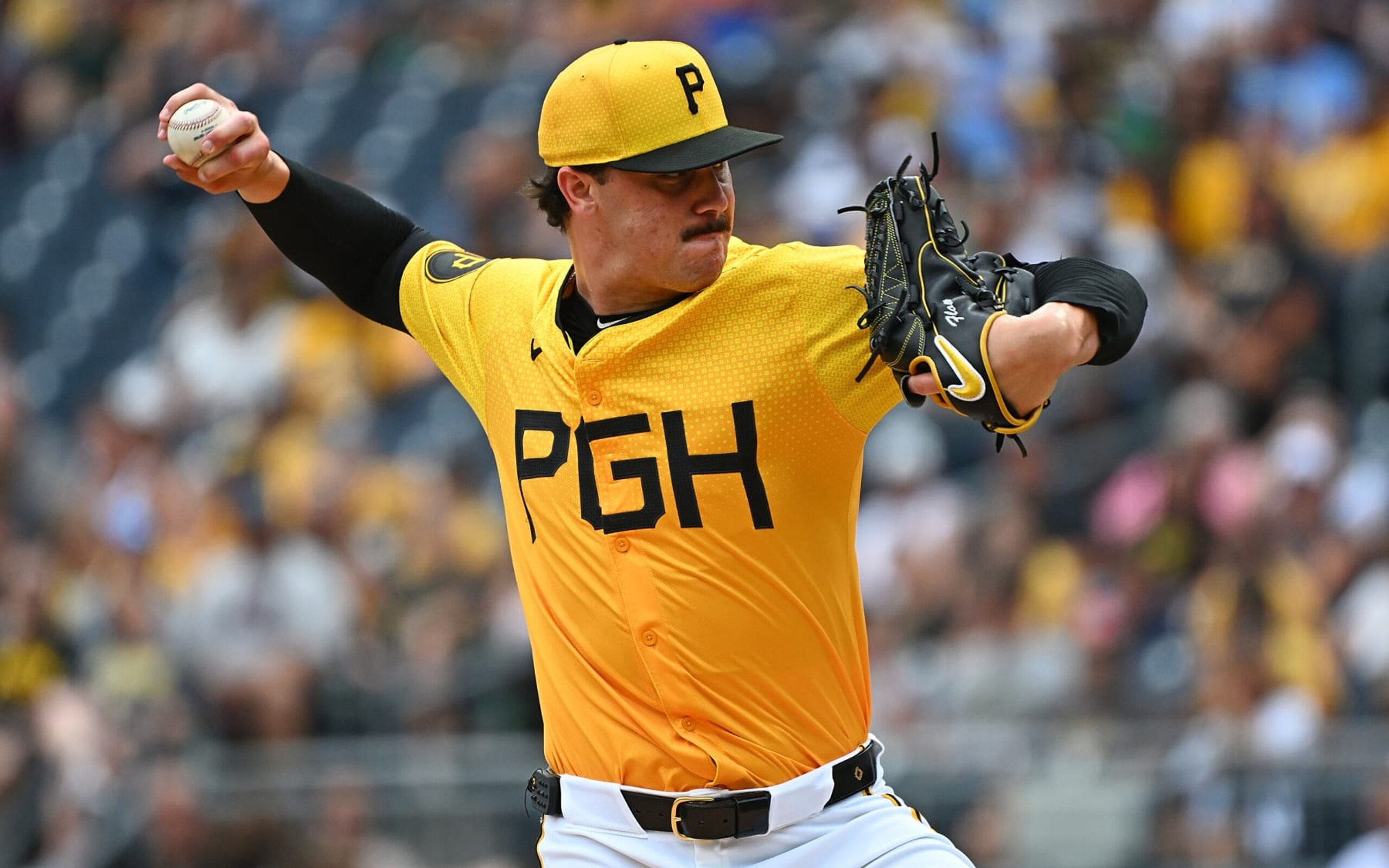
Even with the intense focus on pitch counts for well over a decade at this point, we spent a big chunk of the start of this season discussing what can possibly be done to keep pitchers healthy while watching one big-name pitcher after another shelved for the year by early April.
Within the past two calendar years, 65 MLB pitchers have needed Tommy John surgery—and that's merely the most ominous of the many forearm/elbow/shoulder/lat injuries that load management has done absolutely nothing to prevent.
Heck, it hasn't even been a full week since Pittsburgh's other star rookie pitcher, Jared Jones, landed on the IL with a lat strain. He had yet to eclipse 100 pitches in a start.
Listen, I'm not campaigning for a return to an ancient time when Nolan Ryan was once allowed to throw 235 pitches in a 13-inning outing before proceeding to take the mound again three days later.
But one could easily argue that the industry-wide obsession with pitch counts is actually doing way more harm than good. Pitchers have been trained/wired to give maximum effort on what they know will likely be a maximum of 100 pitches, with ligaments that simply are not built to survive that type of constant strain.
Travis Sawchik of theScore dug into this notion back in April when all Tommy John hell was breaking loose and found that the median velocity on fastballs has been steadily increasing for years, from 90.9 MPH in 2007 to 94.5 MPH through the first few weeks of this season.
The median minimum fastball velocity climbed from 85.6 MPH to 91.5 MPH in that same time frame.
The TL;DR takeaway is they don't make 'em like Greg Maddux anymore.
The art of pitching—picking your spots where you can get away with a "get me over" fastball or a breaking ball with a little less spin rate—has gone the way of the dodo bird, replaced with guys giving it everything they've got for what is more or less a pre-set number of pitches.
We all know this to be true. We are infatuated with Statcast data. We swoon over Mason Miller's 103 MPH bullets. We cackle at Jhoan Duran's splinkers and the spin rate on Seth Lugo's curveballs. And when a pitcher's velocity is a tick below his norm, he gets asked about it after the game.
Still, we have the audacity to wonder what's the harm in letting an exciting rookie throw upwards of 125 pitches in pursuit of a no-hitter, in part because he should be able to recover with more than a week off before making his next start after the All-Star Break?
Skenes threw 39 four-seam fastballs on Thursday.
Each one was clocked at 96 MPH or faster.
And his sliders were absolutely filthy.
Dude was dialed in for all 99 pitches.
Sending him back out there for possibly two more innings already at 99 pitches would've been the pitching equivalent of asking a marathon runner who is about to cross the finish line if he can stretch it to 32 miles today instead of the usual 26.2.
Maybe he would have been no worse for wear?
Maybe he would have bounced back about as poorly as Matt Harvey and Stephen Strasburg did from giving it everything they had in the 2015 and 2019 World Series, respectively?
We'll never know.
However, until we can somehow convince flame-throwing pitchers to start taking their foot off the gas a wee bit every now and then during their starts—a ship that sailed a long time ago—maybe we shouldn't get so outraged when a manager prioritizes UCLs over no-nos.

.jpg?w=2560 "Mahomes Told Teammate to Leave Meeting")


.jpg?w=2560 "🚨 Week 8 AP Top 25 Poll")


.jpg?w=2560 "Updates from EVERY NFL Game 🏈")
.jpg?w=2560 "Baker Gets Glove From Rays 🧤")