Where Does Kyrie Irving Rank Among NBA History's Best No. 2s?
After a years-long odyssey between his run with the Cleveland Cavaliers and his acquisition by the Dallas Mavericks, Kyrie Irving is playing some of the best basketball of his career.
This postseason, he's averaging 21.9 points, 5.1 assists and 2.4 threes per game while shooting 39.1 percent from three. He trails only Jalen Brunson in points scored in the clutch (the final five minutes of games within five points), and he's tied for fourth in assists during those high-leverage moments.
Although the Boston Celtics have limited Irving's impact through the first two games of the NBA Finals, his strong performance as the Robin to Luka Dončić's Batman in the first three rounds of the playoffs made him a common topic of conversation.
Ahead of Game 2 of the Western Conference Finals, when asked how the team survives slow stretches from Dončić, Mavericks head coach Jason Kidd told Bleacher Report, "That's Ky,"
On a recent episode of Mind the Game, Irving's former teammate, LeBron James, said, "I'm so f--king mad... that I am not his running mate anymore. ... He's the most gifted player the NBA has ever seen."
Now that Irving is in the fourth Finals of his career, it's time for a deep dive into where he belongs on the list of the best No. 2 options in NBA history.
Just What Is a No. 2?
1 of 11
Whenever you're trying to rank athletes, numbers are critical, but they aren't everything. There's tons of subjectivity at play here. Differences in eras have to be accounted for, too. The game is played differently than it was in the past. The NBA is also drawing from a deeper (and international) talent pool now.
So while basic and advanced statistics factor into these rankings, each placement was ultimately a judgment call.
The actual definition of No. 2 option—or as we'll call it here, a "Robin"—is important.
In the comics, Robin led the Teen Titans, but he's known more as Batman's sidekick. We're aiming to reflect that with the players selected here, so you won't see the likes of Kobe Bryant or Dwyane Wade. They were someone else's sidekick at times, but by the end of their respective careers, they were known more as the primary protagonists.
On the other hand, Irving had only brief dalliances with being the guy. He did so first with the Cleveland Cavaliers, prior to LeBron James' arrival. He was also the No. 1 option during his two-year tenure with the Boston Celtics.
Both runs had their notable moments, but Kyrie is known more for the years he spent supporting LeBron, Kevin Durant and Luka Dončić. Everyone else featured here is in a similar boat.
10. Joe Dumars
2 of 11
Joe Dumars was the Robin to Isiah Thomas' Batman. He averaged 17.1 points, 4.7 assists and 1.0 steals per game while shooting 38.2 percent from three during the nine seasons in which they were teammates on the Detroit Pistons.
Dumars also made five straight All-Defense teams during that stretch. The Pistons also won two championships with Thomas and Dumars in 1989 and 1990.
Thomas understandably got the bulk of the attention during that run, but Dumars' scoring average wasn't far behind Thomas' 18.5 points during those years. And he was often tasked with defending the opponent's best perimeter players, including Michael Jordan, who once shared a glowing review of his defense.
"He introduced certain tricks to make me expand on my talents as an offensive player," Jordan said in 2003. "And that's why I consider him the best."
9. Willis Reed
3 of 11
One of the great big men of the 1960s, Willis Reed had career averages of 18.7 points and 12.9 rebounds per game. He also won the league MVP award in 1970 and two Finals MVPs in 1970 and 1973, and he was named to the NBA's 75th Anniversary Team a few years ago.
Those accolades might have you wondering how Reed could be a career Robin. Well, the voters may have said one thing, but the numbers said another.
Reed played the bulk of his career with Walt "Clyde" Frazier. During the years those two were together, Frazier averaged 19.2 points and 6.5 assists to Reed's 18.8 and 2.0, respectively. The gaps in those averages were even bigger during the playoffs.
Reed is a legend. His heroic return from an injury for Game 7 of the 1970 Finals is one of the most famous moments in NBA history. But even in an era where big men dominated most games and conversations about basketball, Frazier was New York's Batman.

8. Pau Gasol
4 of 11
Pau Gasol spent the first six-and-a-half seasons of his NBA career as the undisputed Batman of the Memphis Grizzlies. But his career took off after the Los Angeles Lakers acquired him in February 2008.
During his six-plus years alongside Kobe Bryant in L.A., Gasol averaged 17.7 points, 9.9 rebounds, 3.5 assists and 1.4 blocks per game. They won two titles together in 2009 and 2010. While Kobe was unquestionably the leading man for those Lakers squads, Gasol's impact wasn't far behind (at least on the floor).
During the 2010 postseason, Gasol had nearly as many wins over replacement player as Bryant. During their entire regular and postseason run together, L.A. was plus-7.2 points per 100 possessions when both were on the floor and plus-4.9 when Kobe played without Pau.
Gasol's rim protection, passing and finishing ability were all perfect complements to Kobe, who gave his teammate the ultimate seal of approval after he retired.
"Pau, when he retires, he will have his number in the rafters next to mine," Kobe said during the 2018 Oscars. "The reality is, I don't win those championships without Pau. The city of L.A. doesn't have those two championships without Pau Gasol. We know that. Everybody knows that."
7. Anthony Davis
5 of 11
Anthony Davis has won only one championship with the Lakers thus far, but his numbers alongside LeBron James comfortably trump Pau Gasol's with Kobe Bryant.
Part of that is a product of the era in which AD plays. The pace is higher, and the floor is more spread out than it was in the 2000s and early 2010s. That has juiced Davis' numbers to a degree.
AD's availability has been an issue throughout his run with the Lakers, too. But during his four postseasons as LeBron's No. 2 option, Davis has averaged 24.9 points, 11.5 rebounds, 3.1 assists, 2.0 blocks and 1.1 steals per game.
In those playoff runs, the Lakers were plus-6.0 points per 100 possessions with Davis on the floor and minus-5.1 when he's off.
Davis was one of the NBA's most dominant defenders and No. 1 options during the first seven years of his career with the New Orleans Pelicans. His ability to scale his game to fit better with James might be his most underrated trait.
6. Kyrie Irving
6 of 11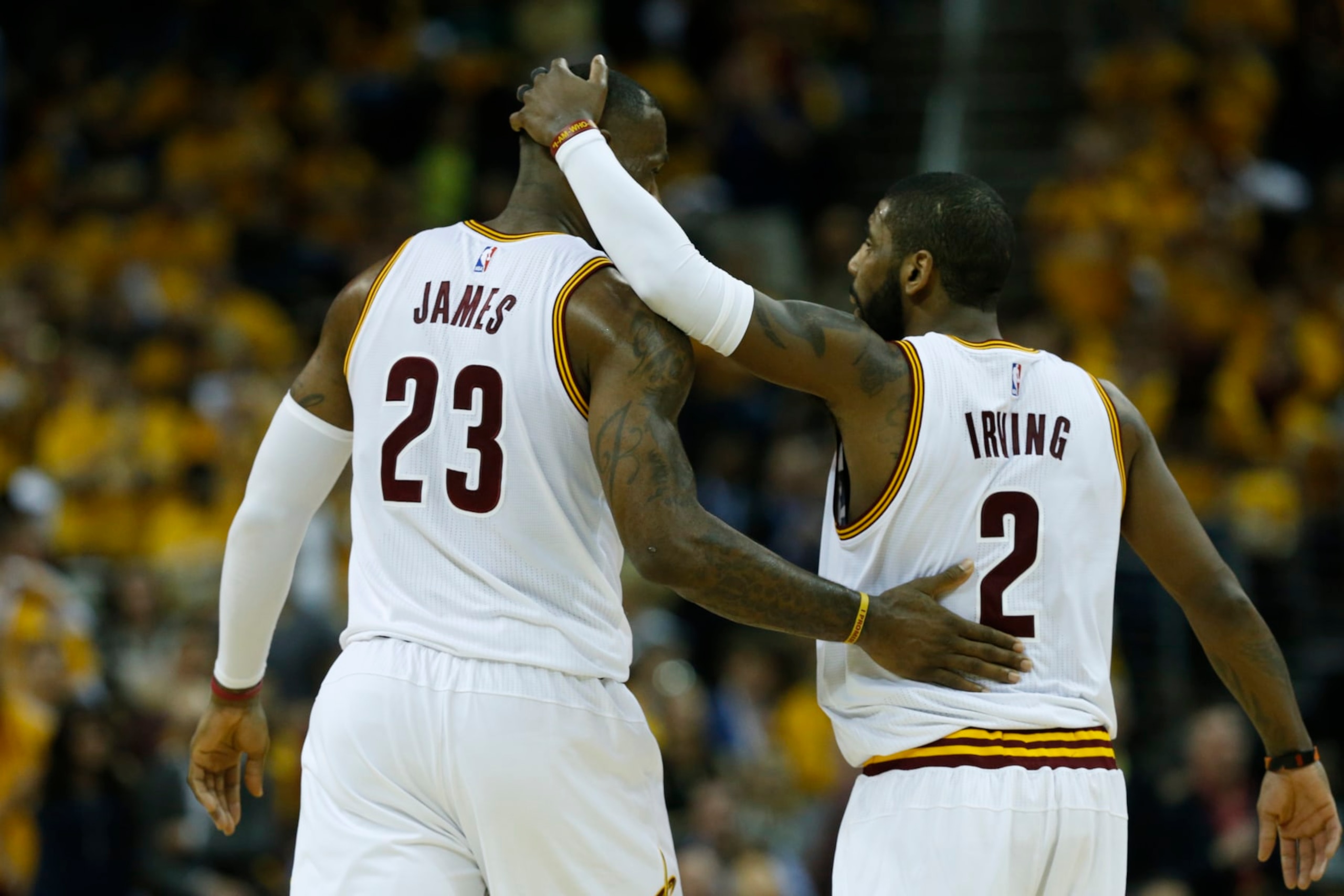
What's unique about Irving, at least relative to the players we've focused on to this point, is that he's been a dynamic No. 2 for at least three different teams.
In 2016, he won a title with LeBron. During that Finals, he averaged 27.1 points, 3.9 assists, 2.1 steals and 2.1 threes per game while shooting 40.5 percent from deep. He also hit perhaps the most important shot of the series when he isolated on Stephen Curry and pulled up for a fadeaway three with under a minute to go in Game 7 that put the Cavs up for good.
In total, Irving averaged 23.9 points and 4.7 assists per game in his three postseason runs with LeBron. Then, after his detour through Boston, he averaged 27.1 points and 5.8 assists per game during the regular season alongside Kevin Durant with the Brooklyn Nets.
And now, he's made it back to the Finals by once again accepting the Robin role, this time with Dončić.
During their season-and-a-half together, Dallas is plus-8.0 points per 100 possessions when Luka plays with Kyrie and plus-1.1 when he plays without him. That impact is a product of Kyrie's nearly unparalleled combination of ball-handling, shot creation and shooting ability.
While those skills have made Irving good enough to be the Batman on plenty of teams, his willingness to be a Robin will be one of the hallmarks of his all-time great career.
5. Draymond Green
7 of 11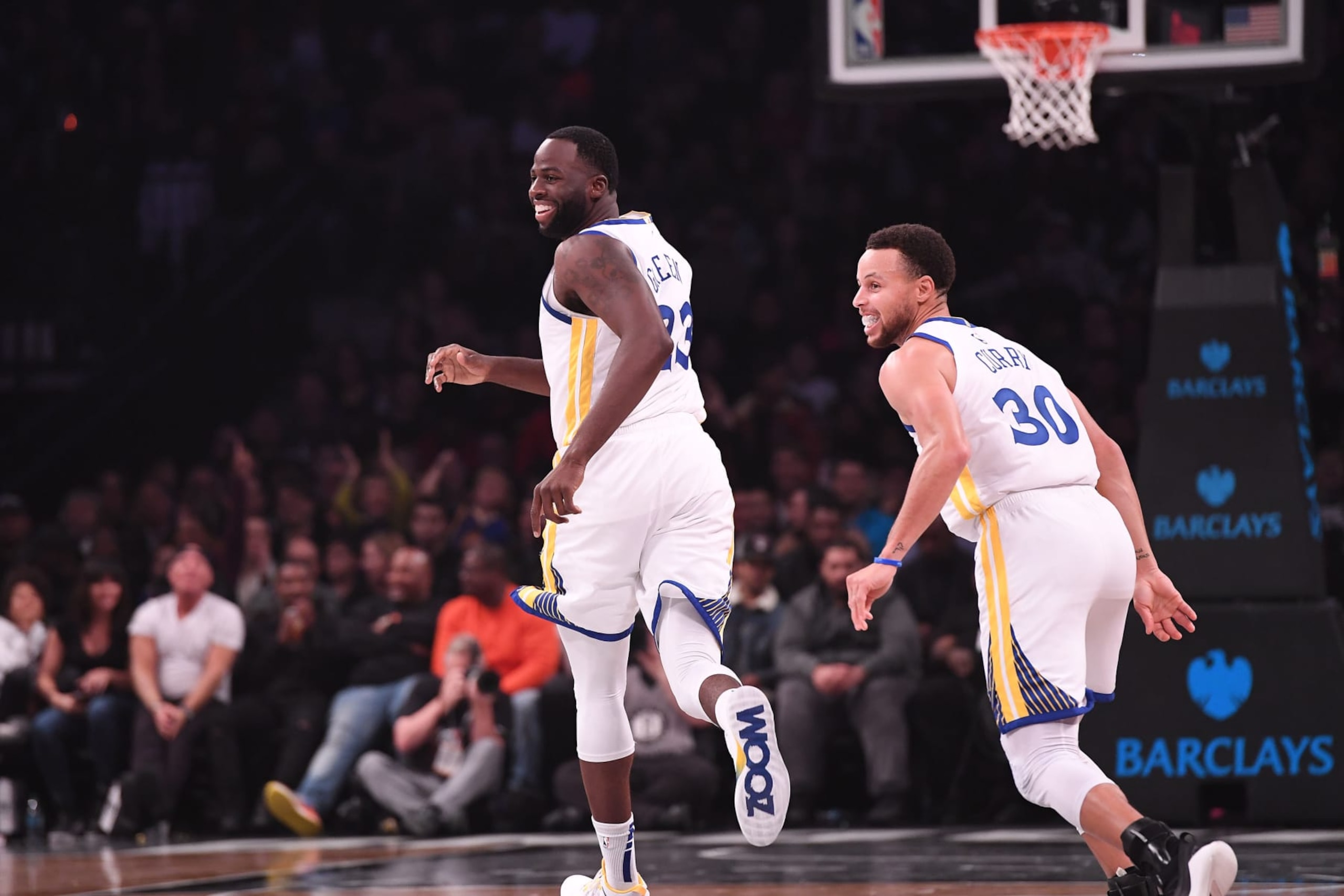
There may be some debate about who Stephen Curry's Robin is.
It could be Klay Thompson, the other Splash Brother. For a few years, it was arguably Kevin Durant, though some would say he was the Batman in that situation. (Besides, they were only together for three seasons.)
But Curry's most important sidekick for the decade-plus run in which the Golden State Warriors won four championships was (and still is) point forward Draymond Green.
In recent years, Green's suspensions and hot takes have somewhat overshadowed what he does on the floor. But at the height of the Warriors' dynasty, he was one of the most unique and dominant players in NBA history. From 2015 through 2022, he averaged 12.4 points, 9.5 rebounds, 6.8 assists, 1.6 steals and 1.4 blocks per game in the playoffs.
Green wasn't just the anchor of the team's defense. He was also its most versatile defender. He could dominate forwards and wings on the perimeter, body centers in and around the paint and protect the rim.
If defense was all that Green offered, he could still be an important piece on winning teams. But his playmaking, passing and ability to read defenses out of the short roll were critical components of the Warriors' all-time offense, too.
4. Manu Ginobili
8 of 11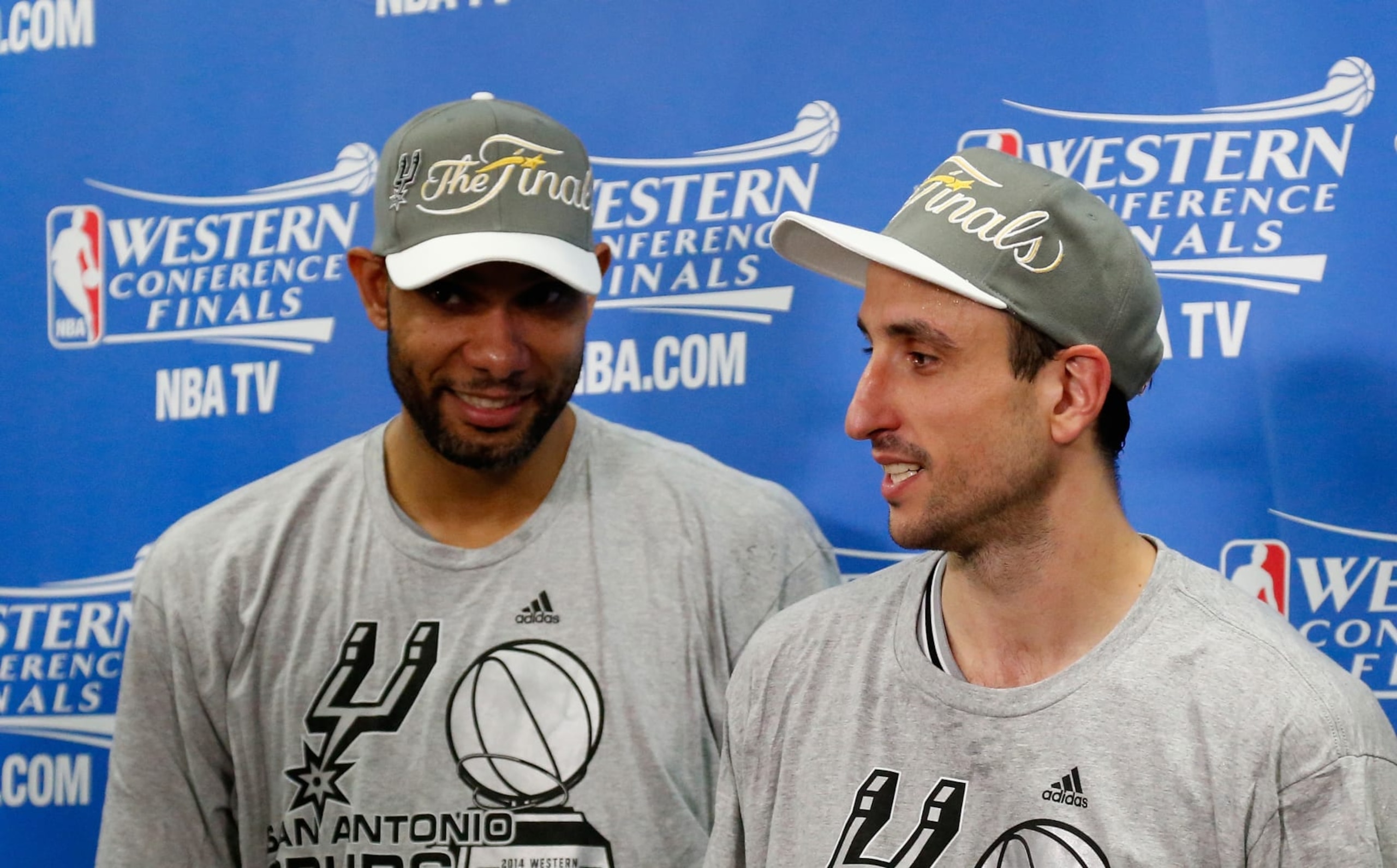
When you're as good as Tim Duncan was for as long as he was, you're bound to have multiple Robins worthy of consideration.
David Robinson was the first. There's an argument for Tony Parker, too. But we'll go with Manu Ginobili, who was second among San Antonio Spurs in wins over replacement player (value over replacement player times 2.7) during Duncan's 19 seasons:
- Duncan (246.0)
- Ginobili (124.7)
- Parker (83.2)
- Robinson (65.3)
- Kawhi Leonard (50.5)
Ginobili came off the bench for the majority of his NBA appearances, but he spent plenty of time against opposing starters. And his unique, lefty combination of playmaking and scoring efficiency made him the element of chaos in a typically rigid San Antonio system that helped the Spurs win four championships in the 2000s.
From 2003, when Ginobili picked up his first ring, through 2014, when he got his fourth, Manu averaged 15.4 points, 4.0 assists and 1.6 threes in only 29.8 playoff minutes per game.
During those postseason runs, San Antonio was plus-8.3 points per 100 possessions with Ginobili on the floor and minus-2.9 when he was off.
3. Kevin McHale
9 of 11
Like Ginobili, Kevin McHale spent some of his time as both a Robin and a bench player. But unlike Ginobili, he eventually graduated to a starting position and became the two in one of the greatest one-two punches in NBA history.
From 1981 to 1992, McHale and Larry Bird played in 12 postseasons together, won three championships and helped lead the league into its modern era. During that run, McHale averaged 18.8 points, 7.4 rebounds and 1.7 blocks in the playoffs.
McHale's post game is legendary. Few (if any) across NBA history had the up-and-under honed in quite like he did.
The chemistry between Bird and McHale was among the building blocks of one of the greatest dynasties in NBA history.
2. John Havlicek
10 of 11
This one may be controversial for the old heads out there. Like Willis Reed, John Havlicek probably isn't seen as a Robin by many.
During the first seven years of his career, he was the Boston Celtics' third-leading scorer (by points per game) behind Sam Jones and Bailey Howell. Over the same stretch, he was third in assists per game behind K.C. Jones and Bill Russell (who was the team's Batman for this stretch and several years before it).
After Russell retired, Havlicek played nine more seasons. At 21.9 points per game, he led the Celtics in scoring during that stretch. However, another big man had a claim to the Batman title. This time, it was Dave Cowens, who averaged 18.8 points, 15.2 rebounds and 4.0 assists per game during his eight years alongside Havlicek.
In other words: During his career, Havlicek won eight championships with essentially two different Celtics dynasties. All of those teams were stacked enough to have several potential Robins and Batmen.
Settling on just one is impossible, but Havlicek's resume at least gives us a good option.
1. Scottie Pippen
11 of 11
This is almost a no-brainer. Scottie Pippen spent almost the entirety of his run with the Chicago Bulls as Michael Jordan's Robin. He won six titles in the modern (or near-modern) NBA. And his versatility on both ends of the floor helped set the stage for today's point forwards and often positionless basketball.
From 1991 to 1998—a stretch that includes all six of the Bulls' championships—Pippen averaged 19.2 points, 7.9 rebounds, 5.5 assists, 2.1 steals and 0.9 blocks per game in the playoffs. He could shut down the opposition's best perimeter player, wreak havoc in passing lanes, facilitate the Bulls offense and dominate as a slasher against defenses that were often keyed in on Jordan.
If there was ever any doubt about just how good Pippen was in his own right, he averaged 22.0 points, 8.7 rebounds, 5.6 assists, 2.9 steals and 0.8 blocks per game during the 1993-94 campaign that Jordan missed to play baseball. He finished third in MVP voting that season.
At the peak of his powers, Pippen was capable of being the best player on both ends of the floor for a winning team. The Bulls went 55-27 in that Jordan-less campaign.
But he accepted a lesser role alongside the greatest player of all time, and the two led perhaps the greatest dynasty in NBA history.

.jpg?w=2560 "AD Trolls Bears WR on IG 😂")
.jpg?w=2560 "Buzz: MHJ Hired Agents for Trade")
.jpg?w=2560 "Report: Steelers WR to Miss 'Weeks'")
.jpg?w=2560 "Viral Dan Campbell Presser 💙")

.jpg?w=2560 "Cam Ward Says He's Not A Loser")