

Few things exist within the eye of the beholder quite like what, exactly, makes an entertainment product entertaining. But at the least, we ought to be able to agree that the worst thing such a product can do is waste people's time.
So, kudos to Major League Baseball for aiming to do less of that in 2023.
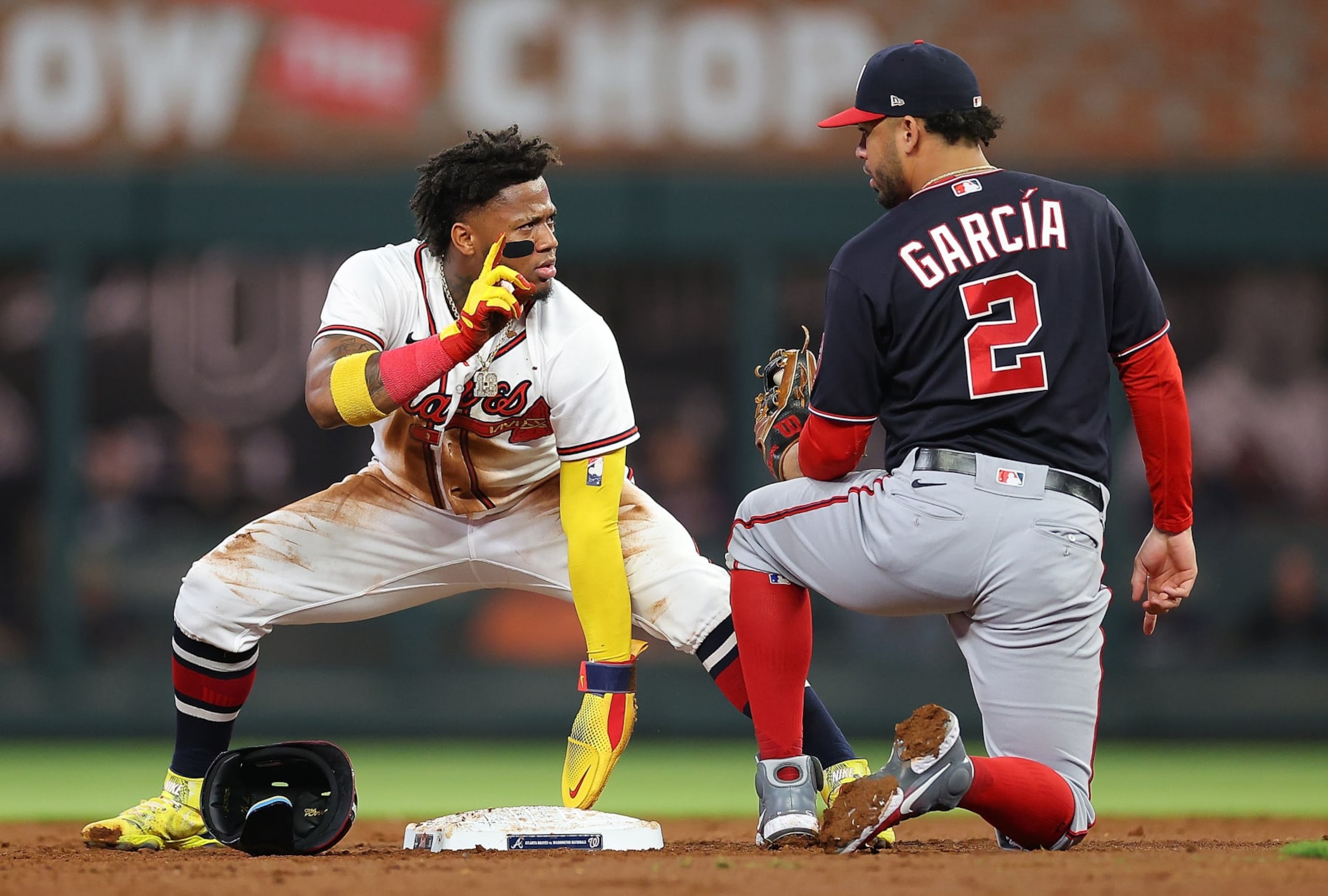
With spring training games slated to begin on Feb. 24, the new rules originally announced by MLB last September are about to become as real in the majors as they were in the minors last year. Regulations on defensive shifts? Larger bases? Limits on step-offs and pick-offs? A pitch clock? It's time to get ready for all of it.
.png?w=2560)
Though it's not a new rule, per se, ESPN's Jesse Rogers reported on Monday that the league has also decided that the "ghost runner" for extra innings—a baserunner who's automatically placed at second base at the start of every half inning after the end of regulation—that applied in 2020, 2021 and 2022 is now permanent.
Call all this a cynical cash grab if you want, but "practical" would be a more sensible word.
Business indeed remained good for MLB in 2022, with Maury Brown of Forbes reporting that the league pulled in record-setting revenues between $10.8 and $10.9 billion in 2022. The league nonetheless isn't so much messing with a good thing as it is getting a frankly overdue start on the long game. With its existing fans not exactly packing the stands of late, it's past time for the nation's pastime to make further inroads with the next generation.
And whatever you do, just don't call these new rules problems in search of solutions.
Less Lollygagging? Good.
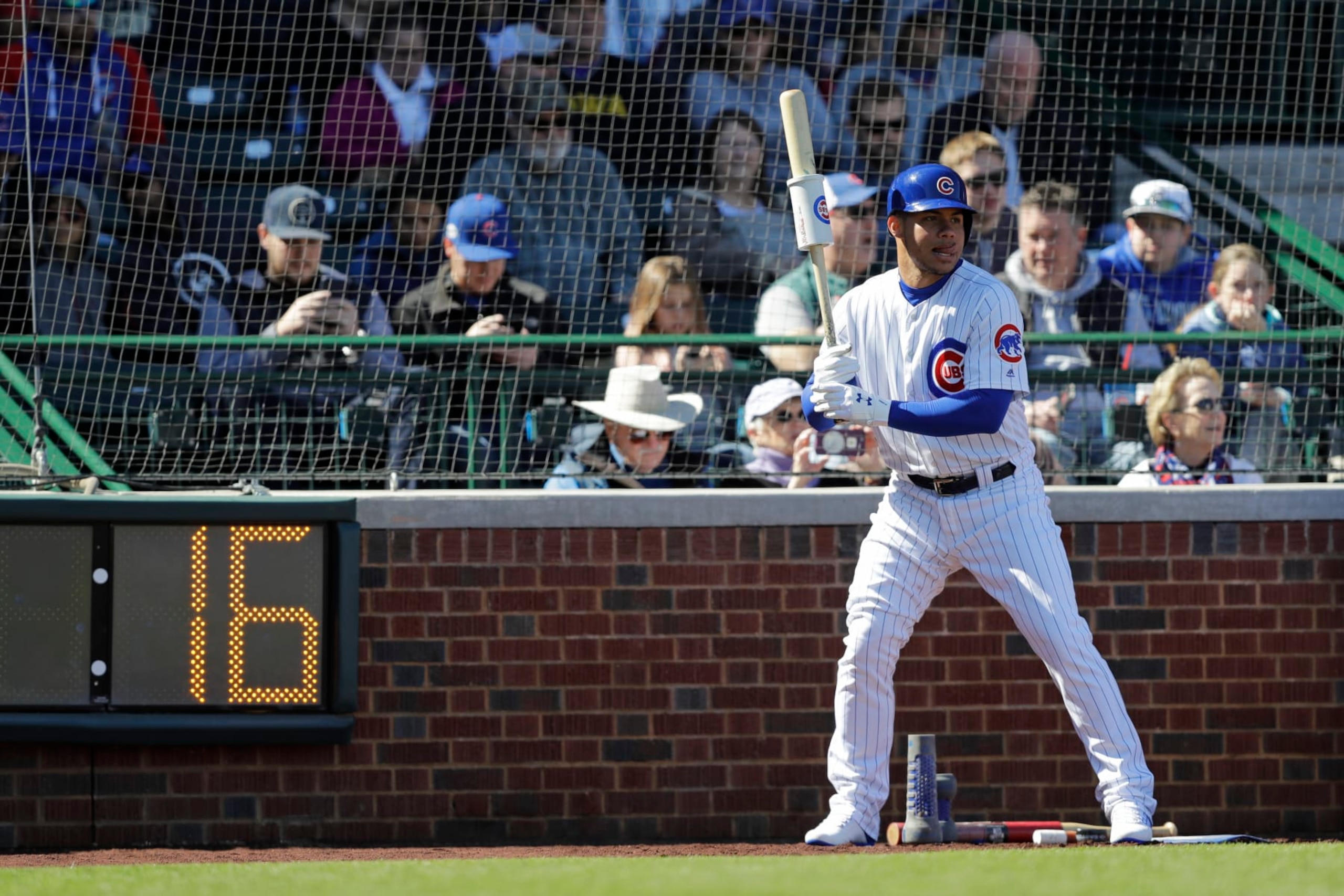
This is not to say that none of the new rules are going to take some getting used to. And yes, we're mainly talking about you, pitch clock.
For over a hundred years, major league pitchers could take as long as they wanted to throw a pitch. Those days are over, as every hurler's next appearance and all the ones after that will allow him just 15 seconds between pitches with the bases empty, with a small bump up to 20 seconds when there are runners on. Violators will be charged with an automatic ball.
If what happened in the minor league testing phase is any indication, these limits are going to have a drastic impact on the average time of games. Per J.J. Cooper of Baseball America, similar restrictions—15 and 19 seconds at Triple-A and 14 and 18 seconds at all other levels—in the minors last year resulted in games getting shorter by an average of 23 minutes.
A drop of that magnitude at the major league level would have resulted in games going from an average of 3 hours, 11 minutes in 2021 to 2 hours, 48 minutes in 2022. Games haven't been played that quickly since 1986.
"What's the rush?" would be a fair question if games were getting longer only because more action was happening within them. But the opposite is true, and largely because of a lollygagging culture that has enveloped too many pitchers.
According to game times pulled from Retrosheet and pitch data from FanGraphs for the last 21 seasons, pitchers peaked with an average of 102.4 pitches per hour in 2004. It's been all downhill since then, with nadirs of 91.6 pitches per hour in 2021 and 93.7 per hour in 2022.
The league is therefore not asking pitchers to rush, but rather to go at a previously established pace. Not all of them are happy about it, to be sure, but fans should be. Albeit on the most basic possible level, they get more baseball with their baseball when pitchers speed up.
More Balls in Play? Good.
Elsewhere on the topic of getting more baseball with your baseball, the dropoff in the rate of pitches is nothing compared to that of balls in play (courtesy of Baseball Reference) since 2002:
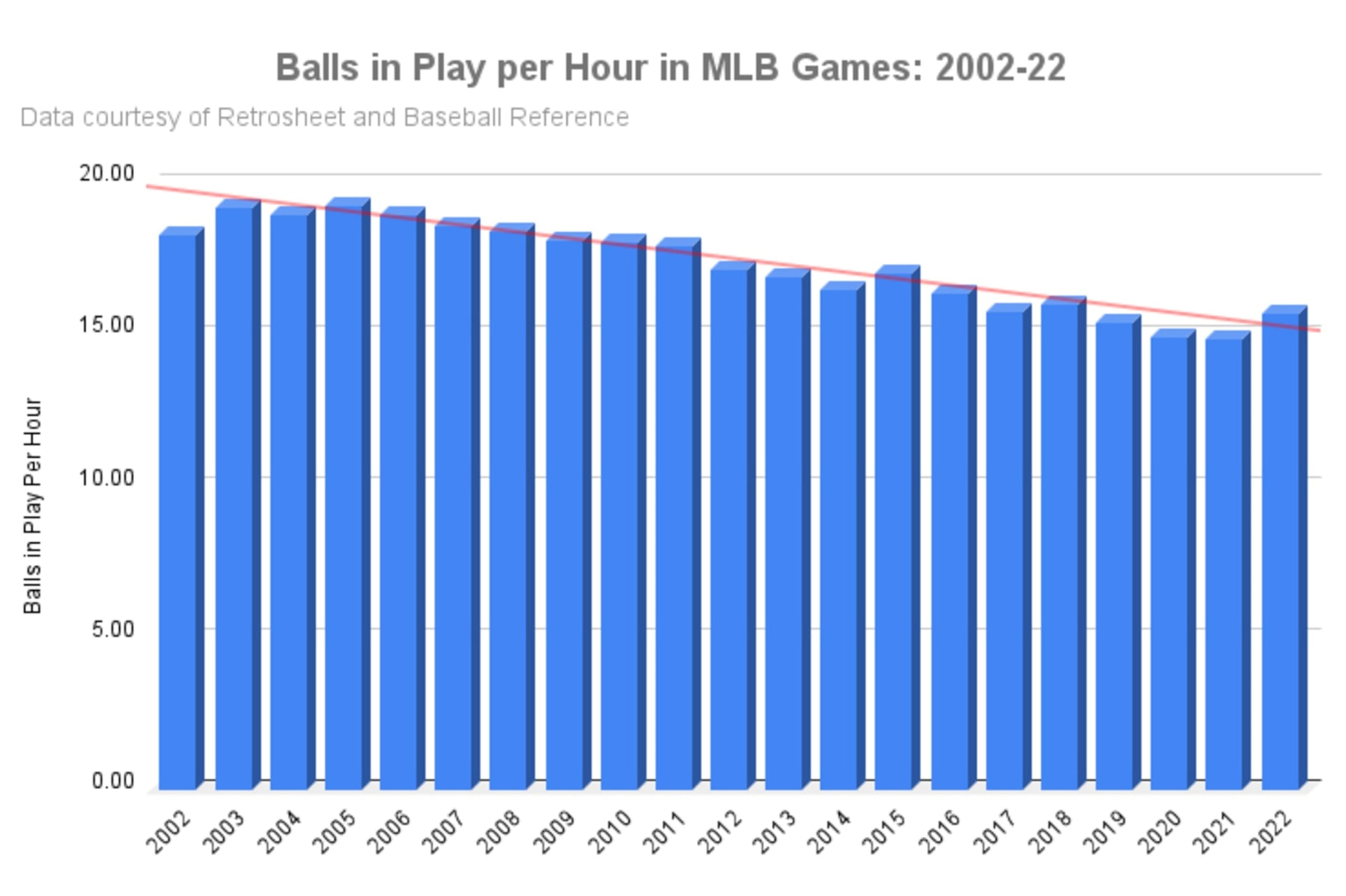
Because home runs aren't counted as balls in play, this isn't a perfect measure of "things happening" within games. But it works as a measure of "baseball happening." With a home run, it's the batter versus nobody. With any other ball in play, it's the batter versus nine fielders. As the baseball gods intended.
Because, as Rob Arthur of FiveThirtyEight covered, pitchers who take longer to throw tend to throw harder, there's at least one reason to believe that the pitch clock will lead to more balls in play. The shift ban should also have an effect, as it doesn't seem coincidental that the frequency of fly balls has increased alongside that of infield shifts since 2015. It got harder for hitters to hit the ball through the defense, so they tried en masse to go over it.
Harder to predict is whether there will be a sudden and dramatic increase in hits this season. But even an increase in outs in the field would be welcome in the sense that fielders should have to work harder for them. Out should be nonchalant plays like these:
And in should be athleticism-oozing plays like this:
And speaking of athleticism-oozing things...
More Stolen Bases? Good.
An increase in the size of the bases from 15 inches to 18 inches may not sound much, but it is. Oh, it is.
Wait 'til you see them," Boston Red Sox manager Alex Cora told reporters Tuesday, "they look like a pizza box, to be honest with you."
One hypothetical benefit of the bigger bases is that, by way of fielders and baserunners having more space over which to contend, there will be fewer injuries. With the space between home plate and first base now shorter by three inches, another is the possibility of more frequent infield hits.
And then there's the benefit you can pretty much bank on: more stolen bases.
Thanks to not only the bigger bases—which decrease the distance between first and second and second and third by 4.5 inches—but also the pitch clock and limitations on pickoff throws, Cooper noted that there were 1.1 successful steals per game in the minors last season. That's as many attempts as there were per game back in 2019.
This bodes well for the major league level, where stolen bases have fallen dramatically out of fashion in the last two decades:
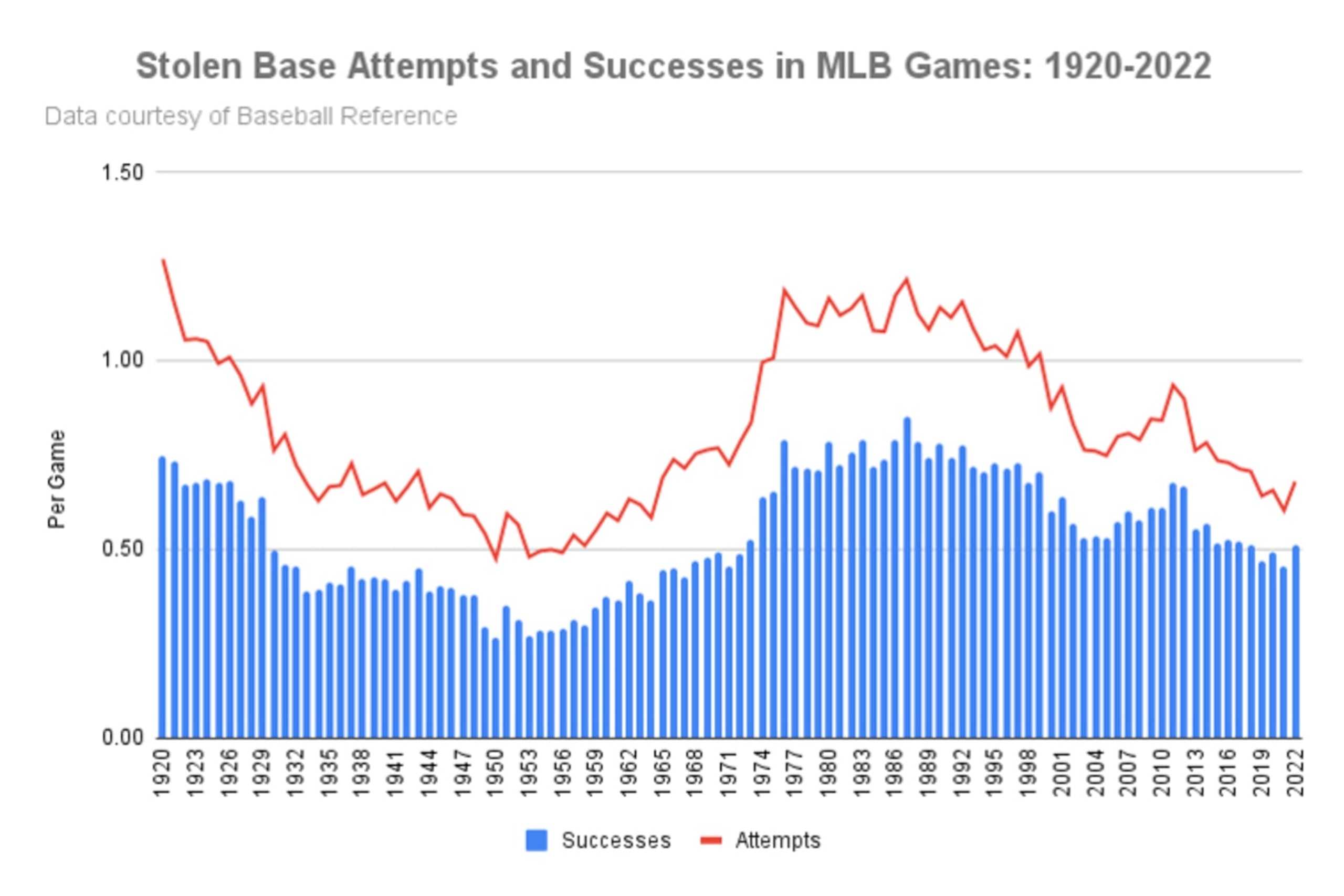
This graph makes it fair to ponder what a "normal" level of stolen bases even is for MLB, but there isn't much question what the most fun level was. There was all sorts of running going on in the 1970s, 1980s and early-to-mid-1990s, and all baseball got out of that was legends like Rickey Henderson, Lou Brock and Tim Raines.
The Ghost Runner Is Staying? Good.
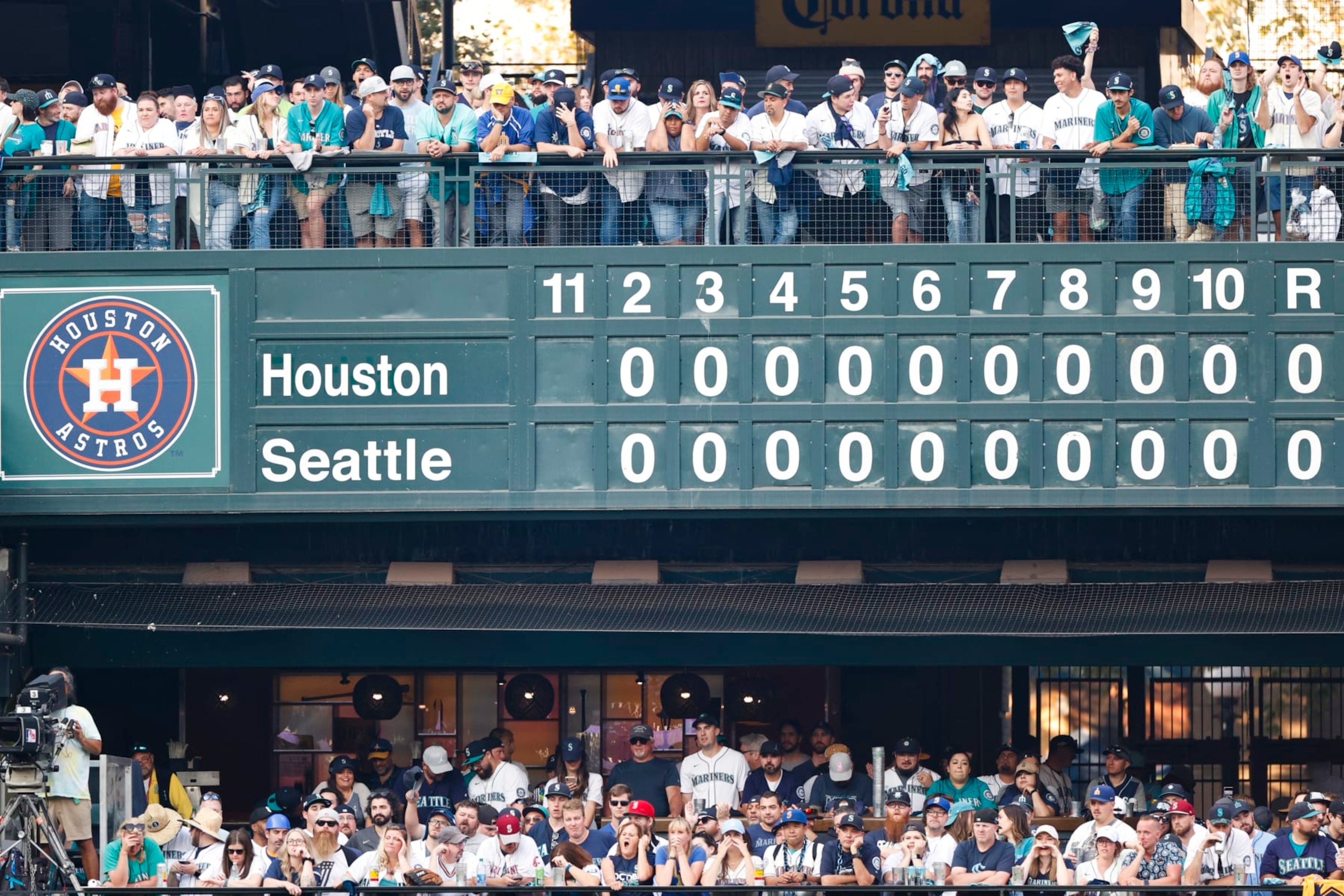
The ghost runner is good, actually.
Not so much subjectively, because, let's face it, the resurrection of the last player to make an out in the previous half inning will never not be weird. Objectively, though, the rule has worked as intended in keeping games from getting too long over the last three years.
To wit, extra-innings games were exactly as common in 2022 and 2021 as they were in 2018. But plate appearances in extras accounted for just 1.3 percent of all plate appearances in '21 and '22, compared to 2.1 percent for '18.
One might say that this is robbing baseball fans of exciting stuff, but is it, though? Because as exciting as the idea of extra-innings baseball may be, the rate of balls in play point to a different sort of reality. Since the 30-team era began in 1998, extra innings have been consistently less action-packed than innings one through nine:
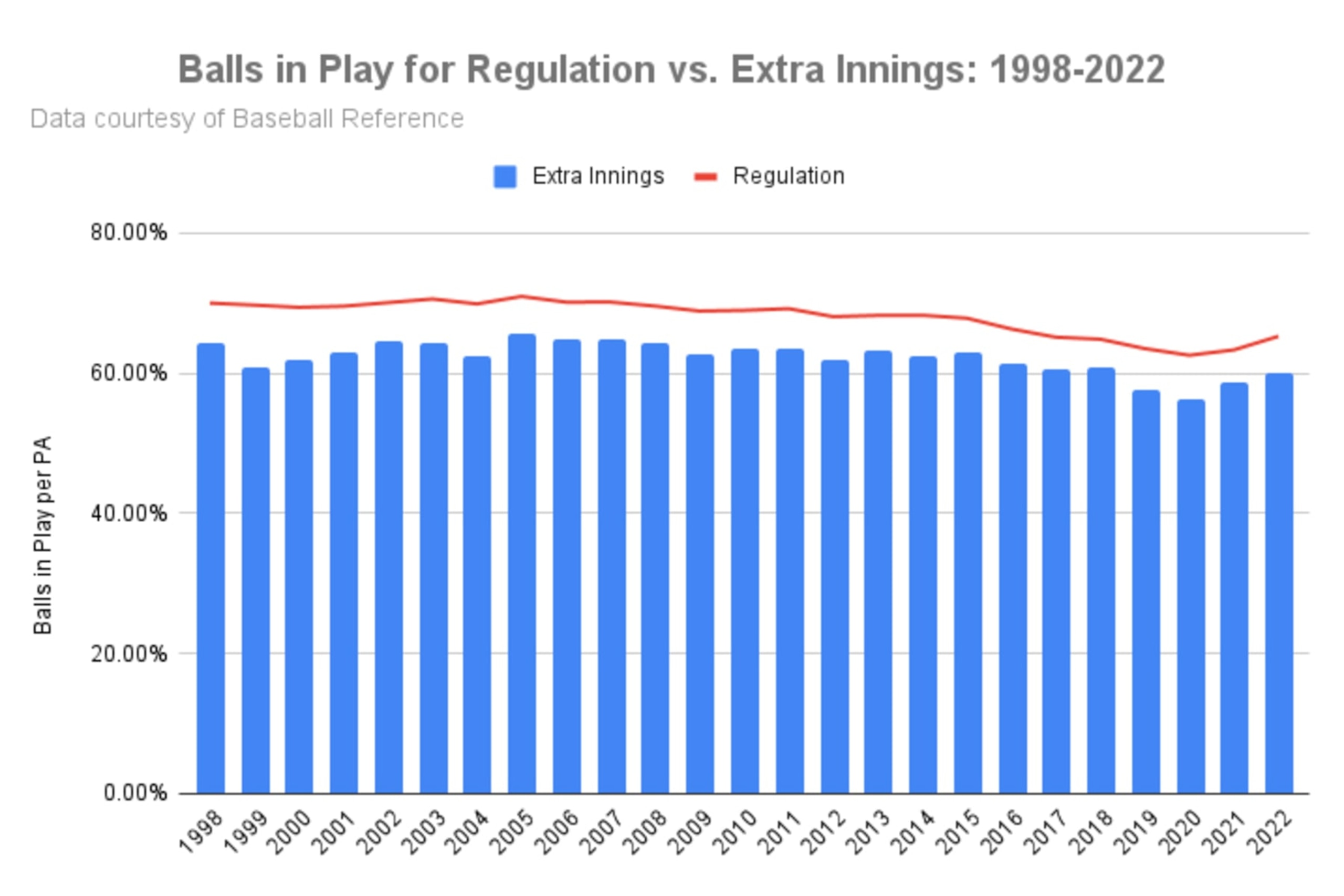
Based on this, the most interesting baseball of the day has generally already come and gone if and when extra innings arrive. That the ghost/zombie runner has resulted in fewer innings of the extra variety is a change for the better.
The TLDR version of all this is we have no notes for the changes baseball has made for 2023. And we say this even knowing that there will inevitably be unintended consequences that could necessitate future course corrections.
In any case, the time to start getting used to the new rules is now. Because just as there was after baseball legalized overhand pitching in 1884, banned the spitball in 1920, lowed the mound in 1969, enforced batting helmets in 1970 and instituted replay reviews in 2014, there likely won't be any going back on these new changes.
Stats courtesy of Baseball Reference, FanGraphs and Baseball Savant.
.png?w=2560)
.jpg?w=2560 "Grading SmackDown 🔠")


.jpg?w=2560 "Reported Details of Seahawks-K9 Split")
