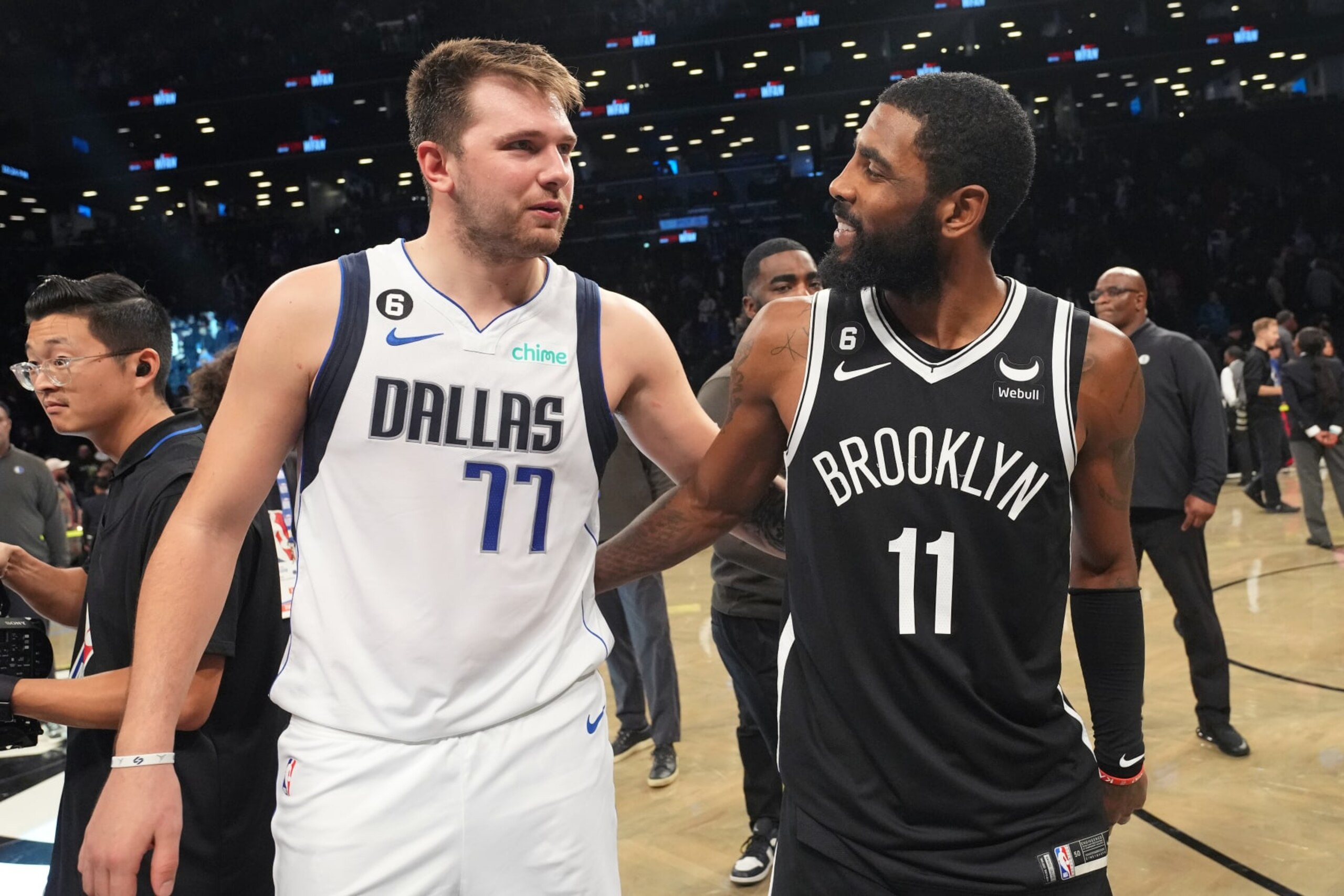


In a vacuum, the Dallas Mavericks' decision to trade for Kyrie Irving doesn't warrant overly complicated unpacking. A franchise in desperate need of a co-star for 23-year-old MVP candidate Luka Dončić just acquired a top-25 player while giving up a pair of starters, one first-round pick and two second-rounders. You do that deal, in a vacuum, 11 times out of 10.
But this deal does not exist in a vacuum. And it absolutely is complicated. From the price paid to the value added to the short- and long-term fallout, this trade is layered with implications. And evaluating it isn't so much about any singular issue as it is about the overarching stakes.
TOP NEWS
Maxey Denies Stephen A. Report 🤨
Knicks to Give Employees Rings

Power Ranking Every NBA Team's Starting Lineup 🔢
Dallas just bet everything on Kyrie Irving—including, and most critically, its future with Luka Dončić.
This does not overstate the gravity of the Mavericks' decision. The opportunity cost is not explosive on its face—Dorian Finney-Smith, Spencer Dinwiddie, an unprotected 2029 first-round pick and seconds in 2027 and 2029—but it also represents the franchise's biggest possible swing for another star.
Dinwiddie and Finney-Smith were arguably Dallas' two most appealing non-Luka players (shoutout Josh Green), and that first-round pick post-dates Dončić's scheduled free agency by three years. (He has a 2026-27 player option.) That is far from risk-free. Kyrie is 30. This pick conveys after what would be his age-36 season. The Mavs could be thrust into a completely different timeline, with or without Luka, by 2029.
Mortgaging any part of the distant future is one thing if the move transforms you into a certifiable, sustainable contender. This trade, alone, fails to do that for the Mavs.
"There's only one ball!" devoutists will bemoan the Dončić-Kyrie fit. That concern is both overstated and not without merit.
Kyrie has experience playing off other ball-dominant stars. He made it work with LeBron James in Cleveland and, on those rare occasions when both were available, with Kevin Durant in Brooklyn.
Dallas doesn't have a training camp's worth of practices to perfectly hammer out the dynamic between Luka and Kyrie. That matters. But the duo can your-turn, my-turn its way to success on the fly.
One-on-one scoring machines allow for effective simplicity. Dončić and Irving are nothing if not self-sustaining life forces. Seventy-one players have finished at least 50 isolations this season. Kyrie (second) and Luka (eighth) both rank inside the top 10 of points scored per possession.
There will be some growing pains. For all Irving's experience operating in star tandems, Dončić is another level of ball-dominant. He is averaging 6.39 seconds and 5.59 dribbles per touch this season. By comparison, Durant is at 3.76 seconds and 2.68 dribbles.
Establishing the new world order will still be a larger adjustment for Dončić. Kyrie is the first player he's ever been paired with that, by both necessity and design, will displace him from the ball to at least some extent. Dončić has little experience leveraging himself as an off-ball scoring threat. Almost 88 percent of his baskets this season have gone unassisted, and spot-up jumpers have only once accounted for more than 7 percent of his total looks, all the way back in 2018-19, his rookie year.
Staggering Dončić and Irving will offer reprieve from any functional warts—and is the most tantalizing benefit of this trade. Dallas' lineups without Luka rank inside the 7th percentile of offensive efficiency and were only a hair better during Dinwiddie's solo stretches (12th percentile). Kyrie should put a higher ceiling on those minutes.
Granted, one-star stints won't be as prevalent in the playoffs. But you have to survive the regular season first. And the smart money is on Dončić and Irving figuring it out on offense, even if it's chemistry through separatism.

The Mavs' defensive survival is less of a given. They rank 22nd in points allowed per possession—25th since Jan. 1—and just traded away their most important perimeter defender in Finney-Smith. Going from Kyrie to Dinwiddie on the less-glamorous end is no picnic, either. Irving is feisty when locked in, but at 6'2", he doesn't wield the same size as the 6'5" Dinwiddie.
Leaning more on the highly disruptive Josh Green and Reggie Bullock won't offset the difference. Maxi Kleber's return from a hamstring injury will go a long way. The Mavs were 16th in points allowed per possession when he went down. Whether he has the same impact independent of Finney-Smith remains to be seen. The numbers are promising, but the sample is limited and aided by cold opponent three-point shooting.
This doesn't render the Kyrie trade a lateral move. (Though, it could be.) More than anything, it seems to leave Dallas one or two non-blockbusters away from genuine contention. That's a pretty comfy spot to be...provided you have the asset ammo to acquire what you're missing.
The Mavs might. Christian Wood has some value on an expiring contract, and they can fork over two conditional first-rounders, in 2025 and 2027, if the right opportunity comes along.
Still, Dallas isn't outbidding anyone for the flashiest names. That's not a stark departure from where the Mavs were before the Kyrie trade, but this finite-asset position is now more permanent. They could have offered up to four first-rounders and three swaps this summer, after their top-10-protected pick to the New York Knicks conveys. That scenario is dunzo.
Which, like, whatever. The Mavs' offseason blockbuster package was theoretical. Kyrie's arrival is actual. There's no guarantee they could have landed someone better over the summer, and even that all-in offer could be topped by competing suitors with blue-chip prospects on the table.
This doesn't inoculate Dallas against harsh critique. If there's anything we know about #ThisLeague, it's that the next superstar trade scenario or demand is just around the corner. The Mavs have essentially decided they wouldn't—or couldn't—get anyone better than Kyrie to pair with Luka over the next few years. That's a pretty flimsy assumption to make.
The fragility is in Dallas' logic. It acquired Irving without guaranteeing him a long-term deal will be waiting over the offseason, according to NBA reporter Marc Stein. This is, um, quite the stance to take after the Mavs just traded away an unprotected first-rounder that doesn't convey until seven drafts from now.
Letting Kyrie walk would be a catastrophic misallocation of assets. Dallas didn't get off any of its less-savory money in this trade and can't just pivot into a glittery contingency. Sure, it will have cap space if Irving leaves or doesn't pan out. But that spending power barely creeps above $20 million. The Mavs will need to ditch Bullock's partial guarantee ($5.4 million) and/or stretch-and-waive some of the harder-to-move crummier contracts just to sniff $30 million.
Chiseling out anything near true max money mandates even more salary-cap gymnastics. And to what end? If Dallas isn't keeping Kyrie and James Harden (player option) is happy in Philadelphia, the next-best free agent is Khris Middleton (player option) or Fred VanVleet (player option).
Good-not-great options won't do anything to overshadow what a monumental failure this move becomes if Irving doesn't stick around. Even if they don't dangle a four- or five-year max, the Mavs are obligated to bring him back on a longer-term deal.
That is hardly a settling notion. Kyrie's talent is inarguable, but so, too, is his complete lack of reliability. He ranks 151st in regular-season minutes played since 2019. Kristaps Porziņģis, the availability-challenged running mate Dallas jettisoned at last year's deadline, has racked up more court time during this stretch:
Select corners of the internet have twisted themselves into a pretzel pointing out that a huge swathe of Kyrie's absences over this span had nothing to do with injury. That is part of the problem.
Irving rendered himself ineligible for Brooklyn Nets home games last year by refusing to get the COVID-19 vaccine. He missed eight games this season after the team suspended him for "publicizing a film containing deeply disturbing antisemitic hate" and then failing, on numerous occasions, to "disavow antisemitism." (Irving eventually did apologize.) And this says nothing of the actual injury-related absences he has amassed over the years—or the circumstances under which he's now left every. Single. Team.
This is the same Kyrie who requested a a trade from the Cleveland Cavaliers while playing beside prime LeBron and on the heels of making three straight Finals appearances. It is the same Kyrie who left the Boston Celtics after declaring his intent to re-sign.
It is the same Kyrie whose refusal to get the COVID-19 vaccine torpedoed a championship favorite, exacerbating the workload placed upon Kevin Durant last season while driving James Harden out of town. It is the same Kyrie who tried to find a sign-and-trade away from the Nets, the team he chose in 2019, only to return when he couldn't.
And it is the same Kyrie who then requested a trade barely two weeks after saying this:
Feel free to believe things will be different in Dallas. You're kidding yourself. We now have three teams' worth of evidence that, no matter how good things look on the court, Kyrie's tenure is going to end poorly—and most likely without a title.
This is the player on whom the Mavericks burned their best blockbuster-trade swing. Deeming it risky is the charitable slant. It verges on reckless.
For as much as Dallas needed to find Dončić a co-star, it didn't have to operate with this level of urgency. He has three years until he can enter free agency, which gives the Mavericks two full seasons before they must grapple with pre-agency and the trade speculation, if not demand, that comes with it.
That isn't eternity. It's also not imminent. At the very least, it's more than enough time to pass on a move that, and on a player who, guarantees you, quite literally, absolutely nothing.
Running this decision by Dončić—as the Mavs did, per Stein—doesn't change the calculus. His stamp of approval offers (some) in-the-moment cover. It won't mean a damn thing a few years down the line if Kyrie has already transitioned to his next endeavor and/or Dallas remains on the outskirts of title contention.
Maybe it all works out. The Western Conference is wide open, and Kyrie was just distraction-free for, like, two months or so. Dallas could make another, not-as-big move. Or two.
Maybe Irving himself is enough to nudge the Mavs over the hump. Failing that, maybe he's pretty damn close—someone who's available and complementary enough to keep around and preserve Dallas' reign atop the "Almost There" throne.
The Mavs, for their sake, need to hope Irving's arrival guarantees at least that much. They will have botched another opportunity to optimize Dončić's window and, potentially, their chance to retain him beyond his current contract if it doesn't.
Unless otherwise noted, stats courtesy of NBA.com, Basketball Reference, Stathead or Cleaning the Glass and accurate entering Monday's games. Salary information via Spotrac.
Dan Favale covers the NBA for Bleacher Report. Follow him on Twitter (@danfavale), and subscribe to the Hardwood Knocks podcast, co-hosted by Bleacher Report's Grant Hughes.


.jpg?w=2560 "Grading SmackDown 🔠")
.jpg?w=2560 "Reported Details of Seahawks-K9 Split")