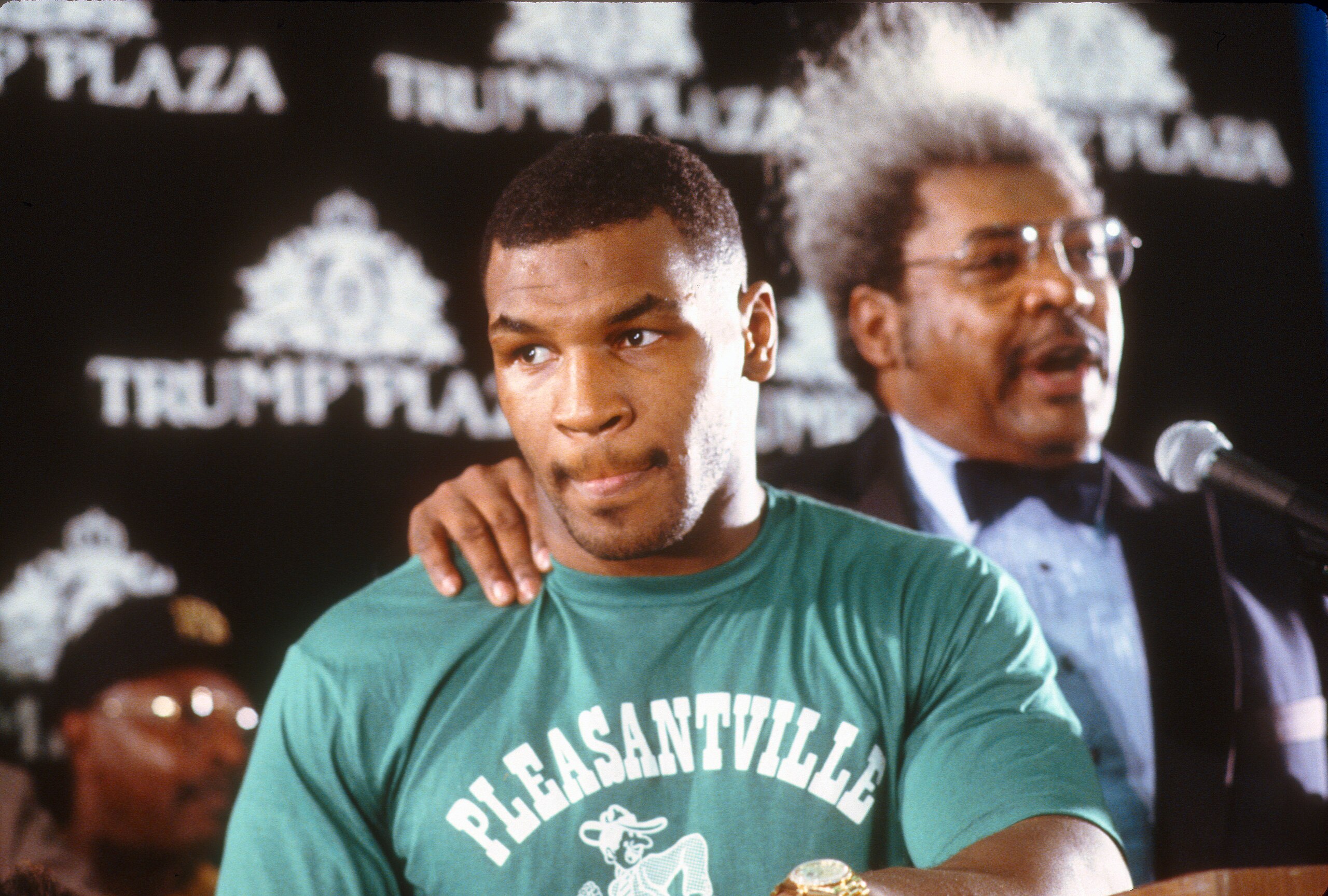

Top Quotes, Moments and Reaction from 'Mike Tyson: The Knockout' on June 1
Toward the end of the second and final part of ABC's Mike Tyson documentary The Knockout, Tyson is asked what he wishes he could tell his younger self.
The preceding two hours of footage had covered Tyson's rape conviction, his nearly three years in prison, a return to boxing once he got out and more legal troubles after his fighting days ended.
Yet Tyson didn't key in on any particular moment in answering the question. Instead, the former heavyweight champion got quiet before finding the message he wish he would've known as a child.
TOP NEWS
.jpg?w=2560 "Cardinals Giants Football")
NFL investigating 2 referees for separate viral exchanges

Deion Playbook Found at Hotel
.jpg?w=2560 "Hill Injury Update Football")
Report: Chiefs Contact Hill's Agent
"It's gonna hurt," Tyson finally responded. "It's gonna hurt bad. It's gonna really hurt. Life's gonna hurt him really bad."
Part two of The Knockout began with Tyson on trial for rape in 1991 and showed the difficulty in convicting him.
"The first 'Oh, no' moment was an entire city block lined up with satellite trucks. ABC, NBC, CBS, CNN, ESPN, all these. It's the big time," prosecutor Greg Garrison said, adding that the anxiety was making him sick.
That was just a prelude to the strength and courage displayed by Desiree Washington, who at the time was 18 years old and going up in court against a beloved boxer who had raped her.
One thing the documentary makes clear is that without Washington's testimony and her ability to explain what happened to her, the issue of date rape in America would not have been as openly considered and discussed.
"There was this quiet gasp in the gallery," Garrison recalled of Washington's testimony. "She was 106 pounds. Just a delicate, little thing, and so the juxtaposition of him at 240 [pounds] ... and her at 18 years old was pretty powerful stuff."
ESPN's Jeremy Schaap noted that Tyson's release from prison in 1995 would've been handled much differently in 2021 than it was then—specifically that Tyson would've been held to a different standard and not as openly embraced as a celebrity again the second he was freed.
But in 1995, Tyson was able to quickly get back in the ring and reclaim his boxing status with victories over Peter McNeeley, Buster Mathis Jr., Frank Bruno and Bruce Seldon. That led to the first of two fateful showdowns with Evander Holyfield with the WBA heavyweight title on the line.
Holyfield won the first meeting in November 1996 by technical knockout. Tyson would be disqualified from the rematch months later for biting a piece of Holyfield's ear off.
Tyson only grew more withdrawn from there, becoming as much of a bully outside the ring as he was inside it. Friends and family recalled knowing then that Tyson was done as the champ.
"Whether it was by design or not, he played exactly the role the media wanted him to play," ESPN's Mark Kriegel said. "He wanted to play the bad guy, and we wanted him to play the bad guy."
Tyson told Schaap in 2003 he got the now-infamous tattoo on his face "because I hate myself. Because I was sick at looking at myself in the mirror."
The next change in Tyson came after the death of his four-year-old daughter, Exodus, in 2009. The overwhelming grief led Tyson to enter therapy and begin trying to atone for his past actions.
In 2013, Tyson reconciled with his former trainer Teddy Atlas after a nasty falling out. A few years later, during an appearance with Oprah Winfrey and Evander Holyfield in 2016, Tyson tried to make peace over the biting incident and wound up shaking hands with Holyfield.
The documentary tried to show Tyson has been both a victim and an abuser throughout his life, trying to reconcile one with the other. The result was a portrait of a man still coming to terms with himself, his history, his actions and, most importantly, the pain that has flown both ways because of it.
"Life has beat me into submission," Tyson said. "Life was tougher than me, so I’m trying to go the other way now. ... I'm committed and living the other way. I learned gratitude. This is what I learned from life kicking my ass. I learned gratitude."
.jpg?w=2560 "Titans Giants Football")

.jpg?w=2560 "Tyreek makes another cryptic post amid Chiefs rumors")


.jpg?w=2560 "Greenlaw Talks Payton Exchange")
