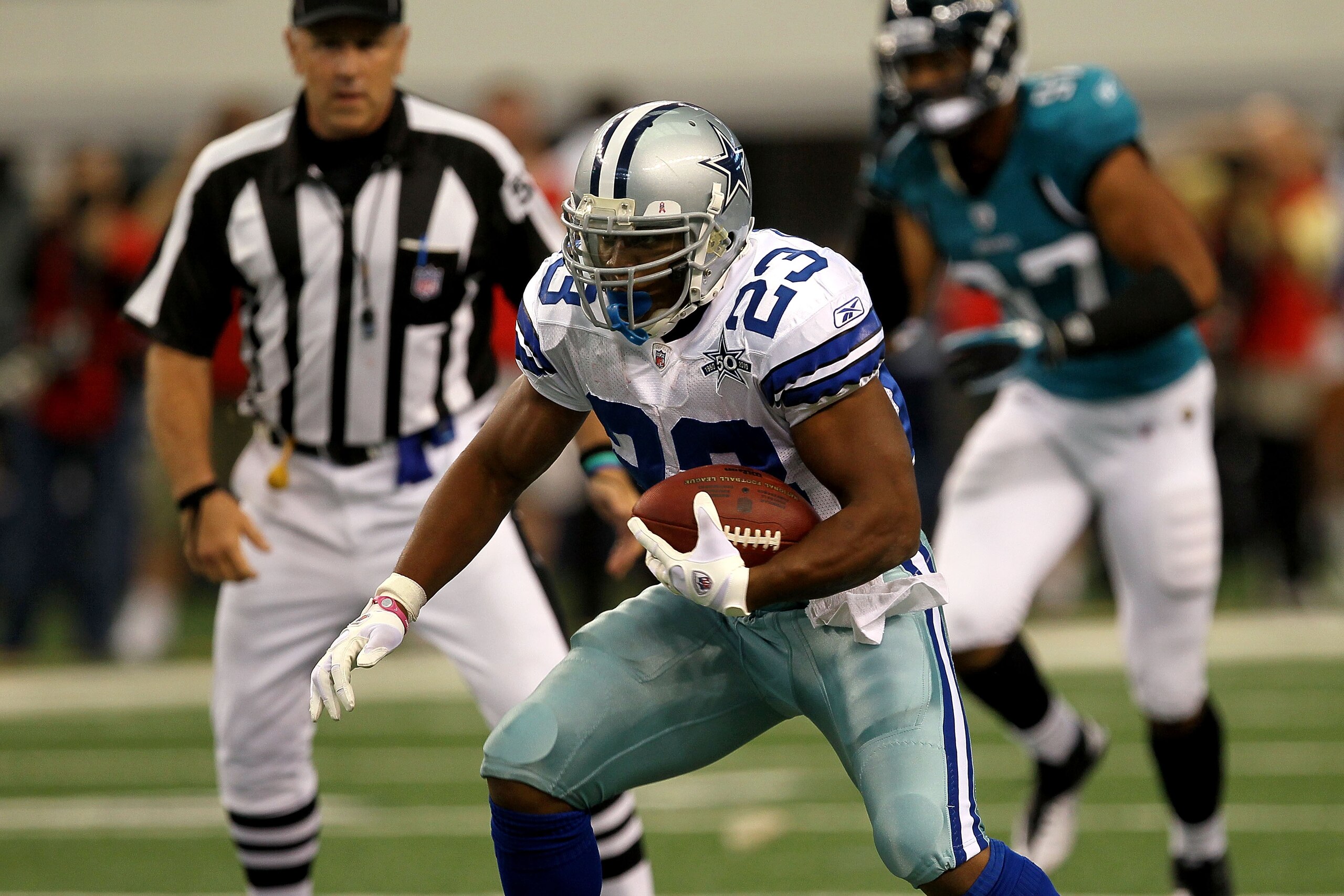

Dallas Cowboys' Tashard Choice, Roy Williams, Marion Barber: Stay or Go in 2011?
Tashard Choice burst onto the scene in Dallas in 2008 with stellar rushing performances against some of the NFL's toughest defenses. With Marion Barber and Felix Jones both out due to injury, the Dallas Cowboys found themselves down to one running back, and Choice was forced to carry the load by himself.
Since then, however, he has been wasted on the sidelines for two years while the circus act of an offense for the Cowboys ground to a halt. He became the third-down back in the offense and ran the wildcat offense while Jason Garrett showed off his masterful offensive skills to the world.
With his rookie contract set to expire at the end of the 2011 season, both he and the Cowboys have a decision to make regarding his future.
Another issue facing the Cowboys is what to do with Roy Williams. In 2010 he and Tony Romo finally seemed to be on the same page, and Williams looked as if he would finally be able to silence critics of the 2008 trade with the Detroit Lions that brought him to Dallas.
Williams' 2010 production, however, would be overshadowed by the collapse of the Cowboys in 2010. Add to that the emergence of Miles Austin in 2008 and the addition of rookie sensation Dez Bryant in 2010, and Williams' value to the Cowboys still remains in question.
Now that Garrett has been named as the head coach of the Cowboys with a four-year contract, decisions on the fate of both Choice and Williams are among the major issues facing the Cowboys as they prepare to salvage what was left of the 2010 season with the ninth pick of the 2011 NFL draft.
And, should the Cowboys cut ties with Marion Barber in 2011?
These are just three of the issues that Garrett must make a decision on—preferably before the 2011 NFL draft. The status of both Williams and Choice could make a huge impact on how the Cowboys will be structured in 2011, and these questions need to be answered by the time the Cowboys begin to make their selections in the draft.
Tashard Choice: Cowboys Must Committ, Pay Him and Play Him or Draft Replacement
1 of 4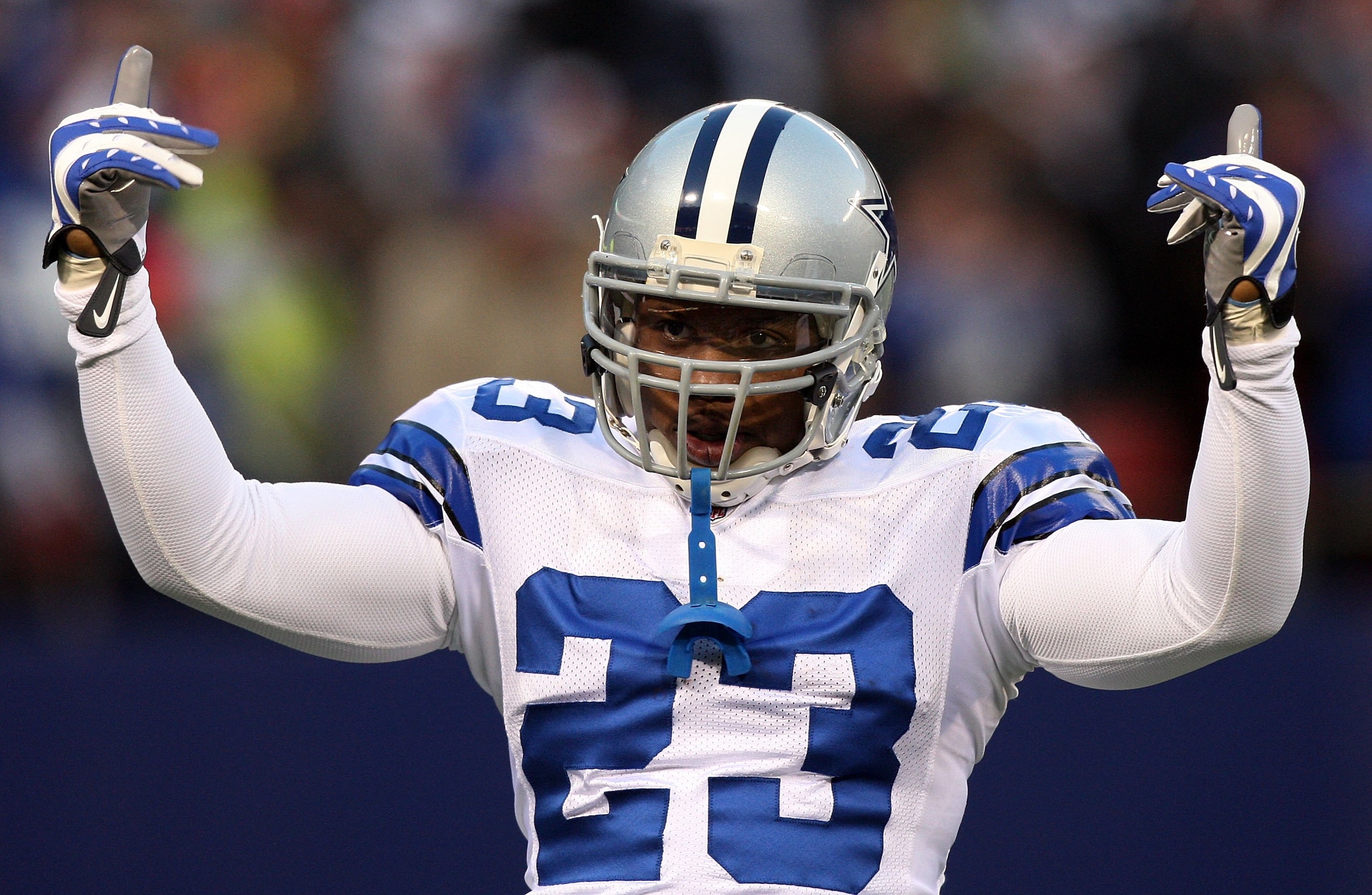
With the exception of a five-game stretch in his rookie year in 2008, Choice's career up until this point has been largely a waste of good talent.
As a rookie in 2008, Choice showed his potential by gaining 472 yards on 92 carries—including a five-game stretch in which he carried the load at running back by himself after both Barber and Jones went down to injury.
During that five-game span, Choice put up solid numbers against some of the league's best defenses—including the Pittsburgh Steelers, New York Giants and Baltimore Ravens.
Choice also added 185 yards receiving on 21 catches, including one 50-yard reception. His emergence breathed new life into a running game that had stagnated with Barber in the backfield.
Since then, however, Choice's touches have been limited.
In 2009, despite his production in the previous season, Choice was limited to only 64 carries, which he transformed into 349 yards with a 5.5 yard per carry average. It was as frustrating for the fans of Choice as it was for Choice himself, as it became increasingly clear that Barber was not the answer for the Cowboys running game.
In 2010, Choice was benched while the Cowboys offense attempted to figure out their issues after Michael Irvin publicly declared that Choice should not see the field unless either Barber or Jones were injured.
After Barber once again went down to an injury in 2010, Choice finally got his chance—and put up 100 yards in his first game against the Indianapolis Colts. After that, Jerry Jones declared that Choice had earned more carries for the remainder of the season.
Duh.
But there is another twist to this story, one that both Choice and the Cowboys must address before the 2011 draft.
With Choice's rookie contract up at the end of 2011, the Cowboys must make a decision regarding their intentions towards him. He has received less than $500,000 per year for each of his first three years and will certainly want to get paid a more competitive salary for a running back with his talent at some point.
Choice also must make a decision before the 2011 regular season begins as to his wishes to remain in Dallas. At 26 years old, he cannot afford to waste any more years while the Cowboys figure out what act they are going to run on offense. Choice has been the victim of a terrible rookie contract, one that made it easy for the Cowboys to set him aside while they played the overpaid Barber and the higher-paid Jones.
Choice's leadership and passion for the game is unquestioned and his production has been stellar when the Cowboys feed him the ball. Without a commitment from the Cowboys that will ensure that he will no longer be set aside, Choice cannot afford to see another year of his career wasted.
He is the only one of the Cowboys' three running backs that has shown he can carry the load as an every-down back. Both Barber and Jones have suffered nagging injuries during each of the past three seasons that limit their playing time, while Choice has done all that is asked of him without question.
If the Cowboys do not commit to Choice, he would be well advised to seek another team that will use him in accordance with his talents.
The questions surrounding Choice carry with them implications as to how the Cowboys may choose to deal with Barber, as well as how to use their first-round pick of the 2011 draft.
Some analysts predict that the Cowboys may go after Alabama's Mark Ingram with their first-round pick, and declining to secure the services of Choice very well could be an indicator of their intentions to do so.
Neither Jones nor Barber have shown the ability to stay healthy for a full season, and the Cowboys will need to draft a running back to carry the load while they are down.
If the Cowboys continue with Barber, don't look for the running game to get any better any time soon.
Roy Williams: Can Cowboys Afford to Let Him Go?
2 of 4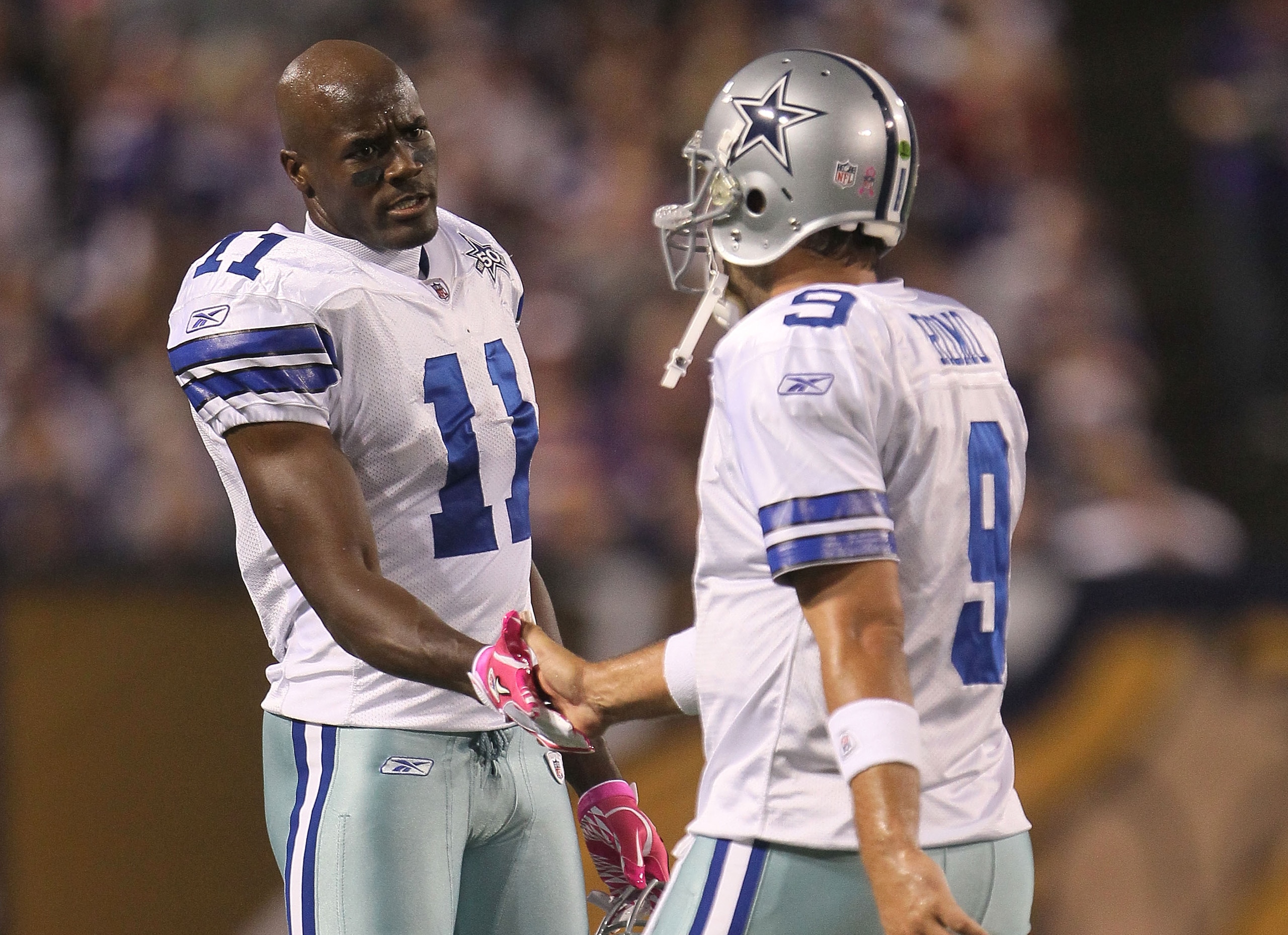
In October of 2008, Williams was brought to Dallas from Detroit in a trade that gave Detroit the Cowboys' first-round pick of 2009.
It was a move that drew instant criticism from many of the media and analysts surrounding the Cowboys.
When Williams failed to immediately become the "go-to" guy for Romo in 2008 and again in 2009, it only fueled contempt from the media for Jones' decision to make this deal happen. Williams' struggles with dropped passes seemed to reinforce those that were bashing Jones for making such a deal.
Add the unexpected emergence of Austin in 2009 as a superstar wide receiver and then the acquisition of rookie sensation Bryant in the first round of the 2010 draft, and it was a foregone conclusion that Williams should be cut or released after the 2010 season.
But in 2010, Williams finally developed a rhythm with Romo. His spectacular catches while taking vicious hits began to win over some of the critics of the trade, and he began to be the receiver Jerry had imagined he would be when he made the deal.
Most of these analysts who criticized Williams failed to take into account that Romo had been throwing to Austin, Jason Witten and even Terrell Owens since he was just a backup. It was only natural that it would take time for the relationship between him and Williams to develop the cohesion and trust that Romo shared with the players he had come up with.
It takes years sometimes for a quarterback and a receiver to develop that relationship, and it was not surprising to see Williams and Romo struggle in their first year-and-a-half.
While many dislike the attitude and quips of former Cowboys wide receiver Patrick Crayton, few would argue that Romo missed having him in the huddle as a trusted target after his departure to San Diego.
With Williams and Romo now sharing that same trust, losing him would certainly affect Romo.
As for the financial considerations surrounding whether or not to keep Williams, most don't realize that the Cowboys would actually be better off keeping him.
Williams' salary for 2011 is $5.1 million, but he will count as $9.4 million against a salary cap that will most certainly return. However, if the Cowboys were to release Williams, it would mean that the remainder of his signing bonus would count against the 2011 cap, and that figure would be right at $13 million. That figure does not include paying someone to take his spot.
It's a cap hit that the Cowboys can't afford to take, and with Williams and Romo finally developing that much-needed cohesion between quarterback and receiver, the Cowboys would be hard-pressed to justify letting him go.
Keeping Williams means stability in the passing game. It means that Romo keeps four receivers that he is used to, and when defensive linemen are closing in on a quarterback, having that relationship with whomever he chooses to throw to is a priceless intangible that the Cowboys cannot afford to lose.
The decision to part company with Williams would most likely result in a trade for players and/or picks in the 2011 draft, with which the Cowboys could use to shore up other areas where they are less endowed, but the guarantees of finding the right player are always slim.
If the Cowboys expect to return to the playoffs in 2011, taking away a weapon that Romo is comfortable with could very well be counterproductive.
Marion Barber: Cutting Barber Means Immediate Improvement in Cowboys Offense
3 of 4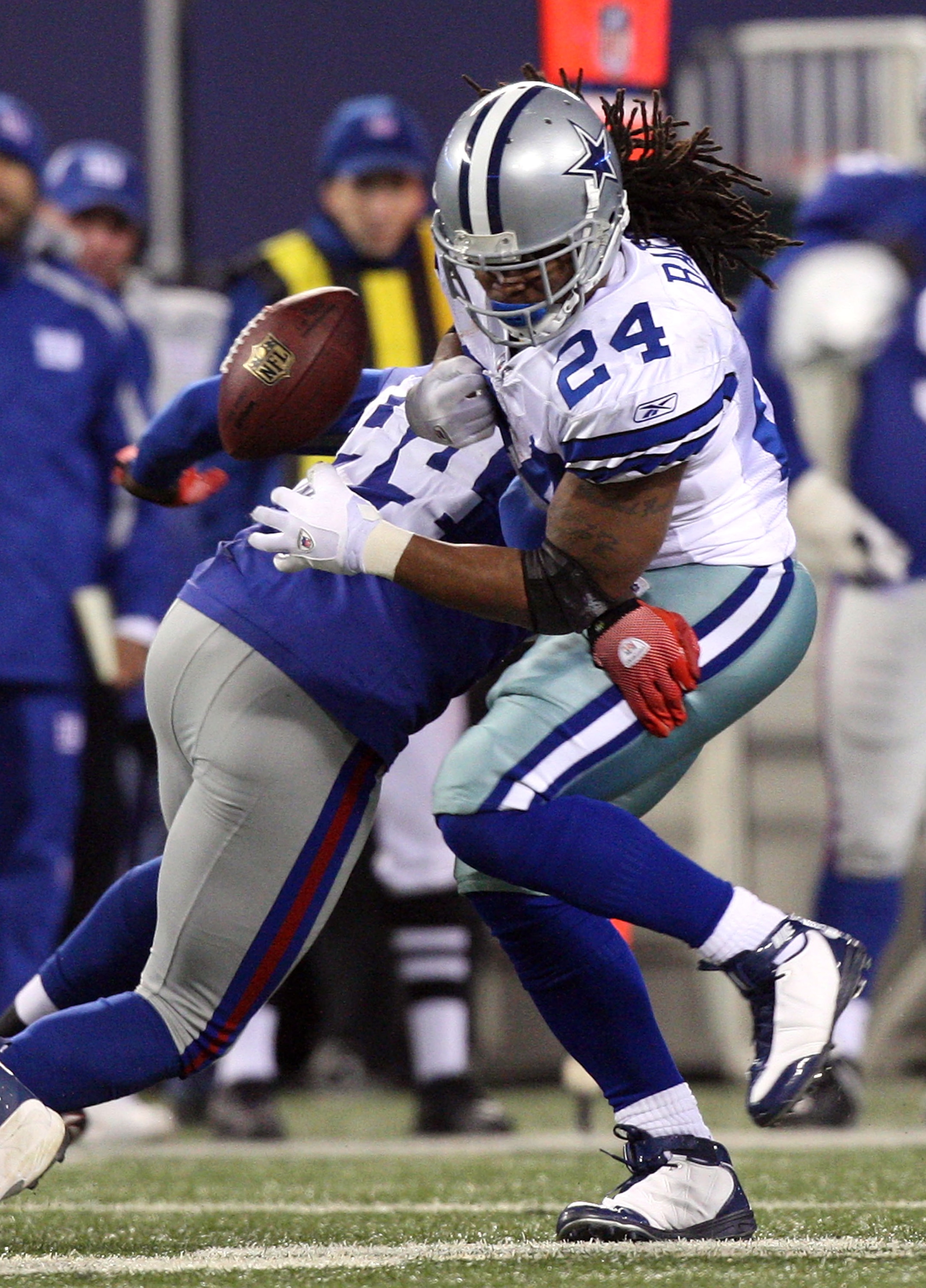
Outside of JaMarcus Russell, Barber may well be the biggest bust in the history of the NFL.
I don't dislike Barber personally, but the production he has brought to the Cowboys has fallen far short of what a seven-year, $45 million contract warrants. Just as bad, Barber's inability to to remain upright has been more and more in question, as his tendency to fall flat on his face in open field is getting downright embarrassing.
Barber's speed isn't much to write home about, and with the fatigue from trying to carry the load as a feature back, it has gotten worse. Many times a hole seems to open in a line, only to close again before Barber gets there.
The Cowboys cannot afford to waste offensive plays where Barber will be stopped for no gain when Choice or Jones could actually produce with the same holes.
The offensive line might look better if the running back actually gets to the line of scrimmage before the hole closes.
The Barber story is a very good lesson to "mediots" (reporters without a clue) and analysts who fail to take into account the conditions surrounding the appearance of success of a player.
Under Bill Parcells, Barber was used as a change-of-pace running back. With Julius Jones carrying the load for the Cowboys offense, Parcells would use Barber as the change-of-pace back with fresh legs in the second half of games—after the opposing defenses began to tire.
Parcells would also bring in Barber at the end of a drive when the opposing defense was already broken and winded, and the result was often an untouched, two-yard trot into the end zone. With Barber being rested, he had amazing energy and could blast past the worn-out defenders.
Fans and media alike began to refer to Barber as "Marion the Barbarian" because of what they perceived as a physical, hard-hitting back that struck terror into the heart of defenders. In reality, all they were seeing was a guy with a vicious—not powerful—running style. When running against a tired defense, this created the illusion that Barber was actually more of a beast than a man.
The results were spectacular statistics and highlight reels with Barber in the picture, but also one of the biggest mistakes in Cowboys history.
In 2007, Jones signed Barber to a seven-year contract worth $45 million and $16 million guaranteed—without first finding out if he could carry the load as a starting running back.
When Barber became the starter in 2007, it was only a matter of time before the pounding he was taking from defenses that were fresh began to take its toll. Barber has yet to put up 1,000 yards in a season, and most likely never will.
The "Barbarian" never reappeared, and in 2008 there were even occasions when a smaller player would tackle him with one arm, and strip the ball from him with the other. In the 44-6 debacle versus the Philadelphia Eagles in 2008, Barber was pushed out of bounds and stripped of the ball, and the Eagles returned the fumble 96 yards for a touchdown.
The result is that Jones has paid out in the neighborhood of $22 million for about 3,166 yards over four seasons. What's worse is that handing the ball to Barber was more often than not a waste of an offensive down, when both Jones and Choice would have been more productive.
Barber's repeated inclination to try and run the ball to the outside on critical plays defies explanation, as if no one has ever told him that he's just not fast enough to get there.
Too many drives have ended with a handoff to Barber that he tried to run to the outside, or simply didn't make it back to the line of scrimmage.
Barber still can be a fantastic part-time player when the defenses are tiring out, but not for $45 million.
It's past time for him to be gone.
.jpg?w=2560 "Colts Football")
.jpg?w=2560)
.jpg?w=2560 "Commanders 49ers Football")
Dallas Cowboys Approach to 2011 Draft Begins with Answers to These Questions
4 of 4
How the Cowboys approach the 2011 draft is largely dependent upon how they choose to address the futures of Choice, Williams and Barber.
Should the Cowboys choose to commit to Choice, the need to select a running back in the 2011 draft will be diminished.
If the Cowboys should decide that the addition of Bryant makes Williams expendable, they could use Williams' value to negotiate a trade for either a player or a draft pick—or both—with which they could use to address other positional needs.
Such a trade could possibly work to the Cowboys' favor financially, and with Williams under contract for at least the 2011-2012 seasons, any team that became interested could be reasonably assured of getting real value, and therefore the trade value of Williams is reasonably high.
And lastly, the Cowboys' decision to cut or release Barber will immediately improve their offense by eliminating wasted plays in which the ball is handed to him.
Should Barber wish to re-sign at a more realistic price, he could return to being a part-time runner that could once again terrorize tired defenses late in games. Against the Arizona Cardinals on Christmas Day of 2010, Barber showed a flash of the brilliance that he is capable of when he doesn't have to carry the load with a spectacular 24-yard run.
All in all, how the Cowboys approach these three issues will also signal what to expect from the Cowboys offense in 2011. Should the Cowboys decide to trade Williams, it will serve as a slight hint that the Cowboys are indeed planning to move away from a pass-happy approach, as the prowess of their vaunted receiving corps would be greatly reduced.
The decision to commit to Choice could also signal a move towards a more conventional offense, as the Cowboys would be more likely to use their 2011 draft choices to help reinforce an aging offensive line, as well as their linebacking and defensive secondary corps.
The Cowboys' approach to 2011 begins with these decisions, and their approach to the 2011 draft will reflect their confidence in that approach.
That's the bottom line.
.jpg?w=2560 "DOLPHINS-AIKMAN")
_0.png?w=2560 "Unranked Teams Cause Chaos in Rankings 📊")

.png?w=2560 "Week 8 Winners & Losers 📊")





