World Series 2010: Texas Rangers-San Francisco Giants Starting Rotation Profile
Ladies and gentlemen, your 2010 World Series combatants—the Texas Rangers and the San Francisco Giants.
Fox television executives may not love it, and there are loads of disgruntled Yankee and Phillie fans grumbling about the legitimacy of this version of the Fall Classic. But this World Series promises to be a thrilling affair.
The defending champions of each league were sent packing, each bitterly disappointed that their dreams of a series rematch would never be realized. Last year's World Series entrants both swept their divisional series foes, only to run into hungry squads that refused to be intimidated by the New York and Philly postseason pedigrees.
Texas has been generally regarded as a potent offensive juggernaut, but as it proved in its thorough dismantling of the New York Yankees, the Rangers can certainly pitch with the best of them. Midseason arrival Cliff Lee and his stellar postseason resume lead the way. But C.J. Wilson, Colby Lewis and Tommy Hunter form a diverse rotation capable of silencing the bats of the opposition, even the vaunted Yankee lineup.
San Francisco on the other hand, may have surprised its opposition with its offensive output, as the Giants earned their way to the World Series primarily on the strength of their pitching and, of course, their beards. Led by two-time defending Cy Young winner Tim Lincecum, the Giants boast a thrilling, young starting staff that should have Bay Area fans excited about the next several years.
With Game 1 rapidly approaching on Wednesday, let's take a look at the starting pitching rotations for each team. Since Texas hasn't quite decided in which order it will trot out its starters and which hurler will occupy the fourth slot, we'll profile the pitchers in contention for those roles.
Texas Rangers' Game 1 Starter Cliff Lee
1 of 8
Though the Rangers haven't yet definitively set the rest of their rotation, this much is certain: Cliff Lee is starting Game 1. When you have a man who can legitimately lay claim to being one of the most dominant starting pitchers that MLB postseason baseball has ever seen, you want him to pitch as early and often as possible.
When Texas swooped in and acquired Lee in a trade with the Mariners, right from under the noses of the Yankees, no one realized quite how impactful the trade would eventually become. The Yankees thought that they had a trade for the ace lefty agreed upon, but Seattle decided that it liked the Rangers' offer better and decided to trade him within the division instead.
Lee's regular season stint with the Rangers wasn't as impressive as his first half with the Mariners when he was 8-3 with a 2.34 ERA, 0.945 WHIP and absolutely astounding strikeout-to-walk ratio of 14.83-to-1. However, he still served to solidify their rotation as he posted an ERA of 3.98, with a WHIP of 1.06 and strikeout-to-walk ratio of 8-to-1. His performances fluctuated down the stretch as he coped with pitching in the late summer heat in Arlington and back tightness that lingered down the stretch.
They didn't necessarily trade for Cliff Lee for the regular season anyway, as they already led the AL West by 5.5 games. Of course, they wanted to solidify their position as the division leaders, but Texas had their eyes on bigger and better prizes once the playoffs would begin. The Rangers needed an ace to lead their staff if they were to accomplish the goals stated by team president Nolan Ryan prior to Opening Day.
Once the playoffs began, Texas' acquisition of Cliff Lee came to be viewed as a masterstroke. His dominant eight-inning, ALDS Game 1 performance against the Rays at the Trop set the tone for the series. After the Rays evened the series at two games apiece, the Rangers once again turned to Lee for the decisive Game 5. The indomitable lefty once again shut down the Rays, this time with a complete game, allowing only one run, and striking out 11 while walking none. If the league named Most Valuable Players for the division series, Cliff Lee would have taken the award home.
Against the Yankees in the ALCS, Lee's services weren't available until Game 3, due to his outing in the final game of the previous series. With the ALCS tied at one game each, Cliff Lee pitched what was potentially the most important game of the series, as he completely subdued the Yankee offense in Yankee Stadium, throwing eight shutout innings, allowing only two hits, one walk and striking out 13. The series never made it far enough for Lee to be required again, as the Rangers defeated the Yankees in six games, and New York was left to dream of what might have been.
Cliff Lee is turning in the exact type of performances the Rangers dreamed of when trading for him. Thus far he is 3-0 with a 0.75 ERA and an almost unbelievable 34-to-1 strikeout-to-walk ratio this postseason. All told, in eight career playoff starts, Lee is 7-0 with a sparkling 1.26 ERA, earning a reputation as one of the greatest postseason pitchers we have seen in baseball's modern era.
Certainly not a bad way to start off any playoff series. The Rangers will hope to win the World Series and entice Lee to resign with them in the offseason, forgoing the offers of other contenders to lead the Texas rotation for several more years.
Texas Rangers' C.J. Wilson: Probable Starter For Either Game 2 Or 3
2 of 8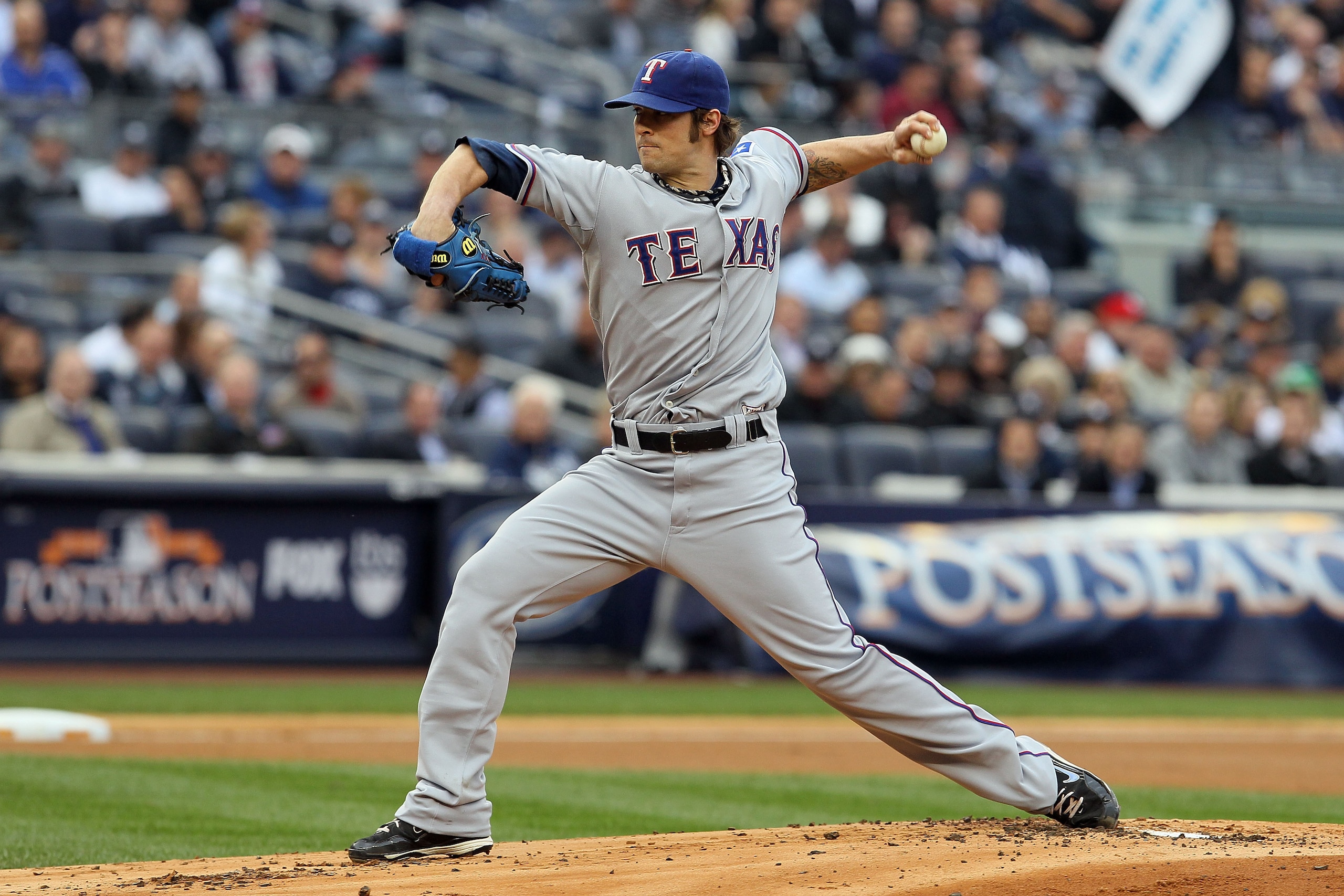
Ron Washington has yet to announce whether he will send Wilson to the hill following Lee as he did in the ALDS, or if he prefers to split up the two lefties and go with Colby Lewis, then Wilson.
In C.J. Wilson's first year as a starter after transitioning from a late-inning reliever, he has been a revelation for the Texas Rangers. No one knew precisely how he would handle the change, but he did so smoothly and pitched like an emerging ace in the process.
During the regular season, Wilson accrued a 15-8 record, with a 3.35 ERA. Amazingly, in his first year as a starter, he threw 204 innings, while only allowing 161 hits, with 170 strikeouts. His one significant blemish was leading the league in walks, with 93. C.J. was able to minimize the damage by only giving up 10 home runs all season, a significant triumph for a pitcher toiling in the hitter-friendly environs of Ranger Ballpark.
He was absolute death on lefties, as they only hit .144 with a meager .176 slugging percentage against him in 2010. Unfortunately for him, San Francisco only has one left-handed hitter that figures to see much playing time—first-baseman Aubrey Huff. The remainder of the Giants' hitters are either right-handed or switch-hitters.
Following Cliff Lee's lead in the division series, Wilson pitched dominant, two-hit, shut-out ball into the seventh inning of Game 2 en route to a Texas victory.
He followed that up by tormenting the Yankees through seven innings in Game 1 of the ALCS, only to fall apart in the eighth, as he and the Ranger bullpen gifted the opening game to New York. Pitching again in Game 5, his command abandoned him and the Yankees were able to capitalize on his mistakes, as he lasted only five innings, allowing five runs on six hits and four walks.
Reports of blisters on his fingers have surfaced in recent days, concerning the Rangers enough that they may ultimately move him back in favor of Colby Lewis, hopefully giving him enough time to heal before making his World Series debut.
Texas Rangers' Colby Lewis: Probable Starter For Either Game 2 Or 3
3 of 8
Colby Lewis has to rank highly amongst the greatest stories of the 2010 baseball season.
Originally drafted by the Rangers in the first round of the 1999 draft, he struggled mightily for a few years in the Ranger system, never developing into the pitcher they thought they had drafted. After injuring his shoulder and undergoing rotator-cuff surgery in 2004, Lewis struggled to find a foothold in baseball. Following his return from injury, he was claimed by the Tigers and spent the next few years bouncing around the systems of Detroit, Washington, Oakland, and Kansas City, without ever finding success.
Upon his release from the Kansas City organization, Lewis found his options limited, so he took the one readily available opportunity he had and signed with the Hiroshima Carp in the Japanese League. Pitching two very successful seasons for the Carp, Colby had regained his confidence and proved that he was once again fully healthy, attracting the interest of Major League teams.
Texas, his original organization, offered him a contract and Colby felt like he had unfinished business to tend to with the Rangers, so he signed shortly before spring training 2010.
Lewis immediately paid dividends for the Rangers as he went 3-0 in April with a 2.76 ERA, while leading the league in strikeouts over the first month of the season. Ultimately, he would finish the year at only 12-13, but was a horse in the rotation for Texas, hurling 201 innings, while posting a 3.72 ERA and finishing seventh in the AL in strikeouts with 196.
Following the two lefties in the ALDS, Lewis picked up right where he left off in the regular season. Against the Rays in Game 3, he pitched into the sixth inning, shutting out Tampa on only two hits, but he gave up five walks. Unfortunately, the bullpen wasn't able to complete the job and Texas lost what could have been the deciding game, 6-3.
Bumped up to the Game 2 starter in the championship series, Lewis earned the first-ever home victory in Rangers' history, hurling 5.2 innings, allowing two runs on six hits and three walks while striking out six Yankees. Given a chance to finish off the Bronx Bombers in Game 6, Colby Lewis delivered, utterly dominating the Yankees to send the Rangers to their first ever World Series. He tossed eight innings, allowing only three hits, three walks, and only one run which scored when the home plate umpire missed a hit batsman, which allowed a runner to score. The Yankees never had a chance against Lewis.
Quite the return to Major League Baseball for a man who, just two years ago, questioned whether he had missed his opportunity as a big-league pitcher.


Texas Rangers' Game 4 Starter: Either Tommy Hunter Or Derek Holland
4 of 8
While Tommy Hunter was the Game 4 starter in both the ALDS and ALCS, he struggled in both starts, leading Ron Washington to consider using lefty Derek Holland in his place during the World Series.
It is thought, however, that Washington is leaning toward sticking with Hunter, due to the predominantly right-handed San Francisco lineup. Conventional wisdom dictates that would make sense, however, reality says that the Giants actually hit better against right-handed pitching as they hit .259 against righties, while only .251 against lefties. Likewise, their collective OPS is .734 versus righties and .716 against lefties.
Hunter, in his playoff starts, didn't last beyond the fourth in either, as he was 0-1 with a 6.14 ERA in 7.1 innings with 12 strikeouts. On the plus side, he didn't walk a single batter, but he was simply too hittable, as is often the case with the the low-strikeout, high-contact pitcher. He may find better success against a less power-laden San Francisco lineup, but they are hot and have proved capable of clutch hitting throughout the postseason.
During the regular season, Hunter was a stellar 13-4, with a 3.73 ERA in 22 starts. In 128 innings, he only struck out 68, but walked only 33 to post a solid WHIP of 1.24.
Holland may find himself remaining in the bullpen not so much because of anything he did wrong, but possibly because he was so productive in the ALCS against the Yankees. In two outings, he pitched 5.2 total innings, allowing only five hits, three walks and no runs while striking out four. He earned the victory in Game 4 with a brilliant 3.2-inning performance after Tommy Hunter was chased from the game early.
He only made 10 spot starts throughout the regular season, filling in for injured regulars. Since he spent much of the season in AAA, the Rangers may be reluctant to thrust him into starting duty in the World Series.
Whichever starter is deemed worthy of the World Series Game 4 start, we will likely hear the final decision announced by Ron Washington tomorrow. Though consideration has been given to Holland, most are still expecting Hunter to get the nod.
San Francisco Giants' Game 1 Starter: Tim Lincecum
5 of 8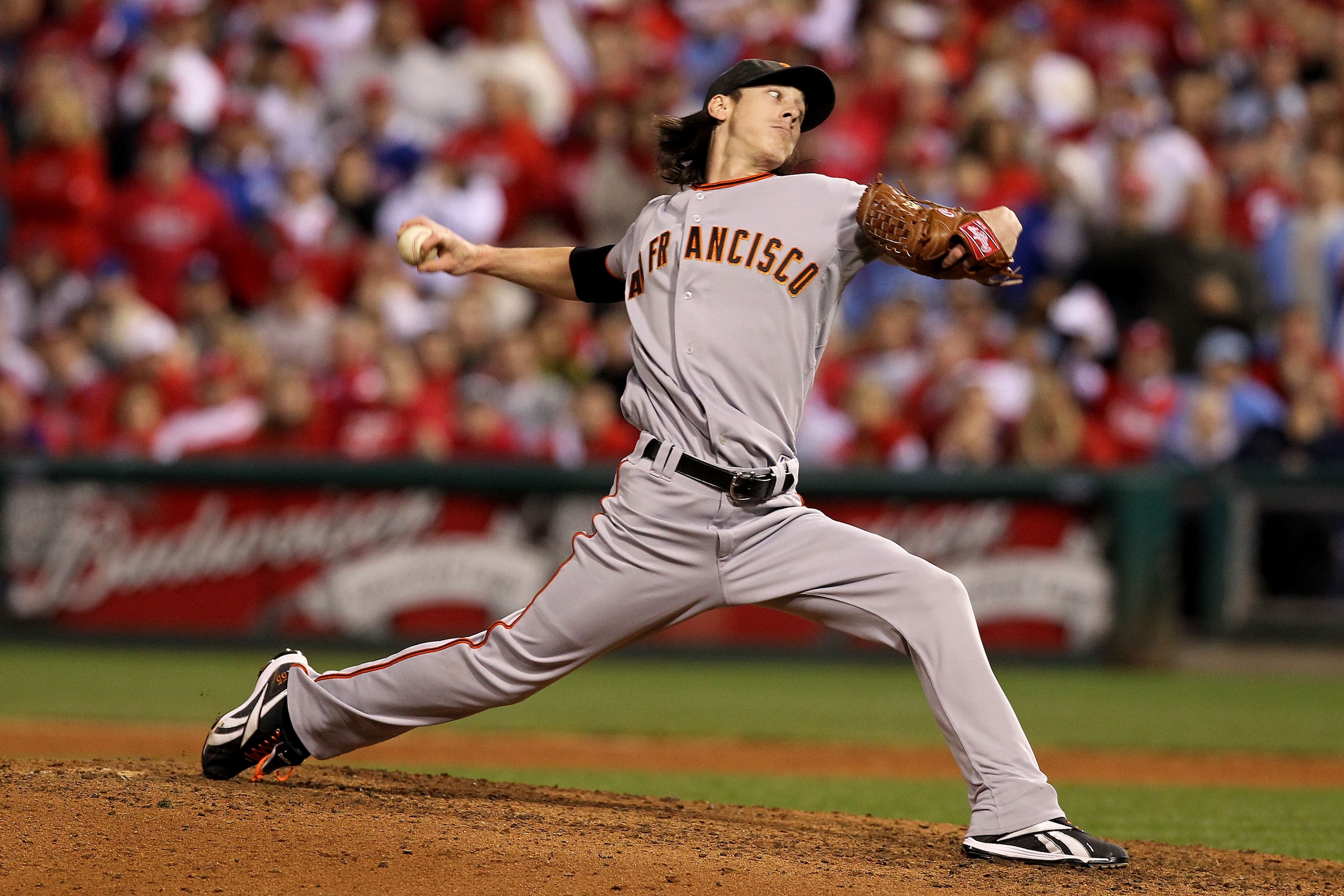
If you've ever been fortunate enough to watch Tim Lincecum pitch, you know precisely why the slightly-built, right-handed hurler has been dubbed, "The Freak." His unique mechanics and delivery appear nearly unsustainable, but he repeats them flawlessly, and to tremendous effect.
Make no mistake though, there is nothing slight about his talent or results. The two-time defending Cy Young award winner burst upon the Major League scene in 2007 and has done nothing but dominate the National League since. In his three full seasons after his rookie debut, he has led the league in strikeouts all years, pitched in excess of 200 innings each year, and has been voted the top pitcher in his league in 2008 and 2009.
During 2010, he wasn't quite as stellar as the previous two years, but the 26-year-old remained one of the top pitchers in the game, going 16-10 with a 3.43 ERA and 231 strikeouts. Though he allowed more hits and home runs than he ever had prior, Lincecum was a dominant force atop the San Francisco rotation.
Making his career postseason debut this year, he certainly did not disappoint. Facing the Braves in San Francisco for NLDS Game 1, Lincecum hurled a scintillating complete game shut-out, only allowing two hits with one walk while striking out 14 batters. If not for Roy Halladay's no-hitter the day before, we would likely be calling Lincecum's start the best postseason debut in recent memory. Although he wasn't flawless like "Doc" was, it's possible that Lincecum's start was even more dominant.
After progressing to the NLCS against the Phillies, Lincecum would find himself battling Halladay head-to-head twice. In Game 1, Tim prevailed, as he threw seven innings, allowing six hits, three walks and three runs while striking out eight in the Giants' 4-3 victory. Later, in Game 5, Halladay returned the favor, beating Lincecum 4-2, although "The Freak" actually pitched better in the second matchup. In seven innings, he allowed only two earned runs on four hits, one walk, with seven strikeouts. If not for the gritty performance of an injured Halladay, Lincecum might have been able to win both. He then pitched part of the eighth inning in Game 6, setting up closer Brian Wilson in the Giants' series clinching victory.
Tasked with leading the rotation into the Giants' first World Series appearance since 2002, Tim Lincecum is primed and ready to finish off 2010 with a flourish. He will once again find himself matched up with a stellar pitcher as he will face off against Cliff Lee this time. That's what aces do however, and Lincecum has proved in his young career to never shy away from a challenge. Game 1 promises to be a pitching matchup for the ages.
San Francisco Giants' Game 2 Starter: Matt Cain
6 of 8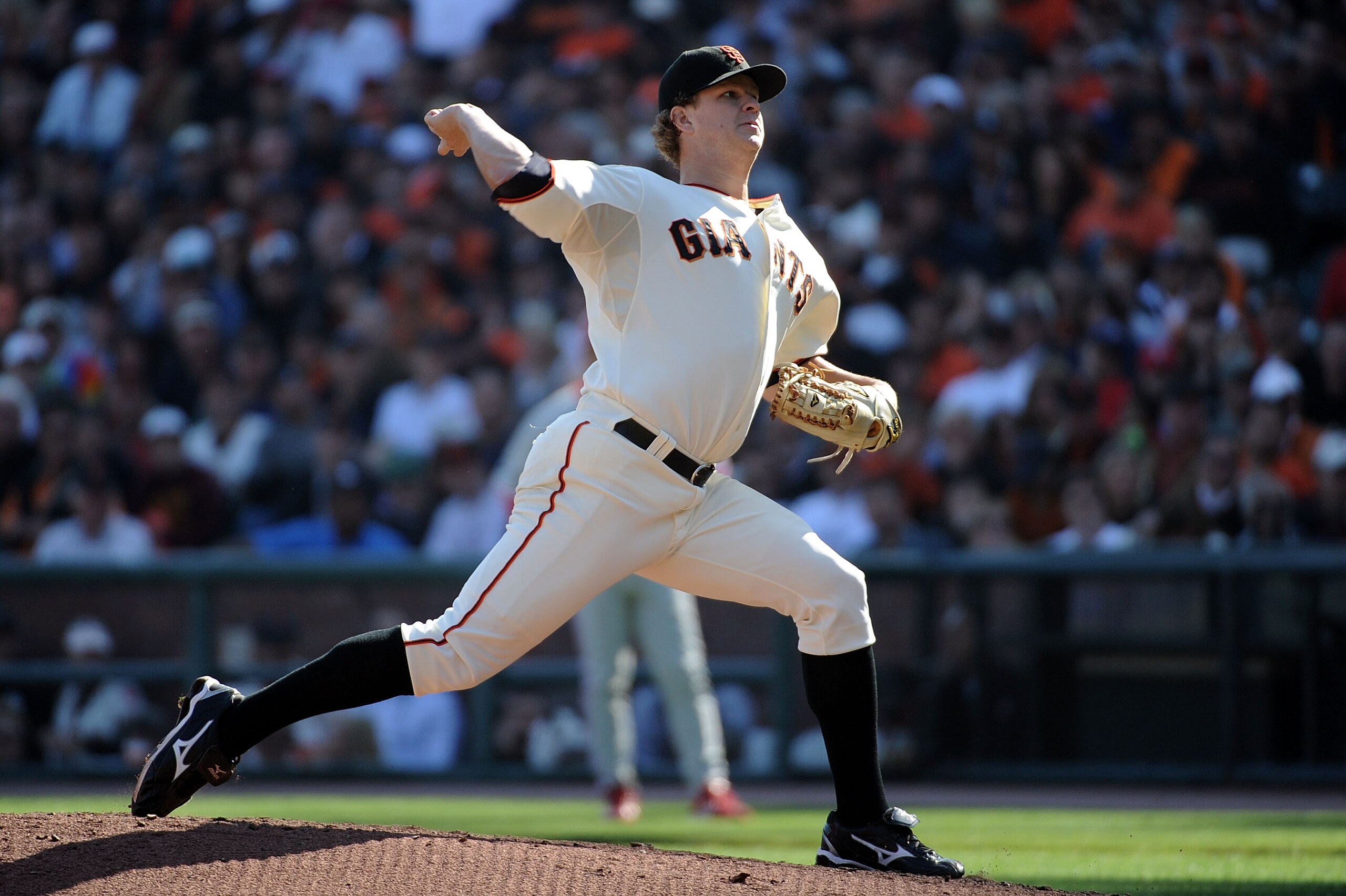
It's about time the Giants got Matt Cain some run support. Cain has been one of the best pitchers in the National League that hardly anyone has heard of outside of the NL West. Consistently deprived of offensive backing, Cain has long been a great pitcher, but one without the stat that everyone notices—victories.
From 2005-2008, Cain made 104 starts, throwing 654.2 innings in that time, striking out 558 with a 3.74 ERA and 1.27 WHIP, only to be limited by his run support, tallying an unspectacular 30-43 record in that time.
Things finally changed for Matt in 2009, as he was named to his first All-Star game, as he went 14-8, with a 2.89 ERA and a 1.18 WHIP. Cain's profile began to rise as the baseball world found out that San Francisco had another starter beyond Lincecum.
Cain continued his upward progression as he was once again a top pitcher in the NL during 2010. His record wasn't stellar at 13-11, but his ERA of 3.14 and 1.08 WHIP were those of an ace. His strikeouts were slightly down, but he posted the lowest walk rate of his career.
He followed his strong regular-season campaign with two great starts in his first foray into baseball's postseason. In NLDS Game 2 versus Atlanta, he hurled 6.2 innings, allowing seven hits, two walks and only one unearned run while striking out six. The Giants would ultimately lose that game 5-4, but through no fault of Cain's. His next start, NLCS Game 3 against the Phillies, he hurled seven immaculate innings of shutout ball, only allowing two hits and three walks with five strikeouts in a 3-0 victory.
Bruce Bochy contemplated splitting up the two righties at the top of the rotation, and the two lefties, Sanchez and Bumgarner, but in the end, decided to pitch the lefties in Arlington, where the ball tends to fly out toward right-center. Matt Cain excelled at AT&T Park in 2010, going 8-4 with a 2.93 ERA and a 1.01 WHIP, making him a logical choice to follow up "The Freak" in World Series Game 2.
San Francisco Giants' Game 3 Starter: Jonathan Sanchez
7 of 8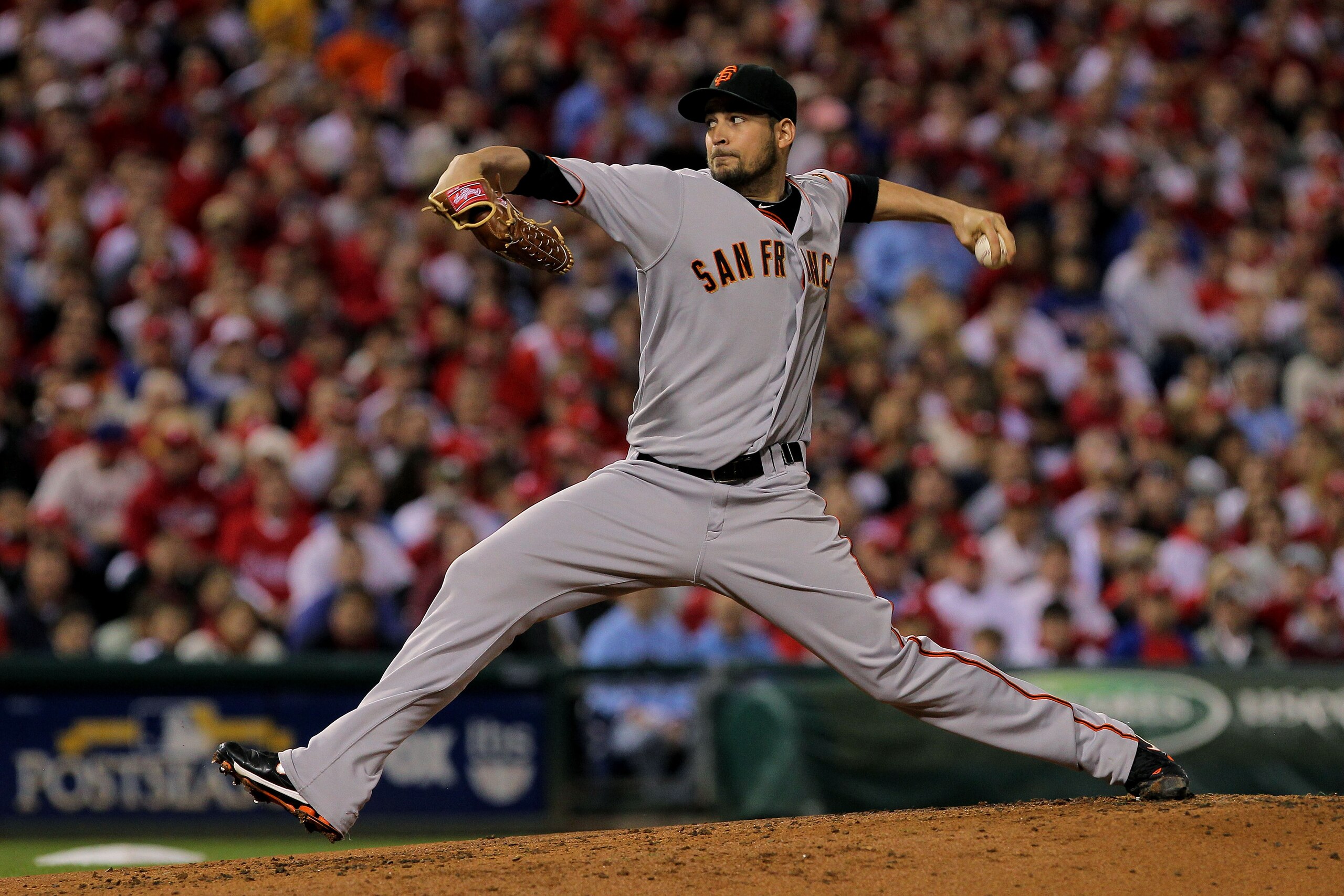
Earlier this year, a decent-sized contingent of fans were clamoring for the Giants to unload Jonathan Sanchez in a trade to acquire a productive bat to add muscle to the San Francisco lineup. Though he had yet to achieve the results long expected, teams were well aware of his massive potential and had been eager to attempt to pry him loose from the Bay Area for the last several seasons.
Patience ultimately prevailed and the Giants were rewarded with a tantalizing glimpse of his pitching prowess in 2009. Though he still struggled with his command at times, he posted a 4.24 ERA with 177 strikeouts in 163.1 innings, showing enough for the Giants to keep their faith that his arrival was imminent. His July no-hitter, only a Juan Uribe error away from a perfect game, solidified the notion that the Giants had a special pitcher in their midst.
The 2010 campaign was the year that the 27-year-old Sanchez finally put it all together. In 33 starts, He went 13-9, with a 3.07 ERA, and a career-best 1.231 WHIP. Unfortunately he led the league with 96 walks, but minimized the damage by only allowing opponents to hit .204 against him. In 193.1 innings, Sanchez struck out 205, good for eighth in the NL. With that electric stuff, he has the potential to dominate, but occasionally he can resemble Oliver Perez, which is not the most favorable comparison one can make.
In the postseason, Sanchez followed his more-heralded rotation-mates, Lincecum and Cain, with a stellar outing in NLDS Game 3. Against the Braves, he tossed 7.1 innings of one-run ball, allowing only two hits while walking one and striking out 11. The Giants were 3-2 winners in that game but, unfortunately, Sanchez didn't figure in the decision. With that dominant outing, Sanchez announced his arrival as a force to be reckoned with.
His results were uneven in the NLCS, as he started Games 2 and 6. In Game 2, he allowed only two runs in six innings, but wasn't as sharp as his previous start, allowing five hits and three walks, en route to a 6-1 defeat. Game 6 was rather forgettable, as his command abandoned him as well as his cool. Pitching only into the third inning, he allowed two runs on three hits and two walks, but was yanked after hitting Chase Utley with a pitch, and getting into a subsequent shouting match when Utley tossed the ball back toward the mound. The benches cleared, but little happened other than Bruce Bochy utilizing a quick hook to remove Sanchez to limit the potential damage. He had thrown only 24 of 50 pitches for strikes.
Sanchez and the Giants will be looking for more consistent results in the World Series, as he will face a deep, potent Rangers' lineup that is capable of punishing a pitcher in a hurry if he makes many mistakes. Bruce Bochy witnessed Sanchez's development all year, and his brilliant performance in the NLDS will give the manager the confidence. But he cannot revert to his occasional self that refuses to throw strikes. Otherwise the hook will be quick.
San Francisco Giants' Game 4 Starter: Madison Bumgarner
8 of 8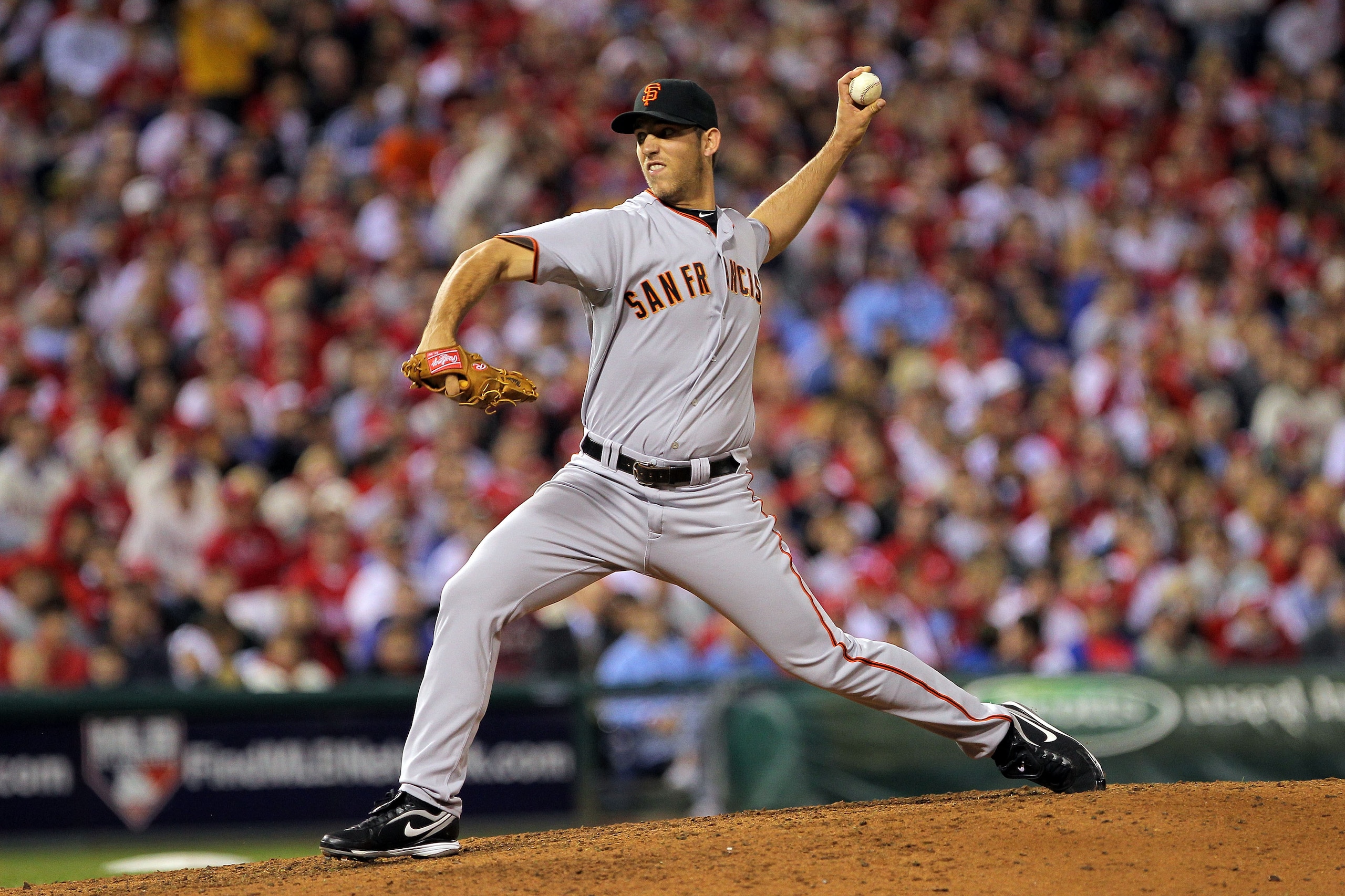
The highly-touted rookie left-hander arrived in San Francisco at the end of June and immediately looked like he belonged. Since being taken as the 10th pick of the 2007 draft, Giants' fans have been eagerly awaiting his ascension to the big-league club.
The 20-year-old Bumgarner slotted right into the rotation, helping to ease concerns over the inconsistency of veteran Barry Zito. In 18 starts, he went 7-6, posting a 3.00 ERA . He gave up 119 hits in 111 innings, which he'd like to improve upon, but he had a solid 2.1 walks per nine innings to mitigate the amount of hits allowed. Bumgarner pitched well enough down the stretch, including a 1.13 ERA in September, to give the Giants reason to choose the recently 21-year-old rookie over Zito for the playoff roster.
Bumgarner followed the trend set by his fellow starters in the NLDS and delivered a victorious performance of his own, stifling the Braves on the way to a series-clinching Game 4 win. In his six-inning outing, he allowed two runs on six hits and one walk while striking out five.
His next start didn't go as well as he didn't finish five innings, getting pulled after 4.2, allowing three runs on six hits and one walk. Though he didn't figure in the decision, the Giants eventually won that game 6-5. Bumgarner would add two innings of scoreless relief in the clinching Game 6 before handing the game over to more experienced arms to preserve the win.
Madison Bumgarner will have an opportunity to further stabilize his spot in the young San Francisco rotation with a solid outing in Game 4 in Arlington. If he and his fellow Giants' hurlers are able to perform to their capabilities in this World Series and beyond, the rest of the National League may have a formidable foursome to fear for the next several years.



.jpg?w=2560 "Jonathan Taylor Landing Spots")

.jpg?w=2560 "Malik Beasley Negotiating Plea Deal (AP)")
.jpg?w=2560 "NFL House in Paris Closes for Protests (AP)")