In most normal years, mid-November is when we see a significant wheat-from-the-chaff separation in college football's Heisman race. It's always still too early in the season to confidently project the winner. However, there's usually a clear favorite, and you can count on one hand the list of viable candidates likely to be finalists.
Take last year, for example. After his Nov. 9 performance against Alabama, LSU's Joe Burrow emerged as the indisputable front-runner. And at that point, the only other players with any realistic argument were Alabama's Tua Tagovailoa, Oklahoma's Jalen Hurts and Ohio State's Justin Fields and Chase Young.
A similar story unfolded in 2018 when Tagovailoa was the favorite in mid-November, followed by Oklahoma's Kyler Murray and West Virginia's Will Grier. Grier fell off when WVU dropped out of the playoff conversation with back-to-back losses, and he was replaced by Dwayne Haskins Jr., who accounted for 17 touchdowns in Ohio State's final three games. But even that preposterous finish wasn't enough to make a serious push for a spot in the top two.

.png?w=2560)

In both 2016 (Lamar Jackson) and 2017 (Baker Mayfield), the favorite was so far ahead by mid-November that it was as much of a "race" as it would be if you or I rolled out of bed and tried to outsprint Usain Bolt for 100 meters.
This year, though, we're still just throwing darts at the wall.
Ohio State's Justin Fields, Alabama's Mac Jones and Clemson's Trevor Lawrence are effectively in a three-way tie for the title of "Heisman favorite," which is roughly what was anticipated long before the season began. Fields and Lawrence were the preseason co-favorites with Jones a good deal behind that duo. But he probably would have been the clear No. 3 in betting odds had it not been for the possibility of highly touted freshman Bryce Young swooping in and stealing that job.
Florida's Kyle Trask stormed back into the mix with a ginormous Week 10 performance against Georgia. Zach Wilson (BYU) and Desmond Ridder (Cincinnati) have done incredible work as the leaders of unconventional College Football Playoff contenders, and they almost have to remain in this conversation for as long as their teams remain undefeated.
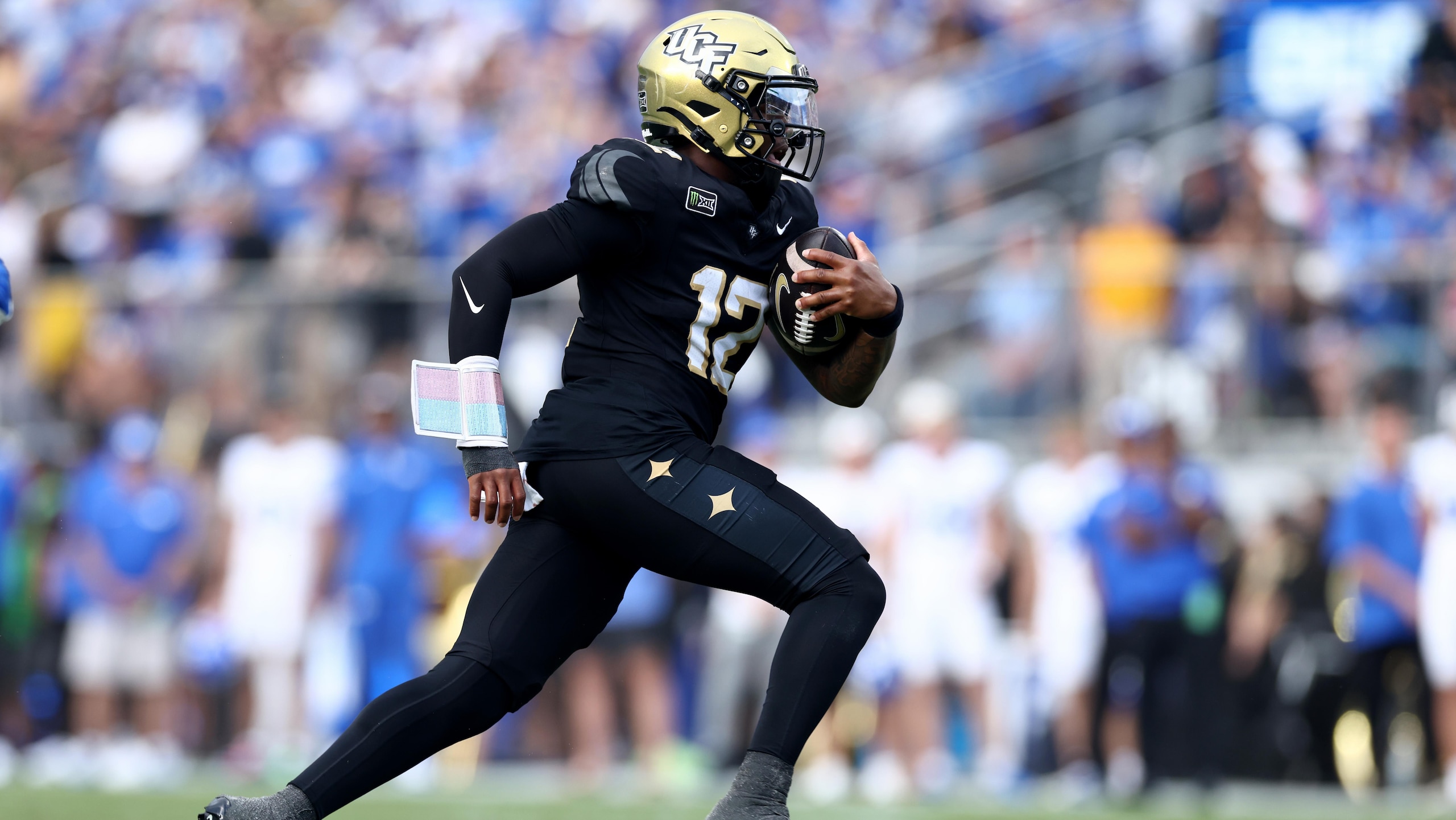
UCF's Dillon Gabriel is putting up ridiculous numbers on a weekly basis. Alabama has a pair of non-quarterbacks (RB Najee Harris and WR DeVonta Smith) with a real argument for the stiff-armed trophy. Clemson's Travis Etienne isn't running the ball as well as he usually does, but he's still in the hunt with more than 150 all-purpose yards and 1.5 touchdowns per game.
Without even mentioning Notre Dame's Ian Book or Texas A&M's Kellen Mond, that's 10 strong candidates, any of whom could realistically win.
Why is it so much more wide open this year?
For starters, the college football calendar is all out of whack.
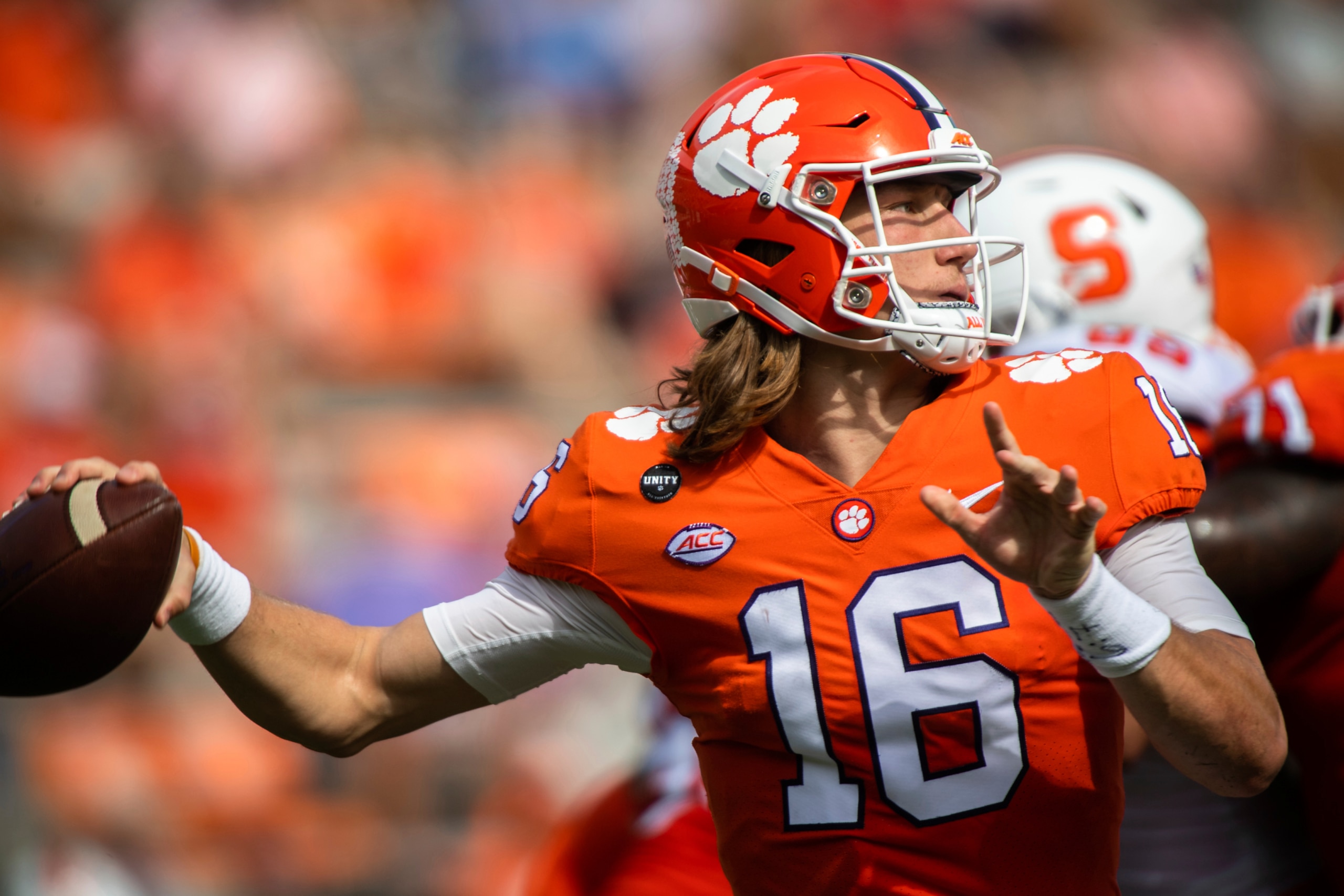
The three favorites played their first games of the season on Sept. 12 (Lawrence), Sept. 26 (Jones) and Oct. 24 (Fields), which means significantly different sample sizes. Moreover, conference championship week isn't until Dec. 19 instead of its traditional home on the first Saturday in December. Thus, in terms of games remaining, we're effectively still in late October rather than mid-November.
Not only are we comparing apples to oranges with many of these Heisman resumes, but in all cases, we are doing so two weeks before those fruits are ripe.
When Burrow started to create some separation last year, he had played nine of his 12 (75 percent) regular-season games. Lawrence would have been at a comparable eight of 11 (73 percent), though he missed the last two games because of a positive COVID-19 test. Jones has played 60 percent of his regular-season games. Fields is only at 38 percent.
The out-of-whack schedule has also resulted in a bunch of different "September Heisman" candidates.
If you're unfamiliar with that lingo, it's when—in a normal year—we all kind of take a step back after the final Saturday in September and say, "OK, the season is about 30 percent complete. Who would win the Heisman if we voted today?"
Oftentimes, the clear favorite in late September is a complete afterthought by early December, but a highlight-heavy, stat-stuffing first three or four games ensures he stays (or they stay) on the radar for a while.
With everything so staggered this year, though, it has been more of a weekly tradition of everyone realizing that someone has looked great through three games. In fact, if USC's Kedon Slovis (381 passing yards vs. Arizona State) or Colorado's Jarek Broussard (187 rushing yards, three touchdowns vs. UCLA) have two more weeks like their first, the list of Heisman candidates may grow even larger.

By the time the SEC started playing, BYU's Wilson had received way more national attention than he would have in a typical September, and the list of potential Heisman finalists from both the ACC and Big 12 had been whittled down to a select few. It was a similar situation when the Big Ten started up, and again when the Pac-12 finally took the field this past weekend.
I've made this comparison previously, but it's almost like a WWE Royal Rumble match, in which guys are entering the Heisman ring at roughly the same rate as others are getting thrown out of it.
But the biggest reason there are so many candidates is simply that there are a ton of guys putting up preposterous numbers.
When Burrow won last year's Heisman trophy—by the widest margin in college football history—he was averaging 362.7 passing yards and 3.7 passing touchdowns per game. If he was doing that this year, he'd just be one of the options.
Trask isn't even one of the three favorites right now, and he's at 363.0 passing yards and 4.4 passing touchdowns per contest. Wilson—also not one of the three favorites—has a passer efficiency rating (200.6) virtually identical to Burrow's (202.0), and he is averaging 3.6 total touchdowns per game.
Mac Jones is at 366.0 passing yards per game and has a higher PER (210.3) than Burrow had. His total touchdown rate (2.8 per game) is lower, but that's largely because Najee Harris is leading the nation with 14 rushing touchdowns.
And Fields is just out of damn control with a 222.4 PER, 4.3 total touchdowns per game and an 86.7 completion percentage.
Moreover, aside from Wilson shredding a bunch of Group of Five schools, all those numbers have come without the early benefit of facing nonconference foes, which arguably makes them even more impressive.
The moral of the story is we've been trying to handicap this race for two months, but it's even murkier now than when the season began.
Things will inevitably shake out over the course of the next five weeks. But if you think you currently know who's going to win the 2020 Heisman, you're only fooling yourself.
Kerry Miller covers college football and men's college basketball for Bleacher Report. You can follow him on Twitter: @kerrancejames.


.jpg?w=2560 "Malik Beasley Negotiating Plea Deal (AP)")