Ranking the Top CFB RBs Set to Play This Fall
There are only 76 FBS college football teams playing this fall instead of the usual 130, and even a significant chunk of those teams will be without key players who are opting out.
But you wouldn't know it from the sheer volume of talent still suiting up at the running back position.
Led by 2019 rushing leader Chuba Hubbard, there are 15 returning running backs who rushed for at least 1,000 yards last year. And that's just the beginning. Start factoring in recent 5-star recruits, other breakout candidates, and guys like Isaiah Spiller, Breece Hall, Jerrion Ealy, Sincere McCormick and Re'Mahn Davis who had strong showings as freshmen, and there were more than 30 names on the initial list of candidates for this top 10.
Translation: This was not an easy task, and there's a good chance we've omitted a player or two who rushes for more than 100 yards per game. Moreover, with quarterbacks like Ohio State's Justin Fields and USC's Kedon Slovis not playing this fall, we should see several running backs making a serious run at the Heisman.
10. Pooka Williams Jr., Kansas
1 of 10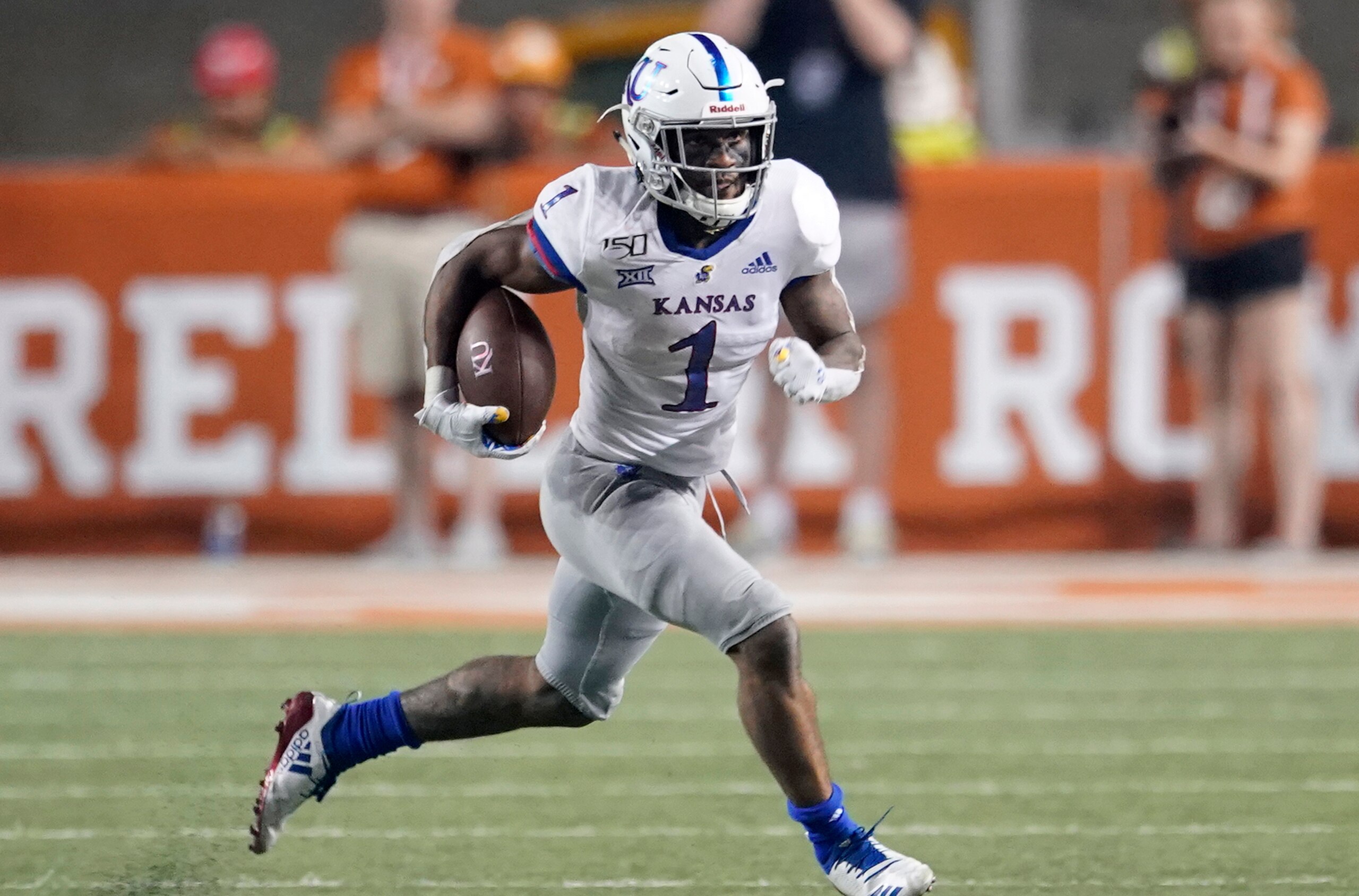
2019 Stats: 203 carries, 1,061 yards, three touchdowns; 27 receptions, 214 yards, two touchdowns
Weed out the leagues that aren't playing and the players who have opted out of this season and you're left with just two returning players who have rushed for at least 1,000 yards in each of the past two years: Clemson's Travis Etienne and Kansas' Pooka Williams Jr.
Etienne is the much more prolific of those two, accounting for 49 touchdowns since the beginning of 2018 compared to just 14 by Williams. But it's quite impressive for this Jayhawks star to be in that two-man club with Etienne, considering Clemson's back got to play an additional four games (in a much better overall offense, no less) in each season.
Williams has been hit or miss for the Jayhawks, which is why he's relatively low on the list.
When he's on, kick back and enjoy the show. He ran for 252 yards against Oklahoma in the next-to-last game of his freshman season and put up another 137 yards against the Sooners this past year. Similarly, he has twice thrived against Texas, rushing for more than 100 yards in each battle with the Longhorns.
In those four games against two of the best teams in the league, he has averaged 189.3 yards from scrimmage with five total touchdowns. For the sake of comparison, all-purpose phenom Christian McCaffrey averaged 190.3 yards from scrimmage during his remarkable sophomore campaign.
But in 13 of his last 20 games, Williams has been held below 100 rushing yards. That includes a dreadful 26-yard performance against Oklahoma State last November and a combined total of 45 rushing yards in two career games against TCU. (He did have 10 receptions for 135 yards and three touchdowns against the Horned Frogs, though, so they weren't total duds.) Kansas State and West Virginia also held Williams in check in both years.
Perhaps he'll be more consistently dominant in year No. 2 under Les Miles. He certainly possesses the talent to be one of the best in the business.
9. Isaiah Spiller, Texas A&M
2 of 10
2019 Stats: 174 carries, 946 yards, 10 touchdowns; 29 receptions, 203 yards
Seniors Najee Harris, Kylin Hill and Rakeem Boyd are the SEC's biggest rushing stars, but the list of noteworthy sophomore running backs in this conference is a bit ridiculous.
Kentucky (Christopher Rodriguez Jr. and Kavosiey Smoke) and Ole Miss (Jerrion Ealy and Snoop Conner) each has a pair of running backs who averaged better than 6.0 yards per carry while accumulating at least 500 yards and five touchdowns last year. LSU has a trio of guys (Chris Curry, John Emery Jr. and Tyrion Davis-Price) who are all poised to break out as sophomores with Clyde Edwards-Helaire in the NFL. Similar story for Auburn's D.J. Williams and Georgia's Zamir White, who should be starters now. And if Tennessee's Eric Gray can build on that ridiculous 246-yard performance against Vanderbilt at the end of last season, look out.
Of the bunch, though, Texas A&M's Isaiah Spiller should be the biggest star.
Just like Pooka Williams Jr., though, Spiller's hot-and-cold tendencies are more than a little concerning.
Against the upper-echelon defenses of Alabama, Auburn, Clemson and Georgia, Spiller was a ghost. He had a total of 34 carries for 67 yards in those four games, which is less than 2.0 yards per rush. He also had an unfathomably dreadful seven carries for zero yards against Arkansas, which had the worst rushing defense in the SEC at 222 yards allowed per game.
Yet, we're talking about a guy who had 1,149 total yards from scrimmage as a true freshman, despite splitting reps with Jashaun Corbin and Jacob Kibodi early in the year. With Corbin, Kibodi and Cordarrian Richardson all out of the picture, Spiller is the only returning player (aside from QB Kellen Mond) who tallied at least eight carries in 2019. He's going to be the bell cow of this offense.
8. Josh Johnson, Louisiana-Monroe
3 of 10
2019 Stats: 201 carries, 1,298 yards, 11 touchdowns; 13 receptions, 122 yards
One benefit of a fall season played without the Big Ten and Pac-12 is the opportunity for more people to realize that the Sun Belt has quite a bit of NFL potential at running back.
Louisiana's Elijah Mitchell rushed for 1,147 yards and 16 touchdowns last season. His teammate, Trey Ragas, averaged 7.1 yards per carry en route to 820 yards and 11 touchdowns. Georgia Southern's Wesley Kennedy III put up nearly identical numbers (824 yards, 6.9 YPC, 11 touchdowns). And Coastal Carolina's C.J. Marable was good for 115.0 total yards from scrimmage per game. All four of those guys are back in 2020.
The brightest star should be Louisiana-Monroe's Josh Johnson.
It's one thing to run well against other Sun Belt defenses. But Johnson also thrived against a tough nonconference slate. He averaged 111 rushing yards and 5.6 yards per carry in three games against Florida State, Iowa State and Memphis.
After the opener against Army this Saturday, there's nothing close to that caliber of opponent on ULM's schedule. Factor in ULM losing starting quarterback Caleb Evans and top receiver Markis McCray as graduates, and the Warhawks might be leaning even more heavily on Johnson against an easier schedule.
For a guy who already averaged 108 yards per game last year, that could mean a spike to something more in the 130 range. It might not be enough for ULM to become bowl-eligible because its defense is downright deplorable, but it would make Johnson one of the most noteworthy running backs in the country.

7. Brenden Knox, Marshall
4 of 10
2019 Stats: 270 carries, 1,387 yards, 11 touchdowns; 14 receptions, 129 yards
Brenden Knox was the only player on the list to take the field this past Saturday, rushing for 85 yards and a touchdown in Marshall's 59-0 shellacking of Eastern Kentucky.
It was an OK start, but it was a far cry from where he ended the 2019 campaign.
Over the final seven games of last season, Knox averaged 126.9 rushing yards. For the season, he had 43 carries that went for at least 10 yards. Among running backs, the only guys with more carries of that distance were Jonathan Taylor (61), J.K. Dobbins (51), Chuba Hubbard (49), Travis Etienne (47), Najee Harris (46) and Jaret Patterson (45). So for him to max out at a pair of 10-yard gains in a shutout win over an FCS opponent was a little strange.
It was clear that Marshall was just using this easy opener to figure out the rest of its offense, though. The Dump Truck got his last touch of the game with about 10 minutes remaining in the third quarter, and much of the first half was dedicated to letting freshman quarterback Grant Wells get loose and build confidence.
Expect more in the near future from Conference USA's preseason offensive player of the year.
6. Rakeem Boyd, Arkansas
5 of 10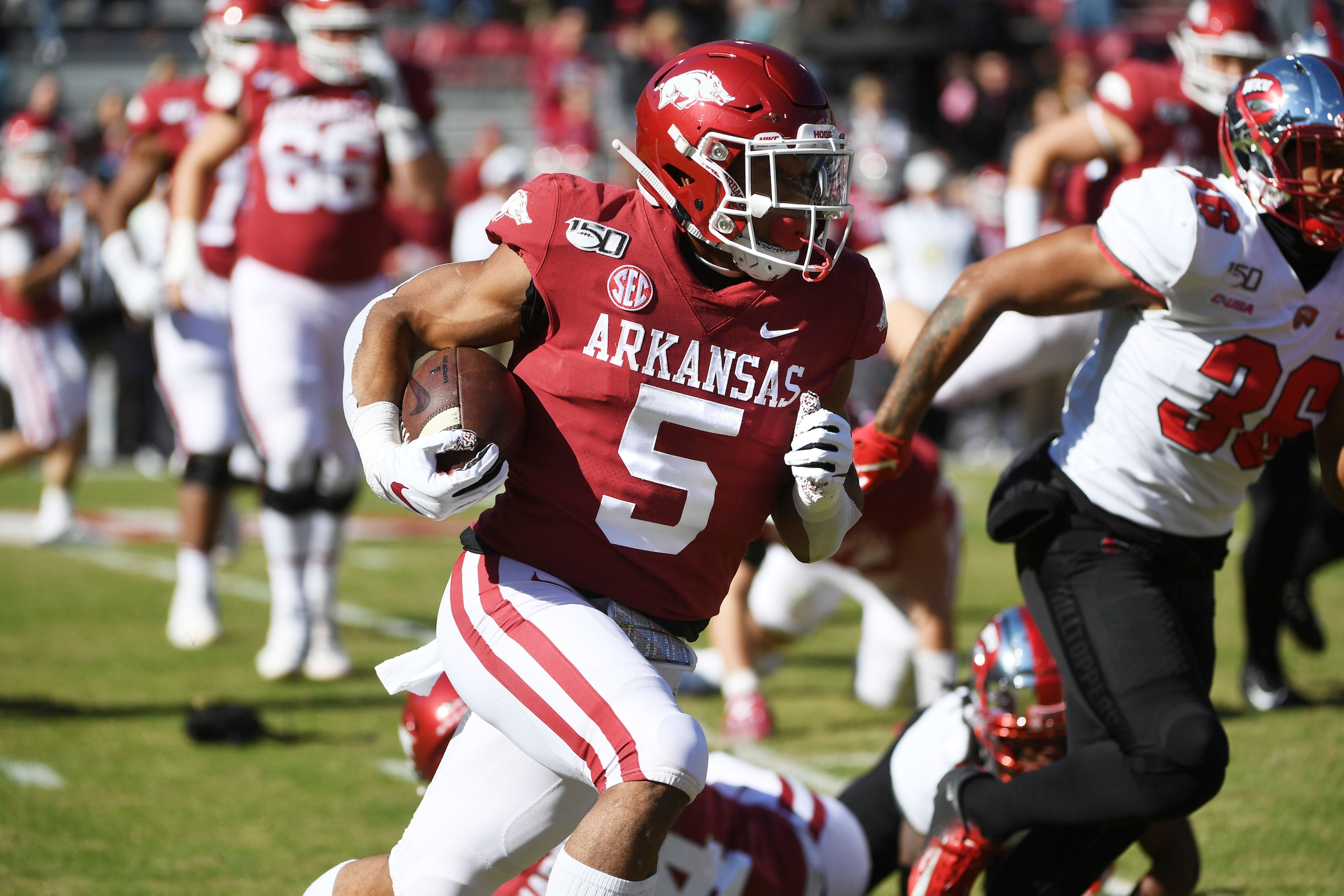
2019 Stats: 184 carries, 1,133 yards, eight touchdowns; 19 receptions, 160 yards
To put it lightly, it has been a tough few years for Arkansas fans. The Razorbacks are 4-23 overall since mid-November 2017, including 19 consecutive losses to SEC opponents. During that time, they also lost to North Texas, Colorado State, San Jose State and Western Kentucky.
But hey, at least they have an exciting running back for the beginning of the Sam Pittman era as head coach.
Even within that ray of light in a sea of darkness, the unfortunate news is that Rakeem Boyd did most of his best work against Arkansas' nonconference opponents—of which, there will be zero in 2020. He averaged 128.0 rushing yards and 8.0 yards per carry in four nonconference games last year, compared to 77.6 and 5.2, respectively, in SEC play.
He did put up more than 100 yards against each of Kentucky and Mississippi State, though, and ended the year with more than 2.5 times as many yards from scrimmage as any other Razorback. He's also the only returning player on the roster who rushed for more than 80 yards last season, so they might rely on him even more this year.
A lot of things need to change before Arkansas can legitimately compete in this conference again, but Boyd could at least be the start of something. The last time this program had a 1,000-yard rusher come back for another year, Alex Collins returned in 2015 for 1,577 yards and 20 touchdowns.
5. Kylin Hill, Mississippi State
6 of 10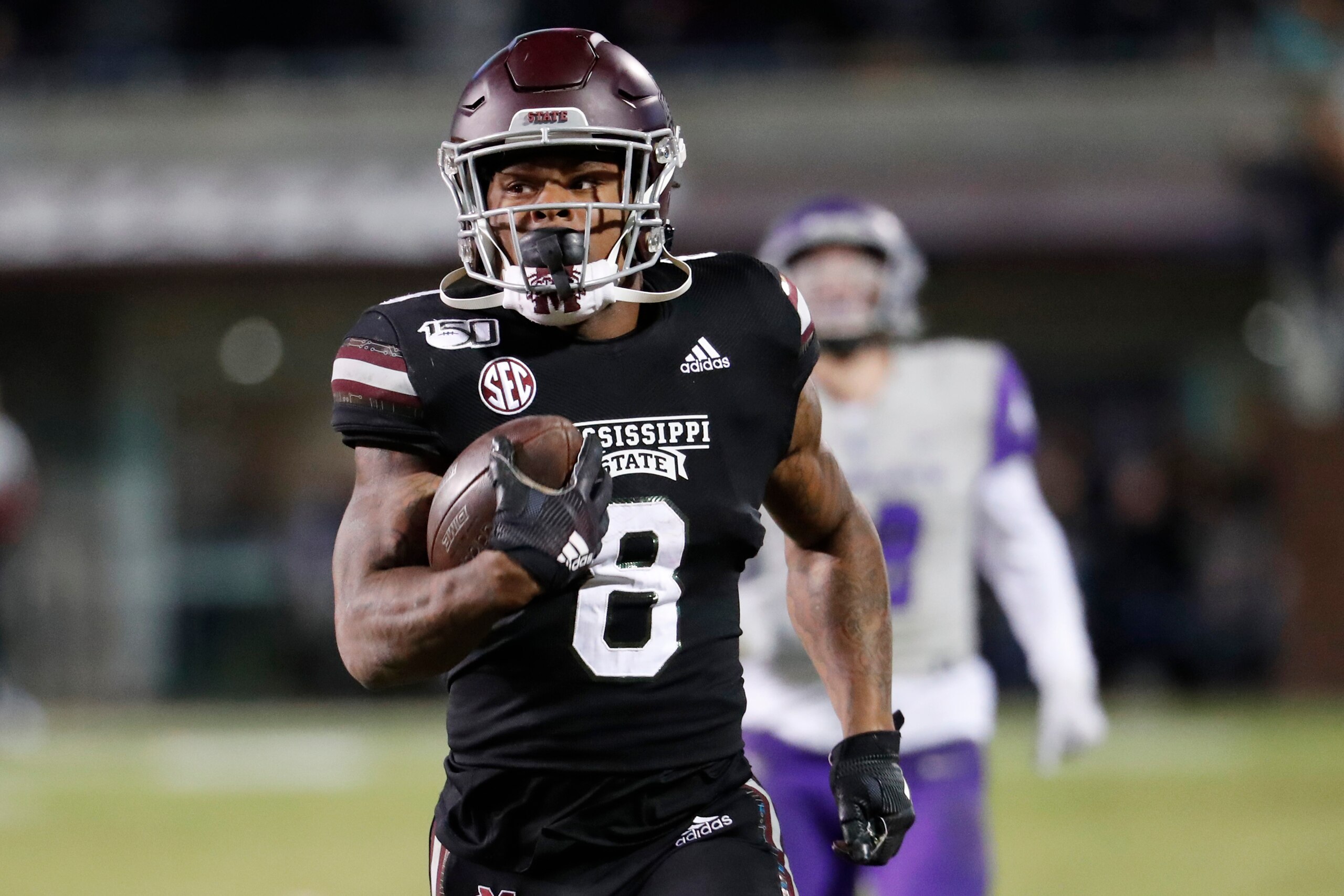
2019 Stats: 242 carries, 1,350 yards, 10 touchdowns; 18 receptions, 180 yards, one touchdown
Kylin Hill was the SEC's most frequently used running back in 2019, averaging 18.6 carries and 20.0 total touches per game. As was the case for many running backs, he struggled against Alabama, Auburn and LSU, but he had at least 120 total yards from scrimmage in eight games.
With Mike Leach taking over as head coach, Hill's rate of carries figures to sharply decrease, but don't be surprised if there's a slight uptick in total touches.
Max Borghi only ran the ball 127 times last year for Washington State, but he led the Cougars with 86 receptions. They had more of a time-share situation in the backfield in each of the two previous years, but Borghi and James Williams combined for 194 rushes and 136 receptions in 2018 after Williams and Jamal Morrow teamed up for 178 carries and 131 receptions in 2017.
Go all the way back to Leach's early years at Texas Tech and you'll find similar splits in every season. So unless the Pirate is going to suddenly change his offensive philosophy after two decades, Hill is probably going to average 8-10 receptions per game in 2020.
He'll still be a major factor in the ground game, if only because Hill is the most talented running back Leach has ever had. But it will be fun to see this star player take on more of a—if you'll forgive an across-Egg-Bowl-lines comparison—Dexter McCluster-type of role this season. That former Rebel averaged 90 rushing yards and 40 receiving yards per game as a senior in 2009.
4. Javian Hawkins, Louisville
7 of 10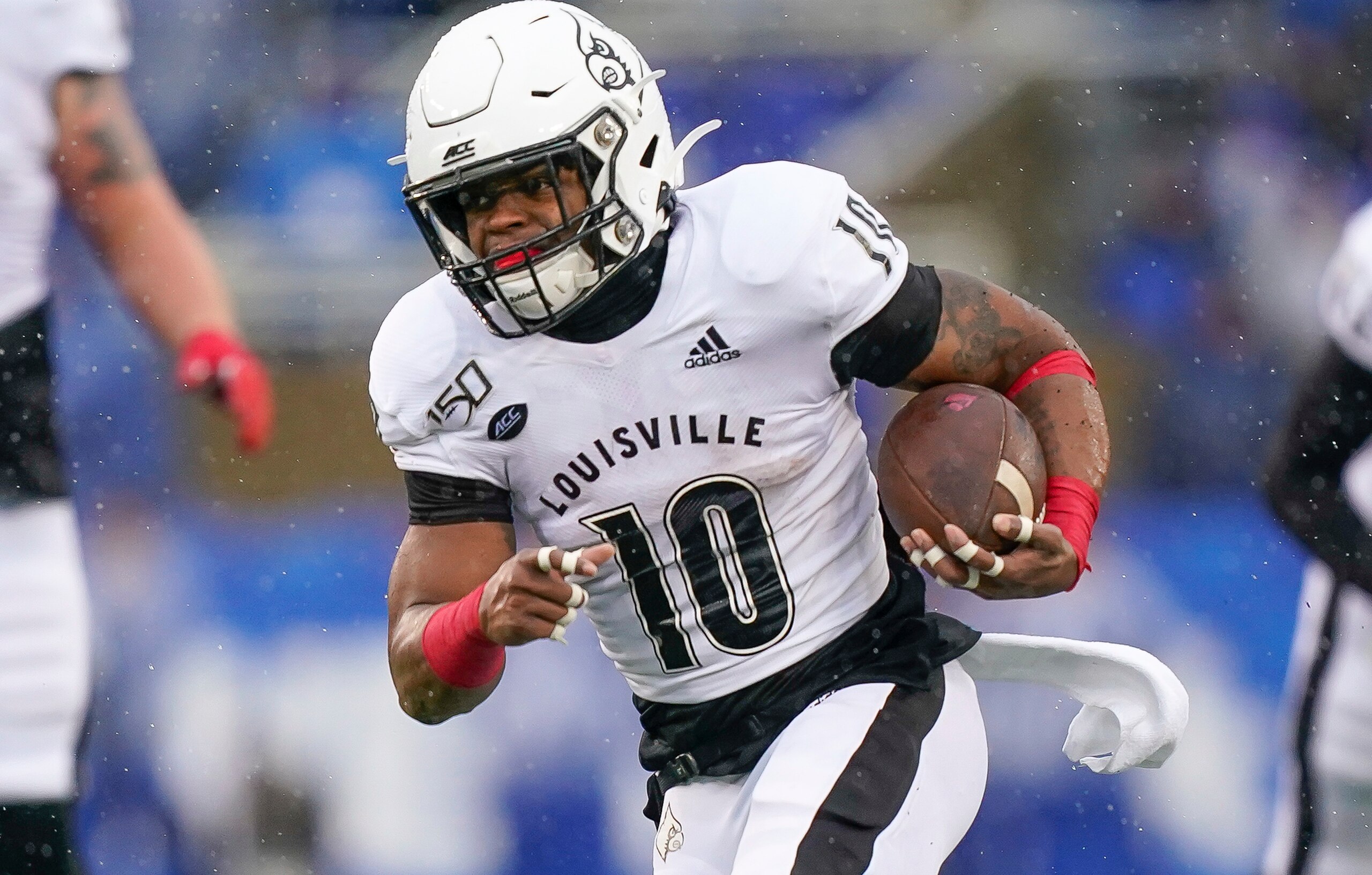
2019 Stats: 264 carries, 1,525 yards, nine touchdowns; four receptions, 58 yards
Heading into last season, all signs—including the team's official initial depth chart in mid-July—pointed toward Hassan Hall leading Louisville in rushing.
Instead, it was Javian Hawkins who won the starting job out of fall camp and quickly blossomed into one of the most potent rushing threats in the country.
After managing just two carries for eight yards while preserving a redshirt year in 2018, Hawkins opened the 2019 campaign with 122 yards against Notre Dame—making him one of just three players in the past two seasons with at least 120 rushing yards against the Fighting Irish. It wasn't enough to get Louisville the win, but it was a promising sign of things to come.
Hawkins eclipsed the century mark eight times. That included a rare 129-yard performance against Clemson's defense, as well as a 233-yard explosion late in the year against Syracuse.
What's bizarre, though, is how uninvolved Hawkins was in the passing game last year. It wasn't quite as strange as the time Melvin Gordon rushed for more than 1,600 yards while making just one reception for 10 yards, but you would think Louisville will try to come up with more creative ways to get Hawkins the ball in 2020.
Jonathan Taylor also had drastic rushing/receiving splits during his first two seasons with Wisconsin (4,171 rushing yards, 155 receiving yards), but he took a big step forward as a receiver last year, making 26 catches for 252 yards and five touchdowns. Hawkins might lead the FBS in yards from scrimmage if the Cardinals do something similar with their star back.
3. Najee Harris, Alabama
8 of 10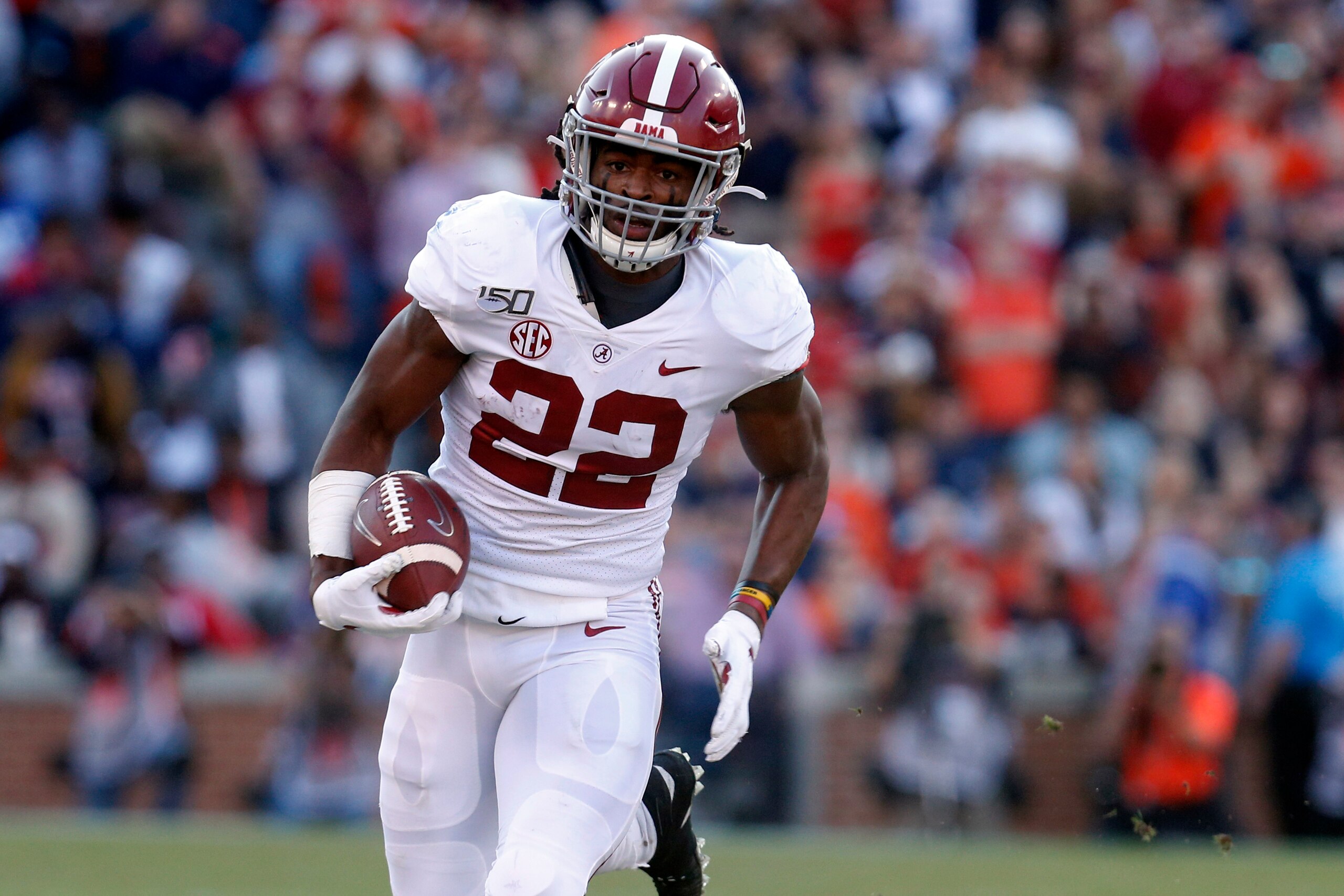
2019 Stats: 209 carries, 1,224 yards, 13 touchdowns; 27 receptions, 304 yards, seven touchdowns
With QB Tua Tagovailoa and WRs Jerry Jeudy and Henry Ruggs III now in the NFL, Alabama may well revert to the type of ground-and-pound approach it rode to a national championship three years ago. The Crimson Tide had a nearly 50-50 split of passing attempts (406) and rushing attempts (436) this past season, but they ran (612) nearly twice as often as they passed (333) in 2017.
And if that happens, Najee Harris might join Mark Ingram and Derrick Henry on Alabama's list of Heisman-winning running backs.
Harris certainly isn't the only option in Alabama's backfield. Last year's backups, Brian Robinson Jr. and Keilan Robinson, are both back. Redshirt freshman Trey Sanders missed all of last season with a foot injury, but the No. 6 overall recruit in the 2019 class could be a major contributor. Even true freshman Jase McClellan has the talent to factor into the equation.
But Harris is going to be the star of the show once again.
He didn't get enough touches early in the year, but in Alabama's final eight games of last season, Harris averaged 110.9 rushing yards and 25.0 receiving yards per contest while scoring 16 total touchdowns. Though the Crimson Tide lost the game, he had career-best marks of 146 rushing yards and 190 total yards against LSU. He matched that rushing total in the Iron Bowl against Auburn and racked up another 136 yards in the Citrus Bowl against Michigan.
He has already proved repeatedly that he can shine against elite defenses. So even though Alabama's regular season will consist of 10 games against SEC defenses, Harris should put up big numbers.
2. Travis Etienne, Clemson
9 of 10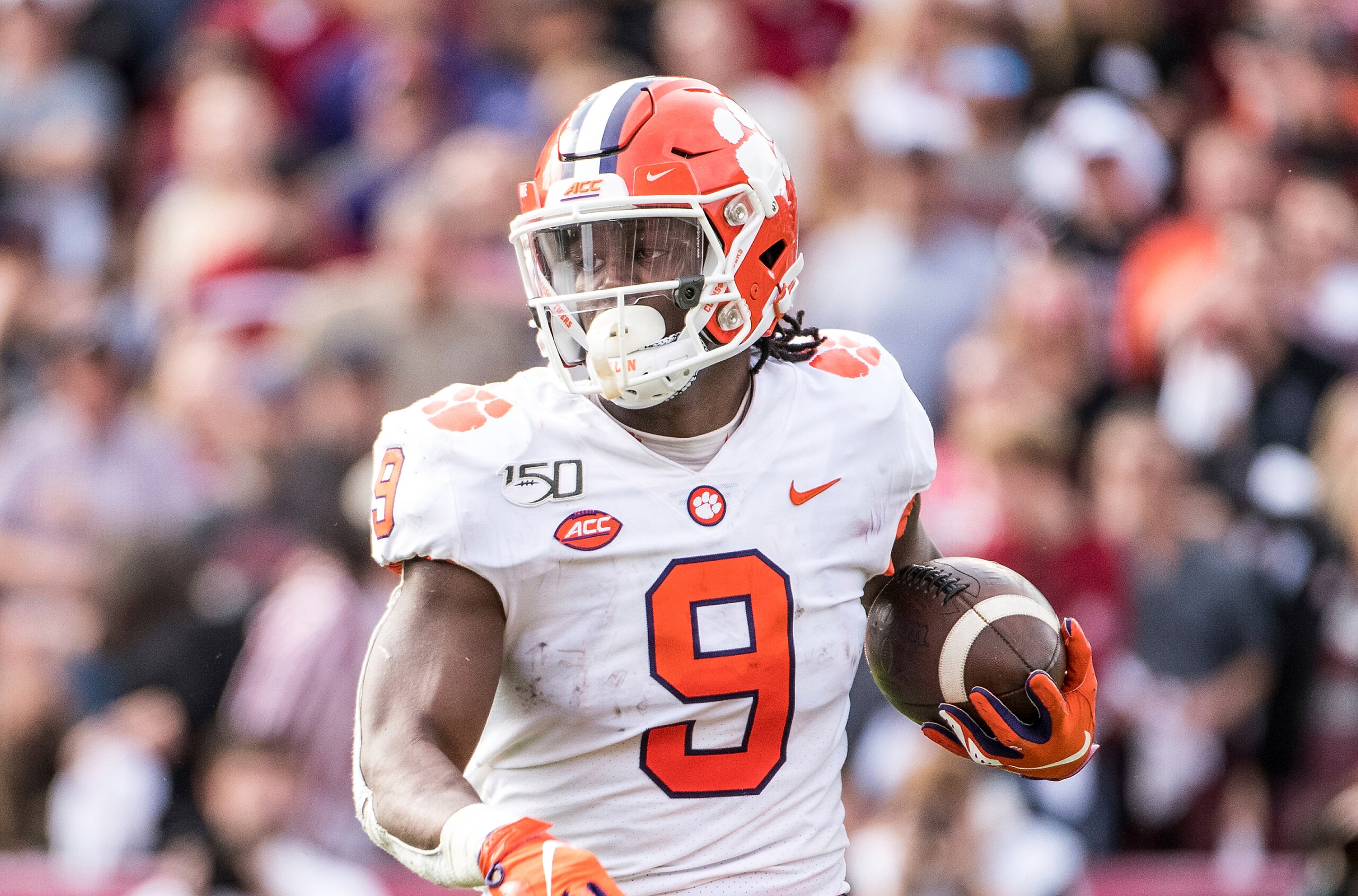
2019 Stats: 207 carries, 1,614 yards, 19 touchdowns; 37 receptions, 432 yards, four touchdowns
Travis Etienne has averaged 8.0 yards per carry over the past two seasons for a team that has played in back-to-back national championships. He finished top 10 in the Heisman vote in both years.
And he is still somehow a little underrated.
A big reason for that is the (understandable and totally justified) national infatuation with Clemson's quarterback, Trevor Lawrence. Etienne averaged 7.2 yards per carry with 13 touchdowns as a true freshman the year before Lawrence arrived on campus, but there's no question he has been viewed as the second fiddle in this offense—a solid running back who benefits from lining up next to a once-in-a-decade talent at quarterback.
Another reason Etienne goes underappreciated is that he doesn't get enough touches. You would think a guy who averages eight yards per carry would have a couple of 250-yard games after three seasons. However, 212 is his career high, and he has eclipsed 170 yards just four times, because he only averages about 12 carries per game.
It doesn't help matters that his best career performances have come against not-exactly-powerhouses Wofford, Georgia Tech and Syracuse.
But if you're doubting Etienne's ability to thrive against quality opponents, try harder. In the past two College Football Playoffs (four total games), Etienne has averaged 114.0 yards from scrimmage and 2.0 touchdowns against the best of the best. This running back is unquestionably one of the best and will almost certainly be a first-round draft pick in the spring.
1. Chuba Hubbard, Oklahoma State
10 of 10
2019 Stats: 328 carries, 2,094 yards, 21 touchdowns; 23 receptions, 198 yards
Travis Etienne and Najee Harris are probably the two main guys battling for the title of "first running back selected in the 2021 NFL draft," but how could we not put Chuba Hubbard at No. 1 after he led the nation in rushing in 2019 as a redshirt sophomore?
Hubbard rushed for at least 220 yards on four occasions last year, terrorizing Oregon State, Tulsa, Kansas State and TCU. At the end of that TCU game—Oklahoma State's ninth of the season—Hubbard was averaging 178.2 yards per game and 6.8 yards per carry. He was on pace for 2,317 yards at that point, which would have made him just the fifth player in FBS history with at least 2,250 rushing yards in a single season.
Unfortunately, that pace was compromised by injuries to starting quarterback Spencer Sanders and star wide receiver Tylan Wallace. But he still rushed for at least 100 yards in each of his final four games while putting together the 11th-highest single-season rushing total since 2000.
Hubbard also became much more of a threat in the receiving game down the stretch. He averaged 1.0 receptions for 4.4 yards in his first nine contests before spiking to 3.5 and 39.5, respectively, in those last four games.
With Sanders and Wallace both back, perhaps Hubbard settles into a nearly exclusive rushing role. Either way, he's going to make a massive impact for what should be one of the most prolific offenses in the country.
Kerry Miller covers men's college basketball and college football for Bleacher Report. You can follow him on Twitter: @kerrancejames.
.jpg?w=2560 "Cam Ward Says He's Not A Loser")
.jpg?w=2560 "Chargers Fall to 0-5 🤢")
.jpg?w=2560 "Viral Dan Campbell Presser 💙")