
Ranking the Most Stacked MLB Teams Since 2000
Were the 2001 Seattle Mariners the most stacked Major League Baseball team of the past two decades, or did they just happen to win the most regular-season games?
We've put together a "starting lineup" of sorts, ranking the nine best MLB teams since the turn of the millennium.
The three main criteria considered were:
- Number of wins
- Number of estimated wins (based on Baseball Reference's pythagorean win-loss percentage)
- Combined batting and pitching wins above replacement, per FanGraphs
One additional rule to consider: A franchise was allowed to be represented multiple times, provided there is a gap of at least three years between seasons considered. This was implemented to avoid duplicate entries on what is essentially the same roster. In other words, we're not putting each of the 2017, 2018 and 2019 Houston Astros on this list, nor the 2017 and 2019 Los Angeles Dodgers. But the 2002, 2009 and 2018 New York Yankees as well as the 2004, 2013 and 2018 Boston Red Sox were all eligible.
Though we were initially willing to consider any team that won at least 93 games, only teams with at least 102 made the final cut. All but one of those clubs also had at least 103 estimated wins, so the bar for inclusion was high.
That didn't stop a pair of 2019 squads from making the grade, though.
One final note before we dive in: How well each team fared in the postseason is mentioned, but it was not integral in the ranking process. It is, however, a testament to how random the MLB playoffs typically are that only three of our top nine teams even made it to the World Series.
Honorable Mentions
1 of 10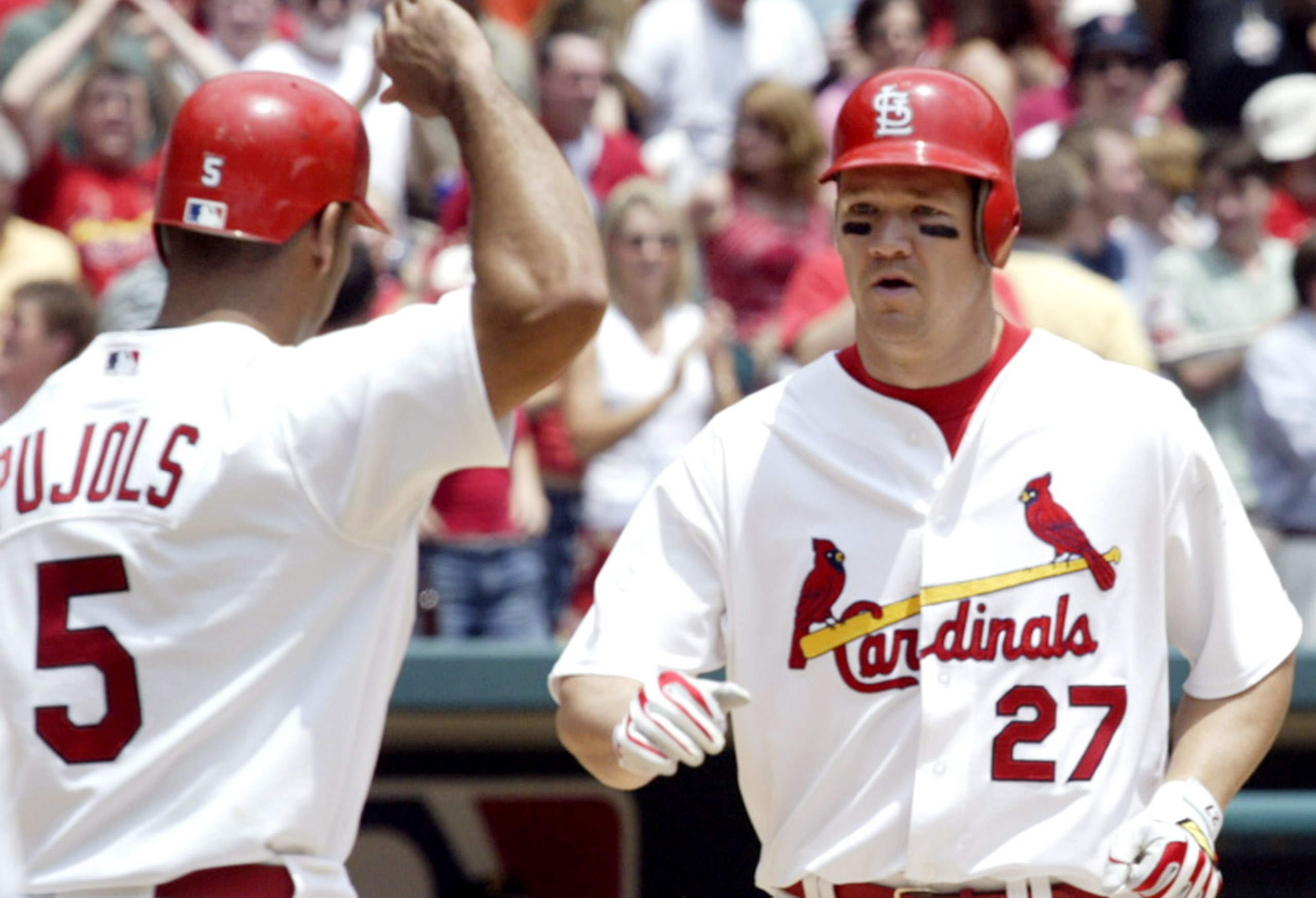
2003 or 2004 Boston Red Sox
Hard to argue with the quintet of David Ortiz, Manny Ramirez, Jason Varitek, Johnny Damon and Kevin Millar. And having Curt Schilling and Pedro Martinez together atop the starting rotation in 2004 was quite the luxury. But they neither won 100 games nor won the AL East in either season, and that narrowly kept them from making the cut.
2004 St. Louis Cardinals
The triumvirate of Albert Pujols (46 HR, 123 RBI), Jim Edmonds (42 HR, 111 RBI) and Scott Rolen (34 HR, 124 RBI) terrorized National League pitching staffs in 2004, pacing the Cardinals to 105 wins. All three finished in the top five in the NL MVP vote that year. The Cards also had four starting pitchers (Matt Morris, Jason Marquis, Jeff Suppan and Chris Carpenter) who won at least 15 games each, though it's telling that no one on the staff received a Cy Young vote.
2009 or 2011 New York Yankees
Led by Alex Rodriguez, Mark Teixeira, Derek Jeter, Robinson Cano, Nick Swisher and Jorge Posada, the Yankees were loaded at the dish at the turn of the decade. But outside CC Sabathia and Mariano Rivera, the pitching staff left something to be desired. That said, the pinstriped bunch that went 103-59 and won the World Series in 2009 received a ton of consideration.
2018 or 2019 New York Yankees
The Yankees won 100 games in 2018 and another 103 in 2019, and if last year's squad could have stayed even a little bit healthy, it could have made a run at matching Seattle's 116-46 record in 2001. Baseball Reference's Pythagorean W-L suggests the Yanks should have gone 99-63 in both seasons, though, and they weren't the best team in the American League in either campaign.
2019 Minnesota Twins
Certainly by Minnesota's standards, the 2019 season was off the charts. Eight starters clubbed at least 22 home runs as the team set the single-season record for homers (307), and the pitching staff was competent enough to turn that into 101 victories. But it's hard to argue the Twins were that stacked when the Astros, Dodgers and Yankees were all better than them.
2019 Washington Nationals
This team was dreadful for the first 50 games, needing to climb out of a 19-31 hole just to reach the postseason. But how could we not at least throw an honorable mention to the Max Scherzer-Stephen Strasburg-Patrick Corbin-Anibal Sanchez starting rotation, especially considering it won the World Series by going through two of the teams in our top five?
9. 2011 Philadelphia Phillies
2 of 10
Key Hitters: Shane Victorino, Chase Utley, Jimmy Rollins, Ryan Howard, Carlos Ruiz, Placido Polanco
Virtually unstoppable from 2007 to '09, this core group was past its prime by 2011.
The Flying Hawaiian Shane Victorino was the youngest of the bunch at age 30. Ryan Howard was 31. Chase Utley, Jimmy Rollins and Carlos Ruiz were all 32. Placido Polanco was 35. Throw in 39-year-old Raul Ibanez as the primary left fielder and there's no question the Phillies were all-in on trying to win in 2011.
And, unfortunately, those aging veterans struggled.
Howard (33 home runs, 116 RBI) was the only Phillie with more than 20 dingers or 84 ribbies, but even he struck out 172 times and had a slugging percentage below .500 (.488) for the first time in his career. Ruiz was the best at getting on base, and his .283 batting average and .371 on-base percentage were hardly cause for celebration.
At the trade deadline, they doubled down on winning immediately, trading four minor leaguers to the Houston Astros for Hunter Pence. At least he hit .324 for them the rest of the way and made them more dangerous.
Key Pitchers: Roy Halladay, Cliff Lee, Cole Hamels, Roy Oswalt, Vance Worley, Ryan Madson
Holy aces galore.
A few months ago, B/R's Joel Reuter ranked the 25 best starting pitchers since 2000. Roy Halladay was No. 4 on that list. Cliff Lee, Cole Hamels and Roy Oswalt all ranked in the back half of that top 25, on par with the likes of Jon Lester, Adam Wainwright and Mark Buehrle. Having four starters of that caliber in the rotation at the same time was unfair.
Granted, Oswalt wasn't his usual self, going 9-10 with a 3.69 ERA while battling a back injury. But rookie Vance Worley picked up the slack with an 11-3 record and a 3.01 ERA while each part of the Halladay-Hamels-Lee three-headed monster ended up with a sub-2.80 ERA.
In the past two decades, no starting rotation has been better than this one. Per FanGraphs WAR, Philadelphia's starting pitchers were worth 27.0 wins above replacement in 2011. The next-closest teams were the 2002 Arizona Diamondbacks and 2003 New York Yankees, tied at 23.8.
Result: 102-60 record; Lost in NLDS
It might feel like a lifetime ago in light of the active streak of eight straight seasons of .500-or-worse baseball, but this was Philadelphia's fifth consecutive year of winning the NL East. And it really should have ended in a trip to the World Series for the third time in four years. But the Phillies drew the Cardinals in the NLDS and couldn't figure out how to get Ryan Theriot or Skip Schumaker out, resulting in a 3-2 series loss.
8. 2001 Oakland Athletics
3 of 10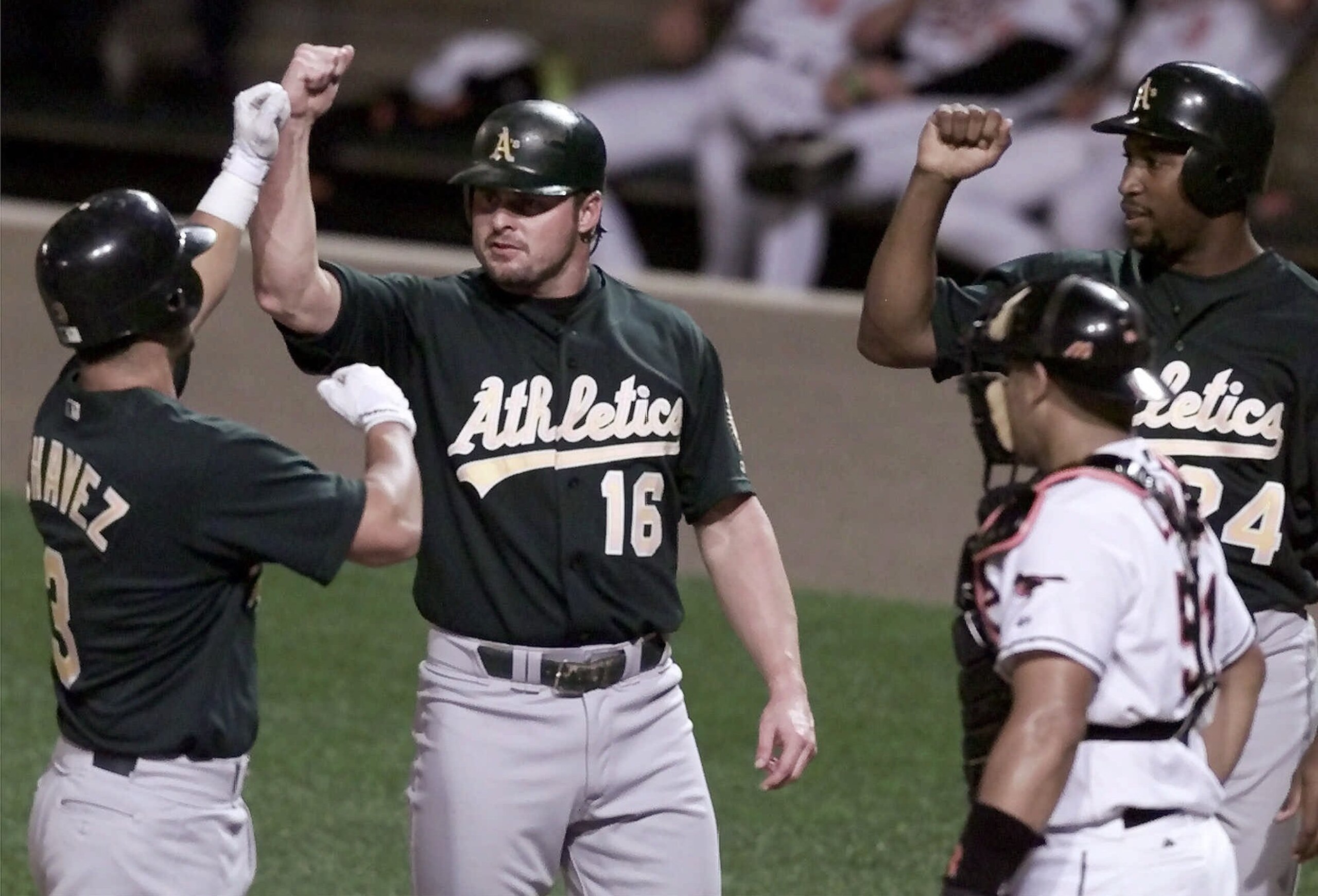
Key Hitters: Jason Giambi, Miguel Tejada, Eric Chavez, Jermaine Dye, Johnny Damon
In the 1990s, multiple players from the same team often at least 31 home runs with at least 113 RBI. Heck, the Rockies had four players do it in 1996.
In the past two decades, though, the 2001 Oakland A's were the only team to have at least three such players in the same year.
In his age-30 season, Jason Giambi was both the elder statesman in the A's lineup and the most noteworthy slugger of that bunch. Giambi was the AL MVP in 2000, but he was better in 2001, batting .342 with 38 home runs, 120 RBI and AL-best marks of 47 doubles and 129 walks. He finished just eight vote points behind Seattle's Ichiro Suzuki (289 to 281) for what would have been his second consecutive MVP honor.
The A's also had the 2002 AL MVP in Miguel Tejada, who racked up 31 home runs and 113 RBI in 2001. And not only did Eric Chavez supply 32 home runs and 114 RBI at the dish, but he also won the first of his six consecutive Gold Gloves at third base.
It was quite the trio, and it became one heck of a quartet when the A's acquired Jermaine Dye from Kansas City a few days before the July 31 trade deadline. Dye batted .297/.366/.547 with 13 home runs and 59 RBI over those final two-plus months. That put him on a 162-game pace of 35 home runs and 157 RBI.
Key Pitchers: Mark Mulder, Tim Hudson, Barry Zito, Cory Lidle, Jason Isringhausen
The A's had a lot of pop in the lineup, but the young pitching staff was their strong suit.
Mark Mulder, Tim Hudson and Barry Zito combined for 56 of Oakland's 102 wins. All three logged at least 214 innings and posted a sub-3.50 ERA, even though each entered that campaign 25 years old or younger and with either one or two years of MLB experience.
Hudson almost won the AL Cy Young in 2000, so his success was hardly a surprise. But Mulder had a 5.44 ERA as a rookie in 2000, and Zito had only pitched in 14 games before 2001. Neither of those 23-year-old lefties was expected to pitch multiple shutouts that season, but they did. And Cory Lidle picked a fine time to have the best season of his career, going 13-6 with a 3.59 ERA as Oakland's fourth starter.
Thus, the A's had four starters with at least 13 wins and an ERA of 3.60 or better—and a solid closer in Jason Isringhausen. According to my independent research, in the past 30 years, the only other teams in that club are the 1997 and 1998 Atlanta Braves (Greg Maddux, Tom Glavine, John Smoltz and Denny Neagle both years) and the 2014 Washington Nationals (Stephen Strasburg, Jordan Zimmermann, Doug Fister and Tanner Roark).
Result: 102-60 record; Lost in ALDS
A lot of people have forgotten about this team because the A's finished 14 games behind the Mariners in the AL West and subsequently lost in the first round of the postseason. But they basically broke even against the M's (9-10 record in 19 head-to-head battles), and they were on the verge of sweeping the eventual World Series champion New York Yankees out of the ALDS until Derek Jeter's iconic assist on Jeremy Giambi in Game 3 swung all the momentum to New York.


7. 2002 New York Yankees
4 of 10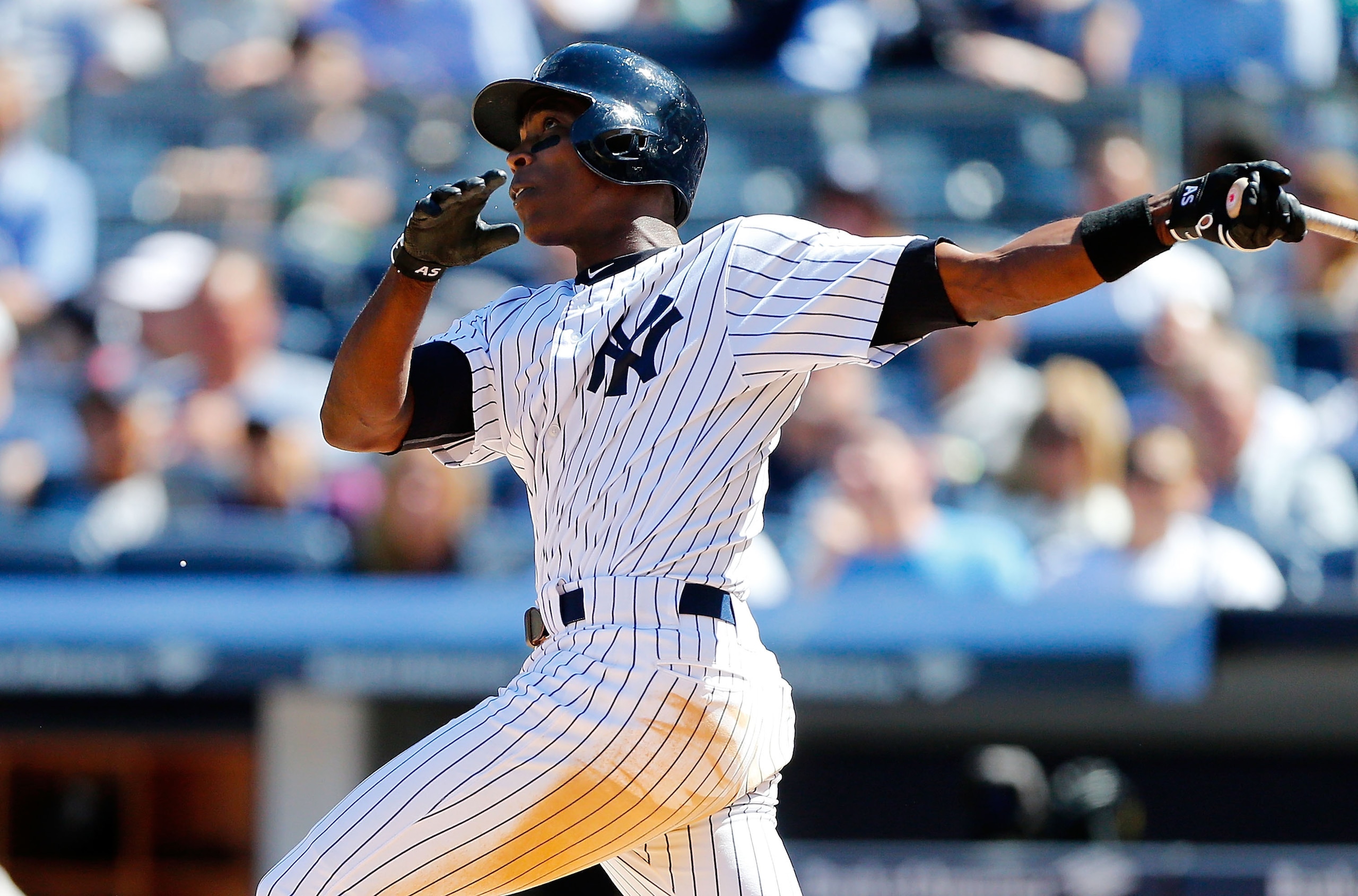
Key Hitters: Jason Giambi, Alfonso Soriano, Derek Jeter, Bernie Williams, Jorge Posada, Robin Ventura
The Yankees are always stacked, which is why they're the most polarizing team in MLB—and perhaps in any major professional sport. You either love them because it's like watching an All-Star team every day, or you hate them because they were the first club to figure out you can just buy stars from other cities when you have a seemingly limitless bankroll.
Case in point: After winning the 1998 through 2000 World Series and losing the 2001 Fall Classic in seven games, they acquired Jason Giambi, Robin Ventura and Rondell White. The Yankees also eventually traded for Raul Mondesi. And those four "new" starters combined to hit 93 home runs. (Giambi did most of that damage, hitting .314 with 41 home runs and 122 RBI.)
While the new guys flourished, so did the homegrown talent. Alfonso Soriano racked up 51 doubles, 41 stolen bases, 39 home runs and 102 RBI. Bernie Williams also had 102 RBI and batted .333. Jorge Posada had 20 home runs and 99 RBI. Derek Jeter was his usual All-Star self, too, batting .297 with 18 homers and 32 stolen bases.
It wasn't quite the Bronx Bombers of the 1920s or even the juggernaut that won 114 games in 1998, but there also weren't any weak spots in the lineup.
Key Pitchers: Mike Mussina, Roger Clemens, David Wells, Andy Pettitte, Orlando Hernandez, Mariano Rivera
There are colossal names on this list, though most of them were well along in years by this point.
Both Roger Clemens and David Wells were 39, Orlando "El Duque" Hernandez was 36 and Mike Mussina was 33. And while Andy Pettitte was the spry guy at a mere 30 years old, he missed nearly two months with an elbow injury.
Don't get me wrong; it was still a strong starting rotation. All five pitched until at least 2007, so they each had a fair amount of gas left in 2002. However, that quintet had a collective ERA of 3.85 that year. So instead of marveling at their greatness in 2002, we're left thinking, "Imagine if they had been in the same rotation together in 1998 instead."
Even legendary closer Mariano Rivera wasn't at his best in this campaign. He made several trips to the disabled list while accumulating just 28 saves with a 2.74 ERA. Those are respectable numbers for a mere mortal, but substandard for a first-ballot Hall of Famer who had 11 seasons with at least 33 saves and an ERA below 2.00.
Still, what an absurdly stacked pitching staff.
Result: 103-58 record; Lost in ALDS
The Yankees posted the best record in the majors in 2002, but they couldn't silence the bats of the Anaheim Angels in the postseason. All 11 Angels who received at least one at-bat hit better than .260. Clemens, Mussina, Pettitte and Wells each allowed at least four earned runs. The Yankees scored five or more runs in all four games, but it wasn't enough to keep pace with Troy Glaus, Darin Erstad and Co.
6. 2016 Chicago Cubs
5 of 10
Key Hitters: Kris Bryant, Anthony Rizzo, Dexter Fowler, Ben Zobrist, Addison Russell, Javier Baez
The 2016 Cubs didn't have a single .300 hitter—unless you want to count Munenori Kawasaki getting seven hits in 21 at-bats—but they did have a pair of All-Star sluggers who seemed like impossible outs.
Both Kris Bryant and Anthony Rizzo batted .292 in 2016. The former hit 39 home runs, drove in 102 runs and was named NL MVP. The latter ended up at 32 and 109, respectively, finished fourth in the MVP vote and won a Gold Glove. Not quite Mickey Mantle and Roger Maris in 1961, but one heck of a pair all the same.
And despite the lack of .300 hitters, the Cubs had some pop from top to bottom. Ben Zobrist had 52 extra-base hits and was effective no matter where he got plugged in the lineup or the field. Javier Baez was similarly valuable in a utility role. And Dexter Fowler, Addison Russell and Jason Heyward weren't exactly slouches at the plate or in the field.
Key Pitchers: Jon Lester, Kyle Hendricks, Jake Arrieta, John Lackey, Aroldis Chapman
Washington's Max Scherzer ran away with the 2016 NL Cy Young Award, but Chicago's Jon Lester and Kyle Hendricks at least hung around that conversation, finishing second and third, respectively.
Lester posted a career-best 2.44 ERA en route to a 19-5 record. He had 26 quality starts in 32 attempts.
Hendricks wasn't quite that consistent in the longevity department, but he ended up with an MLB-best 2.13 ERA—after a rough start in April, no less. From May 1 onward, his regular-season ERA was just 1.89, and his postseason ERA was an even better 1.42.
Trading for Aroldis Chapman was the championship move, though. They gave Gleyber Torres to the Yankees to get the star closer, but it was worth it to end the Curse of the Billy Goat.
Chapman had a 1.01 ERA in 28 regular-season appearances with the Cubs and then logged 15.2 good-not-great innings across 13 postseason appearances. Though he allowed six earned runs in those 15.2 innings, I've got to believe that's better than Hector Rondon would have done in those high-leverage situations if Chicago had just let it ride with its former closer.
Result: 103-58 record; Won World Series
One of the few teams on this list that finished the fight, the Cubs erased a 3-1 World Series deficit against the Cleveland Indians, winning Game 7 in a 10-inning affair that included a brief rain delay after the ninth inning. It took more than a century, but Wrigley Field finally got to add another world championship flag.
5. 2018 Boston Red Sox
6 of 10
Key Hitters: Mookie Betts, J.D. Martinez, Xander Bogaerts, Andrew Benintendi, Jackie Bradley Jr., Rafael Devers
Excluding the outrageous numbers Barry Bonds was putting up from 2001 to '04, Mookie Betts put together perhaps the most impressive individual season in the past 50 years in 2018. He led the majors in batting average (.346), slugging percentage (.640) and runs scored (129). He hit 32 home runs, stole 30 bases and swatted at least 40 doubles for the fourth consecutive year. Betts also earned a Gold Glove for the third straight season.
Even though Mike Trout hit .312/.460/.628 with 39 home runs and 24 stolen bases, Betts was named AL MVP by a landslide.
And while Betts was raking in the leadoff spot, J.D. Martinez was doing the same from either third or fourth in the batting order. Martinez hit .330 with 43 home runs and an MLB-best 130 runs batted in. He finished fourth in the AL MVP vote and made history by becoming the first person to earn two Silver Slugger Awards in the same year—one for DH and one for outfield.
The rest of the lineup pales in comparison to what that duo accomplished at the plate, but Xander Bogaerts (.288 AVG, 23 HR, 103 RBI) and Andrew Benintendi (.290 AVG, 16 HR, 87 RBI, 21 SB) were solid.
Key Pitchers: Chris Sale, David Price, Rick Porcello, Craig Kimbrel
For the first four months of the season, Chris Sale looked like the no-brainer choice to win AL Cy Young—after six consecutive years of finishing between second and sixth place in that vote.
Through the end of July, he was 11-4 with a 2.04 ERA, a 0.87 WHIP and a 13.2 K/9 ratio. However, he landed on the injured list July 31 and only pitched 17 innings in Boston's final 57 games. Despite the shoulder inflammation and the limited innings, he finished in fourth place in the Cy Young vote.
Beyond that ace, Boston's staff was marginally better than adequate.
Both David Price and Rick Porcello have a Cy Young Award on their mantels, but neither one delivered that degree of greatness in 2018, each posting an ERA north of 3.50. So did No. 4 starter Eduardo Rodriguez (3.82). Even closer Craig Kimbrel (2.74 ERA) wasn't as dominant as he used to be.
Nevertheless, this pitching staff delivered one of the stingiest seasons in Red Sox history. The group only allowed 647 runs, which—excluding the strike-shortened 1981 and 1994 seasons—was the fewest runs allowed by Boston since also giving up 647 in 1973.
Result: 108-54 record; Won World Series
As perhaps should be the case for a team that wins 108 games during the regular season, Boston cruised to its fourth World Series title in 15 years. The Red Sox only lost one game in each of their three postseason series.
4. 2019 Los Angeles Dodgers
7 of 10
Key Hitters: Cody Bellinger, Max Muncy, Justin Turner, Corey Seager, Joc Pederson
Cody Bellinger was the NL Rookie of the Year in 2017, and he was much better last season en route to winning the league's MVP award. He hit .305/.406/.629 with 47 home runs and 115 RBI and earned a Gold Glove for his defense primarily in right field.
Bellinger was just the tip of the iceberg.
Joc Pederson clubbed 36 home runs. Max Muncy was close behind with 35. Justin Turner matched a career-high mark of 27. And seven other Dodgers reached double digits in home runs. They led the National League with 279 four-baggers—eight of which came in the season opener against Arizona. They didn't slow down much from there.
Key Pitchers: Walker Buehler, Hyun-Jin Ryu, Clayton Kershaw, Kenta Maeda, Kenley Jansen
It wasn't a vintage Clayton Kershaw season. He gave up home runs at a rate well above his previous career worst, had his worst K/BB ratio since 2013 and posted his worst ERA since 2008. Fortunately, less-than-peak Kershaw is still damn good. He went 16-5 with a 3.03 ERA and a 4.61 K/BB ratio, which is ace-level stuff from what ended up being L.A.'s third-best starter.
Hyun-Jin Ryu led the majors with a 2.32 ERA and did so with a 6.79 K/BB ratio. New York's Jacob deGrom was the near-unanimous NL Cy Young winner, but Ryu's lights-out season landed him in second place in that vote.
And one could argue that Walker Buehler was more impressive than Ryu. He had a worse ERA (3.26) thanks to a rough first month of the season, but he had a 16-strikeout game against Colorado, as well as a 15-K outing a few weeks later against San Diego. And in two postseason starts, he had a 0.71 ERA and 10.7 K/9.
Things got a little messy beyond that trio, as the Dodgers used 11 different starters. But their 3.37 team ERA was the best in the majors.
Result: 106-56 record; Lost in NLDS
The Dodgers won the NL West by a preposterous 21-game margin and were the heavy favorites to represent the National League in the World Series. Yet, even though the Washington Nationals used both Max Scherzer and Stephen Strasburg to beat Milwaukee in the NL Wild Card Game, they ousted the Dodgers in the NLDS—thanks in large part to Kershaw's allowing a pair of home runs in the eighth inning of the decisive Game 5.
3. 2017 Cleveland Indians
8 of 10
Key Hitters: Jose Ramirez, Francisco Lindor, Carlos Santana, Edwin Encarnacion
There was a lot of flux in Cleveland's lineup. Thirteen Indians received between 109 and 342 at-bats thanks to a combination of designed platoons and minor injuries. Yan Gomes was arguably their fifth-most valuable batter, despite a .232 average and mediocre power.
They had four constants who were good enough to hold everything together, though.
Carlos Santana hit 23 home runs, scored 90 times, drove in 79 runs...and was the worst of Cleveland's primary quartet in each of those three categories. Jose Ramirez, Francisco Lindor and Edwin Encarnacion combined for 100 home runs, 302 runs and 279 runs batted in. Ramirez finished third in the AL MVP vote. Lindor wasn't far behind him in fifth place.
Key Pitchers: Corey Kluber, Carlos Carrasco, Trevor Bauer, Mike Clevinger, Andrew Miller
Corey Kluber was sensational. He had a 2.25 ERA with a minuscule 0.87 WHIP. He averaged 7.36 K/BB, notched three shutouts and won 18 games. He led the majors in all five of those categories and easily won the AL Cy Young Award—even though Boston's Chris Sale was busy becoming the first pitcher with 302 or more strikeouts (308) in a single season since 2002.
Kluber was the brightest star, but Cleveland was loaded with strikeout artists.
As a staff, the Indians averaged 10.1 K/9. Setup man Andrew Miller led the way at 13.6, but he was one of eight Indians who pitched at least 50 innings with a K rate of 10.0/9 IP or better.
Not only did they rack up strikeouts, but they also rarely doled out walks, boasting a teamwide K/BB ratio of 3.98—the best mark in MLB history dating back to 1900.
Result: 102-60 record; Lost in ALDS
The Indians made it to the World Series in 2016, but they were better in 2017...until October, at least. Trevor Bauer was nearly unhittable in Game 1 of the ALDS against the Yankees, and they erased an 8-3 deficit in Game 2 to take a seemingly insurmountable 2-0 series lead. Their bats went cold from there, though, as they managed just five runs and three extra-base hits over the final three games.
2. 2019 Houston Astros
9 of 10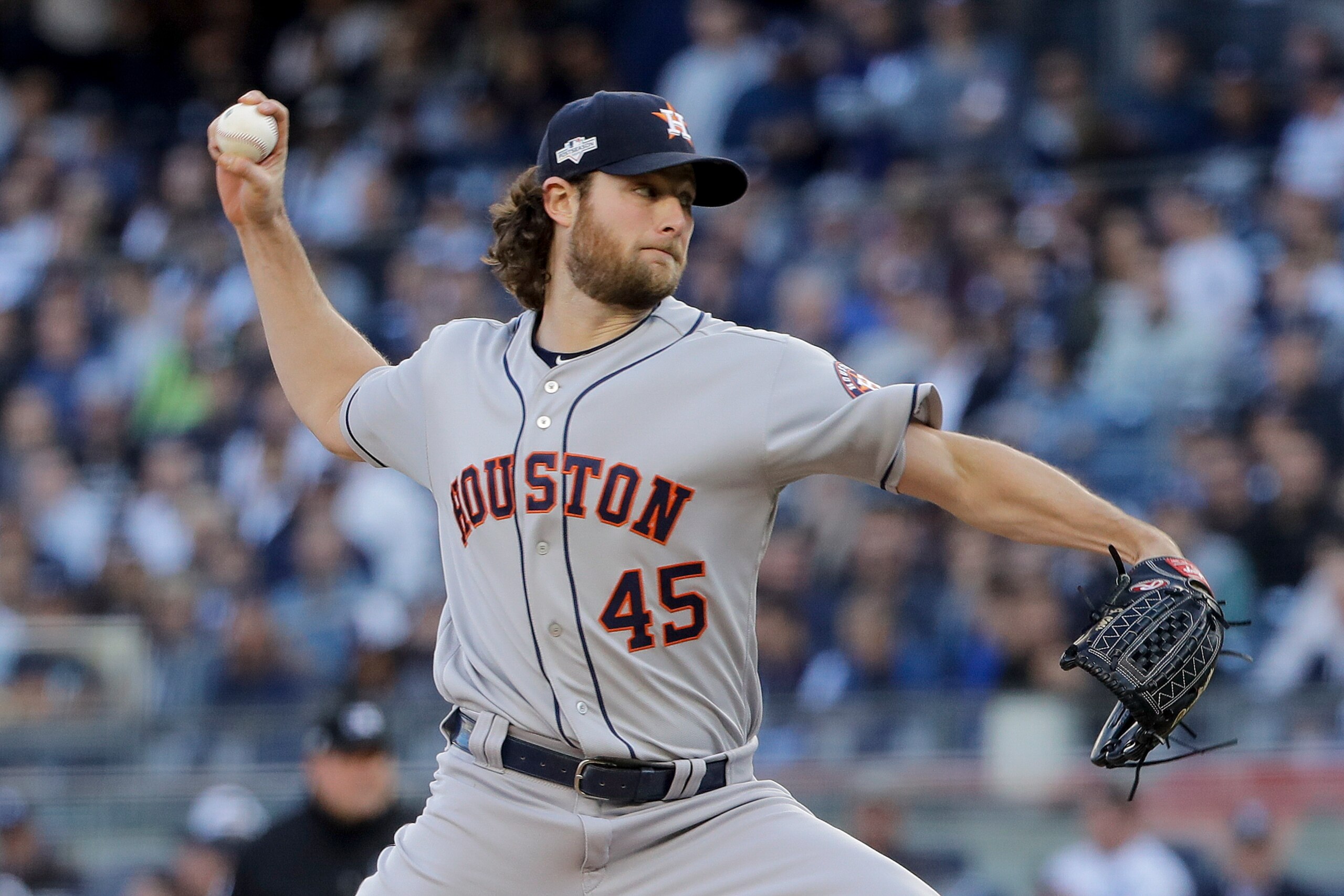
Key Hitters: Alex Bregman, George Springer, Jose Altuve, Yordan Alvarez, Yuli Gurriel, Michael Brantley, Carlos Correa
Even in a season when it seemed like every team had a half-dozen guys mash 20 home runs, Houston had an embarrassment of riches at the plate.
Alex Bregman led the charge with 41 home runs, 122 runs scored and 112 runs driven in, finishing second to Mike Trout in the AL MVP race. He also led the majors in walks, which contributed to his impressive .423 on-base percentage.
Only two of those walks were intentional, though. After all, opponents couldn't exactly pitch around anyone in this murderers' row.
George Springer hit 39 home runs despite only playing in 122 games. Jose Altuve had 31 home runs in 124 games. Yordan Alvarez had 27 in 87 games. And Carlos Correa swatted 21 in 75 games. Bregman was the only one to reach 40 home runs, but those other four Astros all had a 162-game pace north of 40. Both Alvarez and Springer were on pace to eclipse 50.
Bregman, Springer, Altuve, Alvarez, Yuli Gurriel and Michael Brantley all batted better than .290 and hit at least 22 home runs. Even though those six guys missed a combined 191 games, Houston was a wrecking ball on offense.
Key Pitchers: Justin Verlander, Gerrit Cole, Zack Greinke, Roberto Osuna, Will Harris, Ryan Pressly
In Justin Verlander and Gerrit Cole, Houston had perhaps the best one-two pitching punch since Randy Johnson and Curt Schilling in the early 2000s.
Both Astros aces averaged better than 12 strikeouts per nine innings, posted a sub-2.60 ERA and won at least 20 games. Cole (13.82 K/9 and 2.50 ERA) was a bit better in both categories than his 36-year-old counterpart (12.11 and 2.58, respectively), but it was Verlander who won the AL Cy Young by a slim margin. For what it's worth, it was either Verlander-Cole or Cole-Verlander in the top two spots on all 30 ballots. That's how dominant that duo was.
For the first four months of the season, it was Cole and Verlander and pray for rain. Wade Miley made 33 starts and won 14 games, but he was only marginally better than a replacement-level option. And he was hands down the team's third-best starter until the Astros traded for Zack Greinke, who went 8-1 in 10 starts after landing in Houston on July 31.
And if the Astros made it into the seventh inning with the lead, it was usually game over. Between Will Harris (1.50 ERA, 0.93 WHIP), Ryan Pressly (2.32 ERA, 0.90 WHIP) and Roberto Osuna (2.63 ERA, 0.87 WHIP), opponents had little hope of erasing any late deficit against this bullpen.
Result: 107-55 record; Lost in World Series
Houston had the best record in the majors and overcame two losses in both the ALDS and the ALCS to reach the World Series. And in that Fall Classic against the Nationals, they went 3-0 on the road. However, they had home-field (dis)advantage and went 0-4 in those games, losing the series in seven games. The bats showed up, but the pitching ran out of gas. Verlander and Cole went 1-3 in their four starts, and the law firm of Harris, Pressly and Osuna allowed an uncharacteristic six earned runs in 9.1 innings.
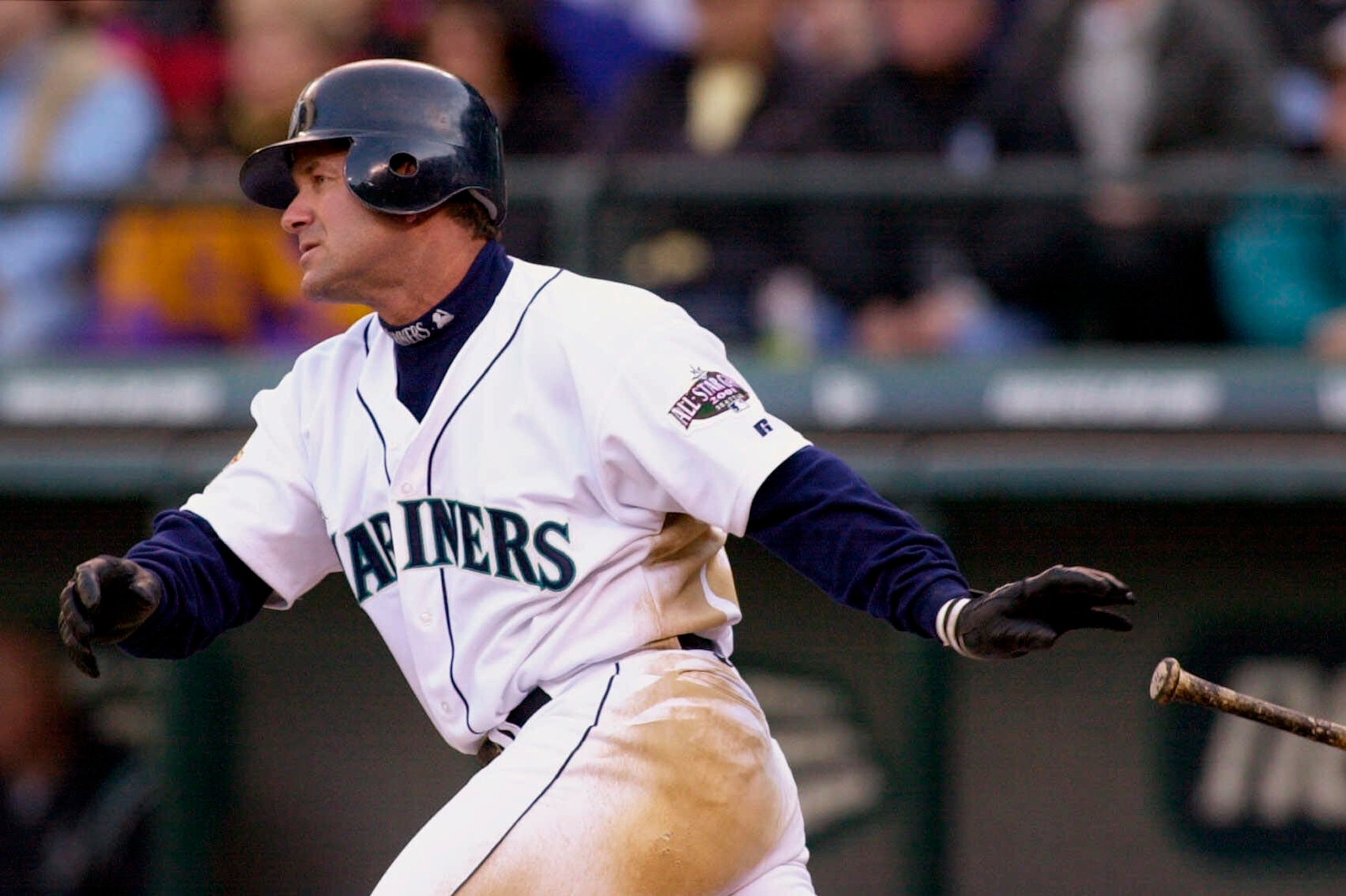
1. 2001 Seattle Mariners
10 of 10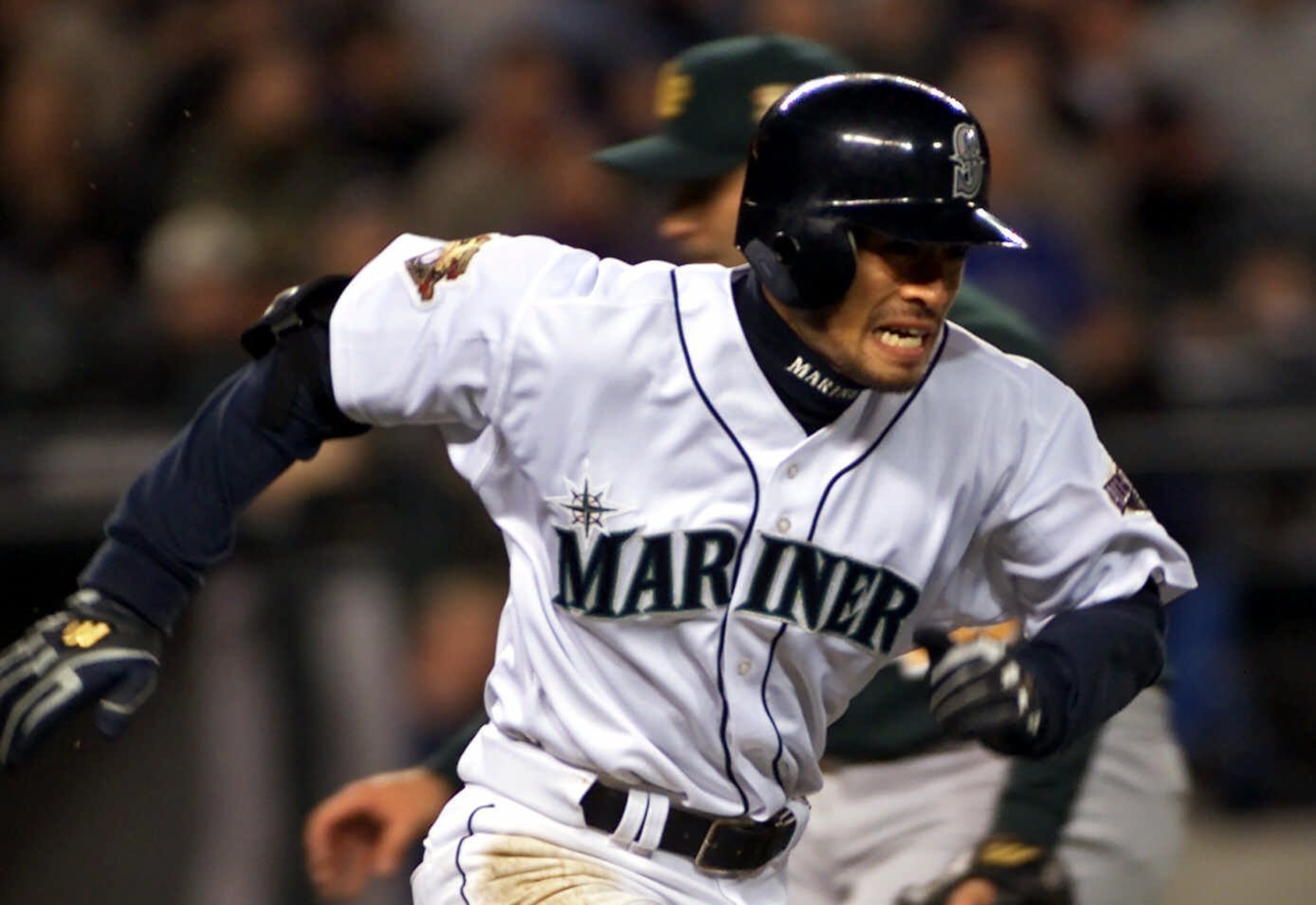
Key Hitters: Ichiro Suzuki, Bret Boone, Mike Cameron, Edgar Martinez, John Olerud
Ken Griffey Jr. left after the 1999 season. Alex Rodriguez signed his megadeal with the Texas Rangers after the 2000 campaign. Yet, the Seattle Mariners had one of the best seasons in MLB history in 2001 without those two all-time greats.
Ichiro Suzuki was the biggest star during this magical year. The 27-year-old rookie from Japan batted .350 with 242 hits, 56 stolen bases and a cannon of an arm in right field en route to winning both the AL Rookie of the Year and MVP awards.
Bret Boone was just as irreplaceable, though. The second baseman's late-career surge in Seattle began that year at age 32. Boone set career-highs in batting average (.331), home runs (37) and RBI (141), leading the AL in the latter category.
Opponents couldn't very well pitch around those two, either, as Mike Cameron (25 HR, 110 RBI), Edgar Martinez (23 HR, 116 RBI) and John Olerud (21 HR, 95 RBI) were also tough to get out.
Key Pitchers: Jamie Moyer, Freddy Garcia, Aaron Sele, Joel Pineiro, Arthur Rhodes, Kazuhiro Sasaki
As far as FanGraphs wins above replacement is concerned, these Mariners had the sixth-best batting season in MLB history, as well as the best since that of the 1976 Cincinnati "Big Red Machine."
But the pitching staff was just OK.
Jamie Moyer (20-6, 3.43 ERA) and Freddy Garcia (18-6, 3.05 ERA) both received some Cy Young consideration, but the Yankees (led by Roger Clemens and Mike Mussina), Diamondbacks (led by Randy Johnson and Curt Schilling) and the Athletics (led by Tim Hudson, Mark Mulder and Barry Zito) all had much more formidable starting rotations in 2001.
Frankly, the "ace" of the Mariners staff might have been setup man Arthur Rhodes, who had an 8-0 record with a 1.72 ERA and a K/BB ratio just shy of 7.0. If Seattle was winning after seven innings, he and closer Kazuhiro Sasaki finished the job far more often than not.
Result: 116-46 record; Lost in ALCS
Seattle's Pythagorean W-L record of 109-53 is tied with the 2018 Houston Astros for the highest of any team in the past two decades, but its actual win total of 116—tying the 1906 Chicago Cubs for the most wins in a single season—cemented the Mariners at No. 1. It didn't help them in October, though. They barely got past the 91-win Cleveland Indians in the ALDS—including losing 17-2 in Game 3 of the five-game series—and then got smoked 4-1 by the 95-win New York Yankees in the ALCS.

.jpg?w=2560)
.jpg?w=2560 "AD Trolls Bears WR on IG 😂")
.jpg?w=2560 "Viral Dan Campbell Presser 💙")
.jpg?w=2560 "Report: Steelers WR to Miss 'Weeks'")
.jpg?w=2560 "Cam Ward Says He's Not A Loser")
.jpg?w=2560 "Buzz: MHJ Hired Agents for Trade")
.jpg?w=2560 "Chargers Fall to 0-5 🤢")