Triple H on 25 Years in WWE, DX and His Complicated Relationship with The Rock
The first day of the rest of Paul Levesque's life started early in his WWE tenure, almost 25 years ago. Performing as the debonaire Hunter Hearst Helmsley, the middle-of-the-card wrestler decided to doing something a little unusual, at least for him: get his own rental car.
Normally, Triple H rode with some of the other guys, like most wrestlers on the rise looking for both allies in the back and an opportunity to save a little cash. But on a tour of the northeast, he decided to get his own ride for the first time, hoping for a chance to swing by and visit his parents in New Hampshire.
TOP NEWS
.jpg?w=2560)
WWE Raw Live Grades 🔠
WWE's Bizarre Oba Femi Plan headlines Raw Fallout 😖
Who Will Be The Next WWE Star to Leave? 🤔
He was in line when he heard it.
"Kevin Nash pulled up outside the window and had a van," Triple H says. "He was honking the horn at me through the window, and he was gesturing like, 'Come out here.' So I stuck my head out and he said, 'What are you doing?' I said, 'I'm getting a car.' He said, 'Who you riding with?' I said, 'I'm by myself for this loop.' And he was like, 'Jump in with us; we've got a van.' I was like, 'Are you sure? It's seems like a tight fit.' He's like, 'Nah, it'll be great.'"
The "us" in this case was a who's who of WWE at the time, title contenders Shawn Michaels and Diesel (Nash), former intercontinental champion Razor Ramon (Scott Hall) and wrestler's wrestler Sean "X-Pac" Waltman. They were a tight-knit bunch, collectively known in the locker room as The Kliq. Joining them, even for one trip down the road, was a pretty big deal.
"I didn't know any of those guys prior to my coming to WWE," Triple H says. "I didn't know them at all. The only connection that I had in any way to any of them was that I knew Terry Taylor, who was friends with Shawn Michaels. Shawn tells the story about my first day, coming up to me and saying, 'ride with us.' It's not really accurate. Shawn's viewpoint was a little bit sketchy at that time, let's just say.
"It was some months. Scott and Kevin told me that they used to watch WCW, and they'd watch Saturdays and see me on the show. And they mentioned to other people a bunch of times that we should hire that kid. Like he looks like he's going to be good. Man, they should get him. Scott even talked to Vince about me. I don't know if that had anything to do with them asking me to ride, but I didn't really know those guys yet."
Hopping in that van changed everything. Triple H was a talented undercard wrestler in a company packed to bursting with talented potential stars looking for a break. Success and failure in the wrestling business is all about being able to differentiate yourself from the pack, from the rest of the roster stuck in that midcard traffic jam, all looking for that one opportunity to shift out of second gear and find a stretch of open road.
While a peer group, even one as powerful as The Kliq, couldn't guarantee a main event push, it could help to provide, at a minimum, the opportunity to be seen and a chance to sit under the learning tree of some of the most savvy and political minds in the wrestling business.
"That was kind of the start of it," Triple H says. "I jumped in with those guys, and we all just jelled. It's hard to find people you get along with in the business, but we'd ride down the road for six hours, and that's all we talked about was the business. People's perception of it being this selfish thing—it really wasn't. It was about the show. Everything about the show. Putting over the people who deserved it but not the ones who didn't.
"It was all from a passion for the business. That's what kind of bound us all together. We joke all the time about Scott Hall. Every night he would get in the car after the show and go, 'Guys, can we just for five minutes not talk about business in the car for once.' And then he'd be the first one to go, 'But before that, did anyone watch the third match?' And that would be the start of it.
"What would have happened had I not met those guys? It's hard for me to look at my career and say because everything outside of my immediate relatives, everyone important in my life is from this business. So it's hard for me to change any part of it and think about what would've happened to my life.
"Every single person that I met, worked with along the way, got in the ring with, I learned something from. They were a cog the wheel of me being here for 25 years, doing what I've been able to do. The things I've learned, to be in the spot I'm in—it's been a hell of a ride."
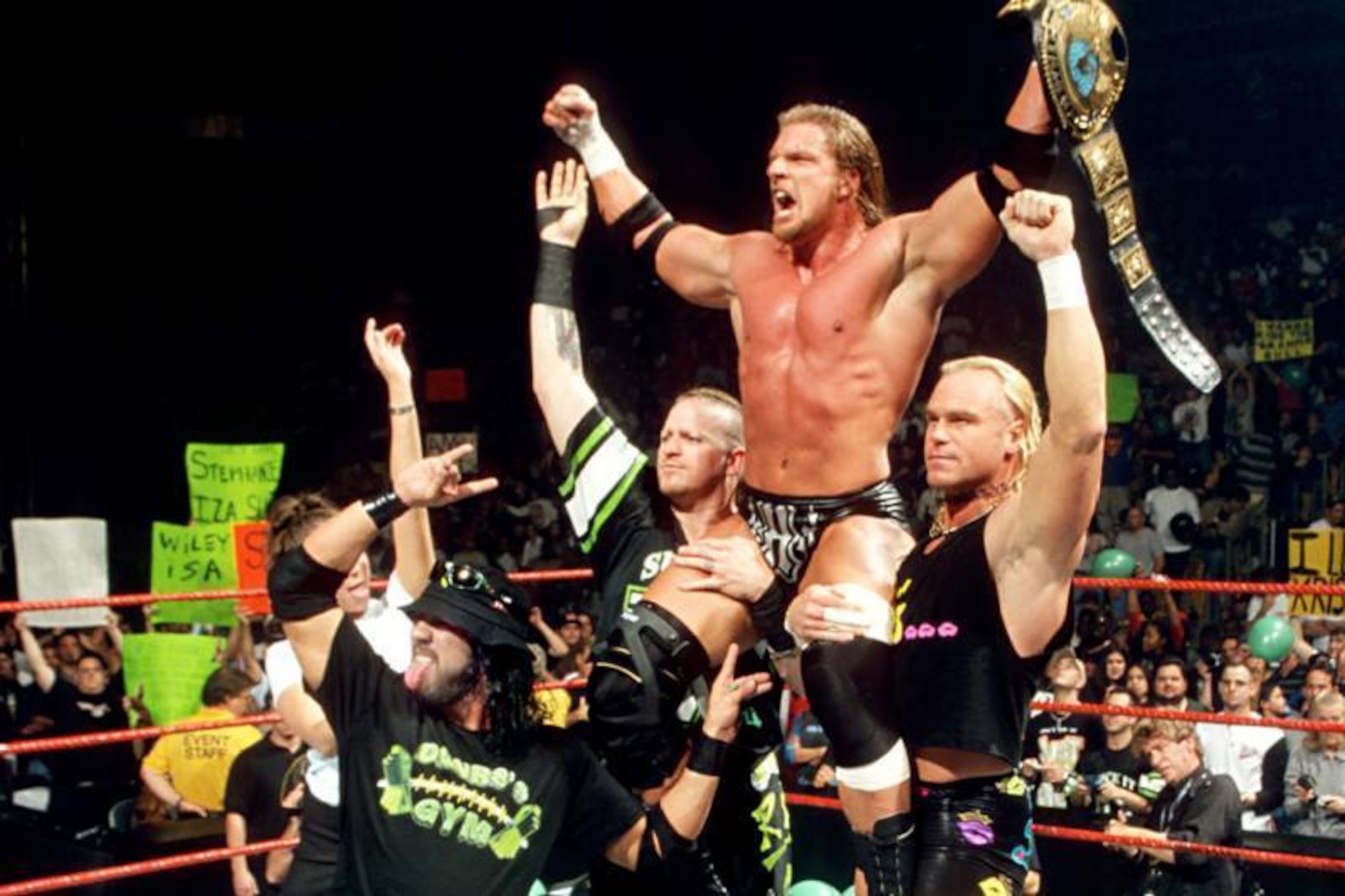
The original D-Generation X grew out of his relationship with Michaels and all those hours on the road, the act a shot across the bow of the entire industry. It would eventually be known as the Attitude Era, but at the time it was a challenge to the decades-long division between babyface and heels.
In the WWE of the mid- to late-1990s, cartoon heroes and villains were colored over with a shade of grey. It was a chance to invent a new kind of character, one Michaels and Triple H both embraced, ushering in the era of the cool heel. When Michaels took a step back from his wrestling career in 1998, his understudy was ready to step into the spotlight and headline in his own right.
"When we formed DX the first time, it was an opportunity for me to really take a leading role even though it was standing next to Shawn in a sense," Triple H said. "DX was me, Shawn, and Chyna at its core, and we were all unique cogs in this wheel. Shawn was the star. But it put me in positions a lot of times when I had to take the ball myself.
"This was when stuff was very unscripted, and we were doing DX, and we were especially unscripted. And I was going to, for the first time, be given the microphone in a big way and told go off on Vince [McMahon]. To have that confidence level again—I still remember the words coming out of my mouth and seeing the look in Vince's eye change and seeing I was hitting a nerve. And thinking like 'oh my God! I'm going to get fired.' I remember walking to the back like, 'I went too far.' But getting out there and having that confidence, that's all a learning experience and repetitions and sometimes just learning how to have that swagger.
"That opening foray into DX was really the door opening up for me. There were periods in there when Shawn was injured, where Shawn wasn't necessarily functioning properly to be able to carry the angle and I had to do it. So I had to learn to step up. And then, when Shawn was injured and was leaving, there was a big giant step, but it was a step that I at least had the tools for, and I felt like to be able to capitalize on."
What followed next is wrestling lore: a main event run spanning generations and more than 1,200 cumulative days holding a world championship title. Triple H had the look, had the pizzazz on the microphone and had a mind for wrestling that earned the trust of WWE's top brass.
It's hard to think about wrestling over the past 25 years and not think about Triple H and his epic confrontations with Mick Foley, "Stone Cold" Steve Austin and his old friend Michaels. But more than anyone else, he will walk into wrestling history with his greatest rival, The Rock.
The wrestling rumor mill has swirled for years with the idea that the two great icons of the early 2000s despised each other behind the scenes. The two battled fiercely, both in the ring and outside it, jockeying for position in a business that can only have a handful of top guys at any given time. But, as Triple H says, it was a relationship predicated on respect.
"It's a funny thing; we weren't friendly," Triple H said. "I don't know that I've ever eaten dinner with The Rock or gone out after show with him or anything like that. We were in different circles. But man, my respect for him was unbelievable. Any time I heard 'Hey, you're going to work with Rock,' I'd be like, 'all right. This is going to be awesome.' We would push each other. There was just this mutual respect. But based on our competitive natures, there was also always this intense rivalry.
"I never felt during that time that Rock and I didn't like each other. But we were uber competitive with each other. There was this competitive nature to everything that we did. When you're in your 20s, you're full of yourself. You have to be in this business to be good at what you do.
"There's a lot of like, 'screw him. I'll do better than that.' You know what I mean? 'He thinks he can do this? I can do that.' I can remember going to Gold's Gym one time and seeing him on the other side of the gym and he's lifting heavy. And I'm thinking, 'I got to go heavier.' There just was something about him. He always drove me to want to do more and be better.
"He's where he is in the world because of that passion and that drive. And if he was going to get up at 4 a.m. and go train after we'd been driving all night long, then I was going to be in that gym too. When we got to Europe, if he was going to get off the bus and go straight to the gym. I was going straight to the gym. It was competitive."
While the two never clicked outside the ring, Triple H had immediately recognized a kindred spirit. They had much in common, from their drive to succeed to their initial failed gimmicks. There was also a commitment to excellence that, frankly, not everyone in the industry is able to maintain once they achieve an initial level of success.
"He comes in the door and it's, like, he's just got, it. Got charisma, got everything," Triple H recalls. "And he, much like everybody else when they first come in, he's stuck with the Rocky Maivia character, and he's trying to make it work. And I'm the Greenwich snob, and I'm trying to make it work. We're trying to find our way, and we're trying to separate ourselves and figure out how can we be something more.
"There were points in our careers that so mimicked each other. When I came in, I got a wonky gimmick. He comes in, and he's got a wonky gimmick. I get in DX and start to transition myself to a more believable version of what I wanted to be. He gets into the Nation of Domination and transfers himself into a more believable version of what he wants to be. And then he's intercontinental champion. Then I'm intercontinental champion. It's tit for tat. Then he's champion, and then I'm champion. And then it's, I'm the bad guy; he's the good guy. And they mirrored each other, and we just danced for the longest period of time.
"When I look at my career and all the people that I've worked with, I don't know that I've worked with anybody more than him. I wrestled him night after night all over the globe, and it was like a night off every night. If I could say one thing to him, it would be, 'thank you,' because his drive and passion made me better. It made me want to somehow chase him and be better and work harder."

It's been almost 10 years since Triple H was wrestling regularly on WWE television. He typically pops in a couple of times a year, helping establish new talent where he can and providing a special moment at every WrestleMania, where his epic entrances have taken on a life of their own.
"I think just from a grandeur standpoint, from idea to execution," he says. "My favorite was when I came out with Charlotte [Flair] and Sasha [Banks] and Alexa [Bliss] and the throne, just because they got to experience the stadium, and we pulled it off in such a big way. It seemed so cool. To me, that one always stands out in my head.
"I wish it had been at nighttime with the Terminator entrance because that one was really cool too. Arnold [Schwarzenegger] was one of my heroes growing up and, for me, him VO-ing and intro-ing me at the beginning of that thing made the whole thing worthwhile. And then, obviously wrestling with Steph against Ronda [Rousey] and Kurt [Angle] and having us ride out together was pretty awesome too."
Triple H was conspicuous by his absence this year, with the King of Kings not taking his normal star turn at the Show of Shows. Now 50, and with his plate quite full with duties behind the scenes as WWE's Executive Vice President of Global Talent Strategy & Development, it raises the question, have we seen the last of Triple H at WrestleMania?
"(Triple H's wife) Steph asked me, six months out, 'Have you heard anything about you doing something at WrestleMania this year?' And I said, 'No. I don't think I'm going to do anything. It doesn't seem like the right thing is there.' To me, it's one of those things at this point in my career, if the right thing is there, I'll do it," Triple H said. "But if it's not, I don't want to do it just to do it. If they need me, I'll do it, if not, great.
"It's so busy for me at WrestleMania and it's so nerve wracking and there's so much to do that it's almost becomes difficult to add wrestling in. When I look back, hindsight on this year, after everything that happened and how WrestleMania turned out, I think, 'well thank God I didn't have the match to do as well.' Because I don't know how I would have accomplished any of the things that we did. It just would have become overwhelming.
"It's really difficult. Taker talks about that a lot. To say once a year, 'Hey, I'm going to just throw my trunks on and go have a match.' And you want to deliver. It's the weight of the world. It's tough. I'm not saying I'm done. The second you make that statement, something comes along that makes you wish you didn't make the statement. If the right thing comes along, I'll do it. If it's not, I'm OK.
"I've had a hell of a run. And I've got no regrets. And to be honest, right now I have as much, if not more fun, helping the guys and girls setting stuff up and NXT and living vicariously through them and enjoying their success. While my own career was great, it's a different level of pride watching them. I'm good one way or the other. There's gas left in the tank, but I don't feel the need to get out on the road and run it all the way out, either."
Jonathan Snowden covers combat sports for Bleacher Report. WWE celebrates 25 years of Triple H on Friday night on SmackDown at 8/7 C on FOX.
.jpg?w=2560)

.jpg?w=2560 "Rams troll Jameis, Giants on social media")
.jpg?w=2560 "Old Brady Vid Goes Viral 🐐")