

Current NBA Comparisons for 2019 Hall of Fame's Biggest Stars
The 13-member class of 2018 doesn't just celebrate legends of yesteryear by welcoming them into the Naismith Memorial Basketball Hall of Fame. It also serves as a reminder of just how much influence the sport's past has on its present.
Today's standouts wouldn't be the same without the examples of their forebears. Without Ray Allen's shooting or Grant Hill's versatility as a point forward, to name a couple, the NBA would look quite a bit different in 2018-19.
To highlight that maturation, we're putting four of the class' most notable members under the microscope. And please know that no disrespect is meant to Maurice Cheeks, Tina Thompson and the others inducted into the Hall, even if they're not featured here.
TOP NEWS

LeBron's Special Helicopter Deal

MJ Makes Record-Setting Donation 🙌
Shams: KAT, Hart Could Be Trade Names
Everyone had an impact on the growth of today's leading basketballers, but Allen, Hill, Jason Kidd and Steve Nash stand out even more, both in terms of on-court performances and importance to the games of their closest current comparisons. These four connections aren't perfect equivalencies, but the adjoining lines between past and present help shine a light on this sport's journey.
Steve Nash = Stephen Curry?
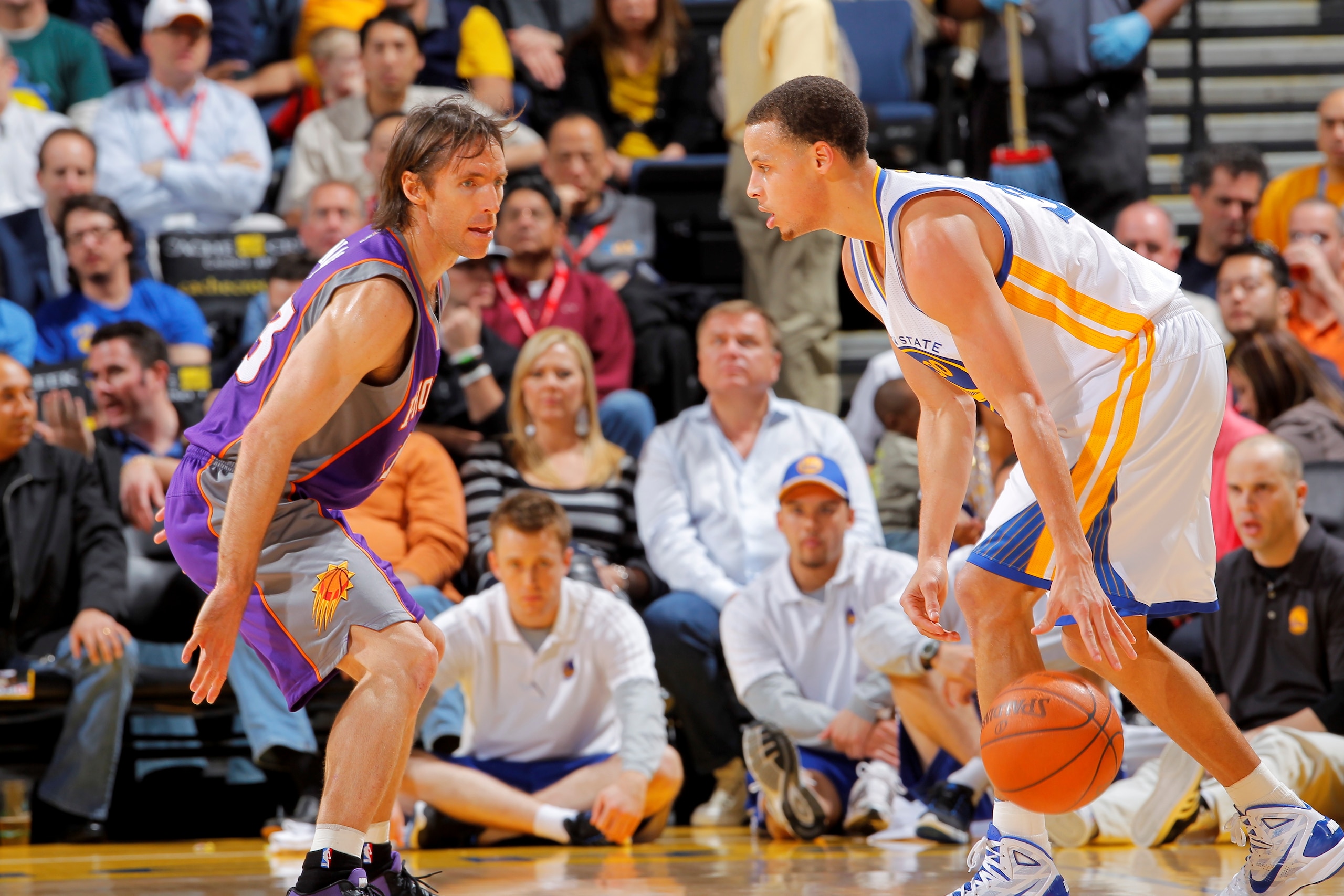
Steve Nash certainly wasn't the first point guard to bring flair into the NBA, but he helped pioneer the type of offensive basketball that's taken today's league by storm. Leading both the Dallas Mavericks and Phoenix Suns to some of the loftiest scoring territory ever, he dazzled fans and opponents with his terrifying blend of efficient shooting and pinpoint passing.
From the day he became a full-time starter for the Mavs at the onset of the 2000-01 season until the end of his playing days in the desert (2011-12), he averaged 16.3 points, 3.3 rebounds and 9.9 assists while racking up eight All-Star appearances and a pair of MVPs. As if that wasn't enough, he slashed an eye-popping 49.8/43.2/90.8, demonstrating consistent shooting excellence from all over the floor, whether in spot-up or off-the-bounce scenarios.
Nash didn't establish the club of true point guards who posted at least 15 points and six assists per game with a true shooting percentage no worse than 60 percent. But he is the man with the most qualified entries, and precious few have joined the fraternity on multiple occasions:
- Steve Nash, 8 times
- Stephen Curry, 4 times
- John Stockton, 4 times
- Kevin Johnson, 3 times
- Mark Price, 3 times
- Chauncey Billups, twice
- Chris Paul, twice
As such, it's only fitting that we turn to Curry as the closest current comparison, especially since the two have worked together; Nash has served as a player development consultant for the Golden State Warriors.
Nash and Curry don't play identical games. The latter is nowhere near as gifted a passer, and his shooting has surpassed Nash's. He's far more comfortable taking over games as a scorer and relies more on his three-point stroke than Nash ever did, mitigating any need to employ that pass-first mentality that defined the Canadian's career. However, the strides he's taken for the Dubs are only available because of his predecessor's trail-blazing habits.
The threes are one thing. Curry might not have as green a light without the inspiration of Nash, who constantly pulled up for triples in transition and attacked early in the shot clock—an incontrovertible feature of Mike D'Antoni's Seven Seconds Or Less offense with the Suns. But it's the little things that make the influence even more clear.
Take Nash's finishing as an example:
That's evident in Curry's game, and his knack for converting plays around the rim, like the ones below, are among his hidden secrets to success. Shooting over 65 percent from within three feet isn't easy for a player his size (6'3", 190 pounds), but he's done it during three of the last four seasons:
"We're seeing someone…I hate to put myself in this statement, but he's taken what I did to another level," Nash admitted to Tim Kawakami, then of the Mercury News, back in 2015. "I mean, the ability to find openings, to shoot going right or left, off one leg, either side of the rim, with the range, the variety…he's doing things I never did."
This shouldn't be controversial because Nash himself is hinting at it, but Curry has taken the mantle from the legendary 1-guard and improved. He's set a new standard with his offensive excellence and ability to carry the Warriors into the promised land, and he'll serve as the archetypal shoot-first point guard for future generations.
The Nash influence is clear, but Curry more than just a sequel. He's the new standard.
Ray Allen = Klay Thompson?
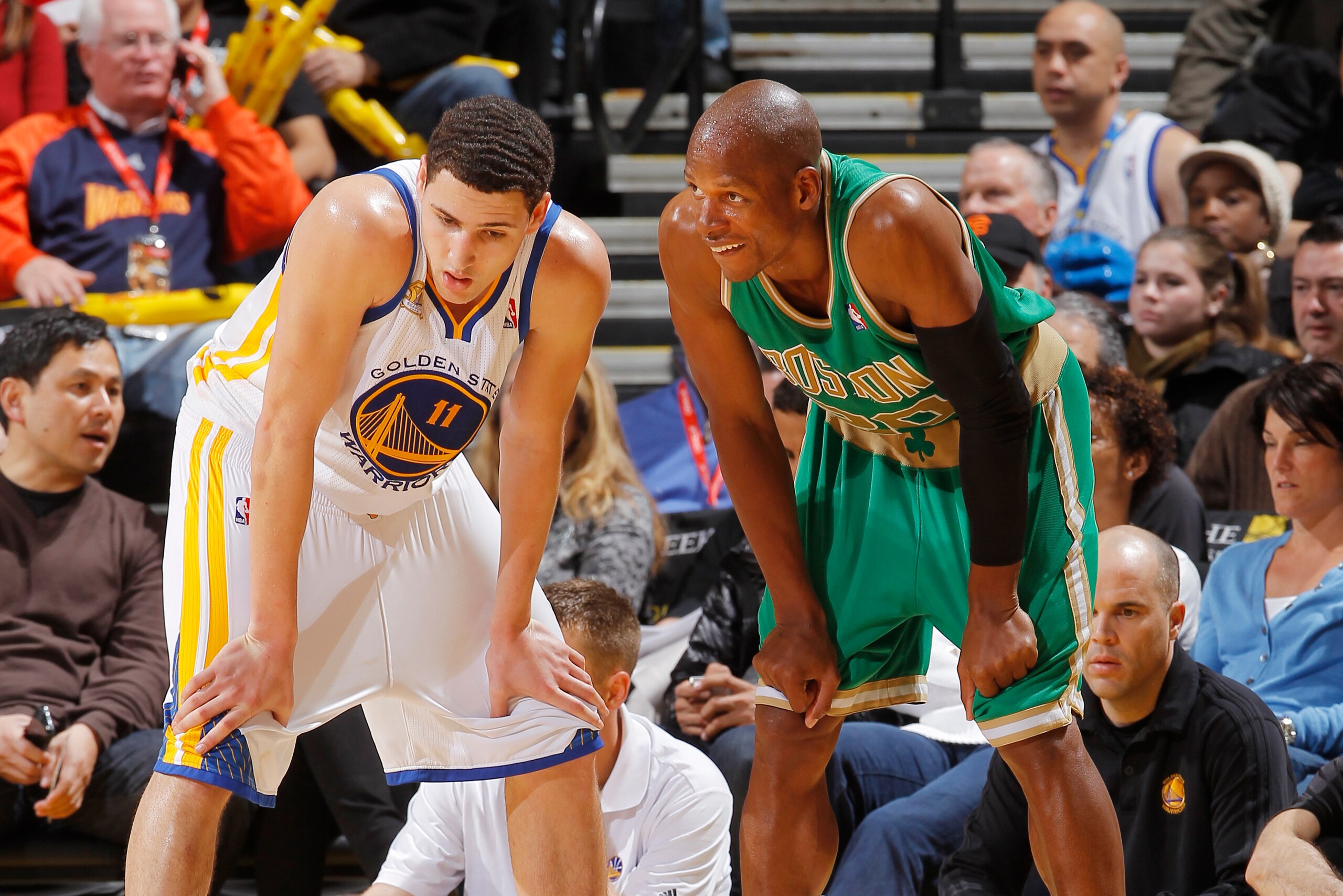
Whereas Curry exceeded the bar Nash set, Klay Thompson doesn't do quite as much for the Warriors as Ray Allen did throughout his prime years. The new Hall of Famer's tenure as a sharp-shooting mercenary during the later stages of his career often masks his all-around play as a younger man, and that includes the ability to attack the basket off the bounce while creating opportunities for his teammates.
How many remember that Allen averaged 4.8 assists for the Seattle SuperSonics in 2003-04? How many can recall the thunderous jams from his early days?
Thompson, whether due to limitations of his specialized skill set (he still struggles to dribble in traffic without looking down) or the role imposed upon him by the remarkable, selfless depth in the Bay Area, hasn't displayed the same sort of wide-ranging game. But he has built upon the primary piece of Allen's legacy: excellent shooting from distance that largely comes in off-ball scenarios.
Throughout his career, Allen took 5.7 treys per game and connected at a 40 percent clip. No one has ever made more shots from downtown during a career. And while he proved capable of taking and making self-created deep looks throughout his first few forays into the Association, he settled into that catch-and-shoot rhythm as a veteran.
You know, like with this fairly memorable shot:
During the final seven years of Allen's career, which date back to the beginning of his tenure with the Boston Celtics, he used assists on 91.6 percent of his made triples, shooting 40.7 percent from beyond the rainbow and taking 5.1 per game. During Thompson's first seven seasons, he's launched 6.9 triples per game, connected at a 42.2 percent clip and required set-up feeds on 93.7 percent of his conversions.
The numbers aren't perfect matches. Thompson is more accurate and more frequently used by the Golden State offense, but he's also even more dependent on assists. Then again, he's also made 428 more treys than Allen did during his first seven go-rounds, which puts him on a rather astronomical pace.
Still, the stylistic similarities are crystal clear.
Thompson presumably watched a lot of Allen growing up, because he's proved able to replicate the impressive form that led to so much success. He has that same high release and ability to move the ball from the shooting pocket into its arc with jaw-dropping velocity, and he's always able to square his body and feet to the basket when curling around screens at full speed:
For both players, it's all in the feet. Rarely will you catch either out of position and unable to set them in ideal fashion, even when they're shuffling back beyond the arc (as you can see in both Allen's legendary Finals shot and the sequence that begins at 1:21 in the above video).
Thompson may not match the all-around game or filmography of Jesus Shuttlesworth, and that could prevent him from ever surpassing Allen in all-time rankings. But much like Curry, he's well on his way to becoming the new standard for his specialty.
Jason Kidd = Lonzo Ball?

Lonzo Ball has a long way to go before he deserves to be used in the same sentence as Jason Kidd, but this comparison for his future is not a new one. He had a successful rookie season despite his shooting woes, excelling on the defensive end (see: quick hands and quicker instincts) and as a distributor, but that's only the beginning of what needs to be a long path of improvement and added value.
The Los Angeles Lakers' 1-guard earned a pair of win shares during his inaugural campaign; Kidd tallied 3.7 during his first season with the Dallas Mavericks and finished his career at No. 29 on the all-time leaderboard (138.6). Ball compiled 63.23 TPA; Kidd ended his rookie season at 89.49 TPA and retired at No. 17 in the career standings (4,586.62).
But this is a common comparison for myriad reasons:
Size is the first shared trait between Kidd (6'4", 205 pounds) and Ball (6'6", 190 pounds). But even more important is how they use those physical gifts: attacking the basket off the dribble, bodying up on defense and excelling on the glass. Neither was blessed with shooting excellence at the start of their NBA journeys, and we don't yet know whether Ball will improve as much as his predecessor did, but they managed to mitigate that weakness in just about every other facet of the game.
You can see the similarities rather easily on defense, where both swipe down at ball-handlers and create plenty of deflections. But it's even more obvious in the transition game, as highlighted throughout this video by DraftExpress:
Again, we're not equating the two. As Kidd himself said on ESPN's First Take, that would be "a stretch," though it's worth noting the then-head coach of the Milwaukee Bucks made that (accurate) claim just a handful of games into the rookie's career.
But no one in today's NBA plays a more similar game on both ends of the floor, much to the chagrin of those willing to dismiss Ball because of his shooting woes and lack of comfort in pick-and-roll defense.
Grant Hill = Giannis Antetokounmpo?
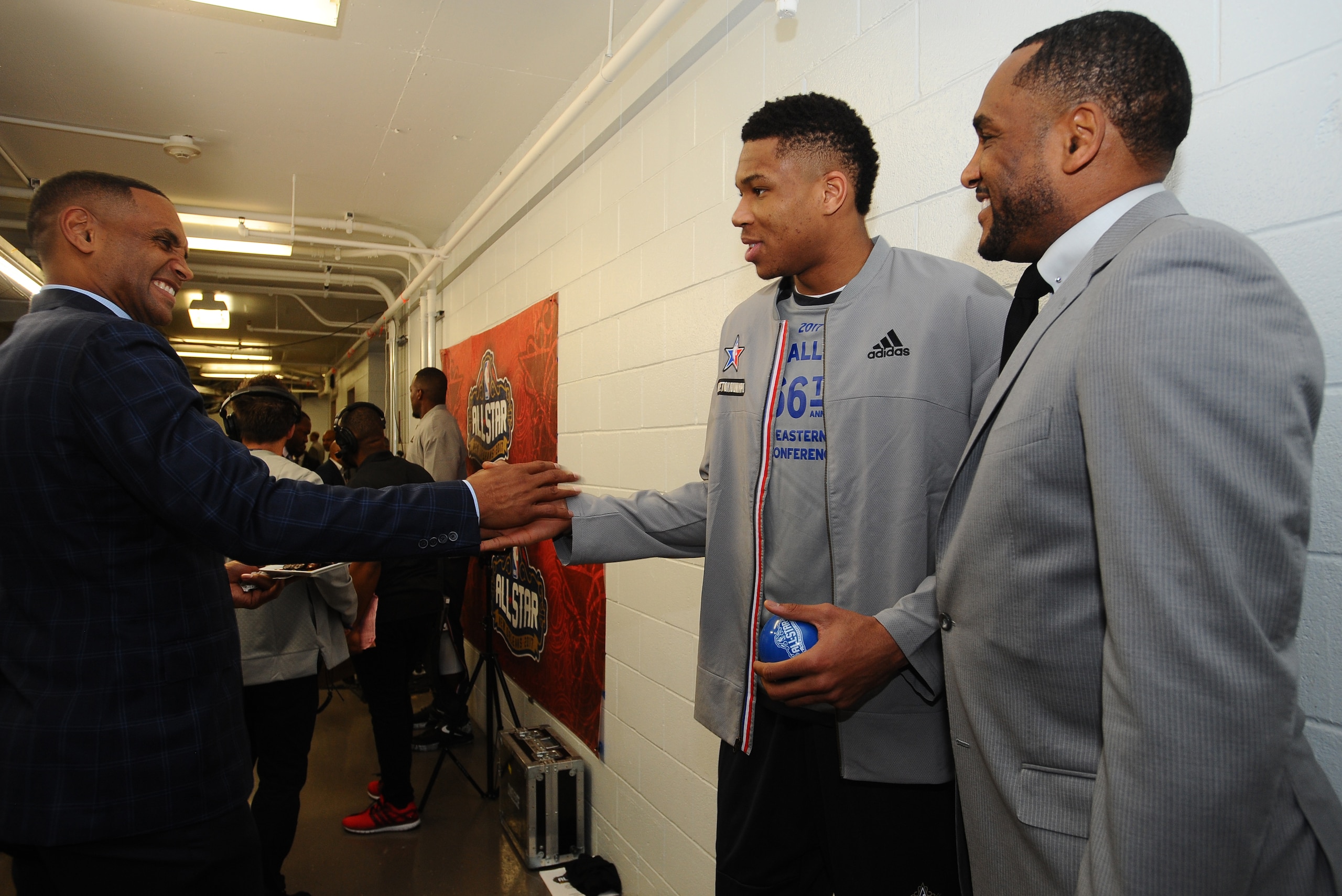
During the first six seasons of his NBA career, before injuries threw him off a celestial trajectory that had him hurtling toward best-player-in-the-world status, Grant Hill averaged an eye-popping 21.6 points, 7.9 rebounds, 6.3 assists, 1.6 steals and 0.6 blocks while shooting 47.6 percent from the field. He rarely fired away from outside the arc (25.6 percent on 0.5 deep attempts per game), but he tormented foes with his lanky strides, all-around game and ground-breaking play as a new-age point forward.
Giannis Antetokounmpo hasn't reached that do-everything level yet, baffling as that may seem to those who have carefully observed him for the last few years. Hill was that good early on.
The Milwaukee stud isn't quite as involved as a primary facilitator, though he's even better at finishing around the hoop with his go-go-gadget arms. But that all-around nature is still there. Throwing out his first few seasons as he transitioned from European play to the rigors of the NBA (he didn't have the benefit of growing at Duke), he's averaged 24.8 points, 9.4 rebounds, 5.1 assists, 1.5 steals and 1.7 blocks during the last two go-rounds.
This is by no means a perfect connection. It's easily the shakiest of the four we're using today. After all, Hill by and large defies comparison, and the aptly nicknamed Greek Freak is a unique figure in today's NBA who deserves the "unicorn" label.
But some of their plays are still so remarkably similar—only natural for two men who, despite possessing different physical gifts, went about breaking down defenses in comparable fashion.
First, take a gander at this spinning slam from early-career Hill:
Remind you of anything?
Hill doesn't have Antetokounmpo's length, which allows the current standout to finish over and around any defender. But he still attacked the basket with ferocity, often converting plays by hanging the air for impossible durations and flipping the ball up after his adversaries had descended, pulled down by the gravitational field he seemingly ignored.
And though these decisions didn't create as many highlight-reel moments, he was always willing, just as Antetokounmpo is today, to dish off the rock to an open teammate. He made the right plays, racking up assists generated both by sterling vision and a willingness to attack.
Hill's career could've been so much more if he'd remained healthy and built upon his early success, though he still deserves all the credit in the world for enjoying a career that spanned nearly two decades and led to a Springfield induction. If Antetokounmpo can keep trending up and fend off injuries, perhaps that'll be the biggest difference between the two.
Adam Fromal covers the NBA for Bleacher Report. Follow him on Twitter: @fromal09.
Unless otherwise indicated, all stats courtesy of Basketball Reference, NBA.com, NBA Math or ESPN.com.

.jpg?w=2560 "Grading WWE Raw 🔠")

.jpg?w=2560 "Viral Rams Coach Vid 🖕")

.jpg?w=2560 "Injury-stricken Seahawks signing veteran RB")