


When the Tampa Bay Buccaneers signed Mike Evans to a five-year, $82.5 million contract extension with $55 million guaranteed on March 9, it set the tone for high receiver value in today's NFL. But in a league where the passing game is more valuable and versatile than ever, that value can be split in different directions.
Specialization has become key at the receiver position, as it has for many positions on both sides of the ball. There's an increasing cadre of slot specialists who have blurred the lines between No. 1 and No. 2 receiver designations, and the days of the static outside receiver are as good as in the past. Very few targets make their value clear doing just one thing.
The 2018 class of free-agent receivers provides very different things—if you want an elite outside guy or an under-the-radar inside target, you can get both in varying skill sets. It's a fascinating group of players who will be looking at the Evans deal and hoping something similar—absolute top-tier pay for their work—is in their near futures.
Honorable Mentions
1 of 13
Albert Wilson
Wilson's name started picking up buzz for the Chiefs last season when he caught a 63-yard touchdown pass against the Raiders in Week 7, and that buzz accelerated in Week 17 when he caught 10 passes for 147 yards against the Broncos. Wilson hasn't ever had a season with more than last year's 42 catches, 554 yards and three touchdowns, but the arrow could be pointing up for a guy who beats coverage with aggression, moves quickly in and out of his breaks, and can provide a decent deep threat.
Jordan Matthews
Matthews was a high-volume slot receiver for the Eagles in 2014 through 2016, but knee injuries complicated his 2017 season after he was traded to the Bills, and Nelson Agholor became a slot star in Matthews' place. Matthews isn't a quick receiver, but he's good in the slot and can get open in zone coverage.
Tyrell Williams
Williams is a lanky, lightning-quick receiver with the potential for frequent big plays, especially as a speed slot receiver. However, he needs to improve his field awareness and hands—his 62.3 percent catch rate in 2017 is decent enough for an ancillary specialist, but if Williams wants to do more, he'll need to be more efficient.
Willie Snead
Suspended for the first three games of the 2017 season for violating the league's policy on substances of abuse, Snead also struggled with injuries last year and dropped from his previous status as Drew Brees' favorite slot receiver to an afterthought. He'll struggle to find a place in an offense that isn't heavy on passing with three and four receivers in its base defense.
Brice Butler
Butler recently said that he's not going back to Dallas unless he gets a legitimate shot at a starting role, which is a pretty bold statement for a guy who has never amassed 400 receiving yards in a season and placed 76th in NFL1000's season-ending rankings for outside receivers. Butler is a sneaky-fast target who should get open more than he does and could catch more balls than he has. Attention to the fundamentals of the position would make him more consistent and valuable.
Deonte Thompson
More a return man than a receiver through most of his NFL career, Thompson played in two dysfunctional passing offenses—Buffalo's and Chicago's—catching 38 passes for 555 yards and two touchdowns last season. He's a good No. 2 or No. 3 receiver with the ability to get open on quick angular routes and nice speed in the open field.
12. Dontrelle Inman
2 of 13
Dontrelle Inman looked like a future star for the Chargers in 2015 and 2016, but the move to Chicago's broken passing game in 2018 did him no favors, as he caught just 25 passes for 343 yards and a touchdown. Traded in the middle of the season, Inman has more potential than he was allowed to show with either of his teams last season.
Go back to his 2016 tape and you'll see an above-average slot and outside target with a good sense of when to break on his routes. Inman could stand to be more aggressive when errant throws in his area become interceptions, but he could provide value to a team set at No. 1 receiver and in need of productive depth at the position.
11. Kendall Wright
3 of 13
Kendall Wright hasn't had a 1,000-yard season since 2013, his second year in the league. He was a reasonably productive receiver when healthy in 2015 and 2016, and the hope was that when he signed with the Bears in 2017, he'd provide a jump-start to a passing game that didn't have much going for it.
Despite having Mike Glennon and the rookie version of Mitchell Trubisky as his quarterbacks, and playing in an offensive system that did little for its receivers, Wright still saw his stats rise from his last couple of seasons in Tennessee. Ha caught 59 passes on 91 targets for 614 yards and a touchdown—hardly electrifying stuff, but in the context of Chicago's offense, he was far more productive than any other receiver on that roster.
In a better passing offense, Wright still has something to offer as a fast straight-line receiver with some route-running ability. His days as a No. 1 receiver are probably done (if they ever existed), but he would be a sneaky-good signing in a diverse offense with multiple deep routes.

.jpg?w=2560 "Steelers Saints Football")
.jpg?w=2560 "Rams Raiders Football")
10. Terrelle Pryor
4 of 13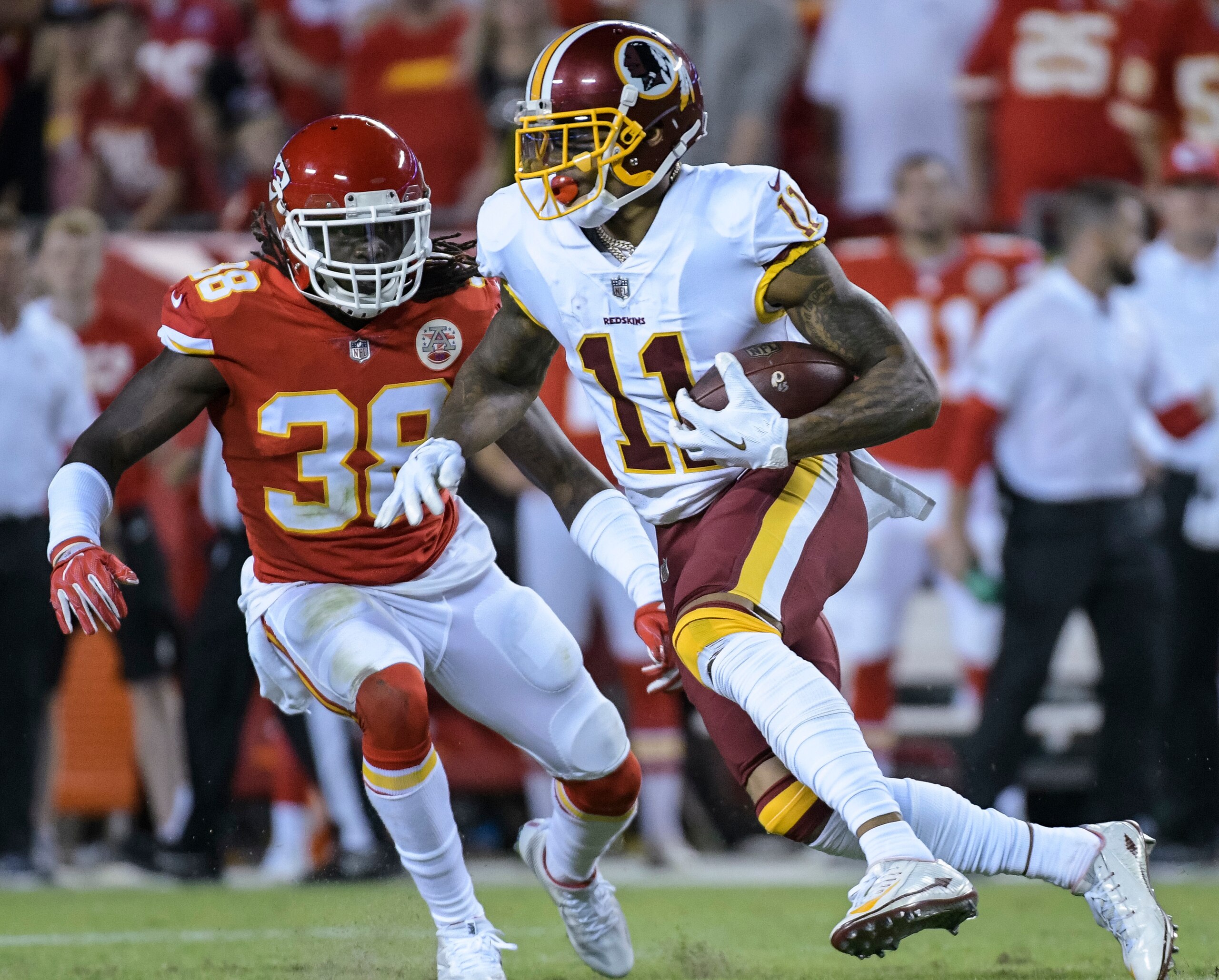
Terrelle Pryor caught exactly one pass for the Browns in 2015, so it's safe to say that nobody in the world saw his 77-catch, 1,007-yard 2016 season coming, especially with a quarterback battery that included five different quarterbacks of little renown. The former Ohio State quarterback seemed to have made the position switch he wanted to make in the NFL pay off prodigiously, and though his breakout season as a receiver had more to do with raw athleticism than route awareness, the Redskins signed him to a one-year, $8 million deal before the 2017 season, hoping Pryor could help a receiver corps depleted by the free-agent defections of DeSean Jackson and Pierre Garcon.
It didn't work, for multiple reasons. Pryor suffered through multiple injuries and never seemed to get the hang of Jay Gruden's offense. He caught just 20 passes for 240 yards and a touchdown in the nation's capital over nine games, and he was placed on injured reserve with an ankle issue in November.
Pryor will be a relative afterthought in this free-agency cycle, but in a vertical passing game that lets him get free with his palette of athletic attributes—speed, size and strength—he can still be effective.
9. Eric Decker
5 of 13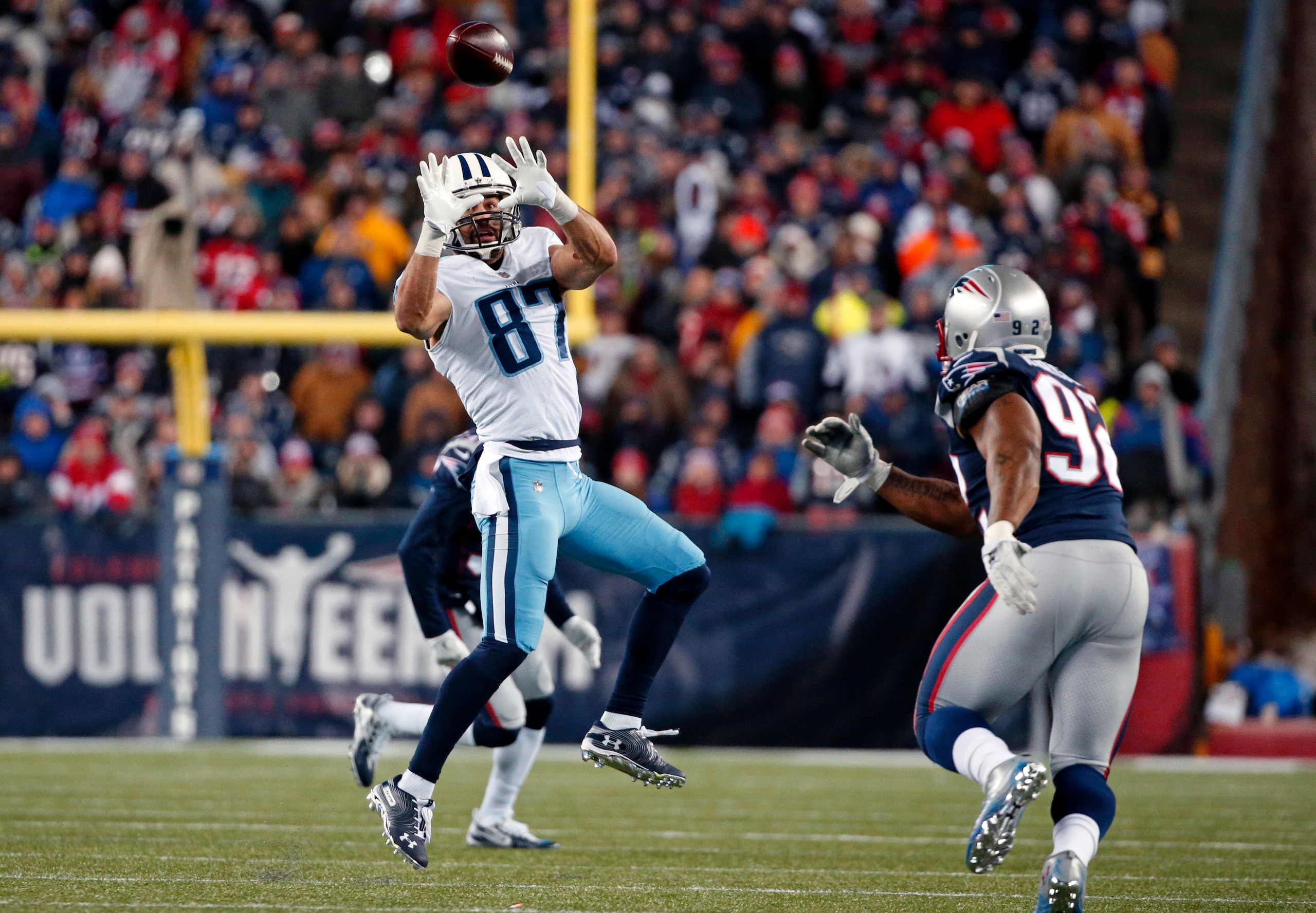
Eric Decker didn't do much in the Tennessee Titans' regular season—not that many receivers could do much in Terry Robiskie's passing game filled with five-yard outs and six-yard slants—but he proved his continued worth in an NFL sense when he caught six passes for 85 yards against the Patriots in the divisional round of the playoffs. That took some of the sting out of a regular season in which he caught just 54 passes on 83 targets for 563 yards and one touchdown.
Decker isn't the speedster he used to be—it takes him a while to build up a head of steam—but he's a route-savvy target both outside and in the slot, and he understands how to find openings in zone coverage. He's also big and physical enough to beat smaller cornerbacks on contested catches. Decker may never have another 1,000-yard season as he did with Denver and the Jets, but he can still contribute as a second and third receiver, especially in goal-line packages.
8. Taylor Gabriel
6 of 13
What a difference an offensive coordinator can make. For the Kyle Shanahan-led Falcons offense of 2016, Taylor Gabriel was the speedster-in-residence, making opposing defenses pay with big downfield catches when they put too many men on Julio Jones or bit over and over on Atlanta's play-action game. He averaged 16.5 yards per catch and caught six touchdowns in the regular season, blowing up for nine receptions for 171 yards in Atlanta's playoff run and near-Super Bowl win.
When the Falcons switched to Steve Sarkisian and a more conventional, less creative offense, Gabriel was boxed in and not as productive.
He lost five yards per reception in 2017, largely because he was used far more often as a short-release receiver instead of the deep threat he had been before. Gabriel was used a lot on curls and quick screens, which isn't really his game—he's at his best when he's told to blaze upfield and find a defender to exploit. If the right team takes him on and uses him in the ways that his skills require, Gabriel could once again be an estimable weapon.
7. Danny Amendola
7 of 13
Danny Amendola saw a resurgence in usage and productivity in 2017, as the Patriots needed to find a middle-distance target for Tom Brady after Julian Edelman's torn ACL cost him the entire season. He caught 61 passes for 659 yards and two touchdowns in the regular season, upping his value to the team in the playoffs with 348 yards and two touchdowns on 26 catches—including eight catches for 152 yards in Super Bowl LII.
Amendola would be perhaps most valuable going back to New England, but he'll do well in any advanced offense where his understanding of complex route concepts (like the 50-yard switch he had in the Super Bowl where he was wide-open against a confused Eagles defense) will be exploited. He's not a dominant player, but he plays his roles very well.
6. Marqise Lee
8 of 13
Marqise Lee was thrown into the Jaguars' No.1 receiver role when Allen Robinson was lost for the season to a torn ACL in Week 1 of the 2017 season, and No. 1 receiver isn't a role Lee is built to play. He caught 56 passes on 96 targets for 702 yards and three touchdowns while struggling through the season with his own injuries. The 58.3 percent catch rate (which dropped to 46.7 percent in the playoffs) has some of its origin in Blake Bortles' inaccuracy, but his eight career touchdowns tell a different tale—Lee isn't an optimal contested-catch receiver. He needs open space to do his thing.
As such, he'd be an ideal second or third receiver on a team that employs a ton of three- and four-receiver sets. Think of how the Eagles saved Nelson Agholor's career in 2017 by moving him to the slot, and you'll have an idea of how Lee could be best used. Lee comes out of the breaks with great speed, and his route running is improving. In the slot, his size disadvantages won't be as pronounced, and he'd have to be more nimble than physical.
5. Sammy Watkins
9 of 13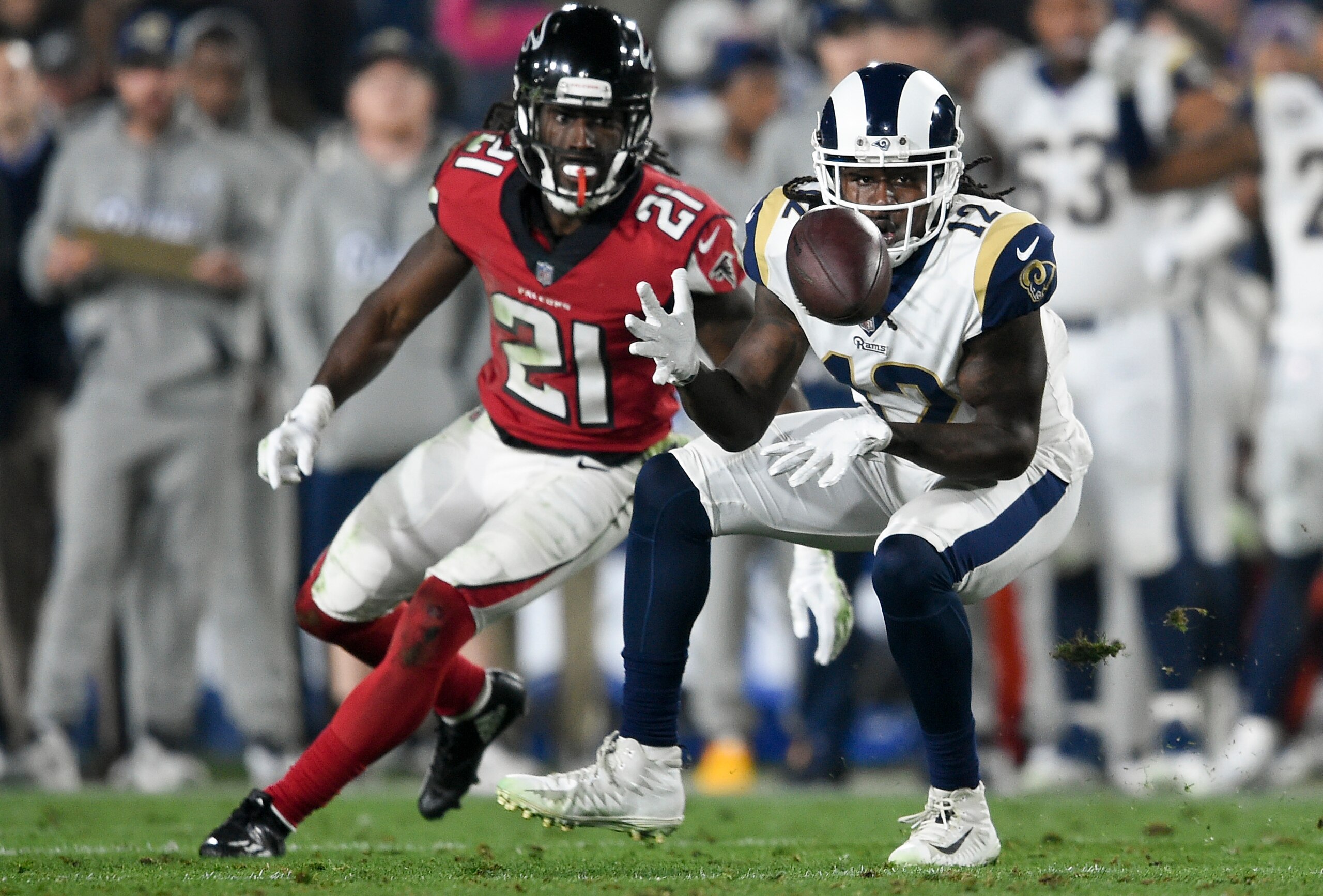
Sammy Watkins is one of the most physically gifted receivers in the NFL. At 6'1" and 211 pounds, he's quick enough to blow straight past tight coverage, agile enough to move through coverages and physically imposing enough to make contested catches. His first two seasons in Buffalo showed his potential starting to come to light, especially the 60-catch, 1,047-yard season he had for the Bills in 2015. Watkins missed half the 2016 season, though, and the Bills traded him to the Rams last August for cornerback E.J. Gaines and a swap of draft picks. The idea was that Watkins' physical gifts would be a huge boon to the passing game new head coach Sean McVay was trying to put together.
McVay's offense did see amazing improvement in 2017, but Watkins' contributions were mixed. He caught just 39 passes for 593 yards, though he did score eight touchdowns, helped by McVay's outstanding red-zone packages. There were times during the season when Watkins and Jared Goff looked to be out of rhythm, and Watkins wasn't nearly as much of a threat on deep passes as one might expect.
It will be interesting to see if the Rams decide to re-sign Watkins or go with a receiver who has a more practiced understanding of the nuances of the position.
4. Donte Moncrief
10 of 13
Donte Moncrief looked like a future star when a healthy Andrew Luck was his quarterback, catching 64 passes for 733 yards and six touchdowns in 2015, and catching seven more touchdown passes in an injury-plagued 2016. With Luck out for the 2017 season, and an unimpressive backlog of backups throwing him the ball, Moncrief wasn't as effective, catching just 26 passes on 47 targets for 391 yards and two touchdowns.
Still, Moncrief showed occasional flashes of the productive athleticism he had showed before, and at age 24, he will be an attractive target for any team willing to look beyond a broken offense and take a measure of the receiver. At 6'2" and 221 pounds, Moncrief has the physicality to brawl against press coverage and catch contested balls, but he's also quick enough to burn a cornerback on a go route and nifty enough with his routes to become a major part of a more comprehensive offense.
3. Mike Wallace
11 of 13
The narrative on Mike Wallace early in his career with the Steelers and Dolphins was that he was a tremendous vertical threat but fell short in the intricacies of the position. That may have been true once upon a time, but no receiver who isn't up on the little things is going to gain over 1,000 receiving yards (as Wallace did in 2016) or average 14.4 yards per reception (as Wallace did in 2017) in an offense designed for the short passing game, with a quarterback in Joe Flacco who has lost a great deal of his deep accuracy over time.
Wallace caught 52 passes for 748 yards and four touchdowns in 2017, but those numbers should be seen in the context of a passing game that was inconsistent at best. The 31-year-old Wallace we saw in 2017 was a nuanced speed receiver able to time his cuts in zone coverage who still has the speed to create big plays when they were available. As an underutilized receiver whose game has quietly expanded, he could be one of the best bargains in this free-agent market.
2. Paul Richardson
12 of 13
The Seahawks selected Paul Richardson out of Colorado in the second round of the 2014 draft, desperately hoping that he could become the team's deep threat after the Percy Harvin trade blew up in their faces. Richardson showed every attribute to do just that, but health has been a major issue throughout his NFL career, and 2017 was the first season in which his ability to adapt to the NFL game matched up with a healthy player.
The results were impressive, as Richardson caught 44 passes for 703 yards and six touchdowns in 16 games and 13 starts, despite one of the worst running games in the modern era and a pitiful offensive line for quarterback Russell Wilson. Richardson is said to be seeking $7 million per season in his next deal, per Bob Condotta of the Seattle Times. His injury history may give teams pause, but his undeniable big-play ability as a top-tier vertical receiver will have some franchises willing to take the risk.
1. Allen Robinson
13 of 13
You have to be an exceptional player if you're at the top of a 2018 free-agent list at your position when you missed all but one game in 2017. Allen Robinson is just that—exceptional. He caught 80 passes for 1,400 yards and a league-leading 14 touchdowns in 2015 and followed that up with 73 catches for 883 yards and six more scores in 2016 with the undeveloped version of Blake Bortles as his quarterback. He developed into one of the better route-running technicians in the league.
Sadly, Robinson's 2017 ended after one 17-yard catch when he suffered a torn ACL, but assuming he's healthy and ready to go for 2018, he's one of the best receivers in the NFL. Robinson doesn't have what you'd call blinding downfield speed, but he can run every route to perfection, and at 6'3" and 211 pounds, he's more than physical enough to match up with any cornerback. Few receivers in today's game are more consistent and practiced than Robinson when it comes to exploiting aggressive defenders with jukes and foot fakes, and his timing on routes is next-level.
As long as his health checks out, Allen Robinson is a franchise receiver wherever he goes.
.jpg?w=2560 "Cowboys Packers Football")
.jpg?w=2560 "Titans Ravens Football")

.jpg?w=2560 "🚨 Week 8 AP Top 25 Poll")
.jpg?w=2560 "Mahomes Told Teammate to Leave Meeting")

