
Fret It or Forget It: What to Make of Disappointing Rookie Preseasons
Preseason football can be a scattered, chaotic and often sloppy mess. It's hard to sort through everything and find the signal in all the noise.
That process is especially difficult with rookies who are seeing their first NFL action. Even the most talented prospects who lit up college fields need time to adjust both physically and mentally. They're doing that while still fine-tuning their technique and mastering a brand-new playbook.
For some NFL rookies, preseason struggles carry more weight because their teams are set to lean on them more. Roster spots may already be at risk, too, which could be the case for Philadelphia Eagles running back Donnel Pumphrey. Others, like Cleveland Browns tight end David Njoku, can shrug a poor showing off easier, knowing better days are ahead soon.
So before you start pulling your hair out over rookies who have failed to impress, here's a handy guide for deciding which poor preseasons to fret and which to forget.
Will Donnel Pumphrey earn a spot on the Eagles' final 53-man roster? Get the new B/R app and follow Philadephia ahead of this weekend's roster cuts.
O.J. Howard, Tight End, Tampa Bay Buccaneers
1 of 8
Tight end is notoriously a position with more than just a steep learning curve at the NFL level.
For even the most highly regarded prospects, that curve can resemble a sharp hairpin turn. They're asked to adapt quickly while playing both as an in-line tight end and in the slot, and rookies also need to master complex blocking assignments.
That's why we often need to adjust early expectations accordingly. Which is what we're now doing with Tampa Bay Buccaneers tight end O.J. Howard.
The red-zone catches and chunk yardage after he streaks up the seam will come from him soon enough, and likely at some point later on in 2017. But in the early going, Howard's role will be different as Cameron Brate takes on the primary pass-catching role for the Bucs at tight end.
That's led to suppressed offensive production during the preseason, with Howard recording a modest four receptions for 43 yards. Similar output is likely coming once the scoreboard matters in the regular season, which is when Howard will initially be the lesser half of an imposing tight end duo.
But that doesn't mean he won't still play an important role for a revamped Buccaneers offense. As ESPN.com's Jenna Laine noted earlier in August, the Bucs coaching staff has been impressed with Howard's blocking skills, which is encouraging because that's usually the area where rookie tight ends struggle. His blocking alone should lead to significant playing time right away.
If he's on the field often, Howard will eventually get more opportunities to contribute as a pass-catcher and make his relatively quiet preseason a memory.
Verdict: Forget it.
David Njoku, Tight End, Cleveland Browns
2 of 8
David Njoku is a walking cheat code. He's a 6'4", 246-pound former high-jump champion whose speed and tackle-breaking ability led to an average of 11.2 yards after the catch in 2016, according to Pro Football Focus.
He's simply not fair and, in the not-so-distant future, will be a mismatch-creating weapon for the Cleveland Browns at tight end. But much like O.J. Howard, he plays a position where the NFL adjustment requires more than a leap. And even Njoku's pogo-stick legs could struggle to clear that high bar as a rookie.
Njoku has sky-high potential because of his physical qualities and athleticism that led to eight touchdowns, 698 receiving yards and 16.2 yards per catch during the New Jersey native's final season with the Miami Hurricanes. But a combination of youth and inexperience will likely limit his production ceiling early, and we might not see him truly take off until 2018.
Njoku is just 21 years old. More importantly, he's a converted wide receiver with only one season of full-time starting experience at the college level. So there's still a rawness to him, and he may need more time than most tight ends to develop. That's been evident in the preseason with Njoku catching only two passes for 13 yards over two games (he missed Week 1 due to a back injury).
The Browns knew Njoku would need some time when they traded back into the first round to secure him at 29th overall. Njoku was one of several promising early draft additions for Cleveland, and the Browns' arrow finally seems to be pointing up. But they're still a rebuilding team, and patience is key as that project keeps moving forward.
They'll get a fine return on their investment in Njoku. Just maybe not quite yet.
Verdict: Forget it.
Ethan Pocic, Guard, Seattle Seahawks
3 of 8
It just doesn't feel like a new football season is upon us until the Seattle Seahawks have reached five-alarm status with their annual offensive line concerns.
That happened when left tackle George Fant was lost for the season with an ACL tear. Immediately, the shuffling began, with offensive line coach Tom Cable telling Derek Lewis of Seahawks247.com that despite his versatility and time spent at right tackle this offseason, he'd like to keep second-round rookie Ethan Pocic on the inside. That makes sense, as Pocic played 720 of his 780 snaps for LSU at center in 2016, per PFF, and he could be shifted to guard.
But concern lingers around Pocic because his preseason so far has been inconsistent at best. He's been beaten by rookies taken far later than him in the draft. That includes Minnesota Vikings defensive end Ifeadi Odenigbo, who didn't hear his name until near the end of Day 3 at 220th overall.
In Week 2 of the preseason, Odenigbo showed why Pocic isn't a strong contender for the left tackle job yet when he muscled the 309-pound lineman aside for a sack. Pocic didn't handle his outside speed well and then wasn't in a position to create leverage and keep Odenigbo from collapsing the pocket.
During the same game, Pocic shifted to guard and again didn't have a solid blocking base, this time on an inside run. The result was a loss of yards after he was easily pushed backward.
The Seahawks once again have title-contending aspirations with their ferocious defense and an offense also loaded with talent. The one potential source of dynamite that can blow it all up is the offensive line. Quarterback Russell Wilson has taken an average of 41 regular-season sacks each year over his five NFL seasons.
A window to add more championship banners can close fast in the NFL. That's why the Seahawks don't have time to wait on Pocic.
Verdict: Fret it.
.jpg?w=2560 "Texans Titans Football")
Quincy Wilson, Cornerback, Indianapolis Colts
4 of 8
Quincy Wilson is a prime example of why the preseason can be a confusing time.
The Indianapolis Colts cornerback has received the highest preseason grade from PFF out of all the players at his position drafted in the first two rounds. A fine showing in Week 2 against the Dallas Cowboys, highlighted by a play in which Wilson reacted quickly to break up a short slant, boosted that grade.
But his preseason also includes a thorough roasting in Week 1, when Wilson repeatedly lost a physical battle against Detroit Lions wide receiver Kenny Golladay. The worst blow Golladay landed against Wilson came on a deep ball that he adjusted to after gaining a step. The result was a 23-yard touchdown when Wilson took a poor angle to the ball and failed to make an adjustment of his own.
However, Wilson showed at a high level of college football that he has the large frame (6'1", 206 lbs) and physicality to handle bulked-up receivers like Golladay. He did that by posting a passer rating in coverage of only 29.9 for the Florida Gators in 2016, per PFF, which was sixth best in the nation. So with that skill set, any stumbles in the 2017 preseason should be forgotten fast.
The Colts need Wilson to mature fast after they allowed 262.5 passing yards per game in 2017 (27th). And needing a rookie cornerback to become an immediate difference-maker often first ends in long completions followed by tears.
Verdict: Forget it.
D'Onta Foreman, Running Back, Houston Texans
5 of 8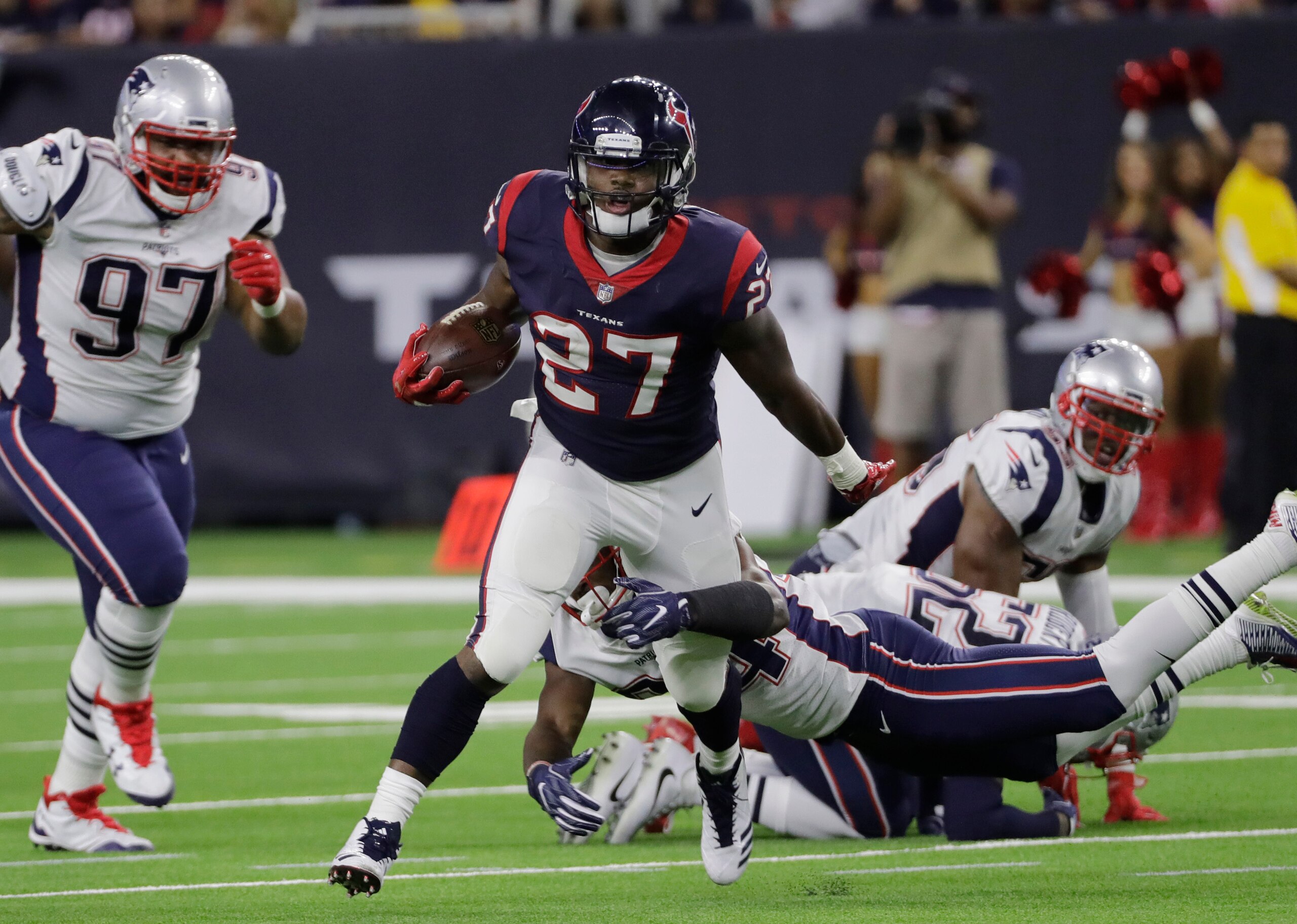
Only five NFL running backs have average annual salaries north of $7 million. With the cost of the position that low and the injury risk high, teams often feel free to take some draft gambles after the early rounds.
Maybe they'll find a jewel somewhere in the third round or beyond, then pay him little during his rookie contract and still not much after that compared to other positions. The Houston Texans were hoping they had scored such a jackpot after using their third-round pick (89th overall) on D'Onta Foreman, the former Texas Longhorn who ran for 2,028 yards during his final college season.
But they're still waiting for that version of Foreman to show up.
Foreman sat out the Week 3 preseason dress rehearsal due to a leg injury. That stung and was a blow to his already low roster standing. Foreman didn't play until the second half of Week 2 and had to wait for his turn behind Lamar Miller, Tyler Ervin and Alfred Blue. Then once he did get on the field, the 21-year-old averaged a meager 2.4 yards per carry on his seven attempts.
He's still showcased his speed and home-run play potential with a run for 41 yards in the preseason and also a 63-yard reception. Texans head coach Bill O'Brien told John McClain of the Houston Chronicle after Week 2 that Foreman has improved but still has a "long way to go."
The Texans were looking for an immediate contributor when they spent a Day 2 pick on a running back after Miller started to wear down late in 2016. And it looks like that wish won't be granted.
Verdict: Fret it.
Chad Williams, Wide Receiver, Arizona Cardinals
6 of 8
There was an available opportunity for Chad Williams to rise up the Arizona Cardinals' wide receiver depth chart, and do it fast. Now he's gone in the opposite direction just as fast.
Williams was a promising third-round pick whose athleticism and leaping ability led to high-end production over his last two years at Grambling State. During that time, he recorded 2,349 receiving yards on 154 catches with 21 touchdowns.
He was a sure-handed target hog, though there was an element of the unknown with him after coming from a lower level of college football. But Williams did put up 152 yards on 13 catches in 2016 against Arizona, his only FBS opponent. So that provided at least some evidence he could still thrive against tougher competition.
But we haven't seen any of that in the preseason. Williams has caught only two balls for 24 yards while playing against second- and third-team defenders. The deafening buzz around draft time has worn off now, especially after Cardinals head coach Bruce Arians told ESPN.com's Josh Weinfuss that Williams is out of shape and won't have a role until he gets in better condition.
The Cardinals wide receiver group is led by a soon-to-be 34-year-old Larry Fitzgerald and John Brown, who finished 2016 with just 517 receiving yards. There was a chance for someone to climb the depth chart quickly in training camp, and now Williams will likely stay buried.
Verdict: Fret it.
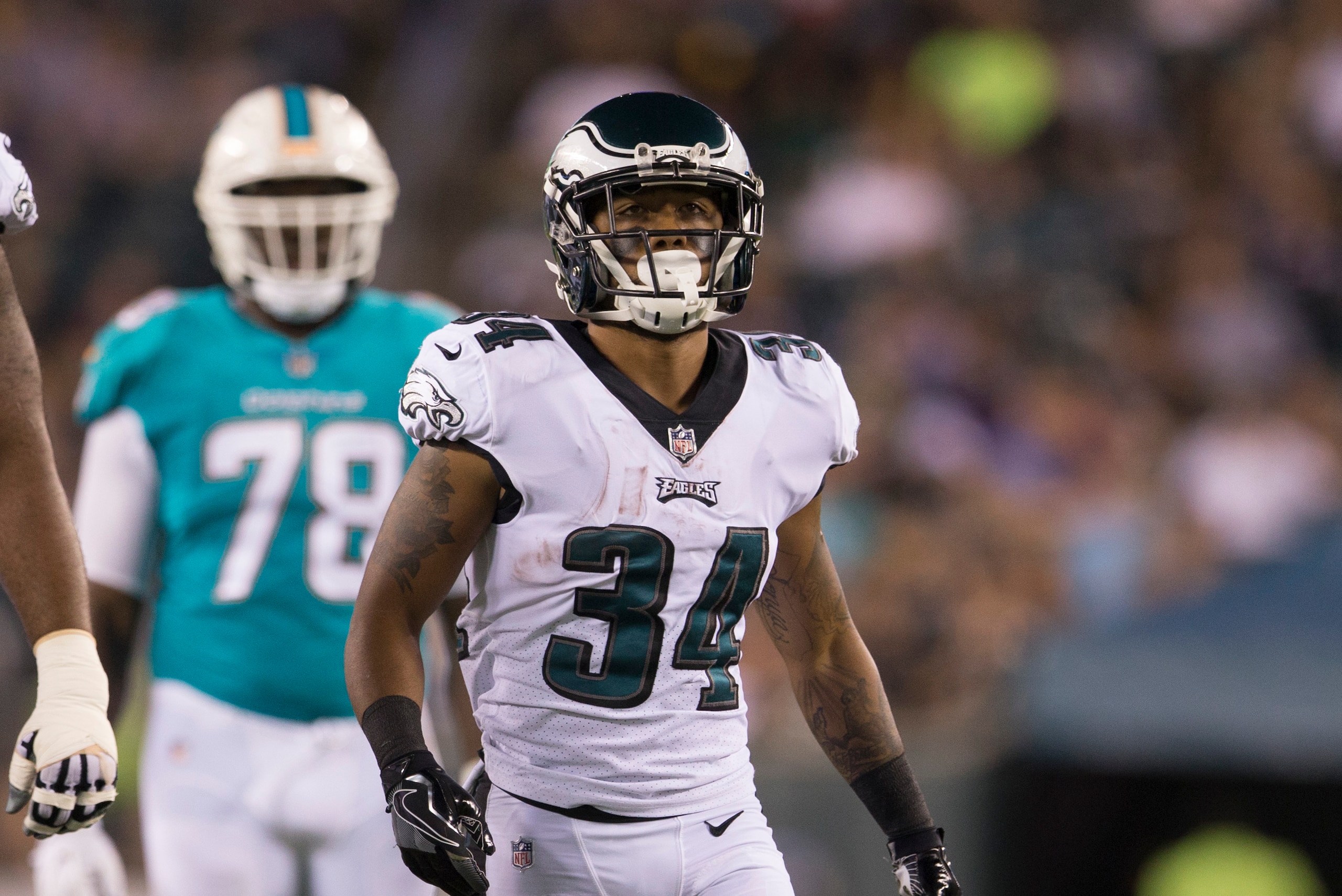
Donnel Pumphrey, Running Back, Philadelphia Eagles
7 of 8
The Philadelphia Eagles drafted Donnel Pumphrey to be a poor man's imitation of Darren Sproles in the short term and then hopefully a solid pass-catching replacement once the 34-year-old retires.
Maybe after he develops, the latter scenario can still become a reality. But right now, that seems like dreamy, wishful thinking, as Pumphrey has sputtered while adjusting to the speed at a higher level and the size needed for success.
Like Sproles, Pumphrey is an undersized passing-down option (5'9", 176 lbs) who has thrived in the past while generating missed tackles after the catch. The former San Diego State standout recorded 1,039 receiving yards over four college seasons. He really sizzled in 2016, finishing with 2,364 yards from scrimmage.
But we're still waiting for the same elusiveness to show up on an NFL field, and even a preseason one. As a runner, Pumphrey has averaged a mere 2.1 yards on his 19 carries over three games. And as a receiver, he's turned 12 catches into a quiet 69 yards.
He's totaled just 108 yards from scrimmage and has been outplayed by undrafted rookie Corey Clement, who has piled up 137 yards with two touchdowns. Those two are likely fighting for the final spot on the Eagles' running back depth chart.
If the Eagles are making that decision on performance alone, they should be leaning heavily toward Clement. But generally, cutting a fourth-round pick without having him play a meaningful regular-season snap isn't a good way to conduct the business of NFL roster building. Instead, it's a good way to potentially zap depth.
That's why PhillyVoice's Jimmy Kempski speculates the Eagles may get creative and find a way to stash Pumphrey on injured reserve. He would then have time to get more comfortable at the NFL level and do it away from the bright game-day lights.
Verdict: Fret it.
Wayne Gallman, Running Back, New York Giants
8 of 8
Eventually, Wayne Gallman could carve out a role for himself in the New York Giants backfield. It's just hard to see that rosy future right now as he looks way, way up from the bottom of the depth chart.
Some parts of Gallman's skill set are appealing, the sort of qualities that put hearts in a scout's eye. His sexiest skill is the one that leads to sprawled defenders. The shifty Gallman forced 153 missed tackles over his final three college seasons, per PFF, which was fifth most among the 2017 draft class.
But then that twinkle in your eye fades a little when you remember he's average at best as an athlete. At the scouting combine, Gallman posted a pedestrian 40-yard dash time of 4.60, which means he won't be surprising any defenders at the NFL level with his top-end speed.
The Giants roster was still the ideal landing spot for Gallman, though, even if he's mediocre athletically. Their rushing offense was nearly nonexistent for much of 2016, when the Giants averaged only 3.5 yards per carry (30th).
But the fourth-round pick hasn't been able to capitalize throughout August and charge through that open door. Gallman has plodded along while recording an unimpressive 76 yards on 22 carries (3.5 YPC), and the lowlight of his preseason came when the 22-year-old fumbled in Week 2.
As a result, Gallman is behind Paul Perkins, Shane Vereen, Orleans Darkwa and Shaun Draughn on the Giants' running back depth chart and faces a tough fight to stay relevant.
Verdict: Fret it.
.jpg?w=2560 "Broncos Chargers Football")
.jpg?w=2560 "Cardinals Giants Football")