
10 of the Most Iconic In-Game Signature Moves in Sports
Is Dikembe Mutombo’s finger wag after blocking a shot one of the 10 most iconic in-game signature moves in sports, or does it matter that the hoarse-voiced Congolese never unleashed this move within the context of an offensive play?
For some, a signature move should account for the totality of a sports play. For others, the actual move should be the only thing that is judged.
For this list, signature moves are strictly defined as an offensive play, and the "iconic" aspect of that play is determined by whether we instantly associate the athlete with that move to such an extent that it’s inconceivable to think of any other athlete performing that move at the same high level.
Of course, the move itself has to be enduring—even in the digital age in which attention spans last about five milliseconds.
Also, this ranking only goes back to 1980 to keep the list as relevant as possible.
So let’s get the debate rolling by seeing which athletes and moves made the cut as the most iconic in sports.
Honorable Mentions
1 of 11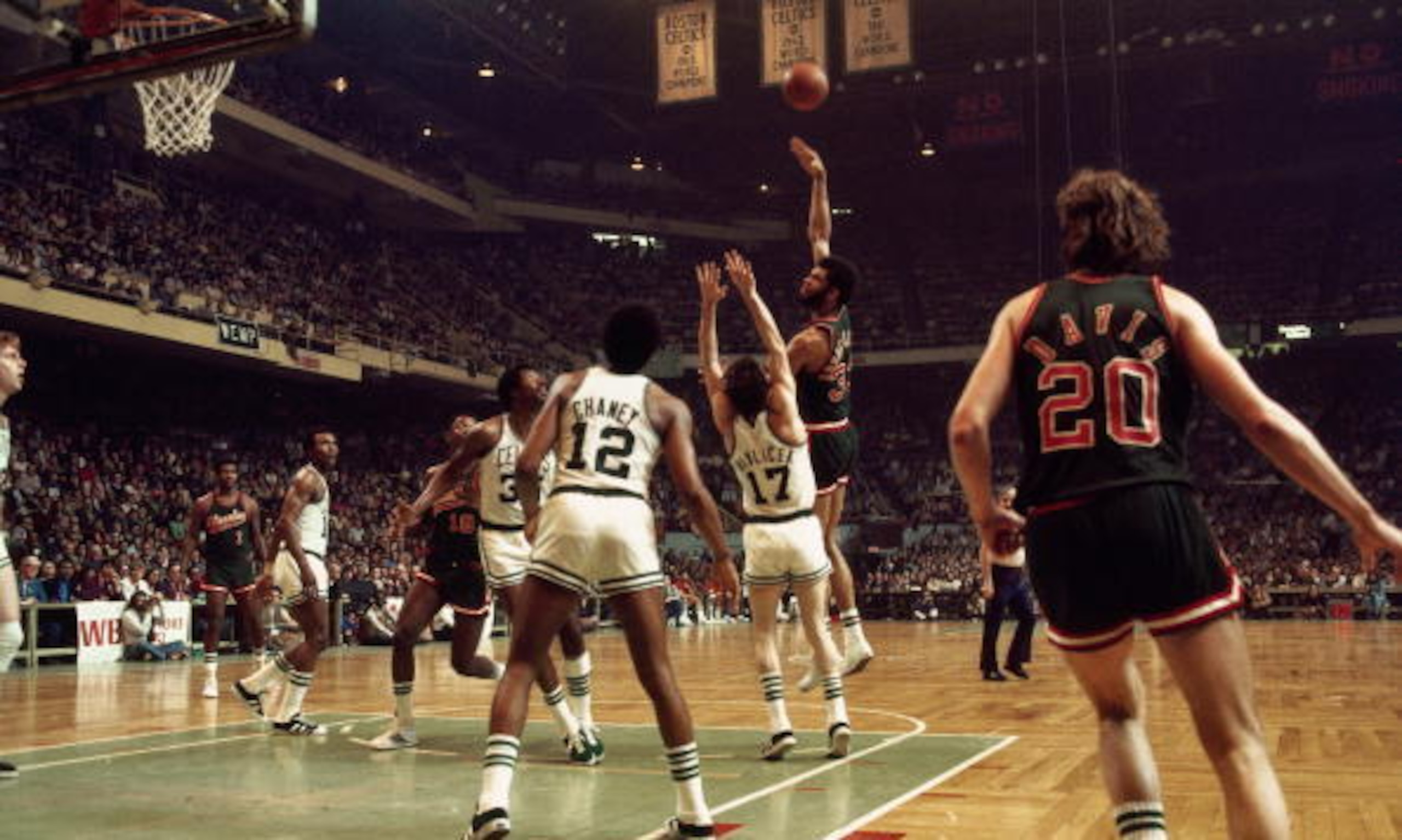
To twist a famous quote, "We have come to praise these athletes, not bury them," and to give them props for executing moves that didn’t make the list because they weren’t done in the context of an offensive play or were too old to be included.
- Kareem Abdul-Jabbar: The skyhook (patented prior to 1980)
- Muhammad Ali: The Ali Shuffle (patented prior to 1980)
- Dikembe Mutombo: The finger wag (defense)
- Derek Jeter: The jump throw (defense)
- Deacon Jones: The head slap (patented prior to 1980/defense)
George Gervin: Finger Roll
2 of 11The finger roll was as smooth as Gervin’s game—polished, graceful and impossible to stop.
It seemed like such an easy move, but no NBA player before or after him could duplicate the panache with which Gervin spun the ball off his fingers and into the net.
We know The Iceman as a shooter, but the truth is he was a scorer in the same cold-blooded vein as the Golden State Warriors' Splash Brothers.
But what made the finger roll so devastating was that Gervin could control the spin so that the ball went wherever he wanted.
It didn’t matter if he called "bank" off the backboard, hit a hook, stepped back for a "J" or feathered a tear drop—Gervin could do magic with that signature move.
And as Shaun Powell of NBA.com said, Gervin didn’t invent the finger roll, but he took it to a level no one else has equaled.
Dirk Nowitzki: One-Legged, Step-Back Fadeaway
3 of 11Widely acknowledged as the greatest European NBA player of all time, and perched in sixth place on the NBA’s all-time scoring list, Dirk Nowitzki may have the most imitated move in NBA history with the one-legged fadeaway.
Unless you’re Mr. Fantastic, it’s nearly impossible to block this shot because Nowitzi is literally falling back at an angle when he lets this shot fly.
No current signature move in the NBA is as famous as this one—so much so that superstars such as Russell Westbrook have copied it and given props to the German.
Dwain Price of the Star-Telegram called Nowitzki’s fadeaway one of the greatest signature shots in NBA history, taking its place in the pantheon with the skyhook and the Dream Shake.
Given that we’re in a stats-heavy sports culture, it’s only a matter of time before someone figures out how many of Nowitzki’s 29,491 points came from one-legged, step-back fadeaway shots.
.jpg?w=2560 "Patriots 49ers Football")
.jpg?w=2560 "Saints Cowboys Football")

Hakeem Olajuwon: The Dream Shake
4 of 11Poor David Robinson.
He became a poster not in the traditional “I got flushed on” way that every NBA center experiences at some point in his career, but because of a shimmy.
Olajuwon’s Dream Shake was in full display during Game 2 of the 1995 Western Conference Finals between his Houston Rockets and the San Antonio Spurs.
As Olajuwon pivoted toward the hoop, reigning 1995 NBA MVP Robinson shifted to guard him.
Here it was.
Two titans of the game, ready to test their mettle against each other.
Olajuwon spun to one side and faked a shot.
Robinson jumped to block a shot that never happened.
Olajuwon spun to the other side with a smooth up-and-under shot that kissed the backboard and fell into the net.
But that was just a sample of the main course because at its best, the Dream Shake was a dizzying combination of spins, pivots, more spins, more pivots and body fakes that left defenders hypnotized.
Phil Taylor of SI.com ranked it among the five best moves in the NBA during Olajuwon’s playing days, writing that the Nigerian center was capable of multiple fakes until the defender gave up.
Olajuwon credits his soccer background for the signature move, as it provided him with the outstanding footwork to be able to stop on a dime, shift to the opposite side of a defender and shift again if the defender recovered in time.
Rajon Rondo: Ball Fake
5 of 11Rondo most exemplifies the notion of street ball as an NBA art form, a whirling dervish of speed, skill and contemptuous confidence that views every opponent as a poster opportunity.
And nowhere is that more evident than in the point guard’s magical use of the ball fake, whether it’s straight up or of the behind-the-back variety, which is even more devastating.
Rondo’s ball-fake skills are living proof that he should have become the greatest street baller of all time.
He’s not a true point guard in the Chris Paul or Steve Nash mold due to his lack of shooting skills.
But when you think of Rondo, you think of his pure ball skills and the look of terror and shame that widens a defender’s eyes when he sees Rondo about to pull off the okey-doke.
Jason Concepcion of Grantland ranked Rondo’s behind-the-back ball fake as one of the NBA’s signature superstar moves, crediting the point guard’s massive hands as the reason he has mastered a grown-folks version of “now you see it, now you don’t.”
Dan Marino: Lightning-Quick Release
6 of 11Before Tom Brady began his assault on Mount Joe Montana to become the greatest NFL quarterback in history, Dan Marino had already staked his claim.
And one of the main reasons the ringless Marino was considered the best is because of his signature lightning-quick release that kept rabid defensive linemen from concussing him.
Not getting sacked had the net-positive effect of allowing Marino to throw a then-record 48 touchdowns in 1984.
For three of his 17 seasons with the Miami Dolphins, his team led the league in fewest sacks allowed, a task made much easier for offensive linemen when their rifle-armed quarterback gets rid of the ball in record time.
CBSSports.com ranked Marino as one of the greatest quarterbacks in NFL history, with the painful addendum that he was the best thrower to have never won a Super Bowl.
Ronda Rousey: Armbar
7 of 11Rousey is so known for her ability to armbar an opponent into submission that she’s become a one-trick pony to many fans who aren’t familiar with the nuances of mixed martial arts.
But here’s the thing about a signature move as devastating as this one: Foes know it’s coming and still can’t stop it.
The former UFC women’s bantamweight champion holds a 12-1 professional record, with nine of those victories coming by way of armbar.
In fact, Rousey’s armbar is so nasty that she has twice dislocated another fighter’s elbow, and she etched her name in the record books with the fastest submission ever in a UFC title fight at a blazing 14 seconds.
Andrew Flowers of FiveThirtyEight pointed out that nine of Rousey’s fights have lasted less than 66 seconds, and 11 of her lightly contested bouts ended with 90 percent of the scheduled fight time unused.
And that’s mostly because her preferred hunting method is to stalk her prey, execute a bone-rattling judo toss, then pretzel an elbow until she hears a bone pop or feels a frenzied tap.
But Rousey’s dominance ended with a Holly Holm high kick, and since she crashed to the Octagon mat on Nov. 14, 2015, she still hasn’t gotten back on her feet.
David Beckham: Bending Free Kick
8 of 11You know a signature move has reached legendary status when it spawns a cult film—in this case, Bend It Like Beckham.
No one will argue that Beckham was slightly overrated, but when it came to free kicks and the ability to put “English” on the ball to make it curve inside the goal posts or onto the head of an attacking forward, no one did it better—not even Lionel Messi.
Sam Cunningham of MailOnline ranked Beckham as the third-greatest English Premier League free kick-taker of all time, citing his 15 goals scored off a dead ball and his unerring accuracy, power, arc and ability to score from any spot on the pitch.
Peyton Manning: Play Action
9 of 11Manning didn’t invent the play action, but no quarterback in NFL history used the play-action pass or fake with more effectiveness.
The man who made “Omaha” sound like a curse word could sell the run better than any other signal-caller in his day.
The quicksilver Edgerrin James and battering rams like Joseph Addai and Donald Brown certainly helped Manning sell the run, but it was the quarterback’s uncanny ability to read defenses and call audibles that killed defenses on the play action.
When Manning audibled into a play action, he froze linebackers and fooled safeties into creeping closer to stop the run, which left his receivers wide open or several steps ahead of their coverage.
In an ESPN.com piece about the magic of the play action, Greg Garber listed Manning and New England quarterback Tom Brady as the two best at the art of fakery, an opinion echoed by Steve Young and Pittsburgh Steelers quarterback Ben Roethelisberger.
Tim Duncan: The Bank Shot
10 of 11It’s entirely fitting that Duncan’s signature move, the bank shot, was as practical and non-threatening as the persona he cultivated during his 19-year career in the NBA.
But consider just how much confidence a player needs to rely on a signature move that’s based on striking the backboard at the perfect angle to ensure a basket.
And it wasn’t as if Duncan just tossed the ball up at the backboard, hoping it would go in.
He hoisted that shot with the insouciance of a man who had practiced that move a thousand times in the gym.
Defenders have a harder time guarding a bank shot because the offensive player angles the ball in a way that makes it more difficult to block.
Dwain Price of the Star-Telegram rated Duncan’s bank shot as the “most lethal” in the NBA and ranked him alongside NBA legends Larry Bird, John Havlicek and George Gervin as the foremost practitioners of this old-school shot.
Michael Jordan: The Fadeaway
11 of 11Jordan 1.0 was a devastating combination of superior athleticism, bull-headed determination (pun intended) and a skill set that was sufficient to earn him three NBA Championships.
But then baseball happened.
And when Jordan came out of retirement, the 2.0 version was the difference between the T-800 robot in The Terminator and the T-1000 version in Terminator 2: Judgment Day made from liquid metal and capable of assuming any molecular life form.
In other words, Jordan 2.0 no longer relied on mere physical skills. He brought new “powers” to the court, and the most unstoppable of these was the fadeaway jumper.
When you think of Jordan’s second act, you think of his shoulder fakes to freeze a defender and then that signature fallback jumper that was impossible to guard.
Jordan needed just a fraction of space to unleash this shot, and as a savvy veteran, he mastered the unseen bump to create that millisecond required to bust out his signature move.
The fadeaway prolonged Jordan’s career because it allowed him to develop a superior post-up game.
No longer did he need to defy gravity to get the majority of his points because the fadeaway was a less physically taxing but equally effective shot that broke the will of all who would stand in his way.
As Sam Eagle of SI.com wrote, Jordan was not the inventor of the fadeaway, but he mastered it to such an extent that we all associate him with this signature move.
.jpg?w=2560 "Packers Giants Football")
.jpg?w=2560 "Ranking Tarik Skubal's Top Landing Spots 🛬")