How the Quarterback Contract Decision Either Defines or Sinks General Managers
The supply of NFL starting-caliber quarterbacks doesn't come close to meeting the demand.
You hear that so often it can become white noise. It begins to sound like an excuse to the beleaguered Cleveland Browns fan who had to sit through Josh McCown starts, or the guy who meticulously painted his face in Houston Texans colors only to watch Brian Hoyer throw four interceptions during a playoff game.
Worse, it starts to sound like the "we've tried nothing and we're all out of ideas!" school of quarterback thinking. What a team has isn't working, but what it wants likely isn't out there, or at least not in abundance.
.jpg?w=2560 "Commanders 49ers Football")
.jpg?w=2560 "Colts Football")
.jpg?w=2560 "DOLPHINS-AIKMAN")
So what's next? In this era of rapidly rising quarterback salaries, what's the best recourse for a general manager greeted with uncertainty at the position in 2016 and beyond?
Washington Redskins general manager Scot McCloughan has a radical idea: wait.
"The market's the market, and some teams will do certain things that throw the market off," McCloughan told SiriusXM Bleacher Report Radio's Ty Schalter and Jason Cole. He was asked about the franchise tag, and why the Redskins stuck to it when dealing with quarterback Kirk Cousins ($19.95 million for 2016).
"So then you've got to step back and say, 'OK, who do we have next year? [Are] there three to five to seven guys that we want to extend prior to the last year of their deal, or do we want to go after one and know we're going to lose three or four next year?'"
That question and line of thinking isn't a new or sudden shift for McCloughan. As Brian McNally from 106.7 The Fan recently noted, he's been saying some variation of those salary-cap thoughts for a while:
His thinking is different from the status quo, but it's not extreme. We're so accustomed to an NFL universe where dollars are heaped upon even marginally talented quarterbacks. Any other approach feels foreign at first.
Although eventually every GM has to find and pay a quarterback, the process should come with equal doses of restraint and creativity. Too often the exact opposite—urgency and fear—are the primary motivations, which results in poor, hastily made decisions.
The Texans, for example, grew weary of watching Hoyer waste defensive end J.J. Watt's prime years. Their solution? Giving Brock Osweiler $72 million over four years, $37 million of which is guaranteed.
Osweiler has made all of seven career starts, and Peyton Manning replaced him during the Denver Broncos' playoff run in 2015. At that point, Manning was a legendary quarterback in name only; he threw 17 interceptions over 10 regular-season games.
Then there's Jay Cutler, who the Chicago Bears rewarded with $54 million in guaranteed cash in 2014. He then threw 18 interceptions the following season, tying the league-worst mark.
The list goes on. It includes the Atlanta Falcons' Matt Ryan, who still accounts for a monstrous cap hit of $23.75 million over each of the next two seasons while his status as a franchise quarterback is eroding. Ryan posted a passer rating of 89.0 in 2015, the lowest since his second NFL season.
All of those contracts were signed with good intentions. The thought and hope was that they each solved a problem and gave both the general manager and his head coach job security for years to come.
But McCloughan is advocating for something beyond good intentions when dancing around the quarterback-contract question that determines each GM's fate. He's prioritizing patience and reason.

"It's a fine line, and like I said, it's tough, but that's why we do this," McCloughan continued when speaking to Schalter and Cole.
"It's the market. The NFL's a phenomenal, phenomenal entity, and the money's incredible. But the way I look at it is I want Kirk in a long-term deal, no doubt about it, but also I'm not gonna put our franchise in a situation where we're gonna lose three or four younger guys that I think are gonna be good football players for one guy. I won't do it. You know, that's just how it is."
The team comes first, and the quarterback is part of said team. But is it realistic in this era of dwindling quarterback supply? Sure, and it all starts with the draft.
In 2015, half of the league dedicated at least 10 percent of their salary cap to the quarterback position, according to Spotrac, with the New Orleans Saints leading at 17.74 percent. But if we look at the 12 playoff teams, something different bubbles to the surface:
| Kansas City Chiefs | 15.18 |
| Pittsburgh Steelers | 14.65 |
| Green Bay Packers | 14.06 |
| Denver Broncos | 13.14 |
| Carolina Panthers | 10.62 |
| New England Patriots | 10.47 |
| Arizona Cardinals | 7.97 |
| Cincinnati Bengals | 7.11 |
| Washington Redskins | 6.34 |
| Seattle Seahawks | 5.81 |
| Houston Texans | 4.38 |
| Minnesota Vikings | 3.59 |
Despite the emphasis and apparent need for a franchise to lock itself into concrete quarterback shoes and then hope to swim, half of the playoff teams in 2015 fell over 2 percent below the double-digit QB spending plateau.
That wasn't a one-year fluke either, as in 2014 the same number of teams played into January while investing less than 10 percent of their salary cap into quarterbacks. The NFC Champion Seattle Seahawks led the way at an incredible 1.58 percent.
Generally, the common thread among those teams is a draft pick outside of the top 10—and therefore removed from the costly slots where franchise quarterbacks are often selected—that was still knocked into the second deck.
The Redskins hope they hit that home run when they selected Cousins with a fourth-round pick in 2012 and developed him for several seasons. But McCloughan outlined a blueprint that gives him multiple swings.
In 2015, the Redskins went 9-7 and won their division with a quarterback who was mediocre for half the season. They did it by surrounding Cousins with plenty of support, and tight end Jordan Reed was a critical cog. He hauled in 87 receptions for 952 yards and 11 touchdowns.
Reed was getting set to enter the final year of his rookie contract in 2016. With Cousins not yet sporting a long-term contract anchor, McCloughan was able to secure his uniquely athletic tight end by offering an extension that averages $9.35 million annually.
McCloughan was also able to be aggressive in free agency and sign cornerback Josh Norman, who's one of the top players at his position and the rare shutdown corner who hit the open market.
He's been able to progressively build a team around his developing pivot. That's better than the alternative of being forced to shed core pieces in an effort to accommodate the signal-caller.
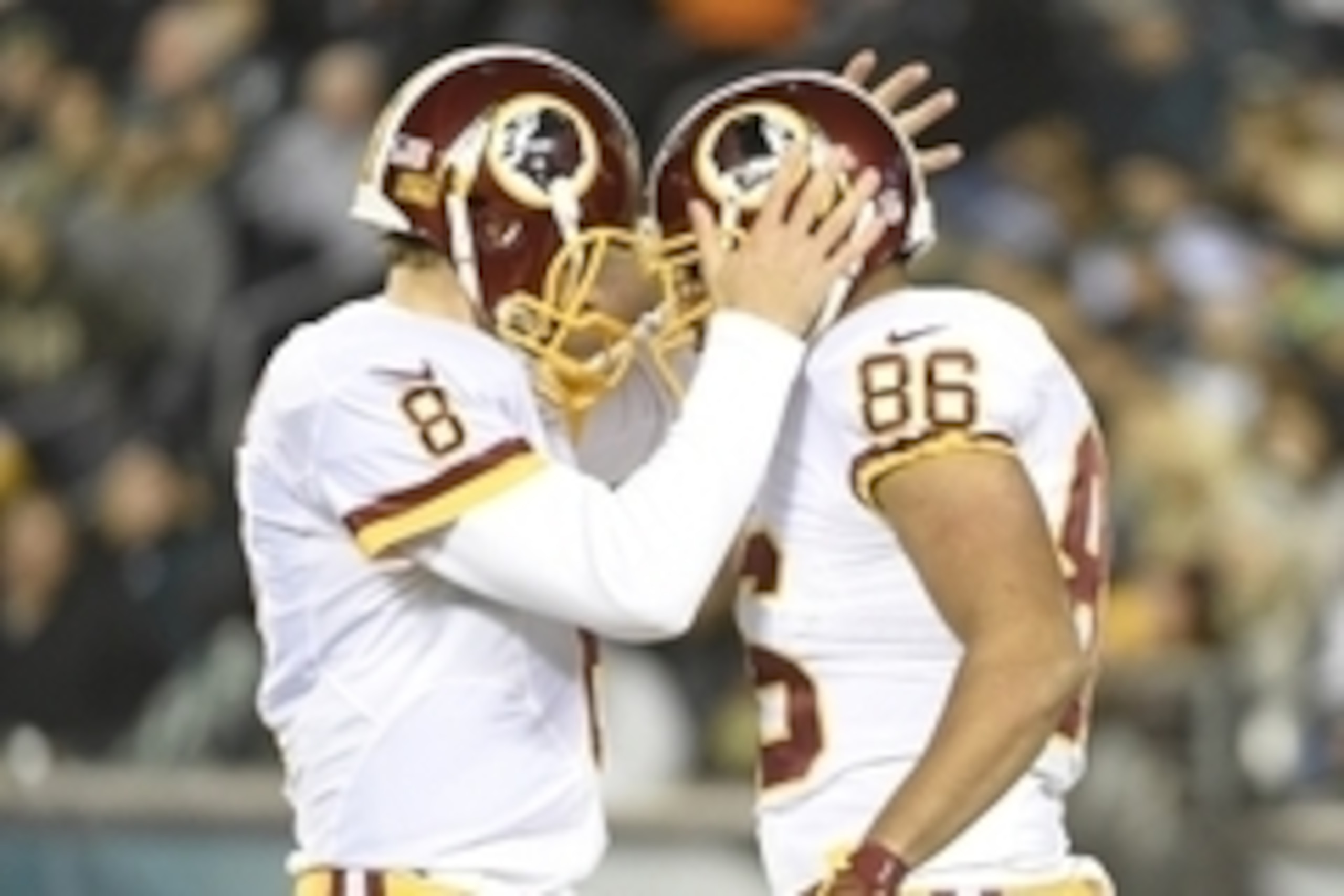
Despite his recent success, nothing is certain with Cousins. Not long ago, he was an intriguing backup whose interception total in 2014 (nine) nearly matched his touchdowns (10). Then he threw nine more interceptions over his first eight games of 2015.
If Cousins works out, then terrific, but McCloughan needs definitive proof he's worth a significant salary-cap sacrifice. If he's not, well, McCloughan is gambling he can find an effective replacement through the draft for a fraction of the $44 million guaranteed Cousins reportedly wanted, according to ProFootballTalk's Mike Florio.
He's probably right, too, because that wish—finding a promising but developing quarterback to replace a mediocre one—isn't hard to fulfill.
The Seahawks operated under the same principle for years when their quarterback, Russell Wilson, was getting paid NFL table scraps. While working with that discount at a premier position, they were able to lock up cornerback Richard Sherman, linebacker Bobby Wagner, fellow linebacker K.J. Wright, safety Earl Thomas and defensive end Cliff Avril.
The Bengals followed a similar path prior to finally paying Andy Dalton. They doled out cash to defensive tackle Geno Atkins first and then signed wide receiver A.J. Green.
Everything starts with the draft, but what happens next when contract time rolls around is just as important.
The overzealous general manager finds himself paying for what he hopes to be true and chasing production from his quarterback that's possible or even probable but not guaranteed. In the process, he bleeds other key pieces from his roster, all in the effort to avoid the risk and fear that comes with reigniting a quarterback search.
The patient GM waits for the QB to reveal his true self and then acts accordingly. That's how dynasties can be built as other offensive and defensive pillars are erected elsewhere. It's also how the championship seed is planted and how a GM keeps his job.
.jpg?w=2560)



.jpg?w=2560 "Malik Beasley Negotiating Plea Deal (AP)")