Greatest Chants and Taunts in Sports Today
There are some individuals and groups out there who would eliminate all taunts and negative chants from the sports world.
Have there been instances of fans and athletes going too far with their words at the professional, collegiate and high school levels? Of course. No athlete at any age or skill level should be on the receiving end of racist taunts. A freshman in high school shouldn't have to worry that students from the opposing school are going to mock, via chants, that his parents are getting divorced.
Common sense should, however, win the day as it pertains to what fans and athletes can and cannot do during competitions.
Cheryl Chumley of WND.com recently wrote about the absurdity of the Wisconsin Interscholastic Athletic Association banning certain chants, taunts and words during sporting events. "Air ball," of all chants, is now a no-no in the eyes of the WIAA. This chant should not only be allowed. "Air ball" should be preserved as a piece of Americana.
Taunts and chants have become as much parts of our sports experiences as games. A World Wrestling Entertainment performer turned a single word into a chant that has legitimately spread around the world. One soccer chant routinely heard in stadiums is an example of fans trolling their own favorite team. Arguably the best taunt in Major League Baseball involves a player not saying a single word before he begins his home run trot.
Sports offer entertainment, a brand of entertainment that includes fans and athletes interacting. Each of the taunts or chants mentioned in this piece draw reactions, and some are even included in highlights on television programs such as SportsCenter. May they all live on despite the wishes of organizations such as the WIAA.
Lighten up, ladies and gentlemen, and have some fun.
Let's Pretend We Scored a Goal
1 of 10Those of you who have ever attended any meaningful sporting event have probably taunted the opposing team. At the very least, you may have just let out a "boo" or two during the event.
You have to be a special kind of fan, though, to taunt your own team during a match.
This self-depreciating chant has been occurring in soccer stadiums around the world for years. Those within a fanbase who are watching its beloved club get destroyed during a game are left with several options. They can attempt to rile up opposing fans, they can leave the match early or they can begin singing and chanting out of nowhere as if their beloved team has finally hit the back of the net.
It's that last one that makes for one of the best taunts in sports today.
Yes, it is often said that passionate fans "live and die" by the fates of their sports teams. Sports don't always have to be so serious. Those who cannot appreciate that and enjoy this type of banter should consider taking up different hobbies.
Bullet Club Point
2 of 10Pro wrestling fans who only actively follow the WWE may be scratching their heads whenever they hear about Bullet Club during NXT programming. Bullet Club is a faction that has been featured in New Japan Pro Wrestling, Ring of Honor and Global Force Wrestling. And a version of it could be seen in the WWE before the summer months arrive.
Kenny Omega, who currently serves as the leader of Bullet Club, spoke about the group's popularity during an interview with Aaron Oster of Rolling Stone in February 2016:
"The Bullet Club has sort of become this pop-culture phenomenon. You don't even have to like wrestling or follow our product, and you can wear a Bullet Club shirt and it's cool. I can understand how New Japan wants to keep up with that. That's their cash cow.
"
There are two specific taunts associated with Bullet Club. One is the "gun point" that the likes of Omega, A.J. Styles and Finn Balor (formerly known as Prince Devitt) use. The other is the "Too Sweet" hand gesture that the New World Order in World Championship Wrestling during the 1990s first made famous.
The WWE has been dropping hints that the company is going to go all-in on its own type of Bullet Club once Karl Anderson and Doc Gallows debut in the company. Balor has been performing both of the Bullet Club taunts at shows for months, and the WWE is selling "Balor Club" merchandise.
Don't believe that the WWE can be responsible for a taunt or chant that becomes a part of pop culture? Ask Daniel Bryan about that.
I Believe
3 of 10The chant that took over the United States two summers ago during the 2014 FIFA World Cup was started at the Naval Academy Prep School long before soccer matches were commonplace on U.S. television every weekend during the European seasons.
Jeff Eisenberg of Yahoo Sports explained back in June 2014:
"Tasked with inventing a cheer for his 50-member platoon in fall 1998, Jay Rodriguez conceived of the now-famous "I believe that we will win" chant and taught it to his peers. Classmates say it was such an instant hit that members of other platoons joined in the rest of the school year whenever Rodriguez led the chant at Navy Prep basketball and football games.
The first time we heard it, we all thought, "This is awesome," said John Reeves, who attended Navy Prep and the Naval Academy with Rodriguez. "Jay was really good at coming up with stuff like that because he was very intelligent and very creative. It caught on like wildfire."
To the bewilderment and amusement of those who know its humble origin, "I believe that we will win" has steadily gained popularity the past 15 years, evolving from a platoon chant, to a Navy football tradition, to a staple of sporting events nationwide.
"
Yes, there are pockets of Major League Soccer and U.S. Soccer supporters who have had enough of the "I Believe" chant. That's understandable, in part because it has been adopted by so many domestic and national fans. We are afraid that we have bad news for those individuals. "I Believe" is not only a part of pop culture.
It's going to be the official chant of U.S. Soccer for the foreseeable future.

Chanting Goalie's Name in Hockey
4 of 10Some National Hockey League traditions will hopefully age like a fine wine. Every NHL playoff series should end with a handshake line. Only those who have been lucky enough to win Lord Stanley's Cup should be able to lift that adored statue over their heads in celebration.
Taunting a goalie who is having a bad night by merely chanting his name should continue for as long as the NHL exists.
Think of all of the ways that spectators taunt pro athletes. Fans yell curse words only those who are sitting around them at the arena or at a stadium will hear. Some who attend hockey games and are able to pound on the boards do so as if that sound will somehow distract a goalie or anybody else on the ice.
There is something unique and oddly haunting about 20,000 home fans belting out the name of a goalie who has been beaten for a goal. That is especially true during a rivalry contest or a playoff encounter involving two teams that don't like each other all that much.
Emotions are heightened during any playoff hockey game. Every line shift made by the two teams could represent a change of momentum for that game and even for the series. Watching a goalie who just gave up a goal having to shake off the fact that the crowd is taunting him with nothing more than his own last name is either disturbing or thrilling, depending on your rooting interests on that day.
Overrated Chant
5 of 10Back in February 2014, David Ubben of Fox Sports wrote about why he thinks the "overrated" chant needs to go away for good:
"I didn't think it needed to be explained, but apparently it does.
No one spends four years earning a degree at Harvard to tell a prospective employer: "Well, honestly, my education was a little overrated. Harvard didn't prepare me for the real world as much as people think."
College basketball teams spend four months crafting resumes for the tournament committee to assess. So after posting a highlight on that resume, it only seems natural to let the world know one thing: That little gem on our schedule really doesn't mean as much as you might think. Please downplay it upon review.
"
Please.
No fan who has ever chanted "overrated" has ever thought that he was somehow diminishing what his favorite team had just accomplished. The only people this chant burns are the vanquished, and they could have prevented the taunt from occurring by winning and silencing the crowd.
"Overrated" is a quality college sports taunt. It takes no personal digs at anybody, nor does it bring any shame to a fanbase. It is also often fitting for competitions in which teams are rated/ranked based largely on opinions as well as their records.
Those who have hot takes about the "overrated" chant are overrating its significance.
Ole, Ole, Ole
6 of 10You may not like it. Depending on your favorite team or your favorite sport(s), the sound of this chant may make you feel physically ill. Not only is the "Ole" song here to stay.
You'd struggle to find a sport where it doesn't exist.
Minor League Baseball parks. NHL arenas. College soccer matches. Combat sports events. WWE shows. "Ole" has invaded and conquered them all.
Alex Baker of Yahoo Sports wrote about the international chant in June 2014:
"Most of us know the familiar “Ole, Ole, Ole” chant sung by international soccer fans at matches around the world. The iconic refrain’s origins can be traced to the bullfighting ring, where it was common to hear the crowd “ole” an exceptional performance. An early version of the chant found its way into soccer stadiums through a Spanish league match in 1982 and was quickly adopted by soccer fans across Europe. Eventually the chant proliferated around the world, and is now sometimes even heard at American football matches.
"
The "Ole" song has been heard loud and clear at multiple major events over the past several months. Supporters of UFC Champion Conor McGregor are known to belt out the song whenever McGregor weighs in or steps into the cage. Fans sang the familiar tune when the Cuban national baseball team hosted the Tampa Bay Rays on March 22, per the State Journal-Register.
Seven Nation Army
7 of 10Alan Siegel wrote "How The Song 'Seven Nation Army' Conquered The Sports World" for Deadspin back in January 2012. In that piece, Siegel takes readers on a journey that shows how the seven signature notes of the song created by the White Stripes became a mainstay of supporters groups at events such as UEFA Champions League matches. From there, the "Seven Nation Army" chant eventually found a home in the United States and at Penn State University.
Full disclosure: I am a Penn State alum, and I remember when "Seven Nation Army" was welcomed as a regular song among students. It started out as something that we would sing during offensive drives after Penn State would earn a first down. The chant gained momentum from there, eventually becoming nearly as important as "Zombie Nation" had become to us years earlier.
While there is not a statistic that proves it, one could realistically claim that the "Seven Nation Army" chant isn't going anywhere anytime soon. Multiple Big Ten schools play it at stadiums and arenas during football and basketball games. It has been heard in the background of broadcasts during the 2016 NCAA tournament. "Seven Nation Army" is the unofficial theme linked with the Baltimore Ravens.
Thanks for your contribution to the sports world, White Stripes.
Bat Flip
8 of 10Goose Gossage, a baseball icon who is deservedly in the Hall of Fame, made headlines earlier this month when he hit at both Toronto Blue Jays star Jose Bautista and New York Mets slugger Yoenis Cespedes during an interview with ESPN. Per ESPN.com's Andrew Marchand, Gossage doesn't like to see such players flipping their bats after they have launched home runs into the seats:
"Bautista is a f---ing disgrace to the game. He's embarrassing to all the Latin players, whoever played before him. Throwing his bat and acting like a fool, like all those guys in Toronto. [Yoenis] Cespedes, same thing. ...
I said what I said. I was passed the torch about a certain way to act. Flipping the bat isn't part of that. All the things I said about Bautista just came to my mind and I got it off my chest.
"
If Gossage is mad now, just wait until Bautista or Cespedes flip a bat that lands in his lawn.
You may not remember all that occurred during that crazy seventh inning of Game 5 of the American League Divisional Series involving the Blue Jays and Texas Rangers last October. Bautista's bat flip, though, will live on thanks to highlight packages and Internet memes.
We love any bat flip because there really is no answer for it. A pitcher who feels disrespected upon seeing a batter flip his bat off to the side can plunk the next hitter who strolls to the plate. That actions puts a man on first base, and it also probably gets that pitcher ejected.
Keep on flipping, Bautista, Cespedes and others. We will keep on watching.
Air Ball
9 of 10There are things in sports that we just take for granted. Casual fans probably couldn't name who first threw a forward pass during an organized football game. Without looking it up, you may not be able to say who originally referred to soccer as "The Beautiful Game."
Josh Levin of Slate tried to pinpoint the birth of the well-known air-ball chant for a piece published earlier this month. It turns out that task was more complicated than Levin may have first imagined.
It is the Cameron Crazies, the name given to the Duke student section, who have claimed responsibility for creating the air-ball chant, per Duke athletics' official website. While Levin did not prove beyond a shadow of a doubt that Duke students created the taunt back in March 1979, Levin does credit the Crazies for coming up with the cadence that is heard in basketball arenas today whenever a shooter gets nothing but air on an attempt.
Air ball is, simply put, a perfect taunt. It can only be used in certain situations. There is nothing personal about the taunt. One who, somehow, has never heard the chant before can pick it up in seconds. It works for high school, college and pro games.
Of all of the things groups such as the WIAA could look into banning, "air ball" should never come close to making the list.
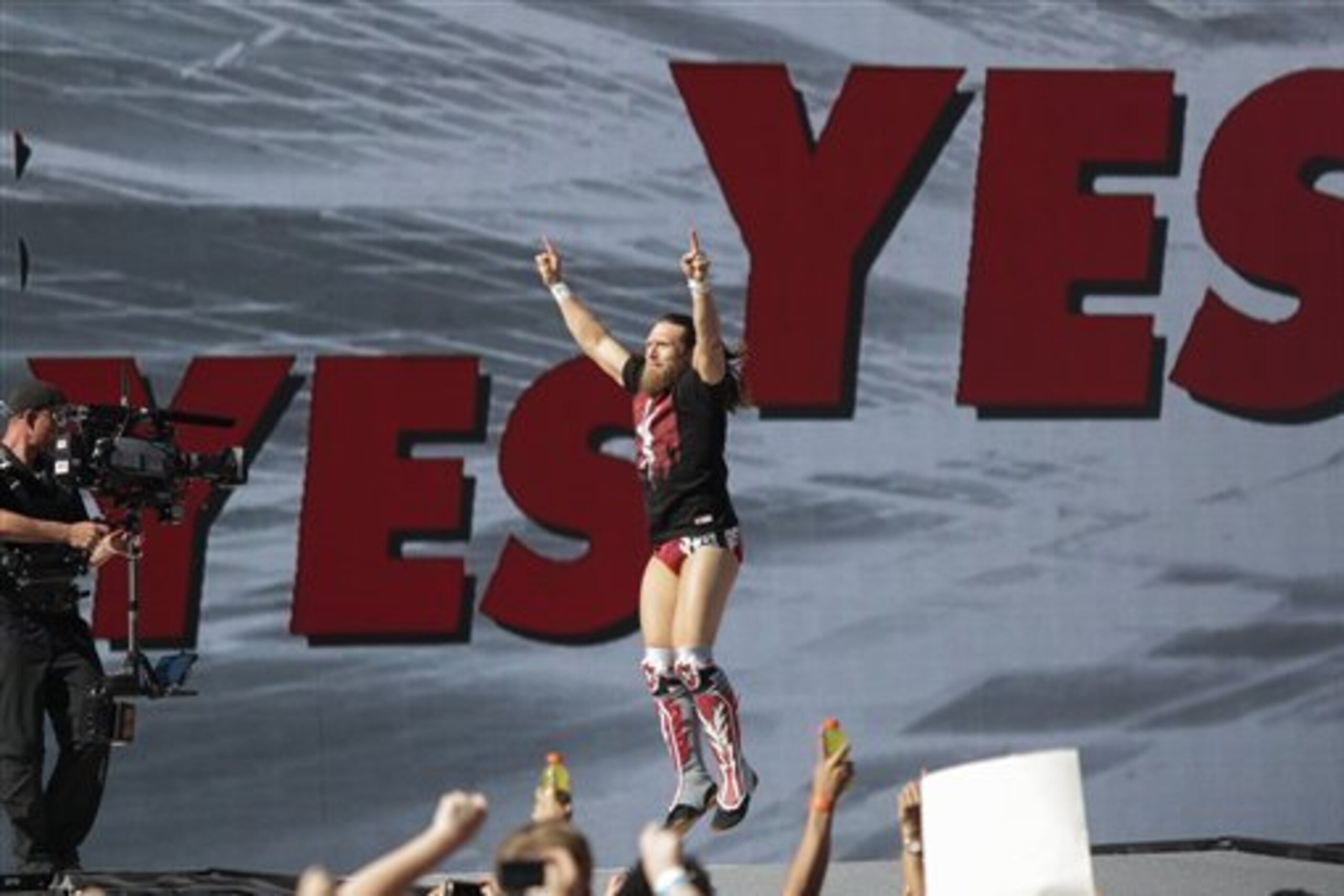
Yes Movement
10 of 10Former WWE wrestler Daniel Bryan was not looking to be the top star in the wrestling industry when he started what became known as the "Yes Movement." As Bryan explained to Brian Fritz of Between the Ropes, the in-ring performer was actually trying to bother fans (h/t ProWrestling.net):
"WWE World Hvt. Champion Daniel Bryan confirmed that his "Yes, yes, yes!" routine was inspired by UFC fighter Diego Sanchez. "I love Diego Sanchez and that's where it came from. Diego Sanchez is such an amazing fighter, but he would come to the ring and he would be like, 'Yes! Yes! Yes!' You just look and him and I love him as a fighter, but that's annoying. I can use that."
"
Instead of annoying WWE audiences, Bryan was accepted and then adored as the top babyface ("good guy") in the WWE.
The story of Bryan's career had a sad ending, an ending that occurred in February 2016 when Bryan announced during a segment of Raw that he had to retire as a wrestler due to issues caused by the many concussions he had suffered throughout his career. Bryan leaves more than great memories and a legacy of being one of the best overall pro wrestlers of his time.
Bryan's "Yes!" chant has become a cultural phenomenon on its own.
Michigan State students and MSU basketball fans have adopted the chant. Supporters of Major League Soccer side Columbus Crew have turned "Yes!" into a mantra for the club, per MLSSoccer.com. Followers of the New York Islanders, per LightHouseHockey.com, and San Francisco Giants, per TheScore.com, have embraced the "Yes Movement."
It could be the most positive chant the sports world has ever seen.
.jpg?w=2560 "Cowboys Texans Football")
.jpg?w=2560 "5 NFL Players Getting Trade Buzz")
.jpg?w=2560 "Vikings HC Called OBJ Before Release ☎️")