

Juventus, Atletico and Leicester Expose Major 4-4-2 to 4-3-3 Switch Difficulties
Formation switches are pretty frequent in the world of football, with managerial tussles—particularly at the top level—constantly seeking to expose weaknesses and source new strengths via numerical shakeups. When two great minds lock horns, it becomes a genuinely fascinating dose of intricate tinkering and tweaking.
The monikers we use to describe footballing systems—4-4-2, 4-3-3, 4-2-3-1 etc.—can be a little crude and undersell the complexity of what we’re seeing. Barcelona use a 4-3-3 almost 100 percent of the time, but from Pep Guardiola to Gerardo Martino to Luis Enrique, their style has changed tangibly, and numerical definitions can’t attest to that.



Some clubs change formations and, because of their “philosophy,” handle it well. Swansea City utilised a 4-4-2 diamond to great effect at the tail end of 2014-15, Paul Lambert’s Aston Villa changed shape every second week, and Guardiola’s Bayern Munich...well, sometimes they play with just a single centre-back, and it’s actually a left-back.
But other teams seem to struggle, and there’s a notable pattern of teams who play 4-4-2 very regularly struggling to adapt to one-striker formations. The majority of teams used to playing with just a single striker can switch to just about anything, but it seems there’s a particular sticking point when teams go from 4-4-2 to 4-3-3.
Under Antonio Conte, Juventus played 3-5-2 regularly and dominated Serie A using it, but they fell short on the continental stage. In 2013, after losing comfortably to Jupp Heynckes’ Bayern in the Champions League quarter-finals, an inquisition was started (although Barcelona’s 7-0 aggregate loss the following month suggested Juve actually did pretty well).

What could Conte do to make his club a powerhouse in Europe as well as in Italy? The answer seemed obvious: the back three isn't cut out for the top level. The following year they travelled to the Bernabeu and made the change, opting for a 4-3-3. It didn’t really work.
Going from two strikers to one was a problem, and it wasn't until Massimiliano Allegri was installed in 2014 that a 4-4-2 diamond—still inclusive of a strike partnership, yet also switching from three to four in defence—led them to a European final against Barcelona. He’d found the best of both worlds and correctly identified that 4-3-3 wasn't really an option.
Within the madness of the recent Premier League festive fixtures, we saw Leicester City dial back their explosive 4-4-2 system and switch to a 4-3-3 for the visit of Manchester City. Two games in four days can kill the legs—particularly in a system as direct as Claudio Ranieri’s—and the tempering was very likely a wise choice.
Holding a City side featuring David Silva, Kevin De Bruyne and Sergio Aguero—regardless of their pitiful away form—to a goalless draw is a success, no question, but the offensive performance was all over the place. It’s no real concern given the Foxes should revert to 4-4-2 when the fixture list unclogs, but it was a rather prescient reminder of the issues faced by teams trying to switch from two strikers to one.
Firstly, the striker’s role changes dramatically when leading the line alone. Jamie Vardy has scored 15 goals this Premier League season, an incredible feat, and he has done it thanks in part to playing off a strike partner.
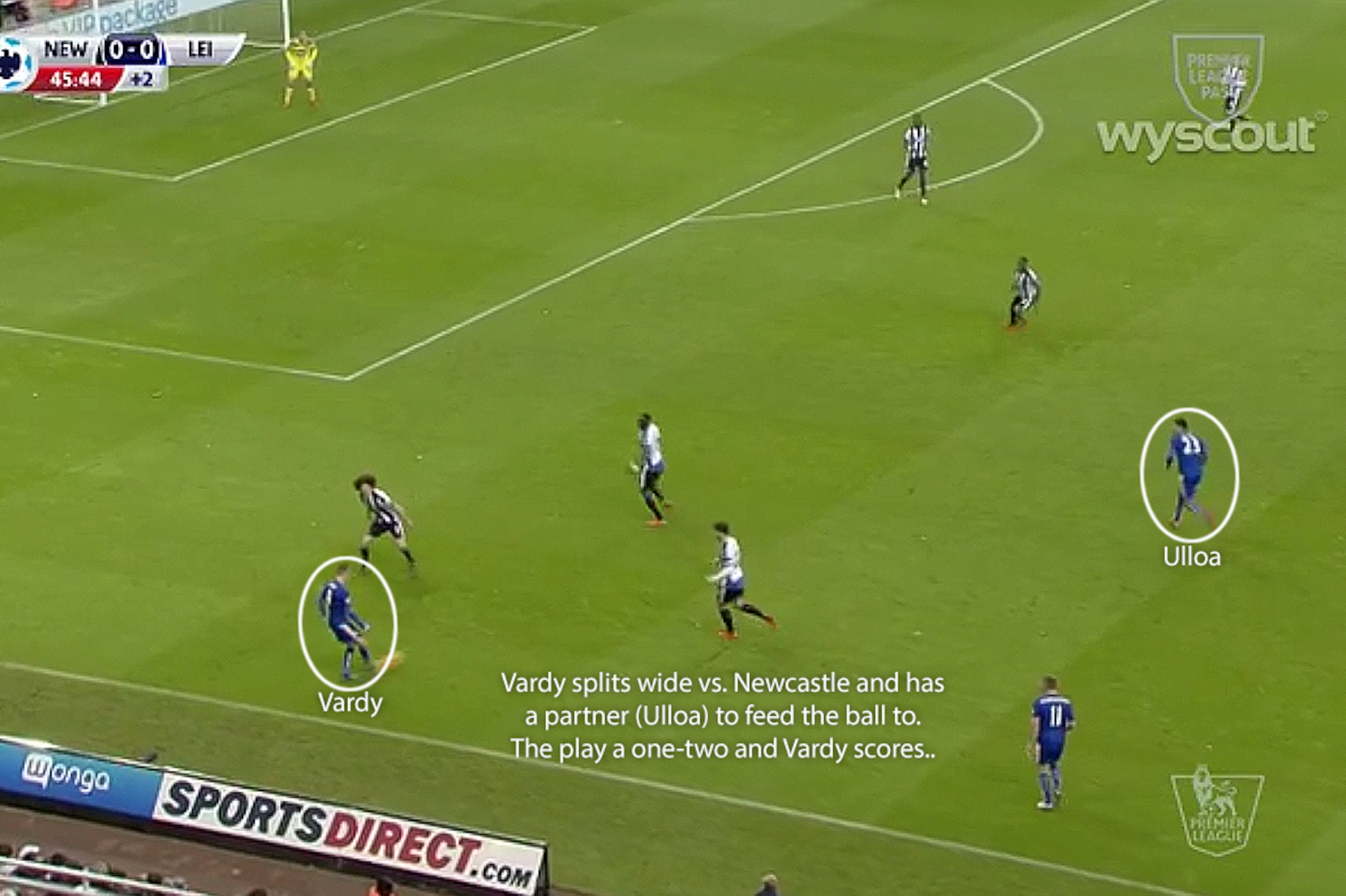
The Englishman loves to dart wide into the channels and chase hopeful passes outside the centre-backs, utilising his extreme speed and tenacity to reach balls many could not. He’s able to depart the No. 9 territory and fetch those because a strike partner—usually Shinji Okazaki—continues to occupy at least one of the centre-backs and gives Leicester a presence in the middle.
Vardy has the option of cutting back in with the ball one-on-one or feeding it inside to his partner. While Okazaki holds the central territory and links with him, the central midfielders (N’Golo Kante and Danny Drinkwater) steadily step forward to anchor the Foxes’ advanced position.
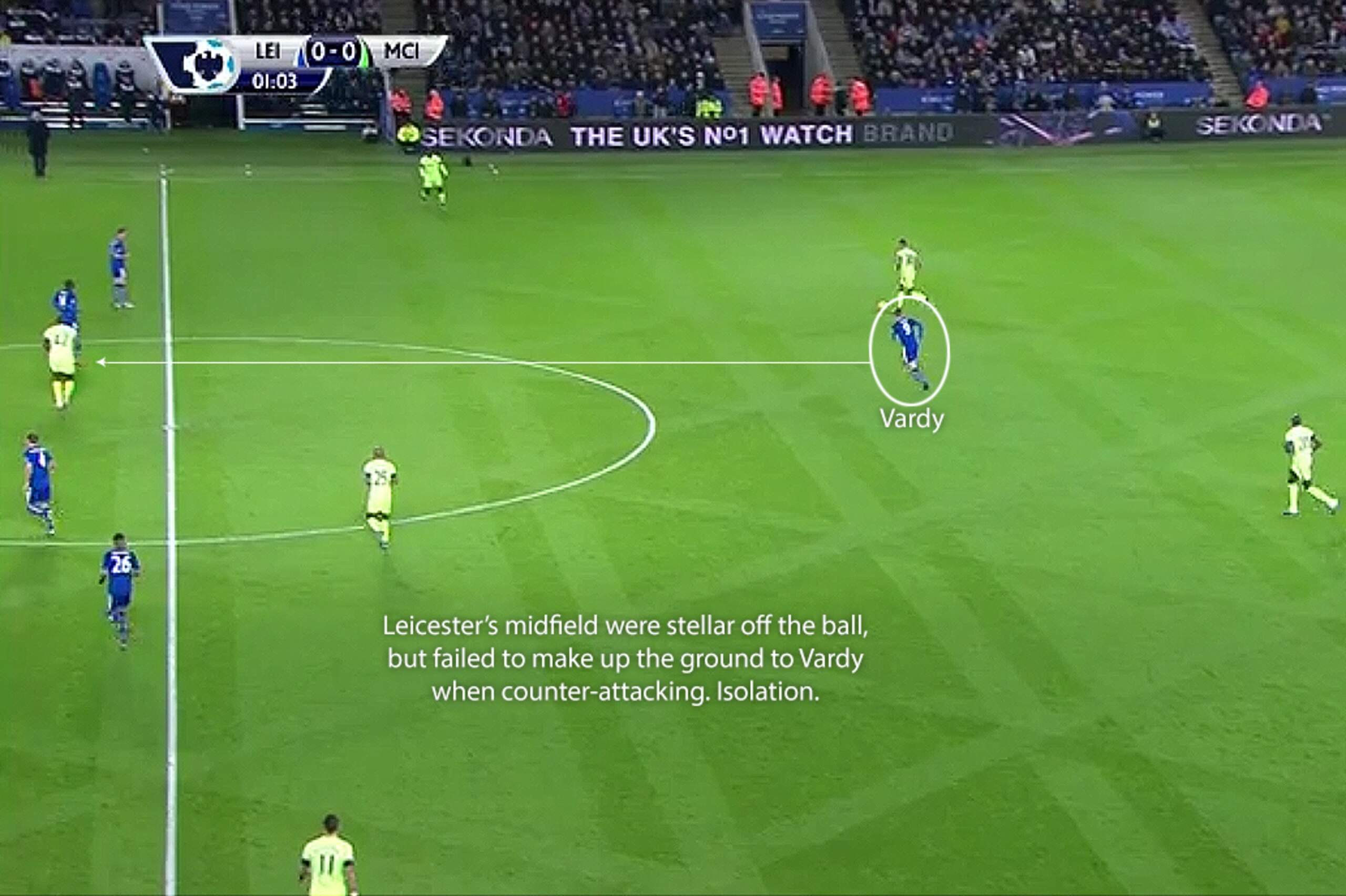
But when Vardy is on his own, he zips wide to chase passes—as he did against City—and has nothing to aim for and no one to help. If he departs the No. 9 space, the opposing centre-backs can feel free to follow him and corner him, as there’s no one else to mark. Vardy played a very lonely role on Tuesday. Without Okazaki or Leonardo Ulloa to occupy and hold, he filtered wide, collected the ball and had no options to press forward with.
Teams who regularly use a 4-3-3 would modify the approach in two ways: either play straight to Vardy rather than hit the channels (though that might require a stronger centre-forward), or build slower, likely via the three central midfielders and a pushed-on full-back.
Another key is the central midfielders’ roles in the attack, and the responsibility of a No. 8 in a 4-4-2 is rather different to a No. 8 in a 4-3-3. If Vardy must split wide to collect channel balls, he needs a runner from the next line to offer support, but Kante and Drinkwater—ingrained in the steadier disciplines of the 4-4-2—didn't free themselves enough to help.
The man difference is Gokhan Inler. He was brought into the XI in place of the second striker, moving the 11th man from just off Vardy to behind the two central midfielders. That necessitates Kante or Drinkwater to push forward constantly when the ball goes up to the striker, and to fill the space Okazaki or Ulloa might.
It’s likely Ranieri will have outlined these role differences, but it’s tough to override four months of doing the same thing over and over when it brings so much success. You can’t blame Kante for not thrusting forward as much as necessary—and he was probably absolutely knackered, too.
We’ve seen similar struggles at the Vicente Calderon in recent years, with Atletico Madrid’s inability to play with a 4-3-3 defying belief at times. How can it be that a lineup containing all the on-paper strengths of this formation fail to carry it out so regularly? How does a front three of Antoine Griezmann, Fernando Torres and Yannick Carrasco produce so little?

It’s all in the details of the roles, and what the players are used to. Atletico have very few players consistently breaking beyond the lines in midfield, and because the No. 8s are used to doing a bit of everything in a 4-4-2, they struggle to assign themselves responsibilities (anchor, mediator, surger) in a 4-3-3.
There are, of course, teams who manage to flit between 4-4-2 and 4-3-3 well, but those sides almost never consider the 4-4-2 to be their bread and butter, and can often simply be a nuance in the system when dominance of possession is achieved. Real Madrid play borderline 4-4-2 with Cristiano Ronaldo up front, but that’s only because they achieve incessant pressure and can handle counter runners with minimal numbers in reserve.
When Borussia Monchengladbach beat Bayern Munich 3-1 at the start of December, they temporarily switched away from a flat 4-4-2 to do so, but played Lars Stindl just off Raffael up top in a 3-5-2. Manager Andre Schubert understands the attacking DNA of his side requires two up top and isn't willing to revert to one in an attempt to “shore things up.”
Leicester, Atletico and Juventus have all shown over the past three years that it’s difficult—and in some cases nigh-on impossible—to go from 4-4-2 to 4-3-3 due to the severe differences in responsibilities for the players. It’s just too much of a culture shock too fast, and it won’t surprise to see others fail with the transition in the future.




.jpg?w=2560 "Raiders Could Start Mendoza")

.jpg?w=2560 "Rodgers Iced Out on Plane 💎")


.jpg?w=2560 "🚨 Week 8 AP Top 25 Poll")