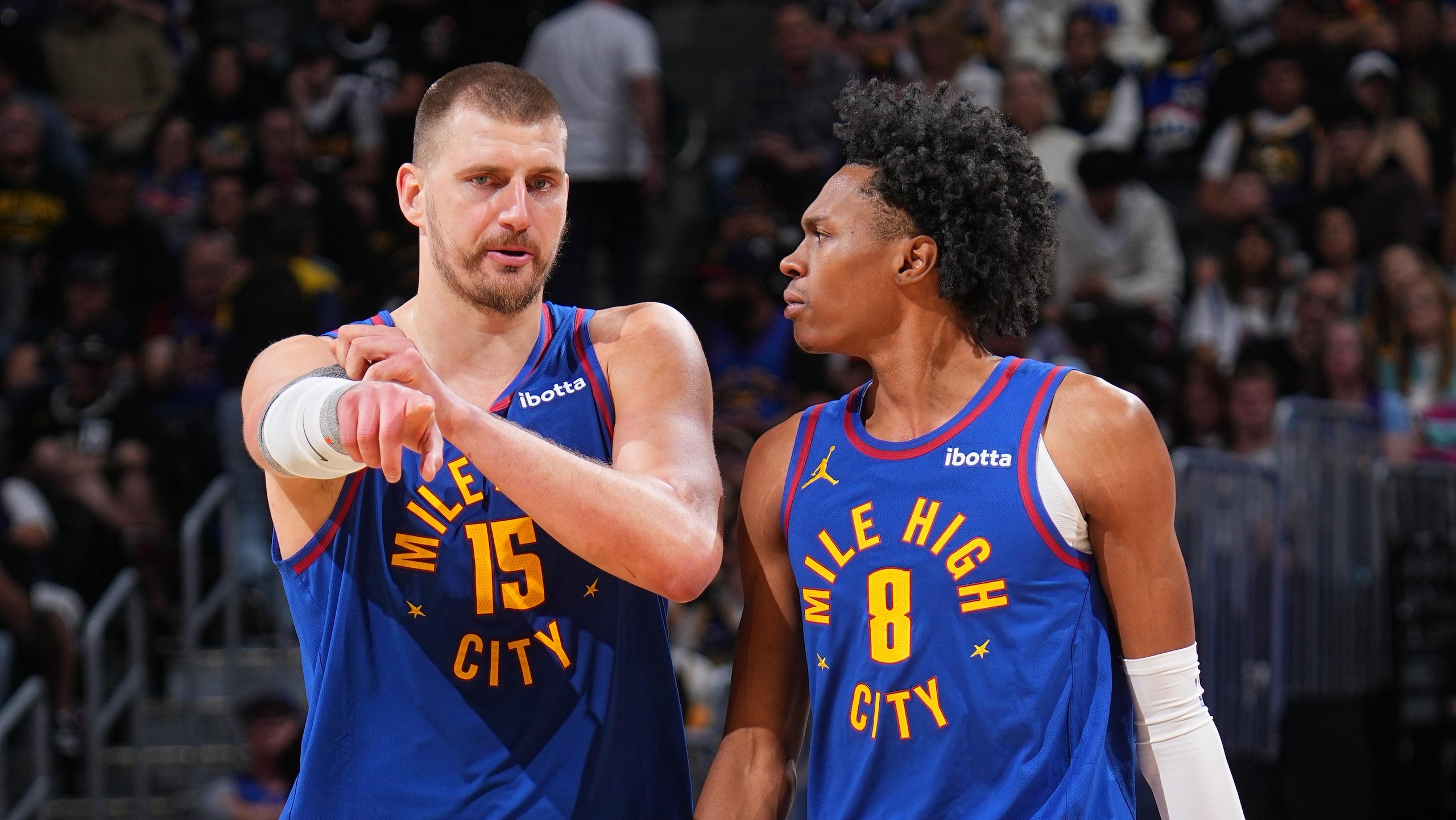


August is often a quiet stretch of the NBA's calendar, but the volume ratcheted way up Wednesday when ESPN's Shams Charania reported that the Denver Nuggets were trading one of Nikola Jokić's most intriguing young teammates, Peyton Watson, to the Cleveland Cavaliers in a five-team deal.
In a vacuum, the move is maybe justifiable.
TOP NEWS

Offseason Grades for Every Team 🧑🏫
Final Record Predictions for Every NBA Team 🔮
NBA Opening Night Rosters 🔒
Watson has a career average of 8.7 points and a 36.1 three-point percentage. Without the one truly high-level stretch of his NBA career (January of this year), those numbers are even worse.
With little more than that context to rely on, Denver's unwillingness to pay him $22 million per year and plunge itself that much further past the second apron might seem fair. (The Nuggets were already above the second apron even without Watson.)
The problem is that there's more context. A lot more.
Chief among the reasons why this deal has been widely pilloried is what it appears to say about the organization's commitment to Jokić.
He isn't just the best player in franchise history. Statistically, he's one of the best players in NBA history.
Jokić is first all-time in career player efficiency rating, box plus/minus and win shares per 48 minutes (catch-all metrics that endeavor to quantify a player's impact in a single number). He's tied for first all-time in career triple-doubles (including the playoffs). He's one of just 10 players in league history with three MVPs. And he's sixth all-time in career MVP shares, behind only LeBron James, Michael Jordan, Kareem Abdul-Jabbar, Larry Bird and Magic Johnson.
Despite all of the accolades he's already piled up, Jokić is smack-dab in the middle of his prime. The 31-year-old has a mostly ground-bound game that should age relatively well. And his team basically just punted on the restricted free agency of its biggest and perhaps best upside bet.
Moving Watson for a first-round pick that won't convey until Jokić is 36 years old—with no players along with it, young or otherwise—all but seals this summer being a fourth straight loser since the Nuggets won the championship in 2023.
In the offseason immediately after the title run, Denver lost Bruce Brown (although CBA rules made that one inevitable). The next summer, Kentavious Caldwell-Pope walked. In 2025, they traded Michael Porter Jr. and draft capital for Cameron Johnson and lost Russell Westbrook. Along the way, they signed Dario Šarić, Jonas Valančiūnas, both of whom are gone.
This summer, they lost Watson and Tim Hardaway Jr. For most of that stretch, Zeke Nnaji's inexplicable four-year extension (which comes with a $7.5 million player option in 2027-28) has been on the books. And at one point, the front office attached three second-round picks to salary dump Reggie Jackson.
Individually, up until the Watson move—and with the exception of a handful of others, like Nnaji and Jackson—there were reasonable explanations. The Porter-for-Johnson swap, in particular, added flexibility without losing shooting. However, MPJ quickly showed how much higher the Nuggets' ceiling might've been with him when he averaged 25.6 points, 3.8 threes and 3.2 assists while shooting 39.8 percent from deep in his first 38 games with the Brooklyn Nets.
Even some of the moves that could be justified at the time, like the Porter deal or Christian Braun's extension, are off to rough starts. When you look at everything over the last four offseasons together, it feels disastrous.
Jokić is the kind of talent whose presence on a roster guarantees competitiveness, but winning at the highest level requires more than that. It certainly requires more than tactically retreating year after year.
If the basketball world at large perceives Denver's post-championship approach as that, it's not hard to imagine Jokić starting to see it the same.
For years, whenever the subject comes up, Jokić has insisted that he wants to stick with the Nuggets for his entire career. He opted not to sign an extension this summer because he can sign for more (five years and more than $350 million) next summer, but nothing's guaranteed.
This roster is better than the general reaction it's gotten this summer. Jamal Murray is in his prime and played at an All-NBA level last season. Aaron Gordon is among the best and most versatile third options in the league. For long stretches of last season, Johnson looked like the ideal gap-filler for this roster.
If Braun is healthier, he could bounce back to around the level that earned him his big payday. Marvin Bagley III was an underrated pickup this summer. And though he wouldn't come with the same upside as Watson, the rumored acquisition of DeMar DeRozan would uplift the bench.
The group could certainly outperform expectations, get back into the hunt for championships and give Jokić plenty of confidence to sign a massive contract next summer. But again, nothing is guaranteed.
Gordon's health has been a massive question mark since the Nuggets' title run. Johnson shot the ball well last season and is more consistent defensively than MPJ, but his offensive highs may not be as high. Braun may have just caught lightning in a bottle the season before signing his extension. And the non-Jokić minutes have been a wild ride for most of his MVP era.
With the Oklahoma City Thunder and San Antonio Spurs younger and more athletic than Denver, the Nuggets' kryptonite Minnesota Timberwolves adding LaMelo Ball and fewer teams blatantly tanking, Jokić could be in for another early playoff exit this coming season.
If that happens on the heels of these last four offseasons, especially if Watson's breakout continues for the Cavaliers, it would be hard to blame Jokić's eye for wandering toward other teams.
.jpg?w=2560 "Purdy Becomes Highest-Rated QB EVER 🤩")
.jpg?w=2560 "Grading WWE Raw 🔠")