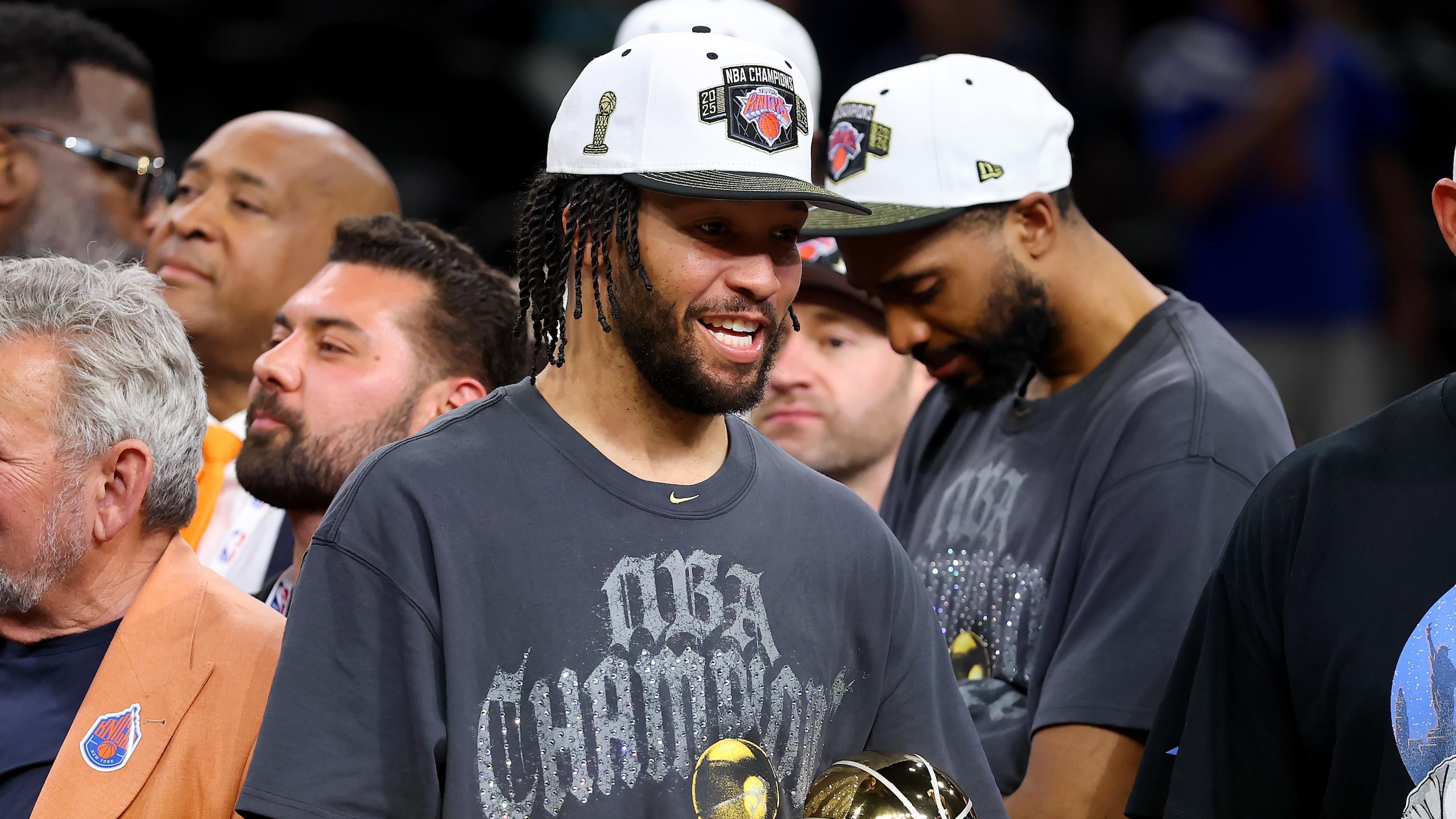


For the first time in 53 years, the New York Knicks are NBA champions. Real, actual, genuine champions.
Don't let anyone tell you or imply otherwise. Inferring anything else dilutes the body of work delivered by Finals MVP Jalen Brunson and the entire organization.
Even team-of-destiny references sell this short.
TOP NEWS
Lakers Waive 2024 1st-Rd Pick
Hornets Give Brandon Miller $209M 💰
Final Record Predictions for Every NBA Team 🔮
This was not David slaying Goliath.
This was one Goliath taking down another.
The San Antonio Spurs were favored entering this series, despite being so young. They have what is supposed to be an unstoppable, unanswerable force in Victor Wembanyama. He is the 7'4" megastar with interstellar roots, the active legend with an impact that belies his age and defies biology.
More than any other team, the Knicks solved what was supposed to be unsolvable. Wemby looked overtaxed in crunch time for much of the series. New York went at him on defense and frequently paid the price. Yet, it never stopped. The Knicks had personnel who could make him uncomfortable and tired (Karl-Anthony Towns), force him into tough decisions at both ends (OG Anunoby) and didn't care about his immense size and length (Brunson).
This doesn't happen by accident. The Knicks did not assemble this roster with Wembanyama and the Spurs specifically in mind. But they did hone it over time to be adaptable and more balanced than many believed.
Brunson's ball dominance has at times been considered a bug rather than a feature. But nothing could be further from the truth. His comfort with being uncomfortable was their lifeblood, and a huge reason why they eked out Game 5.
Still, superstars with uncompromising skill sets aren't hard-wired to incorporate more off-ball work on the fly. Brunson did that following the Knicks' Game 3 first-round loss to the Atlanta Hawks. Towns asked head coach Mike Brown for more touches as the hub.
New York acquiesced, and Brunson continued to thrive—then reverted back to the all-everything when circumstances demanded it.
Towns himself so often embodied the up-and-down nature of this roster. He was not above dissociating from the offense and unfocusing on the other end. But the gravity he has as a floor-spacer can unnerve even the most disciplined defenses, and he spent at least 75 percent of this playoff run defending his ass off.
New York's wing trio of OG Anunoby, Mikal Bridges and Josh Hart has its flaws. This gaggle is also the only one of its kind. The defensive interchangeability is through the roof, as is the ability to impact games, even when they're not scoring or getting many offensive touches.
The bench wasn't always deep in the conventional sense. You didn't always watch the Knicks loving their ability to field nine or more players in a regular rotation. But they loaded up on optionality.
Tyler Kolek was a huge part of the Knicks beating the Spurs in the December NBA Cup. Six months later, it was Jose Alvarado injecting much-needed ball-handling into an historical Game 4 comeback that effectively sealed this team's championship fate. He was acquired at the trade deadline, but spent most of the playoffs on the fringes of the rotation. He was ready anyway.
Jordan Clarkson, on a minimum contract, fell out of the rotation midstream. He rejoined it later in the season, reestablishing himself as a try-hard offensive rebounder and defender.
Selected No. 51 overall last June, rookie Mohamed Diawara spent a chunk of the regular season gobbling up wing reps. Landry Shamet, another player on a minimum contract, consistently ranked among the NBA's best bargains whenever he was healthy.
New York also cultivated longer-game options. Mitchell Robinson is the team's most tenured player. The Knicks meticulously monitored his minutes and appearances and worked around his free-throw-shooting limitations, because they could. Having the forethought to extend Deuce McBride immediately after the 2024 Anunoby trade is a sliding-door moment.
This team was neither built nor perfected overnight. The full vision took a while to actualize.
Plenty of people wanted the plug pulled on Towns or Bridges at the trade deadline. Some wanted the same all over again to start the first round of the playoffs.
Instead, the Knicks are being rewarded for a blend of calculated risk-taking, patience and continuity.
Firing Tom Thibodeau after their first Eastern Conference Finals appearance since 2000 was a dice roll. But it led them to Mike Brown, a far more flexible tactician, who futzed, fiddled and experimented until the very end of this banner season.
Not overreacting to implosive vibes around the trade deadline, on the other hand, was a masterclass of restraint. The Knicks instead found a way to turn the failed mini-mid-level signing of Guerschon Yabusele and second-round equity into Alvarado and the financial runway needed to sign Jeremy Sochan.
New York's playoff run itself will be portrayed as proof of good fortune. It avoided the Detroit Pistons and Boston Celtics. The Philadelphia 76ers were hobbled. The Cleveland Cavaliers were fatally flawed. The Spurs were too young. Opponents shot just 31.3 percent from downtown for the entire playoffs. The Knicks converted 39.1 percent of their own triples and finished the postseason plus-150 from beyond the arc.
The list goes on. And on. Each item carries a varying amount of legitimacy.
None of it makes the Knicks overly lucky.
Good luck is a constant in every championship run. The Knicks aren't a one-hit wonder just because they benefited from the bracket, fewer health issues, a top-10 star on a below-market contract, etc.
Focusing on what they couldn't control also dilutes what they overcame. Anunoby suffered a hamstring strain that sidelined him for two games. Robinson played through a broken finger during the NBA Finals.
Bridges' offensive vanishing acts spanned much of the first round and a huge swathe of the Finals. New York fundamentally shifted its offensive approach in the middle of the playoffs. Deuce McBride, arguably the team's most important reserve, forgot how to make shots on the championship stage.
Spare yourself from the pretzel-twisting bracket talk, too. Avoiding a Pistons squad that almost got daddy'd by the Orlando Magic and then fell to the Cavaliers isn't some godsend. The Celtics look like a sigh-of-relief miss on paper, but also blew a 3-1 lead to the Sixers.
Wembanyama and the Spurs can't be both one of the two teams everyone is most scared of moving forward and a good-fortune pull.
Even if the competition could have been tougher, the Knicks did what genuine champions do: They dominated it.
They join the 2017 Warriors and 2024 Celtics as the only teams to rack up 16 playoff wins with fewer than four losses.
Their 15.4 net rating for the postseason will go down as the highest of all time.
Nothing about this Knicks team was guaranteed, let alone destined. They may not be the best or most convincing champs, but they don't stand out for their vulnerabilities.
This team finished with a top-10 offense and defense during the regular season, typifying a potential champion's profile before the playoffs ever started. We were conditioned to dismiss them because of midseason tumults, the existence of the Spurs and Oklahoma City Thunder, weaknesses both genuine (secondary offense) and exaggerated (defense), and because, well, Jalen Brunson is a 6'2" balletic tank rather than 6'5" worth of wiry fluidity.
At some point, the accumulation of winning trades and signings, firings and hirings, comebacks and blowouts, depth and adaptability is just the reality. And the reality is, these Knicks are champions of design over destiny.
They are here on purpose, because they were good enough—great enough—to be.
If they stay together, they could be good enough—great enough—to be back here again.
They were, and perhaps still are, the Goliath hiding in plain sight.
Dan Favale is a National NBA Writer for Bleacher Report. Follow him on Bluesky (@danfavale), and subscribe to the Hardwood Knocks podcast, co-hosted by Bleacher Report's Grant Hughes.
.jpg?w=2560 "🚨 Davante Out 6-10 Weeks")
.jpg?w=2560 "Tank Dell Playing Sunday 💯")