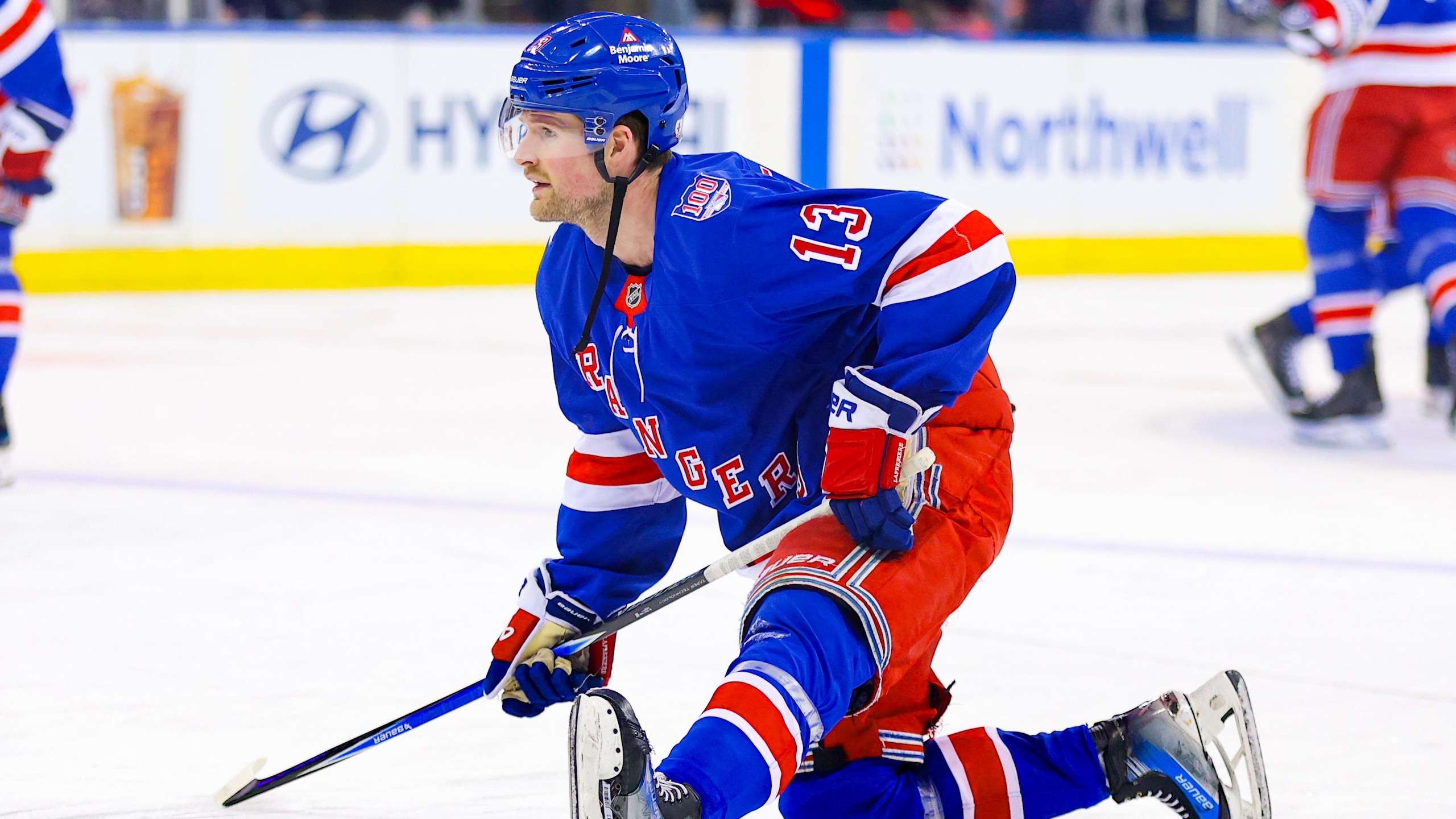

Is Alexis Lafreniére Salvaging His Rangers Career in a Lost Season?
In a New York Rangers season almost completely bereft of entertainment, let alone success, there has been one critical source for optimism: Alexis Lafreniére appears to be finding his groove.
The Quebecois winger has 30 points in his last 30 NHL games. Among the 322 NHL forwards to have played at least 300 minutes since New Year's, Lafreniére ranks 23rd by points-per-60 and 30th by goals-per-60. It's a far cry from the hollow performances in 2024-25 and the first half of this season, which led to his being labeled a "disappointment" and speculation about a change-of-scenery trade.
TOP NEWS
Re-Ranking Top Free Agents 🛒
Grades For Every Team's Prospect Pool 🔠
Canes Troll 3 Philly Teams 😅
What are the catalysts for Lafreniére's newfound success? More importantly, is he merely riding an ephemeral hot streak in a stretch of meaningless games, or do his recent performances point towards the 24-year-old finally establishing himself as a high-end NHLer?
Power Play Usage
Entering this season, Lafreniére had only broken the 50-point plane once in five NHL campaigns. His backers would often point out that his production, deflated compared to other young players, was as much about opportunity as anything else. It was only in 2023-24 that Lafreniére became a regular in the top six.
The trading of Artemi Panarin to Los Angeles in February opened up a featured spot on the power play. In those 16 games since, Lafreniére has four goals and an assist with the man advantage; quite the streak from a winger who had eight total PP points his previous two seasons combined.
It's not only about icetime. Again, this is not Lafreniére's first cameo on the top unit. In fact, he earned a run of games early in the season when Vincent Trocheck sat out with an injury. The Rangers' PP struggled to score and Lafreniére was as culpable as anyone. Sitting on the flank above the right circle, pucks often died on his stick.
This is where Head Coach Mike Sullivan deserves a lot of credit. He changed the deployments on the top power play unit. Lafreniére has moved to the net-front, swapping spots with J.T. Miller. This deployment leans into Lafreniére's strengths. He has an eye for getting into the right spots around the net, a keen sense of timing those movements to receive pucks, and remarkable hands for deflections and beating goaltenders in tight.
Regular power play deployment with top players plus a role built for his strengths? That's the recipe for increased offensive production.
Improved Habits
Even when Lafreniére has been successful in the past, it has often come through a rush offense. This season has been the first in which he's consistently created offense from sustained offensive-zone possessions.
There are a handful of reasons for this phenomenon, but the biggest is that he's demonstrating more resilience in the offensive zone.
Lafreniére is holding on to pucks longer. In the past, when Lafreniére came under pressure with the puck upon a zone entry or holding it along the walls, he'd be quick to relieve himself of the puck. The result? Dead possessions at best, or awful turnovers in middle ice that left the Rangers vulnerable to transition.
With help from the coaching staff, Lafreniére has become braver and more confident, trusting that he can maintain possession by keeping his feet moving and waiting out the pressure.
The Gabe Perreault Effect
There's no question Lafreniére has improved since the Panarin trade, but his rise has also come with being placed on a line with Gabe Perreault. While he's no slouch, he's not Panarin. How does someone play better by splitting away from an elite offensive play driver?
One factor may be something as simple as handedness. Artemi Panarin played the left wing on Lafreniére's line despite being a right-handed shot. It's a role that suits Panarin's game extremely well, but it does come with its drawbacks. In order to make plays across the ice on his forehand, Panarin would have to open up his hips and often move low-to-high within the offensive zone. This often meant Panarin was converging in a similar space as Adam Fox, himself right-handed. Zibanejad and Trocheck, too, are right-handed shooters.
Perreault, in contrast, is a left-handed shot. A super creative playmaker, Perreault is gifted at making east-west passing plays or connecting on low-to-high sequences. And as a left winger, he is able to more naturally make straight-line passes across the slot.
By introducing a left-handed shot, Sullivan has given Lafreniére a greater diversity of options for Lafreniére to get open and connect for grade-A scoring chances.
Maybe This Was Always Coming
The big question: Is this all sustainable?
Lafreniére's play dipped mid-season (who on the Rangers showed well in that time?), but I believe a lot of the earlier criticisms of Lafreniére this season rang hollow; he isn't engaged, he's playing soft, he's not getting to the tough areas of the ice.
In reality, I think he often did those things. It just wasn't getting rewarded on the scoresheet. There were numerous examples of Lafreniére driving the middle lane, battling for space in high-traffic areas, and getting his stick on rebounds first. The puck wasn't going in the net, but I predicted his fortune would change.
In fact, there's been a retconning of Lafreniére's entire career. In his early seasons, Lafreniére was putting up phenomenal numbers for a third-line role. In 2023-24, he got his first full-time opportunity in the top six, scored 28 goals, and was the Rangers' best forward in the Eastern Conference Final.
He produced eight goals and eight assists in 19 games to start the 2024-25 season, earned a seven-year contract extension, and then management sent out a memo trying to trade the entire leadership core, and the entire organization imploded. That doesn't mean Lafreniére isn't without fault for his struggles last season and during stretches of this one, but perhaps treating him like a catastrophic failure in need of a change of scenery was an overcorrection.
That Lafreniére has done this for more than 30 games suggests this is more than a hot streak. He's not even riding a shooting percentage bender; since Jan. 1, Lafreniere has 11.94 expected goals to his 13 actual goals, per Evolving Hockey. The Rangers' overall goal scoring at 5v5 with Lafreníere on the ice is right in line with expectations relative to shooting percentage.
And, these are not empty-calorie points. Of his 30 points since January 1st, 24 have been either goals or primary assists. That's a remarkable distribution.
Moving Past First-Overall Expectations
Even by this standard of play, Alexis Lafreniére does not live up to first-overall billing. Certainly not the standing of a Nathan MacKinnon or Auston Matthews, but not even more modest options like John Tavares or Steven Stamkos.
To be blunt, Rangers fans need to get over it. Trading him because you're mad about unfulfilled expectations is the equivalent of punching a hole in a wall. It's not productive. Lafreniére is a 24-year-old who has largely shown himself as a borderline first-line player and now looks to finally be pushing into bona fide top-line status.
Along with better habits on the defensive side of the game, is that worth a $7.45 million cap hit in a rapidly growing cap environment?
I don't think there's much debate.
.jpg?w=2560 "Viral Dan Campbell Presser 💙")
.jpg?w=2560 "AD Trolls Bears WR on IG 😂")
.jpg?w=2560 "Cam Ward Says He's Not A Loser")
.jpg?w=2560 "Chargers Fall to 0-5 🤢")
.jpg?w=2560 "Report: Steelers WR to Miss 'Weeks'")