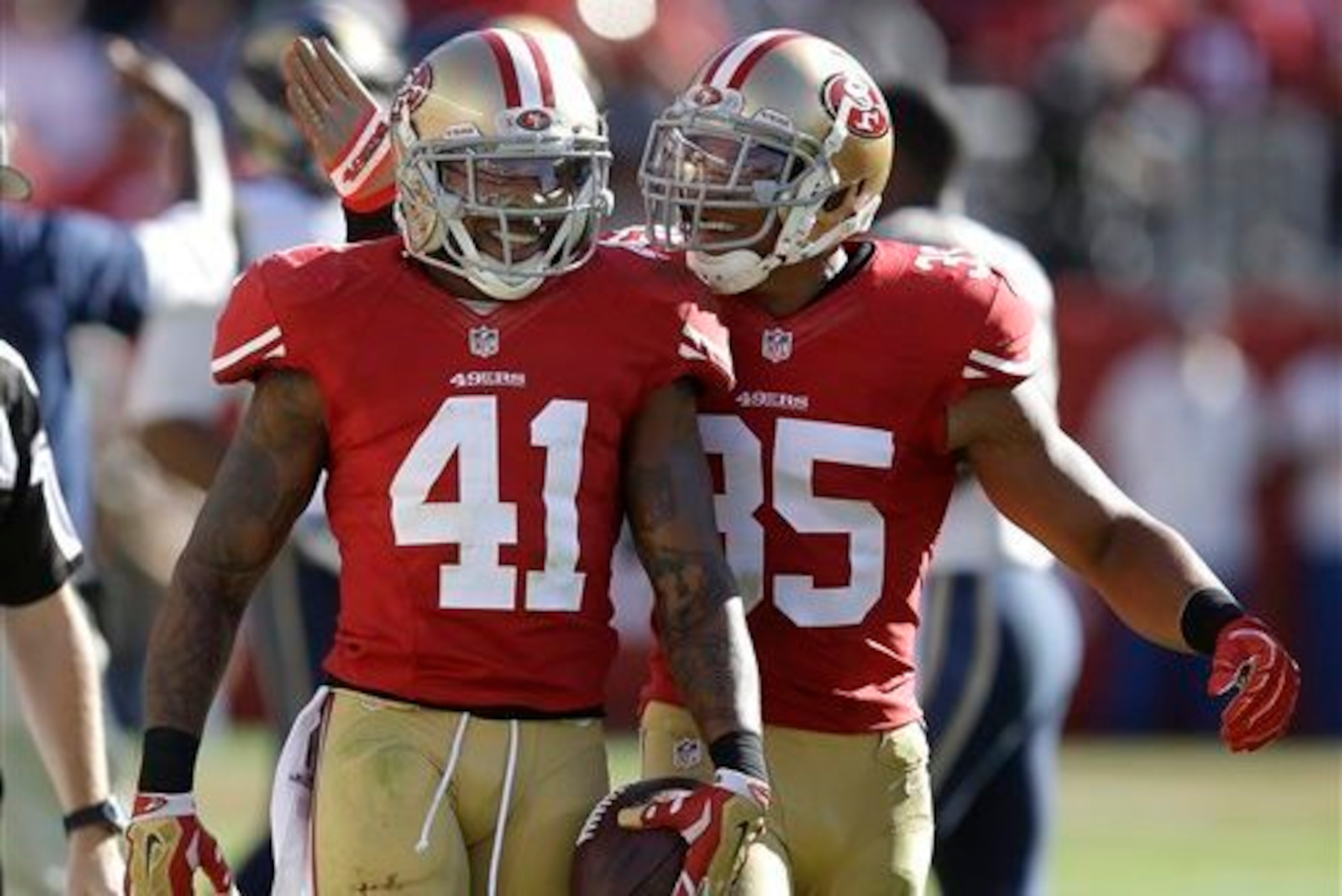

San Francisco 49ers: All-Time Top Players for Each Uniform Number, 26-50
Last week, we began a countdown of the top players at every number in San Francisco 49ers franchise history. As the countdown to the start of training camp continues, the countdown of uniform numbers also continues, going to numbers 26 through 50.
Nowadays, these numbers are primarily assigned to running backs and defensive backs, with linebackers and tight ends being eligible for the numbers in the 40s as well. While that hasn't always been the case, the rules do more or less coincide with the 49ers' era of dominance in the '80s, so today's slideshow is filled with players who moved the ball on the ground or patrolled the secondary.
This is also the slideshow with the highest percentage of retired numbers. Four numbers in this range have been retired, with Hall of Famers on both sides of the ball represented.
Unlike the first spreadsheet, where an active player in Colin Kaepernick waltzed to a fairly easy win at his number, there are no walkovers for modern-day players here. Have the likes of Antoine Bethea or Eric Reid done enough to claim a number as their own after only a few seasons? Let's go in-depth and find out.
Nos. 26-30
1 of 5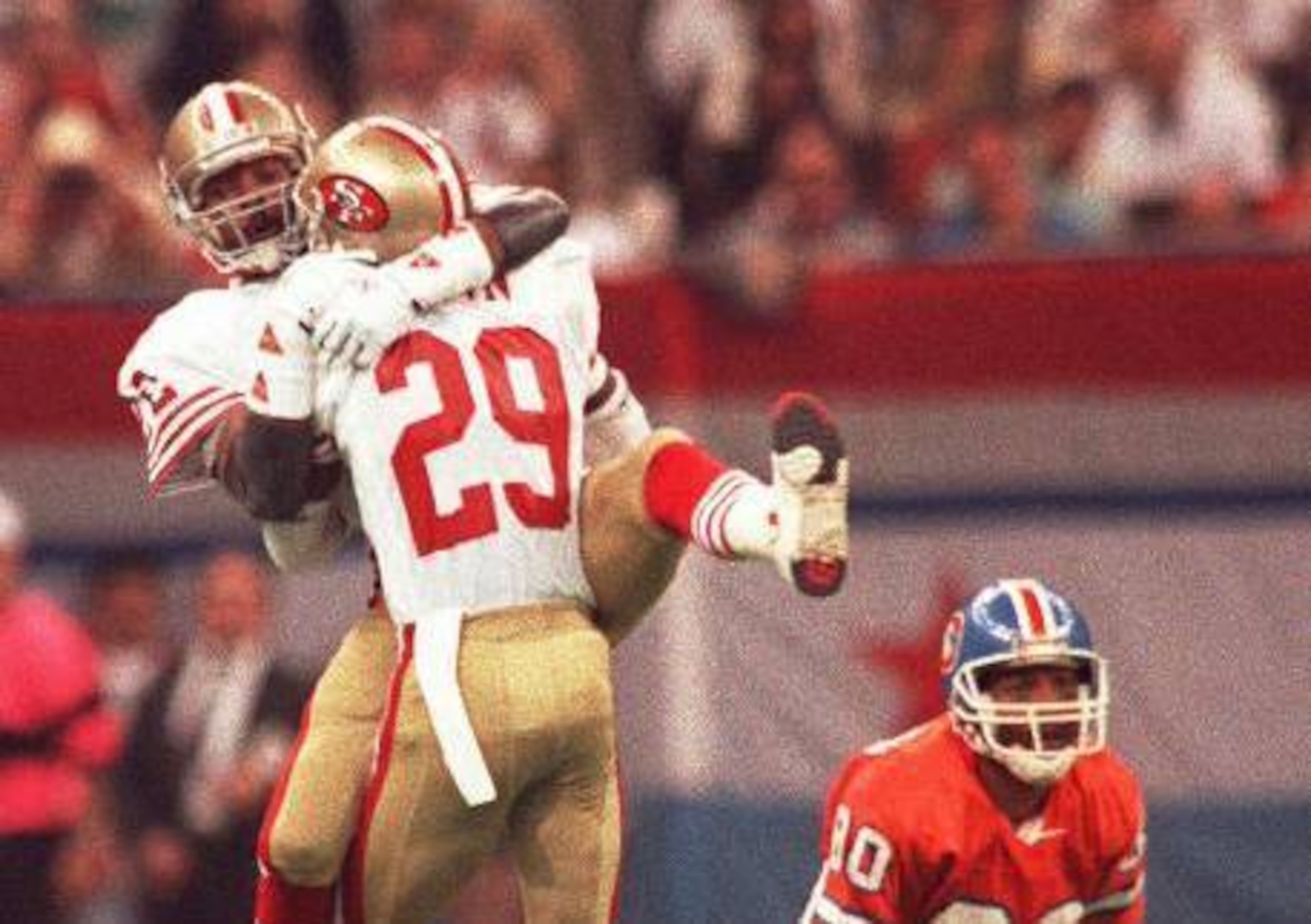
26: Wendell Tyler (1983-1986)
Tyler was the running back before Roger Craig took over the role full-time for the ‘80s 49ers, making the Pro Bowl and winning a Super Bowl ring in 1984 and finishing with 3,112 rushing yards for the franchise. Darryl Pollard, who started two seasons at cornerback and won his own Super Bowl ring in ’89, and Mark Roman, who played for four seasons at safety in the 2000s, also are worth considering.
27: Carlton Williamson (1981-1987)
Tough, tough call here. Williamson was a two-time Pro Bowler at strong safety and part of the three defensive backs the 49ers drafted in 1981, paving the way for secondary success in the ‘80s. He finished his career with 17 interceptions. His main competition is R.C. Owens, known for his “alley-oop” connection with Y.A. Tittle in the late ‘50s. I may be siding too much with modern-era players here.
28: Dana Hall (1992-1994)
Not much to choose from here. Dana Hall won a Super Bowl ring as an occasional starter at safety with the 49ers, finishing his 49ers career with four interceptions. That’s one more than Charles Cornelius, who also wore the number in 1979 and 1980, or Keith Lewis, who wore it from 2004 through 2008. Joe Cribbs is the biggest name to wear the number, but his best years were in Buffalo, and he ran for just 890 yards as a 49er. The road is clear for Carlos Hyde to take this one after a season or two.
29: Don Griffin (1986-1993)
Griffin manned the cornerback position for eight seasons, providing solid, if never Pro Bowl-level, play on his way to earning two Super Bowl rings. He finished his 49ers career with 22 interceptions. He also was the team’s punt returner, though he only averaged 9.0 yards per return on 74 punts.
30: Bernie Casey (1961-1966)
Casey finally made the Pro Bowl the year after he left the 49ers, but he arguably deserved it for a couple of years of being a top target for John Brodie. Casey led the 49ers in receiving for three seasons and racked up 4,008 receiving yards on 277 receptions. He played second fiddle to Dave Parks when he joined the team in 1964, but the former college high-hurdler remained a useful receiver for his entire 49ers career.
Nos. 31-35
2 of 5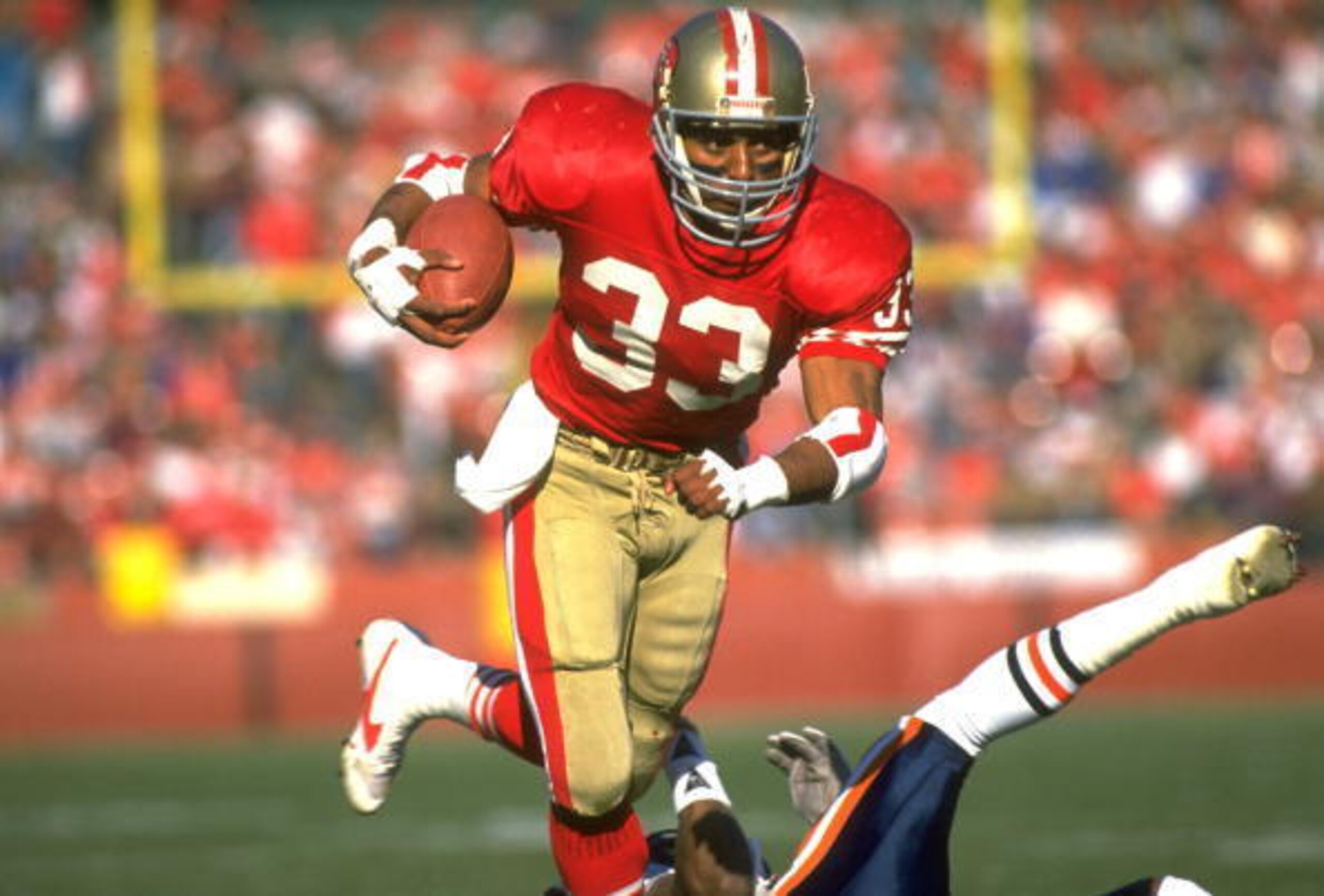
31: Donte Whitner (2011-2013)
The hard-hitting force of San Francisco’s secondary during the Jim Harbaugh-era, Whitner’s career in San Francisco was short lived but impactful, making two Pro Bowls in his last two seasons before he left in free agency. His short career makes other safeties possible choices here, notably Chet Brooks and Zack Bronson, but Whitner’s accolades make him the pick.
32: Mel Phillips (1966-1977)
Longevity or peak value? That’s always the question when doing a list like this, and I’m always torn between possibilities. Phillips started as a safety for more than a decade for the 49ers, through the good years of the early ‘70s and the bad years of the late ‘70s, recording 12 interceptions over his career. His main competition is Ricky Watters, who had three Pro Bowl years as a running back from 1992 to 1994—and don’t forget about Norm Standlee, a star for the AAFC-era 49ers. This is a real tough choice, but I’ll take the longevity this time over only three years of Watters.
33: Roger Craig (1983-1990)
While Frank Gore and Joe Perry are ahead of him on the franchise rushing yards list, Craig’s value as a receiver out of the backfield, as well, keeps him as my choice for greatest running back in franchise history. Craig is one of only two players, along with Hall of Famer Marshall Faulk, to have 1,000 yards rushing and receiving in the same season, with Craig being the first ever to reach that total in 1985. Add in an All-Pro nod in 1988, four Pro Bowl nods and three Super Bowl rings, and it’s surprising that he hasn’t had more of a push to make the Hall of Fame, only being a finalist once in 2010.
34: Joe Perry (1948-1960, 1963)
Another retired number, which makes this selection much simpler. Perry wasn’t an original 49er, but joined in their second season in the AAFC. He held the franchise record for rushing yards until Frank Gore broke it, and was the first NFL rusher ever to have back-to-back 1,000 yard seasons, back in the days when they only played 12 games. He wasn’t very powerful or very elusive, he just had blazing speed—they didn’t time the 40-yard dash then, but he could run a 9.7 100-yard dash, hence his nickname “The Jet”. He retired as the NFL’s all-time leader in rushing yards, which he held until Jim Brown broke it in 1963.
35: John Henry Johnson (1954-1956)
Johnson’s a Hall of Famer, but this isn’t as cut-and-dry as you might think. Johnson only played for the 49ers for three seasons, racking up most of his rushing yards with the Pittsburgh Steelers. They were a good three seasons, making the Pro Bowl in 1954, but that’s a short period of time. It’s enough to get him past the likes of Larry Schrieber and Dexter Carter, but don’t count out Eric Reid taking this one day, if he plays for long enough.
Nos. 36-40
3 of 5
36: Merton Hanks (1991-1998)
Hanks was more than just a flashy pidgeon-necked touchdown celebration. A Pro Bowl safety for four years in the mid ‘90s—including an All-Pro nod in 1995—Hanks was a ball-hawking free safety, recording 31 interceptions in the red and gold, and is one of the better draft steals in franchise history, having fallen all the way down to the fifth-round. He edges out Tommy Davis, a very good kicker and punter from the 1960s who is third on the 49ers’ all-time scoring list behind Jerry Rice and Ray Wersching.
37: Jimmy Johnson (1961-1976)
Another no-brainer, Johnson’s number was retired by the team the year after he retired after spending more than 15 years as one of the top man-to-man defenders of all time. When Paul Zimmerman put together the all-century team for Sports Illustrated in 1999, he picked two open-field cornerbacks. One was Deion Sanders, and the other was Johnson. He often went entirely unchallenged during games, so feared were his coverage skills. Even so, his 47 interceptions stood as the team record until 1989.
38: Dashon Goldson (2007-2012)
Was Goldson a product of San Francisco’s top defense, considering his lower level of play since he moved to Tampa Bay? It’s possible, but as a product of that system, Goldson made two Pro Bowls and an All-Pro nod in his six years with the team. One of the hardest hitters on the team, Goldson made his mark with 14 interceptions and 278 tackles, many of them of the “bone-crushing” variety. It helps that there’s not much competition at the number.
39: Hugh McElhenny (1952-1960)
Another retired number and another Hall of Famer. An explosive, elusive runner, McElhenny had 4,288 rushing yards in his 49ers career, averaging 4.9 yards per attempt. He was a kick and punt returner as well, and a solidly above average one at that. The two-time first-team All Pro and six-time Pro Bowler gained 9,100 all-purpose yards for the franchise and was named to the 1950s All-Decade Team and the 50th Anniversary All-Time Team. It’s worth noting that Kermit Alexander had a solid career as a returner in the No. 39 jersey after McElhenny but before it was retired.
40: Abe Woodson (1958-1964)
A real tough one here. Woodson was a cornerback but really excelled as a return man. He remains the franchise leader in punt return yards with 4,873 and is only behind Dexter Carter in all return yards. Couple that with 15 interceptions, five Pro Bowls and two All-Pros, and you have one of the most dangerous weapons of his day. He just gets my pick over Ken Willard, a fullback who had 8,086 yards as a runner and receiver for the team in the late ‘60s and early ‘70s. Either pick works here.
.jpg?w=2560 "49ers Giants Football")
.jpg?w=2560 "Commanders Vikings Football")
Nos. 41-45
4 of 5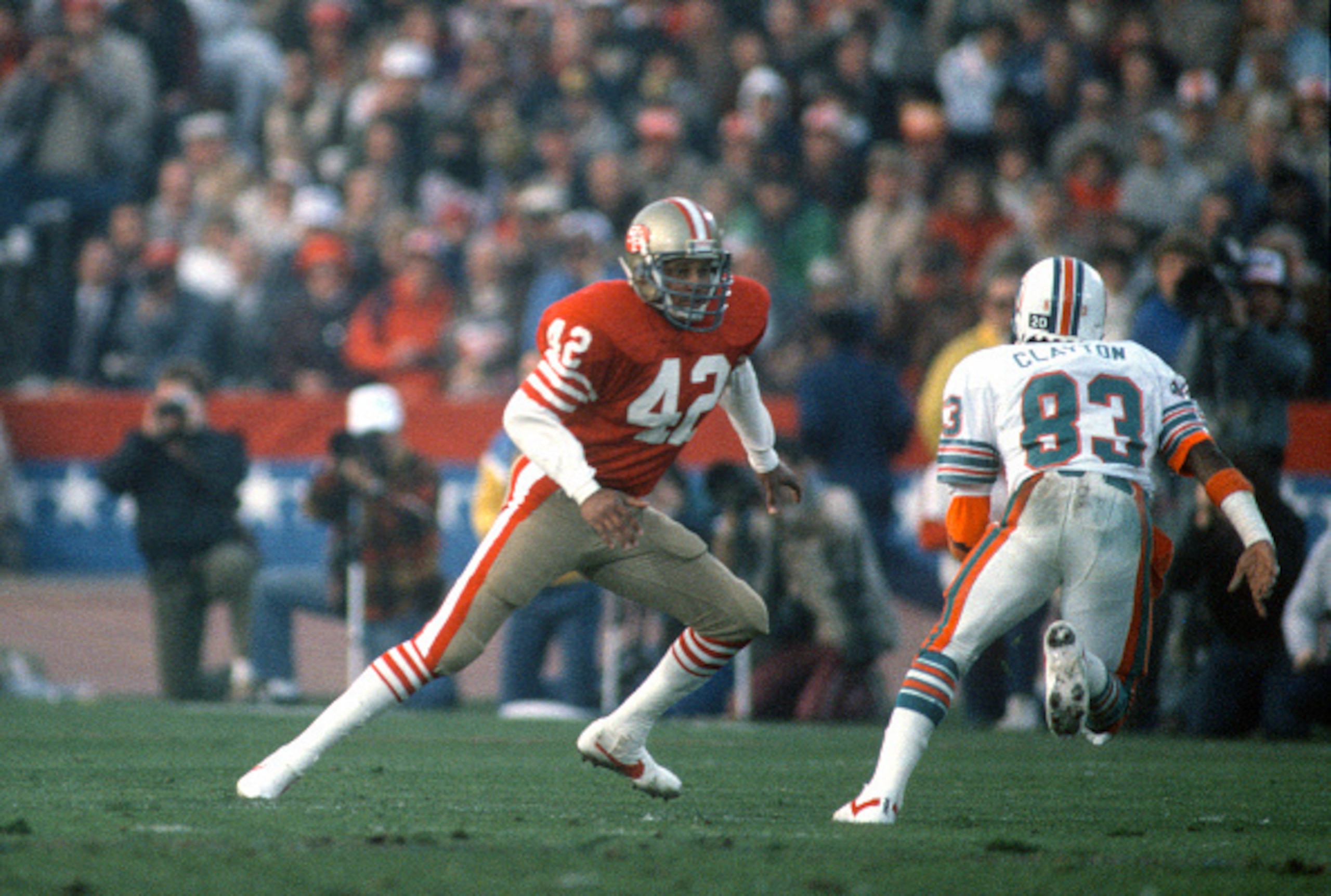
41: Terry Kirby (1996-1998)
I was tempted to put Antoine Bethea here, but couldn’t justify doing it after just one season. If he duplicates his performance from 2014, he’ll take this slot hands down. Until then, we’re giving it to Kirby, who gained 1,237 yards as a runner in the late ‘90s for the franchise, serving mostly as a change of pace for Garrison Hearst.
42: Ronnie Lott (1981-1990)
Another retired number and the greatest defensive back in franchise history. Lott’s accolades need no introduction. He’s the franchise leader with 51 interceptions. He was named first-team All-Pro five times, both as a cornerback and a free safety. He made the Pro Bowl in nine out of his 10 seasons, missing only 1985. He was the soul and leader of the 49ers’ underrated defenses in the ‘80s. He continued to play after amputating the top of his finger. A legend.
43: Jim Cason (1948-1954)
We have to go back to the AAFC to find the best 43, and he was actually wearing No. 93 at the time, but you take what you can get on a number with some slim pickings. Cason was a two-time Pro Bowler at safety, single-wing halfback and punt returner in the infancy of the franchise. Cason led the AAFC in 1949 with nine interceptions, totaling 25 in his 49ers career. He also totaled 2,521 all-purpose yards, mostly as a returner.
44: Bruce Taylor (1970-1977)
A lot of people will pick Tom Rathman, the hard-nosed fullback from the glory days in the late ‘80s and early ‘90s, and it’s hard to argue too strenuously with that pick. Instead, however, I’ll go with the Pro Bowl cornerback and returnman from the early ‘70s in Taylor—Rathman never made a Pro Bowl. Eddie Dove, a safety from the early ‘60s, and John David Crow, a halfback from the late ‘60s, make this a fairly crowded number.
45: Johnny Strzyklaski (1946-1952)
When the going gets tough, the tough cheat—in that Stryzkalski only wore No. 45 for one season, but on a weak number, we’ll take it. An original 49er, Strzykalski had two seasons of phenomenally productive rushing, leading the AAFC in yards per carry in both 1947 and 1948. Then Joe Perry, future Hall of Famer, arrived, and Strzyklaski converted to more of a blocking player, excelling there, too. He wasn’t just a product of the weaker AAFC, either—he made a Pro Bowl in the NFL in 1950 when the 49ers moved into that league.
Nos. 46-50
5 of 5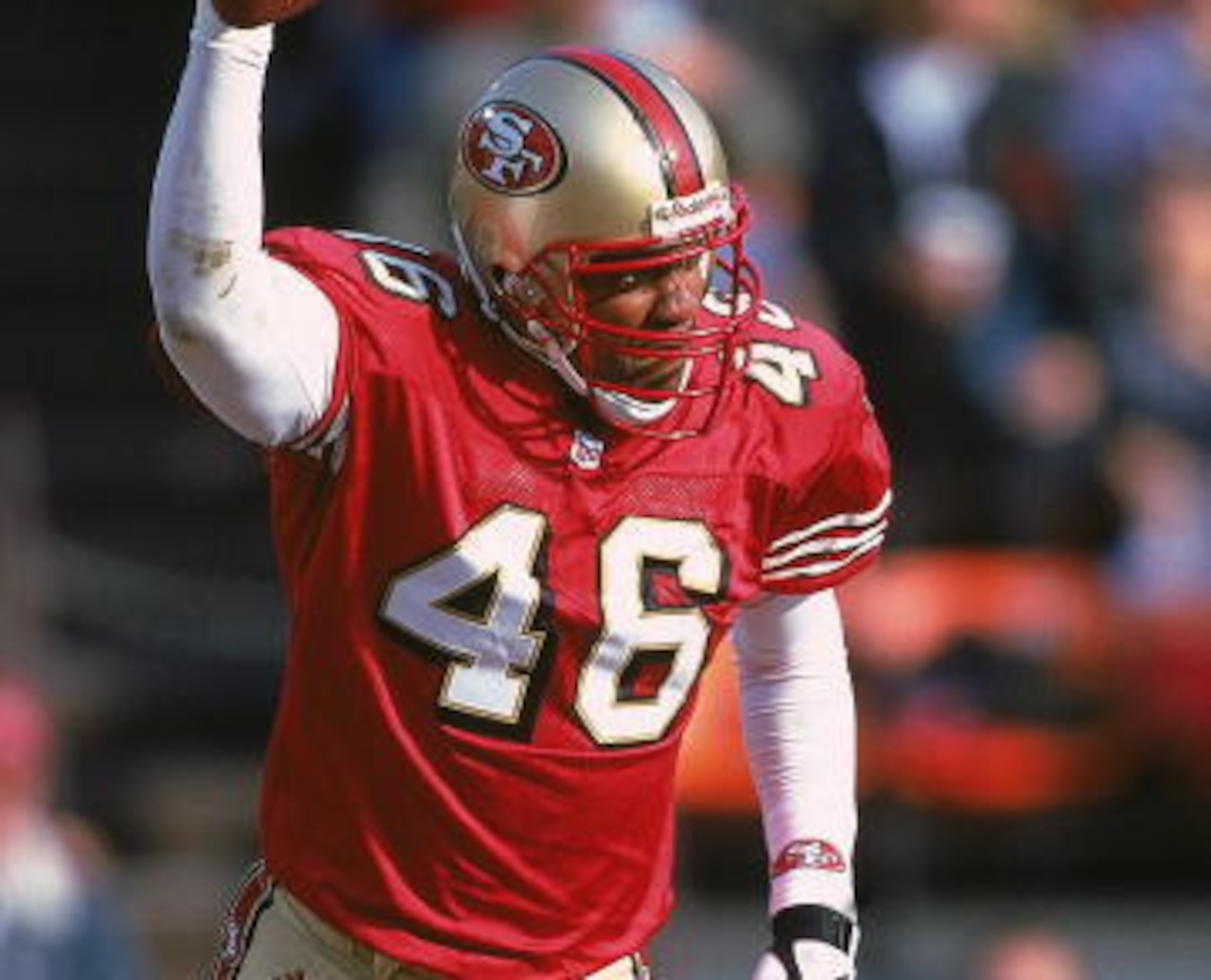
46: Tim McDonald (1993-1999)
McDonald split his career between the Phoenix Cardinals and the 49ers, but it was in San Francisco that he won his Super Bowl ring. Playing strong safety for seven years, McDonald was one of the top tacklers at his position, recording 469 solo tackles in San Francisco, sixth all-time (according to the collection of official and unofficial numbers on Pro Football Reference). McDonald and Merton Hanks are up there with any safety duo in franchise history.
47: Dicky Moegle (1955-1959)
The 49ers really haven’t ever had a truly outstanding No. 47, so Marcus Cromartie, this may be your time to shine! Until someone really stakes a claim, we’re going with Moegle, a safety from the 1950s. He made the Pro Bowl as a rookie in 1955 and finished his 49ers career with 20 interceptions. Ed Henke is worth a note here as well, though he also wore Nos. 75 and 89 and will show up later on this countdown.
48: Sammy Johnson (1974-1976)
Can I count Aldon Smith, who wore No. 48 in his rookie training camp and preseason before switching to 99? No? Can I count Busta Anderson or Shayne Skov, both of whom are wearing number 48 at the moment as they’re trying to make a roster? No? Fine, I’ll take Johnson, who had 809 yards from scrimmage in two-and-a-half years on the team. It’s him or John Woitt, who had an interception return for a touchdown in 1969. These are some slim pickings.
49: Earl Cooper (1980-1986)
It feels like 49 should be passed down from legend to legend, with whoever has had a long, productive career with the 49ers donning the jersey—so, for example, Joe Montana handing the jersey to Jerry Rice and then to Bryant Young and Patrick Willis and now Joe Staley, I suppose. Little things like “the rulebook” and “attachment to one’s original number” prevent that from happening. Bruce Miller as a great blocking fullback is a popular choice here, but I’ll go with Cooper, a fullback and tight end from the early ‘80s. He never quite matched his rookie season totals of 83 receptions and 1,287 yards from scrimmage, but he was useful for many years. Ralph McGill and Jeff Fuller, safeties from the ‘70s and ‘80s, respectively, get honorable mention nods.
50: Riki Ellison (1983-1988)
Some really good competition at this number! Ellison was a very strong middle linebacker for the team, with three Super Bowl rings, but he’s far from the only linebacker to excel in this number. Ed Beard, Dave Washington, Gary Plummer and Derek Smith also put up very solid numbers in the jersey. None particularly jump out over another as the absolute best, so I’m counting rings—it’s a fairly solid tiebreaker.
Bryan Knowles is a featured columnist for Bleacher Report, covering the San Francisco 49ers. Follow him @BryKno on twitter.
.jpg?w=2560 "Commanders Cowboys Football")

.jpg?w=2560 "WWE Raw Live Grades 🔠")

.jpg?w=2560 "🚨 Puka Out for MNF")