

Real Madrid's Midfield Remains a Question Mark Heading into the 2015-16 Season
It was a Sunday in the Spanish capital, Real Madrid were basking in Clasico triumph and splashed across Marca's front page were Toni Kroos, Luka Modric, James Rodriguez and Isco. "'Los Blancos' get a makeover," the Madrid-based daily declared, hailing the impact of a new-look midfield quartet that had helped to butcher Barcelona 3-1 at the Bernabeu.
Theoretically, it was a central ensemble that shouldn't have worked; four playmakers, four No. 10s essentially, combining in the same midfield. Barcelona's passage through them should have been pain-free. But, somehow, it wasn't. The seemingly one-dimensional quartet did work. Like, really work. So much so that when it came time for Real Madrid's visit to the Camp Nou in March, Marca was calling for more of the same: "A classic 4-4-2, Real's best shot vs Barca," it declared unequivocally. Had Madrid stumbled upon a utopian midfield balance?

Many of us thought so, but many of us also possess short memories. Eight weeks prior to the first Clasico of last season, that same quartet had themselves been butchered. By Real Sociedad, of all sides.
Admittedly, funny things happened at the Anoeta last season: Real Madrid, Barcelona and Atletico Madrid all lost there; Ruben Rochina scored from halfway there; Kiko Casilla had a brain fart there; a Scotsman unsuccessfully attempted to speak Spanish there. But Real Madrid's trip to the Anoeta showed them a reality that, ultimately, they only ever temporarily escaped: You can't just attack.
Three months before that, of course, Real Madrid had captured the European Cup to conclude a campaign featuring a midfield three of complementary contrast: Xabi Alonso, Angel Di Maria and Modric. Thus, in two straight seasons, Real Madrid have identified two markedly different midfield sweet spots—one needlessly discarded; the other majestic but defensively flawed.
Now, another "makeover" is necessary.

Such a process in 2015-16 will transpire under a new boss, using a new formation, carrying new ideas. For Rafa Benitez the positional options are infinite. At his disposal for now are Modric, Kroos, Rodriguez, Isco, Casemiro, Asier Illarramendi, Lucas Silva, Cristiano Ronaldo, Gareth Bale, Jese, Lucas Vazquez and Denis Cheryshev. The latter five represent midfield options if you consider the wide attacking berths of Benitez's characteristic 4-2-3-1 as midfield posts.
Yet, despite the abundance of talent and the limitless possibilities such a bunch provide, definitive answers seem scarce at the Bernabeu. "Don't worry, we're just getting started," was Benitez's message after a flat pre-season opening against AS Roma in Melbourne, a match in which more than 20 Real Madrid players were used but in which few seemed to look comfortable with the Madrilenian's instructions.
Marca has described Benitez's primary focus as "The 10-metre rule," the new boss demanding less space between lines and greater defensive attentiveness across each. It's an approach that's totally logical: The difference between Barcelona and Real Madrid last season was not Lionel Messi, Luis Suarez or Neymar; it was the art of systematic defending from front to back. Just go and check the goals-against column. Or any number of numerical indicators.
The issue for Benitez, though, is that the composition of his midfield—and, therefore, the setting of the side's balance—can't be configured and settled upon until the whereabouts of Ronaldo, Bale and Benzema are sorted in his formation. Essentially, he has to build his team in reverse.

In a chilly Melbourne, he deployed Bale down the middle in the hole behind the striker, prompting Marca's headline: "Built around Bale." Afterwards, Benitez said of the Welshman: "It's not an experiment and I think that it's an interesting possibility for other games if he likes it there." Though the move wasn't entirely successful, the thinking behind it was encouraging, Benitez exhibiting a willingness to be flexible to coax the best out of a unique, natural beast.
Following a difficult season, Bale's case is undoubtedly the most intriguing heading into 2015-16. He needs space, freedom. An athlete, a creature of dynamism and power, he needs a role defined by instinct, not strict rules. That might be down the middle; it might be down the left; it could be up front. Who knows. Not even Benitez does yet.
Ronaldo's case is also curious. He still covets the freedom of the left, but is increasingly operating like a No. 9. Thus, he poses a number of questions: If he starts on the left, does his drifting toward the centre of the attack demand too much from Marcelo at left-back, stretching the back four and rendering the system's defensive principles void? But, if he starts up front as a No. 9, are you then unsettling the club's top dog?
Benzema, however, would appear to be the least problematic of the trio. Not needing a kick-start, not going through a period of evolution, his skills well understood, the Frenchman is capable of adapting to the needs of the other two. If Benitez continues with Bale centrally and Ronaldo on the left, Benzema will simply carry on up front. If the Portuguese is repositioned at the head of the attack, clearing the left for Bale, Benzema has the capacity to sit behind the Ballon d'Or winner, given his skill set is that of a central fulcrum. Indeed, you could call him an oversized No. 10 wearing a No. 9 shirt.
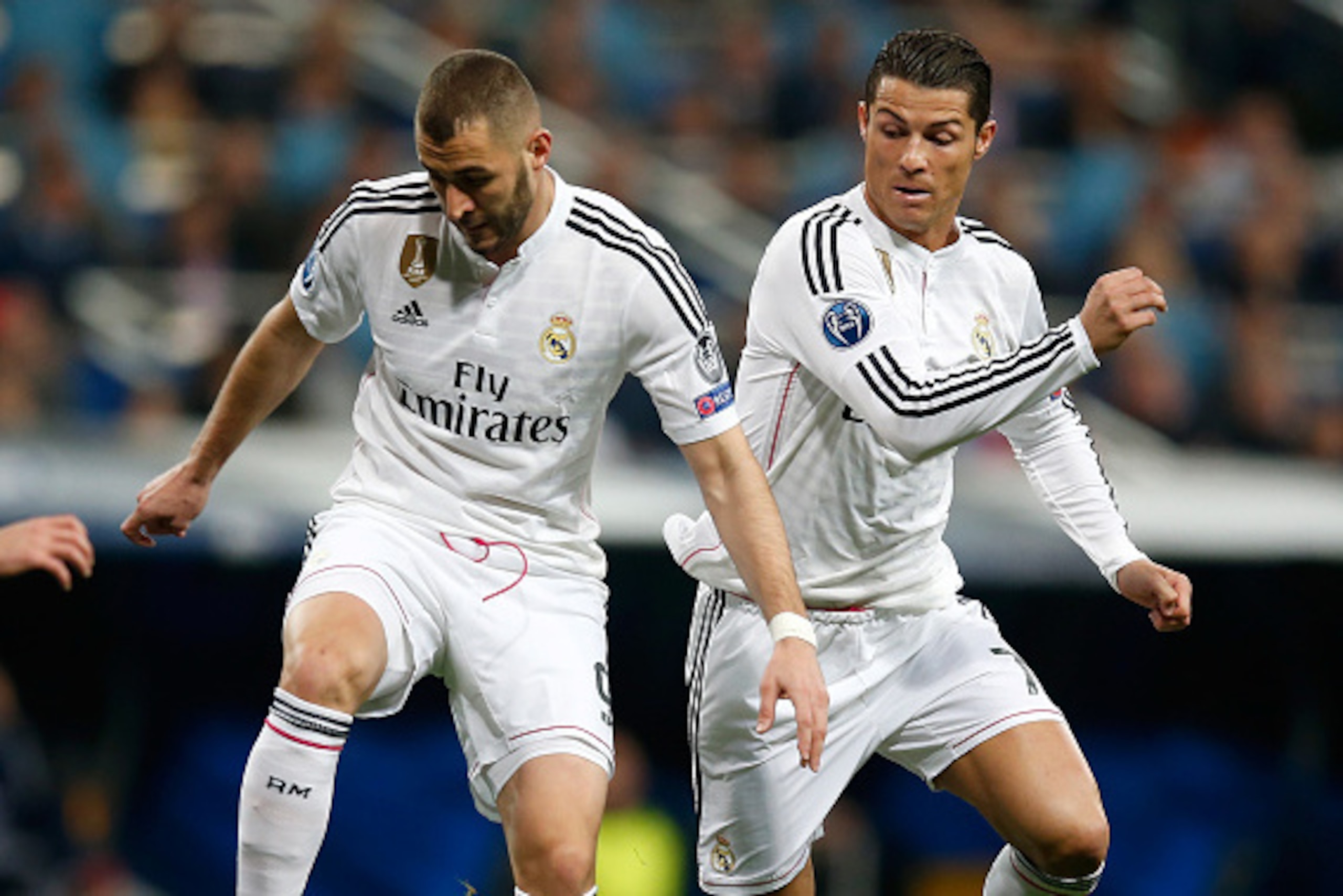
Naturally, these possibilities, these questions surrounding the Real Madrid's "BBC" may seem detached from the issue of Real Madrid's midfield. But they're not: Real Madrid's squad is forward-centric; the composition of the whole lineup is dependent upon, and worked around, the all-powerful front three.
It's similar over in Catalonia at Barcelona, but with one major difference: The clarity or certainty over the positioning of Messi, Suarez and Neymar means the construction of an obvious, first-choice midfield has become straightforward.
But that's not the case in the capital. Answers are still being sought, riddles still being deciphered. So far only Modric and Kroos appear to have settled positions in Real Madrid's midfield, Marca labelling the Croatian and the German as "Benitez's centrepieces" and the "first pieces that seem set in stone." The pair will almost certainly fill the midfield pivot in Benitez's 4-2-3-1, but the three positions in the next line ahead of them could witness a state of flux throughout the opening half of 2015-16.
Rodriguez will undoubtedly be a leading player floating across that line. Behind him, Isco will be pushing to do the same. In such circumstances the duo's versatility, their adaptability, will be a major asset they're going to need.
For when you ponder the exact composition of Real Madrid's strongest midfield heading into next season, definitive answers are difficult to find. Each supposed solution brings with it another question—questions that will persist while the whole central cast undergoes another "makeover."
.jpg?w=2560 "49ers Giants Football")

.jpg?w=2560 "Ertz Returning to Eagles")
.jpg?w=2560 "WWE Raw Live Grades 🔠")
.jpg?w=2560 "Dak Addresses 'Dumb' Old Romo Tweet 🤣")

.jpg?w=2560 "Follow Raw As It Happens 👊")