J.J. Watt Is NFL's Best Player, but Not Its Most Important
In early July, for the first time since the NFL Network started taking annual player polls on the topic in 2011, a defender was chosen as the best player in the NFL.
It probably goes without saying that the defender in question is Houston Texans defensive end J.J. Watt, who only four years into his career has won two Defensive Player of the Year awards and has been a first-team All-Pro three times.
Last week, Bleacher Report's Matt Miller reinforced Watt's claim to said throne by also calling the 26-year-old the league's best player.
.jpg?w=2560 "Texans Titans Football")
.jpg?w=2560)
.jpg?w=2560 "Cardinals Giants Football")
But statistically, we're coming off the two most pass-happy seasons in NFL history. And when it comes to points per game, the last five seasons rank first, second, third, fourth and fifth within the Super Bowl era:
| 1. 2013 | 46.8 |
| 2. 2012 | 45.6 |
| 3. 2014 | 45.2 |
| 4. 2011 | 44.4 |
| 5. 2010 | 44.0 |
With that in mind, and when you consider that active quarterbacks like 2014 MVP Aaron Rodgers, 2014 Super Bowl MVP Tom Brady, 2013 MVP Peyton Manning and 2014 co-passing-yardage leaders Drew Brees and Ben Roethlisberger are all potential Hall of Famers, it becomes hard for some to agree with the notion that any defensive player could be considered the best.
A retort, for example, from B/R veteran Mike Freeman:
"The problem with calling Watt the top NFL player, though, is that the NFL is a passing league, and in a passing league, there's no way Aaron Rodgers and Tom Brady aren't Nos. 1 and 2. Rodgers, to me, is clearly the best player in the sport. Brady, to me, is second. This is almost indisputable.
Then Watt at third. Putting him behind two future Hall of Fame quarterbacks is no insult. It's a reflection of the times. If Watt played when [Reggie] White played, when defenses were allowed to have more of an impact, his presence at No. 1 would be more justified. But not now.
"
“I think Aaron definitely deserved it,” said Watt, regarding the debate about the No. 1 spot on NFL Network's list, per USA Today's Nate Davis. “I think there’s a reason he won the MVP.”
But we must carefully consider that acronym. MVP stands for most valuable player, which truly is not the same thing as best player. The MVP doesn't have to be the league's best player, and the league's best player doesn't have to be the MVP.
On the surface you'd expect them to be one and the same, but that's a fallacy. A company's CEO isn't always its best employee, and top-grossing films, shows and performing acts are actually quite rarely those that receive the best reviews.
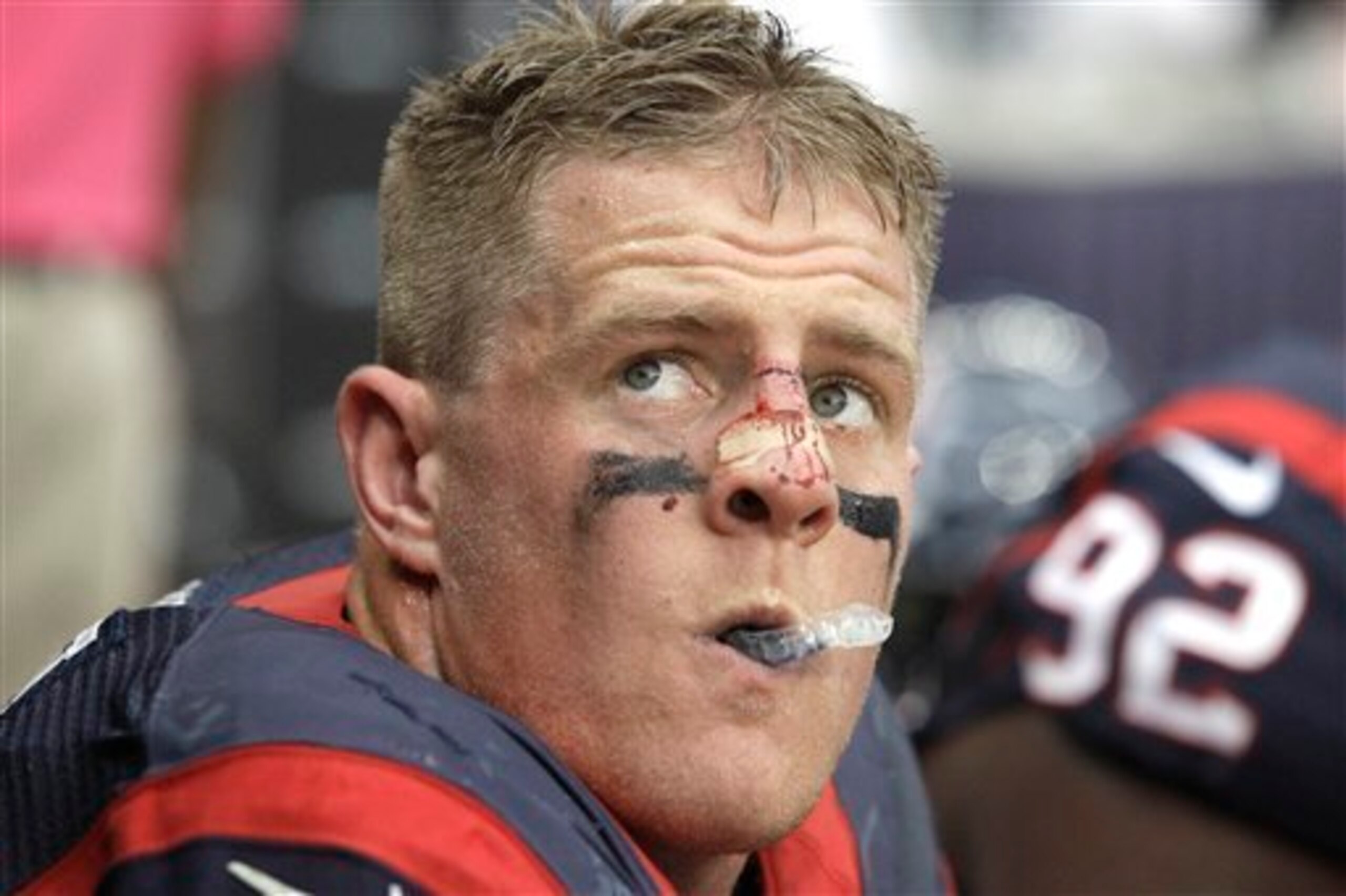
And no, Watt is not the NFL's most valuable player. No chance. It doesn't matter that he has 51.5 sacks in a three-year span and that his Pro Football Focus grade in 2014 was more than twice as high as every other player in the NFL except two.
Watt is not the league's most valuable player, because despite all the individual accolades above, the Texans have won just 11 total games the past two seasons and haven't been to the playoffs since 2012.
In 2014, six defenses still gave up fewer points than the Texans, who ranked 16th overall.
We don't know with certainty that Houston would be substantially worse without Watt, but the very fact that he's dominating like no other player in the game and yet his team is still falling short of the playoffs indicates he isn't the most valuable player in football.
This isn't an easy thing to quantify, but we can use statistics from Advanced Football Analytics to get a more tangible feel for how much more valuable good quarterbacks are than even great defensive ends.
Advanced Football Analytics measures every player's impact on a per-play basis by establishing just how often they make plays that either increase their team's win probability (WPA, or win probability added) or their expected points (EPA, or expected points added).
In both areas, Watt ranks outside of the top five:
| 1. Aaron Rodgers | 5.16 |
| 2. Tony Romo | 4.18 |
| 3. Ben Roethlisberger | 4.05 |
| 4. Peyton Manning | 4.00 |
| 5. Matthew Stafford | 3.58 |
| 6. J.J. Watt | 3.32 |
| 7. Philip Rivers | 3.25 |
| 8. Eli Manning | 3.17 |
| 9. Matt Ryan | 2.92 |
| 10. Drew Brees | 2.81 |
| 11. Tom Brady | 2.79 |
| 12. Russell Wilson | 2.68 |
You'll notice that he's surrounded only by quarterbacks in both cases:
| 1. Aaron Rodgers | 212.8 |
| 2. Ben Roethlisberger | 161.5 |
| 3. Tony Romo | 144.9 |
| 4. Drew Brees | 137.2 |
| 5. Peyton Manning | 135.6 |
| 6. Tom Brady | 132.2 |
| 7. Joe Flacco | 118.4 |
| 8. J.J. Watt | 117.7 |
| 9. Andrew Luck | 110.0 |
| 10. Philip Rivers | 109.0 |
| 11. Matt Ryan | 107.6 |
| 12. Russell Wilson | 97.7 |
Late last season, Scott Kacsmar from Football Outsiders summarized it well:
"We’ve seen the Texans lose 14 games in a row with Watt playing at a high level. We’ve seen them allow 40+ points in games he shined. He’s a great player. He’s running away with DPOY. Maybe he should get more red-zone snaps at tight end. He’s just not MVP material when his impact on the game is so minimal compared to the quarterback position where several great players are having incredible seasons.
"
It's not Watt's fault that he's a defensive end rather than a quarterback, but at the risk of being extreme I'll point out that the world's best screenwriters don't get close to as much love and attention as the world's best actors.
That might also help explain why, according to Spotrac, 13 quarterbacks have higher average annual salaries than Watt.

The first obvious sign that Watt is, in fact, the NFL's best player is that he's the only non-quarterback on either of those lists above. Nobody will dispute that the gap between the best quarterback and the second-best quarterback in football is minuscule in comparison to the gap between Watt and anyone else who plays defense, let alone defensive end.
It's just amazing, really. As a 3-4 defensive end, he faces far tougher challenges as a pass-rusher than a 4-3 end or a 3-4 outside linebacker, and yet he's already the only player in NFL history with two 20-sack seasons.
Dating back to the start of 2012, nobody's even close to him when it comes to sacks:
| 1. J.J. Watt | 51.5 |
| 2. Justin Houston | 43 |
| 3. Robert Quinn | 40 |
| 4. Mario Williams | 38 |
| 5. Elvis Dumervil, Von Miller | 37.5 |
And that explains why he blows out the rest of the league when it comes to PFF grades:
| 1. J.J. Watt | 304.7 |
| 2. Von Miller | 190.0 |
| 3. Evan Mathis | 128.6 |
| 4. Peyton Manning | 120.9 |
| 5. Aaron Rodgers | 115.7 |
| 6. Cameron Wake | 108.3 |
| 7. Drew Brees | 107.4 |
| 8. Geno Atkins | 107.2 |
| 9. Justin Houston | 102.9 |
| 10. Gerald McCoy | 102.7 |
That's why Watt became the first unanimous choice as Defensive Player of the Year, why he became the first defensive player in six years to receive MVP votes and why he deserves to be considered the game's best player despite the fact he may never deserve an MVP award.
Brad Gagnon has covered the NFL for Bleacher Report since 2012.
.jpg?w=2560 "Broncos Chargers Football")
.jpg?w=2560 "MHJ Bought Own Jugs Machine")