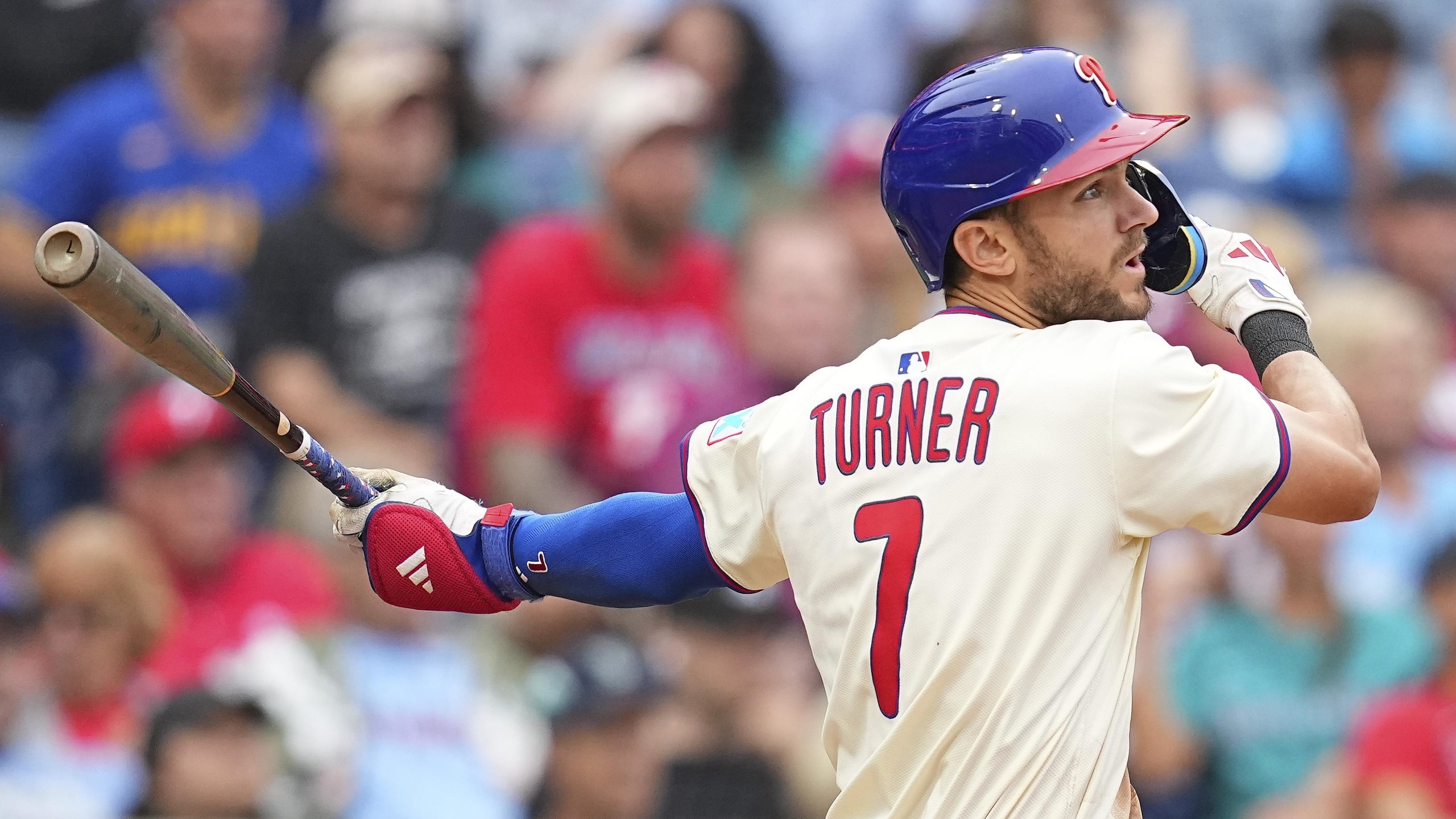


Trea Turner is threatening to make history as the worst batting champion in Major League Baseball history, and the only question that matters is: Who cares?
Turner has "only" a .301 batting average to lead all National League hitters. He's on track to tie the lowest ever mark by a batting champion, set by Carl Yastrzemski in 1968.
It wouldn't be surprising if Turner finished in the .200s and still won the NL batting title. He has spent the better part of the year batting in the .200s, and his closest pursuer (Sal Frelick) is hitting .298.
TOP NEWS

Brewers Closer Blasts Tropicana Field Roof

Latest MLB Trade Rumors 👂
Best Fits for Cubs' Star FAs 🧩
Are we watching infamy unfold in real time? Or are we merely hearing the death knell for batting average as a useful barometer for hitting?
For the Record, This Is Not a New Debate
It feels a little surreal to still be talking about how much batting average matters.
This conversation is straight out of the early 2010s, specifically around the time when a Trojan War was being waged between traditional-minded statheads and those who preferred newfangled approaches. Mike Trout and Miguel Cabrera were Achilles and Hector in this saga. It was a whole thing.
Yet here we are. Or at least, here I think we are after Jon Heyman of the New York Post mused about batting average a few weeks ago and was met with thousands of engagements, hundreds of comments and at least one YouTube video from a former player:
This was (and still is!) an interesting observation that passed the fact-check test. And even now, the top three team leaders for batting average are still in first place.
Yet the implication that batting average only recently became suspect is, well, suspect.
Maybe the debate didn't truly get nasty until Mike vs. Miggy, but you can look back as far as 1919 and see some skepticism as to whether batting average was really the best measuring stick for batting proficiency. Here's the New York Times remarking on that year's juxtaposition of Ty Cobb and all his hits and Babe Ruth and all his extra-base hits:
"The usual glitter of Ty Cobb's high batting average at the head of the American League clouters is somewhat subdued in the 1919 official averages by the remarkable batting outburst of Babe Ruth of Boston ... The Georgia Gem is perched on the top of the batting list, with an average of .384, and while Ruth's average is but .322, his destruction with extra base drives stands out prominent as the greatest batting accomplishment of years. His figure for total bases was 284."
The writer's sense that Ruth was at least as valuable as Cobb despite a 62-point disadvantage in batting average looks well-founded in retrospect. Ruth crushed Cobb not just in home runs (29 to 1) and total bases (284 to 256), but in on-base percentage (.456 to .428) and WAR (9.9 to 5.5).
This leaves one of two possibilities: Either that writer was a time traveler from the future who avoided revealing all that he knew for fear of being accused of witchcraft, or the change in the winds brought on by Ruth was just that obvious.
As baseball has now been living in the world that Ruth built — one in which the home run is king and doubles and triples are lesser nobles — for over 100 years, one tends to think it was the latter.
Batting Average Still Tells Us a Lot...But Also Not Enough
All that said, it should be possible to take a nuanced position between "Batting average is the only thing that matters!" and "Batting average is [bleeping] useless."
Hitters are meant to hit the ball, and batting average is an effective measure of how well they do so. If they hit what they swing at, well, that's just good hitting.
Even now, though, there are still a number of Cobb vs. Ruth comparisons that don't reflect well on batting average. In fact, here's one:
Player A: .285 AVG, 0.7 WAR
Player B: .285 AVG, 5.4 WAR
Player A is Luis Arraez, who still has an outside chance at a fourth straight batting title even if his average is down from .314 last year. And he really is the platonic ideal of a hitter who hits what he swings at, as he leads the league at making contact and putting balls in play.
Player B, though, is Geraldo Perdomo. He has 10 home runs and 55 walks on Arraez, and those alone do a lot to explain the value gap between the two. Throw in how Perdomo has also stolen 15 more bases and, unlike Arraez, is actually useful on defense, and the fact that they have the same average feels like a mere footnote.
This is all basic stuff by now, and signs that batting average is past its prime influence are prevalent both inside and outside MLB's boundaries.
On the inside, Juan Soto and Shohei Ohtani have $700 million contracts despite the fact that each is exactly a .281 career hitter. And on the outside, Cal Raleigh and Kyle Schwarber are both hearing "MVP!" chants even though they're hitting in the .240s.
A New 'Batting Champion' Standard Is Needed
The other reason for everyone to ditch batting average as the default measuring stick for hitters: The gold standard is dead.
Though ".300 hitter" still works as a shorthand for an outstanding hitter, that description maps onto fewer hitters every year. Whereas the number of .300 hitters once reached triple digits in 1929, barely that many have done so in the last eight seasons combined.
The league-wide batting average dipped under .250 back in 2018 and has yet to climb back over. The league made a noble effort to nudge batting average back in the right direction with new rules in 2023, but the average hitter still hasn't climbed out of the .240s.
Even if it doesn't happen this year, a batting champion with a .200-something average feels inevitable. And even if everyone recognizes it as a sign of the times, ".290 hitter" just doesn't have the same ring to it as a shorthand.
Still, let's recognize the opportunity before MLB. Namely, one to retire batting average as the default for each year's "batting champion" and replace it with a stat that gets the point across better.
On-base percentage (OBP) is the most obvious pick. Because it counts walks and hit-by-pitches, it does a better job than batting average of capturing how tough an out a given batter is.
The best candidate on merit is weighted on-base average (wOBA), which is a version of OBP that accounts for how a hitter reached base. It weighs extra-base hits more heavily than singles, as they should be.
The latter is a bit too esoteric for mass consumption, however. And while the former is more straightforward, there's inherently something awkward about looping in BBs and HBPs into a discussion meant to be about hitting.
So, how about the stat that even the guy from 1919 intuited was a useful catch-all: Total bases.
It's easy to understand as a counting stat that gives hitters one point for a single, two for a double, three for a triple and four for a home run. As proof of concept, the leaders for the last five years mostly read like a who's who of the best of the best:
- 2021: Vladimir Guerrero Jr. (363) and Trea Turner (319)
- 2022: Aaron Judge (391) and Austin Riley (325)
- 2023: Shohei Ohtani (325) and Ronald Acuña Jr. (383)
- 2024: Aaron Judge (392) and Shohei Ohtani (411)
- 2025: Aaron Judge (310) and Shohei Ohtani (311)
This list hits harder than the one for the official batting champions for the last five years, which includes such "Oh yeah, totally forgot about that" luminaries as Yuli Gurriel, Jeff McNeil and Yandy Díaz.
Of course, sitting here and pondering such a big change is different from expecting MLB to actually make it happen. Given its place in history, to decommission batting average would be akin to the U.S. government throwing a big ol' sheet over the Statue of Liberty.
Nonetheless, why anyone is still bothering with batting average is already a good question. And at this rate, it doesn't seem likely to reclaim its former relevance anytime soon.
Stats courtesy of Baseball Reference, FanGraphs and Baseball Savant.


.jpg?w=2560 "Raiders Could Start Mendoza")



.jpg?w=2560 "Rodgers Iced Out on Plane 💎")
.jpg?w=2560 "🚨 Week 8 AP Top 25 Poll")
.jpg?w=2560 "Packers Safety Slams Refs 🤬")