Bayern Munich Complete Identity Change with Sale of Hometown Hero Schweinsteiger
Bastian Schweinsteiger's transfer saga finally came to an end on Saturday when, after months of speculation about whether he would pen a new deal with Bayern Munich, run out his contract or leave for a new challenge, it was announced that the 30-year-old would leave his hometown club for Manchester United.
Speaking to reporters at the 2015-16 squad's unveiling on Saturday, CEO Karl-Heinz Rummenigge confirmed (h/t Goal) the deal. Goal reported the player will receive a €13 million annual salary for the duration of his three-year contract and a €5.6 million signing-on fee. Bild broke the news late on Friday night, claiming Bayern would receive a transfer fee in the region of €18 to 20 million for the Germany captain.
TOP NEWS

Messi Picks Next Gen Talent 💫
Live World Football Goals and Highlights 🔥
5 Potential Replacements for Michael Carrick as Manchester United Manager Amid Rumors
In purely financial terms, Schweinsteiger's sale is a good deal for Bayern. To receive such a high transfer fee for an injury-prone player just weeks away from his 31st birthday, especially when he had just a year left on his contract, is a real windfall. He probably wouldn't have been a starter in a fully-fit Bayern side and certainly would not have played in his favored role as an anchoring midfielder.
Yet although Schweinsteiger's depature may not leave a big void on the pitch, his presence will be missed in the Allianz Arena dressing room and at the Sabener Strasse training ground. For years, he was a symbolic figure in the Bayern team, a local lad who rose through the ranks of the academy and was a role model for rising talents, as well as a figurehead for the club.
Although he was Philipp Lahm's deputy in the club's leadership structure, Schweinsteiger was above all others the symbol of Bayern Munich, a hard-nosed, powerful, Bavarian midfielder who poured emotion into his game.
In response to the news of Schweinsteiger's departure, Die Welt ran the headline: "Bastian Schweinsteiger: With this transfer, Bayern are selling their heart." It was perhaps somewhat dramatic, but it made a good point. Bayern have long been Germany's team, forming the core of the Nationalmannschaft from their squad.
Just a year ago, Germany began their World Cup campaign with six Bayern representatives in Joachim Low's starting lineup, including the captain Lahm and Schweinsteiger. The latter was the vocal leader of the team on the pitch, and his performance in the final was inspirational; the image of him bruised and bloodied as he left the pitch victorious is perhaps the defining image of the team's triumph.
Yet should Bayern complete the signing of Angel Di Maria this summer, Pep Guardiola may only have two Germany internationals, Manuel Neuer and Jerome Boateng, in his preferred starting lineup, neither of whom is a native Bavarian. Either way, Schweinsteiger has followed Toni Kroos out of the club, leaving only Neuer, Boateng, Mario Gotze and Thomas Muller as current Germany internationals in the squad.
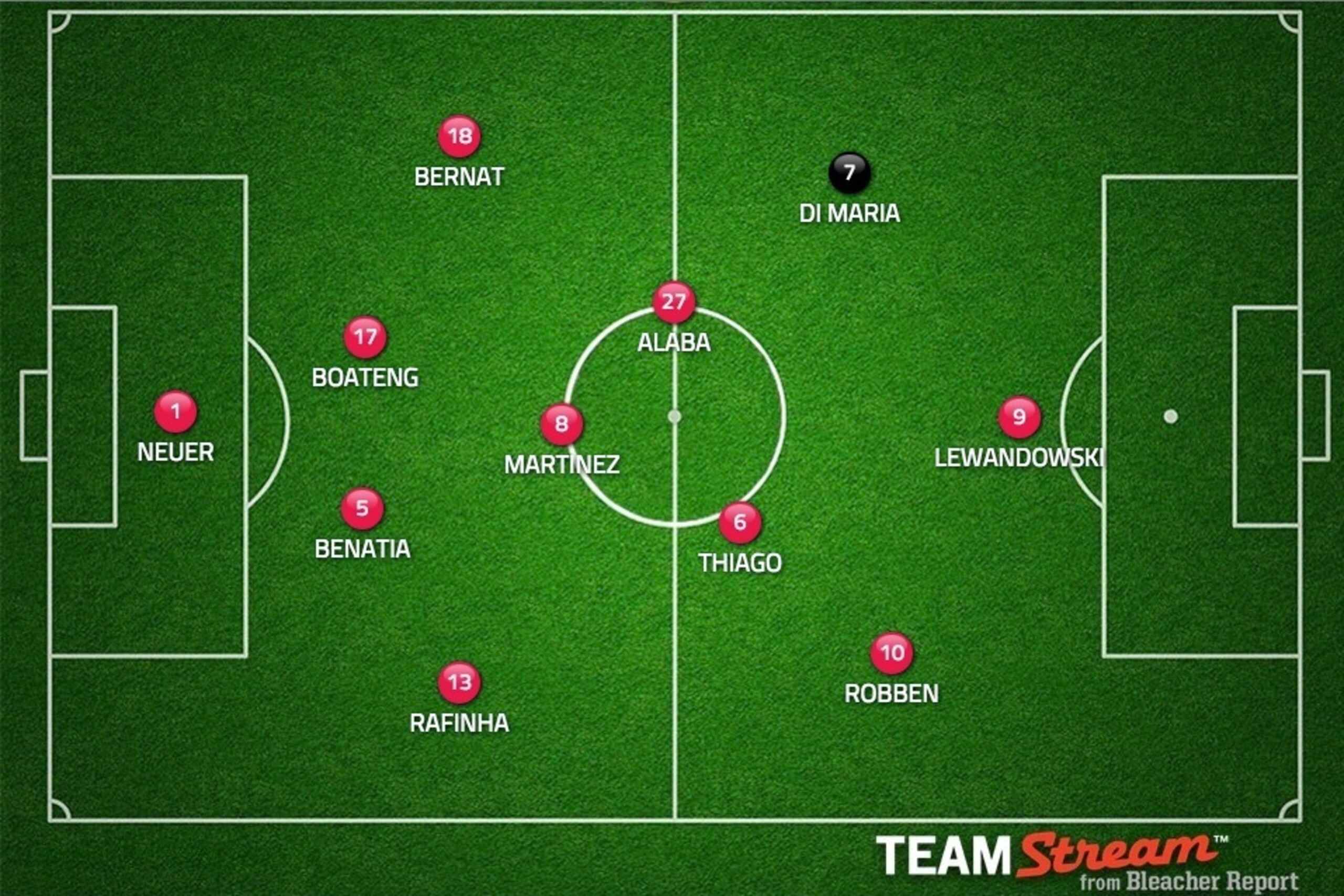
Bayern's decreasingly German and decreasingly Bavarian character has accelerated over the last couple years as, despite the Mannschaft's World Cup victory and the general rise of German football, Pep Guardiola has cultivated a contingent of his compatriots in the squad.
Other non-Germans such as David Alaba, Mehdi Benatia and Robert Lewandowski have become key players, all of whom can expect to be part of the team's core in the coming years. And although there are several quality German central midfielders in their youth ranks, the Dane Pierre-Emile Hojbjerg is the first in line.
Bayern are evolving now from Germany's team into a more international side in which citizenship doesn't really matter. Much like Barcelona leaving "Mes que un club" behind and ditching charity UNICEF's logo for a lucrative sponsorship with Qatar Airways, Bayern appear to be moving in a more pragmatic direction with less attachment to Munich and Bavaria.
Their coach is Spanish, their style of football is no longer in line with that which the German FA (DFB) has indoctrinated youngsters in recent years and their squad is largely foreign.

With Schweinsteiger's sale, Bayern have entered a new chapter in their history. The Germany captain's sale makes sense in terms of the money and squad development, but it remains to be seen how fans and players will react. Rightly or wrongly, many fans have already denounced the sale, claiming it would never have happened with Uli Hoeness as club president. And many are not comfortable with the Bavarian phrase and Bayern Munich motto "Mia san mia" ("we are who we are") being applied to a lineup that may not include even one native Bavarian.
It's not a given Schweinsteiger's now-former teammates will take his departure in stride. Via Goal, Lahm admitted "he will be missed," the two having played with one another since their youth. Manuel Neuer said it was "unusual" to be without Schweinsteiger when the team was presented. Jerome Boateng also weighed in: "I think we're all sad."
Such responses are understandable given the magnitude of Schweinsteiger's sale and should be of little concern on their own. If Bayern experience a poor start to the 2015-16 campaign, though, questions could soon arise as to whether the club is heading in the right direction.
The coming weeks will be critical as fans and the team adapts to the club's changing identity. On paper, Bayern will be fine without Schweinsteiger in terms of the starting lineup and substitutes. And their new-found pragmatism about not requiring a notably German or Bavarian identity does not limit their squad building. But at the same time, narrative has a value, and the pursuit of results without purpose or team ethos can be problematic. Just ask Real Madrid.
Time will tell whether Schweinsteiger's sale will bring more reward or troubles, but one thing is certain: With his departure, Bayern have completed their transformation from a distinctly Bavarian club to one less rooted in history and local culture. Effectively, the Bayern Munich days are over; the International Munich phase has just begun.
.jpg?w=2560 "Cam Ward Says He's Not A Loser")
.jpg?w=2560 "🚨 Texans Trade for MHJ")
.jpg?w=2560 "Grading MHJ Trade 📝")
.jpg?w=2560 "Chargers Fall to 0-5 🤢")

.jpg?w=2560 "MHJ Bought Own Jugs Machine")