New York Jets Defensive Position-by-Position Breakdown and Depth-Chart Analysis
The top of the New York Jets depth chart is easy to identify. If the starters haven't returned, then the new starters are most likely to be the high-profile free agents the team added this offseason.
The middle and bottom of the depth chart, however, is a little bit murkier.
Isn't that always how it works in New York? The starters provide concrete answers, while the backups leave major question marks. That sentence pretty much describes the entire Rex Ryan era in New York (with the exception of the last couple of years, where the starters and the backups were question marks).
With any luck, training-camp battles will help determine who finishes where on the depth chart, but right now, we already have a good idea of what most of the depth chart will look like, particularly on defense.
Defensive Line
1 of 5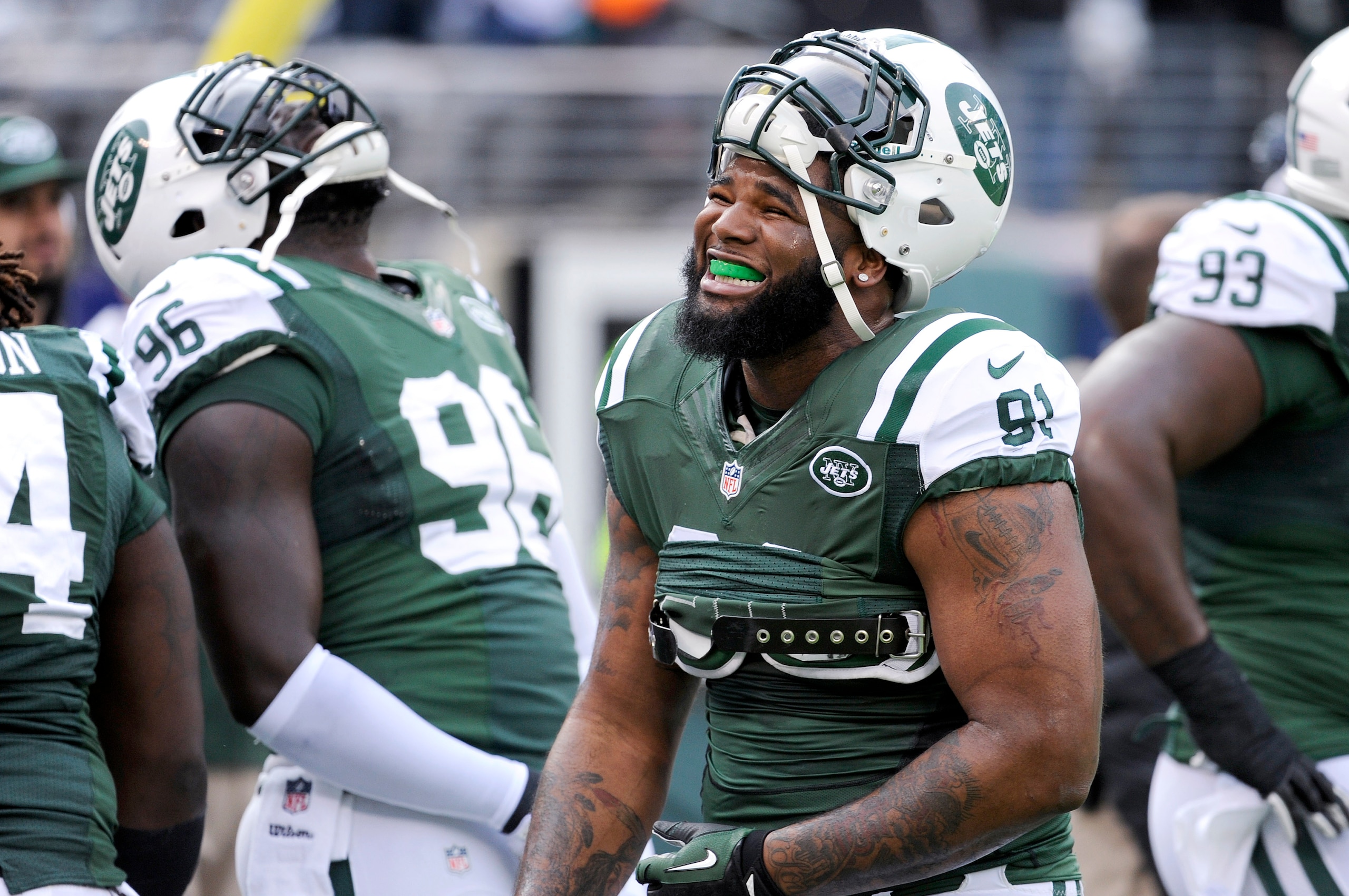
Starters: Muhammad Wilkerson, Sheldon Richardson, Damon Harrison
Backups: Leonard Williams, Stephen Bowen, Leger Douzable
The Jets have one of the most stacked defensive lines in the NFL. With three first-round picks up front, it's no secret why.
As we speak, Muhammad Wilkerson and the Jets are in a contractual dispute that's resulted in a standoff and a holdout. There's a good chance he will be back with the team, but he has a bit more leverage now that the league has suspended Sheldon Richardson for four games for violating the substance-abuse policy.
Wilkerson would be fined $30,000 per day if he holds out of training camp, but the Jets just can't risk going into the season without two of their starters up front. They have some depth, but no defensive line can withstand that kind of shortage.
Damon Harrison has developed from undrafted rookie into bona fide NFL starter, and at 6'4" and 350 pounds, he's a load and can hold his gaps with the best of any true 0-technique nose tackle in the NFL.
The absence of either Wilkerson or Richardson would put Leonard Williams in the spotlight as a Day 1 starter; as the sixth overall pick in the draft, he should be up to the challenge. Like any rookie, though, he would be better off if he had some time to get his feet wet.
Outside Linebacker
2 of 5
Starters: Quinton Coples, Lorenzo Mauldin
Backups: Deion Barnes, Julian Howsare, Trevor Reilly, Calvin Pace
The Jets have had a problem at outside linebacker for years. The primary source of that problem has been a shortage of young, athletic pass-rushers off the edge. With one third-round draft pick, that problem lingers no more.
Louisville outside linebacker Lorenzo Mauldin has experience as both a 3-4 outside linebacker and a 4-3 defensive end, and while he may not have the natural agility of an edge pass-rusher in a 3-4 (7.47-second three-cone drill at the 2015 Scouting Combine), he has great straight-line burst and a nonstop motor to beat tackles. He also has the requisite length at 6'4" with 33" arms.
Quinton Coples was not an immediate hit at outside linebacker even after being drafted in the first round in 2012, but he has become a more productive pass-rusher each year in the league, according to Pro Football Focus. He's also been learning a new position for the past two seasons after spending his college career and rookie season playing with his hand on the line as a true lineman.
The bigger question is how the depth chart will shake out behind Coples and Mauldin.
Calvin Pace has been a fixture in the Jets defense for the past seven seasons, and he has only missed eight games in that time. At 34 years old, though, it may be time for the Jets to move in a new direction. That's where undrafted rookies Deion Barnes and Julian Howsare come in. Both men have better traits (in terms of athleticism, burst, quickness, etc.) and way more long-term upside than Pace.
Reilly was a seventh-round pick from the previous regime, so his spot is far from guaranteed, but his burst as a pass-rusher and his special teams experience go a long way in helping him earn a spot.
Inside Linebacker
3 of 5
Starters: David Harris, Demario Davis
Backups: Jamari Lattimore, Taiwan Jones
For the third straight year, David Harris and Demario Davis will be the Jets' top two starting inside linebackers. Why mess with what's been working? The run defense (while mostly a product of the defensive line) has benefited from the two talented inside linebackers—Davis is the more athletic of the two, while Harris is the more physical.
Both men have been fully healthy for the past two years, and the Jets better hope it stays that way, because their depth is a little spotty. Jamari Lattimore provides some experience, having started multiple games in each of the past two seasons while serving mainly as a run-stopping linebacker with some pass-coverage responsibilities. His role on special teams should help him earn a spot on the roster.
Undrafted rookie Taiwan Jones bears the dubious distinction of a "run-thumper," and he's not going to be running from sideline to sideline or covering tight ends and running backs with a 4.95-second 40-yard dash. However, his lack of speed did not result in a lack of production in college, as he still notched 127 tackles in the past two seasons with 19.5 tackles for loss.
There may be a fifth spot for an inside linebacker, and if so, that spot will come down to veterans Erin Henderson and Joe Mays. The winner will likely be the one who shows the quickest learning curve in the defense and offers the most on special teams. If special teams is the determining factor, the spot should go to Mays.
.jpg?w=2560 "Texans Titans Football")
.jpg?w=2560)
.jpg?w=2560 "Cardinals Giants Football")
Cornerback
4 of 5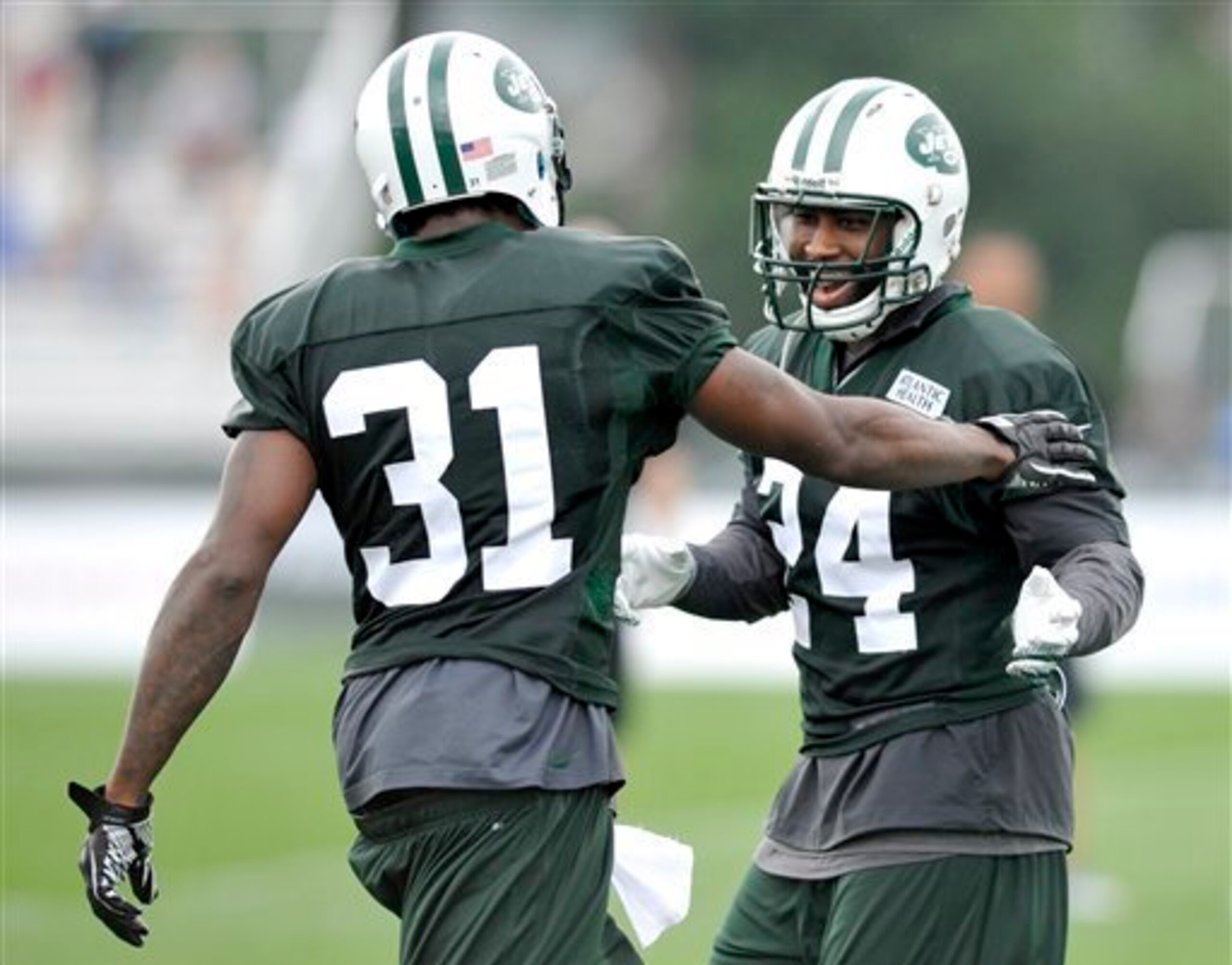
Starters: Darrelle Revis, Antonio Cromartie
Backups: Buster Skrine, Dee Milliner, Marcus Williams
Oh, what Rex Ryan would have given to be the head coach for the 2015 Jets defense. After the torturous 2014 season in which the Jets had next to no talent in the secondary and were forced to improvise, the defensive backfield now features two familiar faces in Darrelle Revis and Antonio Cromartie, along with a talented group of depth players to supplement the stars of the secondary.
After tearing his ACL in 2012 and playing in a zone scheme that was not a fit for his skill set in 2013, there were questions as to whether Revis would return to the same level of dominance he enjoyed with the Jets in the first six years of his career. He answered those questions with a resounding "yes" as Revis yielded only 51.9 percent completions on throws into his coverage in the regular season and allowed only two touchdowns while logging two interceptions and 11 pass breakups, according to PFF.
Cromartie was faced with similar questions after a down 2013 season that saw him become a salary-cap casualty in 2014. He redeemed himself with a strong 2014 season under Todd Bowles, who was the defensive coordinator for the Arizona Cardinals. Cromartie allowed 59.3 percent completions into his coverage, while allowing only two touchdowns with three interceptions and six pass breakups.
With those two back in the fold, the Jets can go right back to where they spent most of the Ryan era: running a man-coverage-heavy defensive scheme that relies on its cornerbacks to cover receivers all over the field.
That means the bull's-eye will be even greater on the backs of the likes of Buster Skrine, Dee Milliner and Marcus Williams, but all three have shown they are capable of holding their own in man coverage. Skrine has not achieved statistical greatness in the recent past, and although he allowed only 56.9 percent completions into his coverage, he gave up eight touchdowns with four interceptions. He is decidedly smaller than the average Jets cornerback at 5'9" and 186 pounds, so he must rely on smarts and athleticism to make plays in coverage.
This year could be a proving ground for Milliner, who may be on his last chance to prove his status as a first-round pick. He spent the 2014 season on injured reserve with a torn Achilles, which allowed Marcus Williams to step in after a few more cornerbacks went down with injuries. Williams' experience and Milliner's talent should earn them roster spots over other unproven cornerbacks.
Safety
5 of 5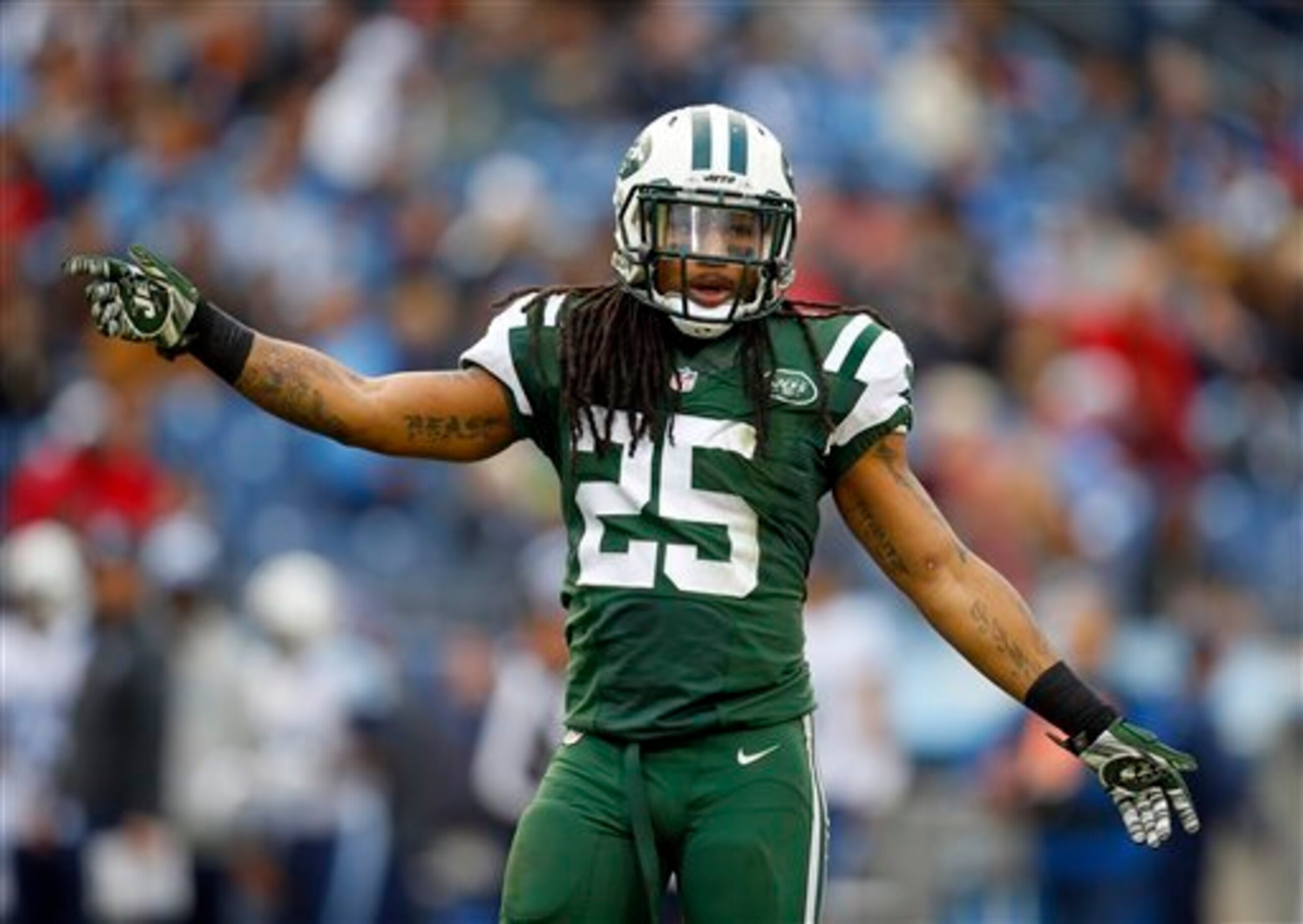
Starters: Marcus Gilchrist, Calvin Pryor
Backups: Antonio Allen, Jaiquawn Jarrett
We don't need to wonder who will be starting at safety. Head coach Todd Bowles put those questions to bed months ago when he said that Marcus Gilchrist would be manning the free safety spot while Calvin Pryor would be moving back to his more natural spot as a strong safety.
Pryor spent most of his rookie season as a free safety, not because it's where he fit best, but because it's where the team most desperately needed the help. The 2014 first-round pick was billed as a hard-hitting safety coming out of Louisville but was instead essentially neutered of his ability to deliver those big hits by the Jets putting him 15 to 20 yards away from the line of scrimmage.
The Jets suffered from an abundance of strong safeties and not enough free safeties last year, but they are hoping for different results despite a similar approach this year. Gilchrist has played all over the secondary, from cornerback to free safety to strong safety, but his coverage deficiencies make him a much better fit as a strong safety. He has spent the past two years at strong safety but will need to discover some sideline-to-sideline speed and ball skills to make the switch to free safety.
Antonio Allen is yet another strong safety who was miscast last year as a cornerback in part because the Jets lacked options at that position. They had hoped that his 6'1", 210-pound frame would be a weapon in rerouting receivers off the line of scrimmage, but his lack of polish in fundamentals came as no surprise seeing as the position was completely foreign to him. As a backup strong safety, though, Allen could thrive.
Jaiquawn Jarrett played mostly free safety for the Jets last year, and if things go disastrously in the Gilchrist experiment at free safety, Jarrett could see even more playing time than he got last year.
Unless otherwise noted, advanced stats provided by ProFootballFocus.com.
.jpg?w=2560 "Broncos Chargers Football")

.jpg?w=2560 "MHJ Bought Own Jugs Machine")