

Highlighting the Best Small-School Prospect at Every Position in 2015 NFL Draft
While the majority of NFL draft picks come from Football Bowl Subdivision college programs, there are hidden gems among their small-school counterparts to be had each year. The 2015 NFL draft is no exception.
The top talents from major college football programs are well known to not only the entire NFL, but even to casual fans of the sport. Unearthing lesser-known talent from the small-school ranks can be the key to building a championship team (just ask the New England Patriots, who signed Super Bowl hero Malcolm Butler as an undrafted free agent out of West Alabama last year).
Scouting players from Football Championship Subdivision, Division II and Division III programs can be challenging, because the athletes those players face on a week-to-week basis are typically smaller and slower than those they will have to compete against in the NFL.
Nonetheless, there are plenty of players at those levels who have enough talent to play in the NFL, even though they ended up at smaller college football programs for one reason or another.
The players highlighted in the following slides—each from non-FBS programs—are not all locks to be drafted. Only a few of them are projected to be top-100 picks. However, they all have the tools to stick around on NFL rosters and could end up being great finds for the teams that acquire them.
Taking into consideration each player's physical tools, skills that should translate to the next level and production relative to competition, the following prospects grade out as the non-FBS players who should come off the board first at each position in the 2015 NFL draft.
QB: Chris Bonner, Colorado State-Pueblo
1 of 14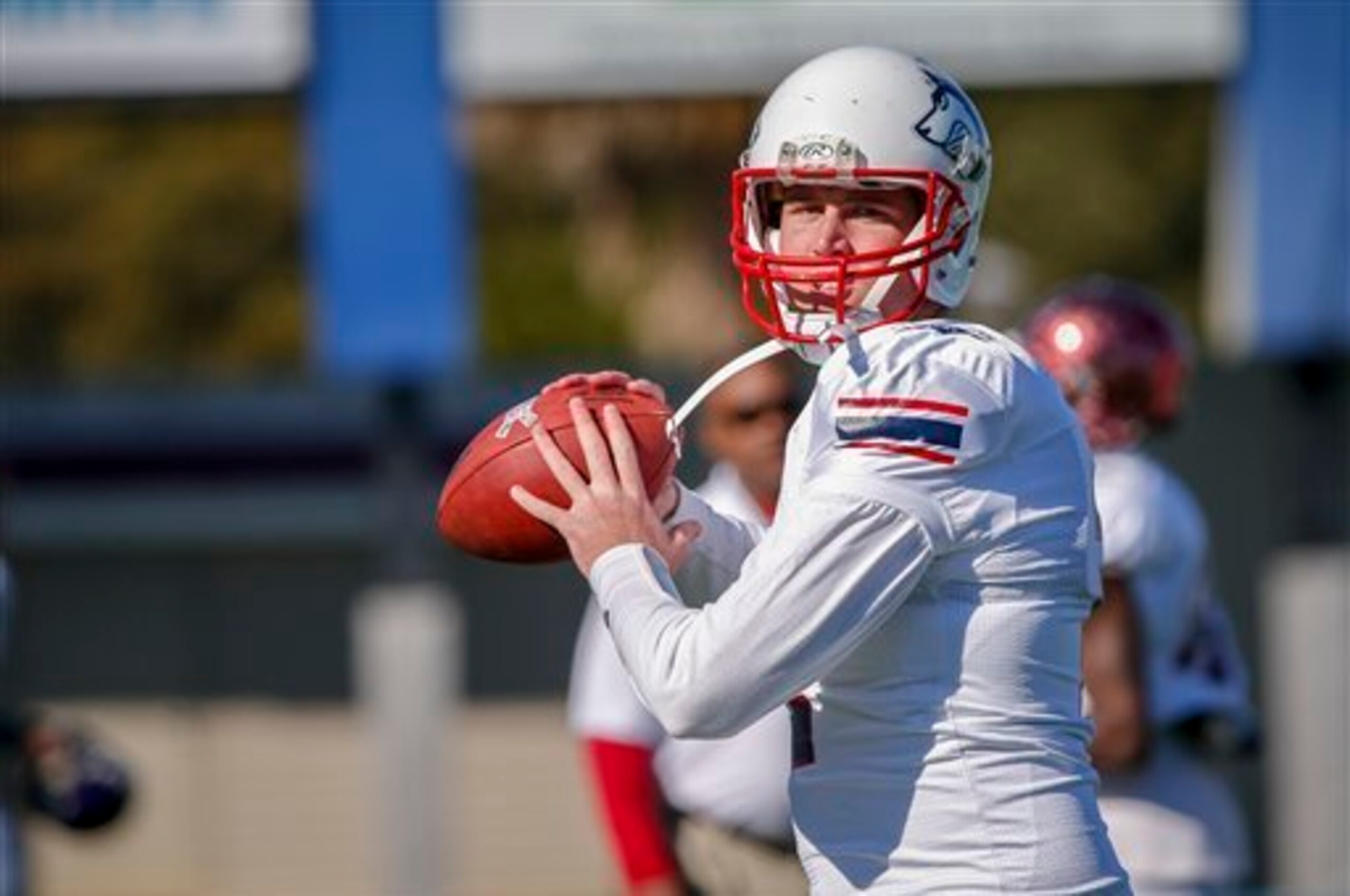
A physically gifted signal-caller who led Colorado State-Pueblo to the Division II national championship this past season, Chris Bonner is well worth a look for any team interested in drafting a late-round, developmental quarterback prospect this year.
The first thing that stands out about Bonner is his size. When he worked out at the Colorado pro day in March, Bonner measured in at 6'7" and 231 pounds, according to WalterFootball.com's Tony Pauline.
Bonner also has above-average arm strength and mobility. He has experience playing under center and demonstrates good pro-style footwork. Given a chance to season his game, Bonner has the tools to potentially develop into a starting-caliber quarterback in time.
He completed only 56 percent of his passes last season, which is a significant concern given that he played against lower-level competition. Bonner has to become more consistent with his accuracy, and he also has to learn how to throw the ball under pressure rather than taking a sack or making an unnecessarily risky throw.
In a draft class with more legitimately draftable large-school quarterback talent, Bonner might go undrafted. But this year, with only five quarterbacks who are sure bets to be selected, he should be well worth a flier on Day 3 of the draft.
Honorable Mention: Bryan Bennett, Southeastern Louisiana
RB: David Johnson, Northern Iowa
2 of 14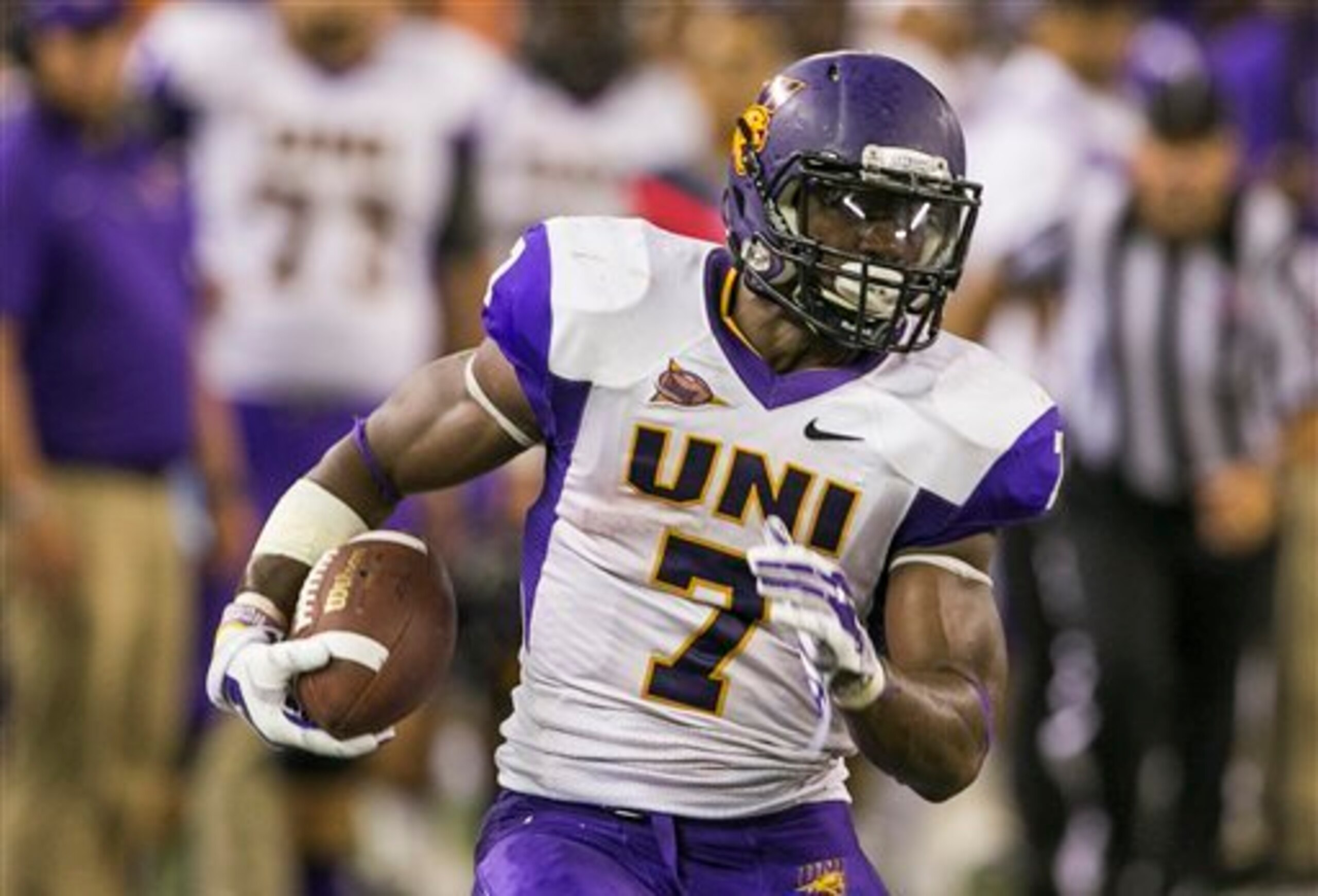
One of the most well-rounded running backs in this year's draft, David Johnson is a strong bet to be among the first handful of small-school prospects off the board.
Johnson has great size (6'1", 224 pounds) and is a very good all-around athlete. Despite his size, he is light on his feet. He has the speed and moves to extend plays in the open field.
Although he is a big running back, Johnson does not exhibit much power. It is questionable whether he has the burst and vision to consistently be successful between the tackles.
What makes him a potentially special playmaker, however, is that he is more than just a ball-carrier.
Johnson is an excellent receiver out of the backfield—perhaps the best in the entire draft class—and also has experience returning kickoffs. That versatility, which could enable a team to play him at positions other than just tailback, might vault him ahead of some of the other second-tier running backs.
In four seasons at Northern Iowa, Johnson accumulated 4,682 rushing yards, 49 rushing touchdowns, 1,734 receiving yards, 14 receiving touchdowns, 438 kickoff return yards and one kickoff return touchdown.
Honorable Mention: John Crockett, North Dakota State; Zach Zenner, South Dakota State; Tyler Varga, Yale; Terrell Watson, Azusa Pacific
WR: Dezmin Lewis, Central Arkansas
3 of 14
One of just four wide receivers at this year's NFL Scouting Combine to measure in at 6'4" or taller, Dezmin Lewis is a big target who could be an enticing sleeper prospect in the middle rounds for teams looking to add size to their passing offense.
At 6'4" and 214 pounds, to be exact, Lewis also has long arms (32 ½ inches) and a great ability to adjust his body in the air to make challenging catches. This combination of traits gives Lewis a wide catch radius that could make him a dangerous target on the perimeter, especially in the red zone.
Over the course of a productive four-year career at Central Arkansas, Lewis caught 197 passes for 2,668 yards and 24 touchdowns.
Lewis is not a spectacular athlete, and he will likely struggle to separate against faster cornerbacks in the NFL. Given that, it will be crucial for him to become a more complete route-runner.
It can be said that Lewis is a raw prospect who will likely need time to develop before he fully realizes his potential, but his large frame and ability to make contested catches should help him compensate for his flaws. He is a player who will create mismatches against smaller opponents and make his quarterback look good by making impressive plays on imperfect throws.
Honorable Mention: Tre McBride, William & Mary; Jake Kumerow, Wisconsin-Whitewater
.jpg?w=2560 "Chiefs Giants Football")
.jpg?w=2560 "Colts Football")
.jpg?w=2560 "Titans Colts Football")
TE: MyCole Pruitt, Southern Illinois
4 of 14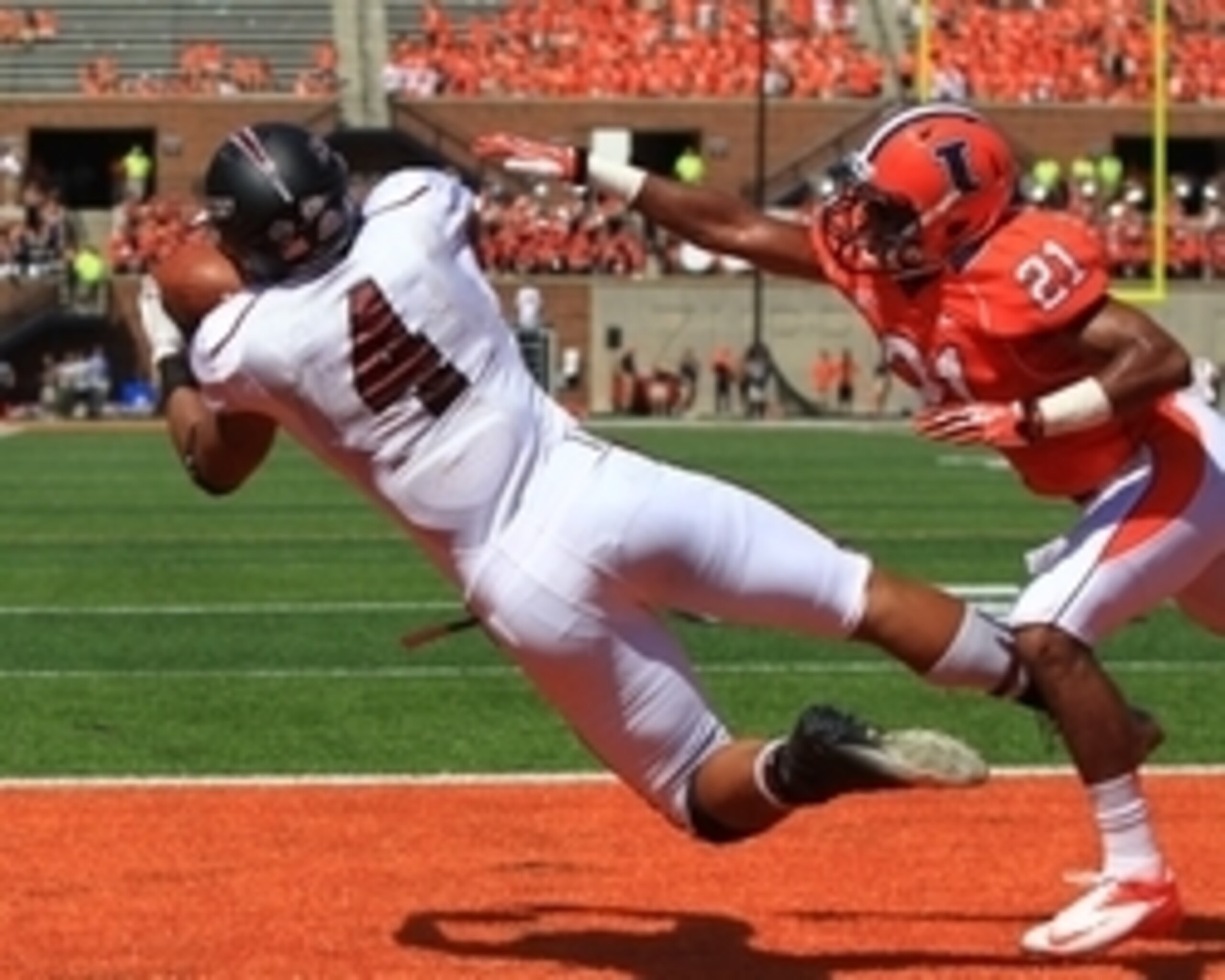
After leading all Football Championship Subdivision tight ends in receptions, receiving yards and receiving touchdowns for the 2014 season, MyCole Pruitt stands out as the top small-school tight end prospect in the 2015 draft class.
Pruitt, a two-time first-team FCS All-American, had four productive seasons at Southern Illinois, in which he caught a total of 221 passes for 2,601 yards and 25 touchdowns.
A good athlete and reliable pass-catcher, Pruitt was also the fastest tight end at this year's NFL Scouting Combine, where he recorded a 4.58-second 40-yard dash.
Pruitt, who played all over the offensive formation for the Salukis, projects as a "move" tight end/H-back for an NFL offense. At 6'2" and 251 pounds, Pruitt is undersized to be a traditional in-line tight end, and he is not a powerful blocker.
Whether Pruitt will be able to carve out a consistent role at the next level remains to be seen, as he needs to become a more polished route-runner. With that being said, he always found a way to get the job done in his collegiate career, and his versatility to play a variety of roles—both on offense and special teams—should warrant a selection on Day 3 of the draft.
Honorable Mention: Brian Parker, Albany; James O'Shaughnessy, Illinois State
OT: Jake Rodgers, Eastern Washington
5 of 14A Washington State transfer who played four different offensive line positions over the course of his collegiate career as a whole, Eastern Washington's Jake Rodgers is a versatile blocker who has enough physical ability to stick on an NFL roster.
Rodgers, who measured in at 6'6" and 315 pounds at his pro day, according to NFL Media's Gil Brandt, has the frame NFL teams look for in an offensive tackle.
An adequate athlete, Rodgers shows the movement skills to mirror his opponent and make blocks downfield at the second level. He combines his quality length with good functional strength, as he typically holds his ground as long as he keeps his hands on an opponent.
The problem for Rodgers is that he has no defining traits to make him stand out. Although he is strong enough to be an NFL offensive lineman, he lacks a pad-popping punch and can struggle to finish plays as a result. He does not have great first-step quickness either and could have some trouble against outside speed-rushers.
Rodgers appears to be on the fringe of being drafted, but his experience playing both tackle and guard on both sides of the line helps him. Even if he goes undrafted, that ability to play multiple positions increases his odds of making a 53-man roster as a backup lineman.
Honorable Mention: Doniel Gambrell, Notre Dame College
OG: Ali Marpet, Hobart
6 of 14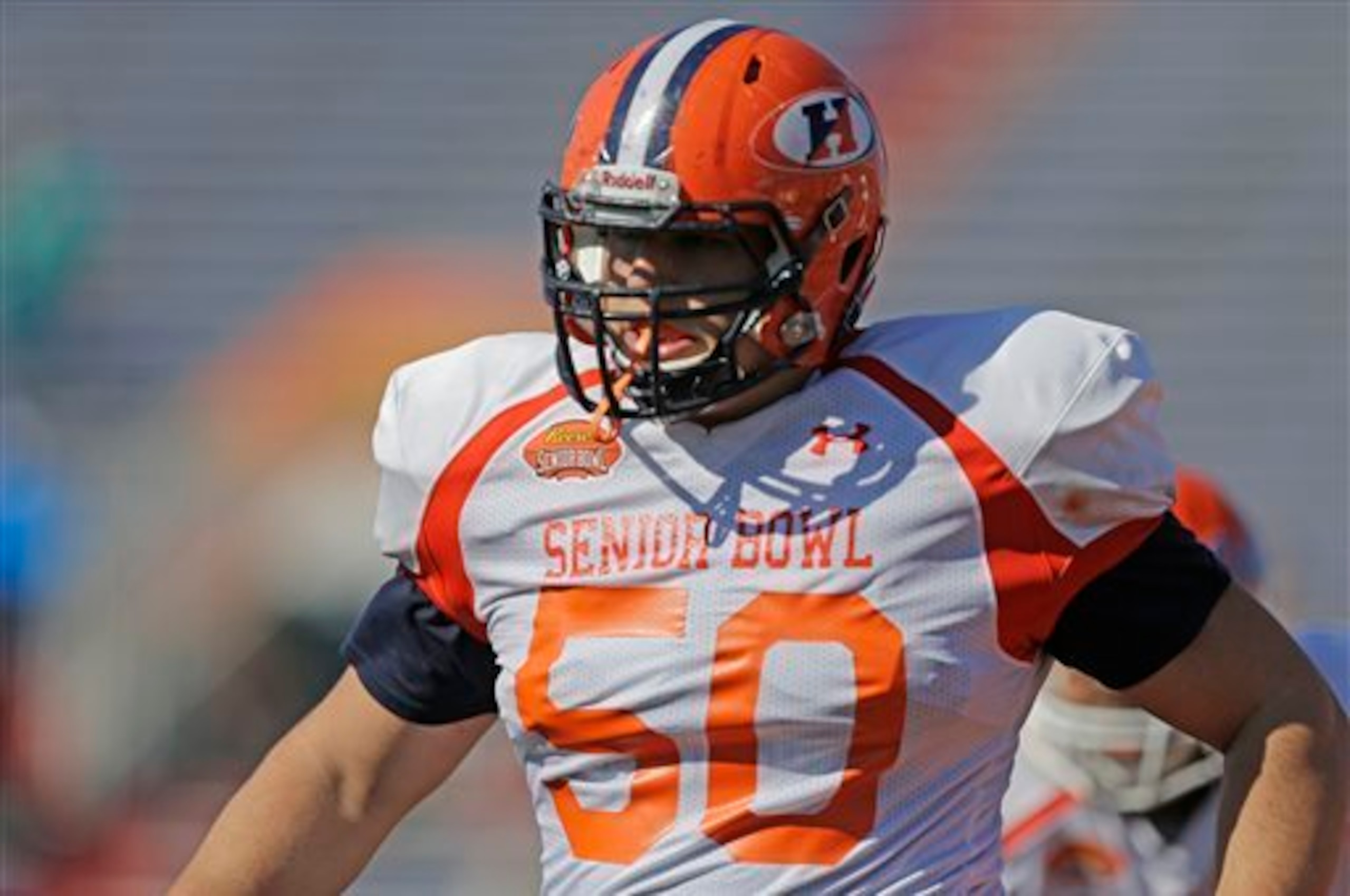
A rare NFL draft prospect from Hobart College, Ali Marpet is the only Division III player in this slideshow. He appears to be well on his way to becoming the first top-100 pick from a Division III school since the Seattle Seahawks selected Ferrum College running back Chris Warren with the 89th pick in the 1990 NFL draft.
Marpet began making a name for himself at this year's Senior Bowl, where he consistently demonstrated his power despite going against bigger and quicker defensive linemen than he ever faced at Hobart. He continued his rise to prominence at the NFL Scouting Combine, where he was the only offensive lineman to break five seconds in the 40-yard dash, posting a time of 4.98 seconds.
Although he was an All-American left tackle for Hobart in 2014, Marpet projects as a guard to the NFL. While the 6'4", 307-pound lineman does not quite have the length NFL teams covet at the tackle position, his strong punch and ability to accelerate off the line make him a good fit to succeed inside.
The leap to the NFL from the Division III level is very much a massive one, which will likely lead to some growing pains for Marpet early in his career. It is very difficult to project whether the excellence Marpet displayed against much smaller and slower opponents will translate to the next level.
It is a huge boost to Marpet's draft stock, however, that he stood out at the Senior Bowl when one might have expected him to look overmatched. Selecting him in the early rounds would be a roll of the dice, but his physical attributes give him high potential that should warrant a second- or third-round pick.
Honorable Mention: Robert Myers, Tennessee State; Antoine Everett, McNeese State; Marcus Reed, Fayetteville State
C: Nick Easton, Harvard
7 of 14Ivy League rivals Harvard and Yale are typically known for being academic powerhouses, but they have a few prospects between them with a real shot at being drafted this year. One of those prospects is Nick Easton.
While Easton was not invited to this year's NFL Scouting Combine, he proved himself to be one of the most athletic centers in the draft with a terrific performance at Harvard's pro day. According to the pSPARQ formula created by Zach Whitman of 3sigmaathlete.com, Easton's pro-day numbers actually project him to be the most athletic offensive lineman in the entire draft.
That athleticism is apparent in Easton's film. He is light on his feet and is able to effectively pull-block and execute second-level blocks. He also displays good functional strength and the power to bury defenders into the ground, though he is largely untested against NFL-caliber defensive linemen.
Having measured in at 6'3" and 303 pounds at his pro day, according to WalterFootball.com's Tony Pauline, Easton is small for an NFL offensive lineman. Whether he will be able to consistently hold up against bigger, quicker opponents is uncertain.
Nonetheless, Easton's movement skills make him likely to get a shot as a late-round draft pick. Certainly an intelligent player coming from the Ivy League ranks, Easton has intriguing developmental upside and could prove to be a steal as a sixth- or seventh-round pick.
EDGE: Davis Tull, Tennessee-Chattanooga
8 of 14The edge defender group—which encompasses both 4-3 defensive end and 3-4 outside linebacker prospects—might have the most impressive small-school crop among all positions this year. There should be at least five small-school edge players drafted, but the most tantalizing prospect among them is Davis Tull.
A three-time winner of the Southern Conference Defensive Player of the Year award, Tull had an exceptionally productive career at Tennessee-Chattanooga. Over the course of his four seasons for the Mocs, Tull recorded 60 tackles for loss—including 37 sacks—along with 10 forced fumbles and four recovered fumbles.
Tull certainly did enough in his collegiate career to make NFL teams take notice, but he has helped himself even further in his predraft workouts by proving himself to be one of the most explosive athletes in this year's class.
At the NFL Scouting Combine, Tull posted a 42.5-inch vertical jump and 11-foot broad jump, both of which ranked him in the top five among all combine performers. Tull also put up 26 repetitions on the bench press at the combine, while he ran a 4.57-second 40-yard-dash at his pro day. All in all, Tull ranks No. 1 among edge players in the pSPARQ rankings compiled by Zach Whitman of 3sigmaathlete.com.
On the field, Tull shows natural bend around the edge and is active with his hands. While he consistently had an athletic advantage over his opponents at the FCS level, he utilized technique rather than relying upon his physical traits to succeed.
The biggest concern for Tull is that he lacks size and length at 6'2" and 246 pounds with 31 ¼-inch arms. He struggles to hold up as a run defender at the line of scrimmage and might be limited to playing as a 3-4 outside linebacker as a result. Even so, his combination of athleticism, technical skill and past production could make him a top-100 draft choice.
Honorable Mention: Lynden Trail, Norfolk State; Kyle Emanuel, North Dakota State; Zack Wagenmann, Montana; Zack Hodges, Harvard
DT: Derrick Lott, Tennessee-Chattanooga
9 of 14
Although Davis Tull's production and measurables make him the class of the small-school edge defender group, he’s not even the best prospect in this year's draft from Tennessee-Chattanooga's defensive line. That honor goes to Derrick Lott, a Georgia transfer with the tools to be a disruptive force in the middle of an NFL front.
At 6'4" and 314 pounds, Lott was the largest player to run a sub-five-second 40-yard dash at the NFL Scouting Combine; he clocked in at 4.99 seconds. He has very good length for a defensive tackle, with 33 ⅝-inch arms, and possesses great all-around movement skills for the position.
Lott can beat his opponents with both his quickness off the snap as well as his power. Though he is at his best as a penetrator, he shows enough strength to hold his own up the middle at the point of attack.
Old for an NFL draft prospect at nearly 25 years of age, Lott has a history of battling injuries, including a broken ankle in 2009 and a season-ending elbow injury in 2013. Those concerns could make teams hesitant to invest anything more than a Day 3 draft pick in Lott.
Lott is best suited to play as a 4-3 defensive tackle, but he has the length, strength and quickness to also transition to playing 3-4 defensive end. Either way, his attributes should enable him to make a successful transition to the NFL, so long as he can stay healthy and continue to build upon his physical gifts.
Honorable Mention: Xavier Williams, Northern Iowa
LB: Edmond Robinson, Newberry
10 of 14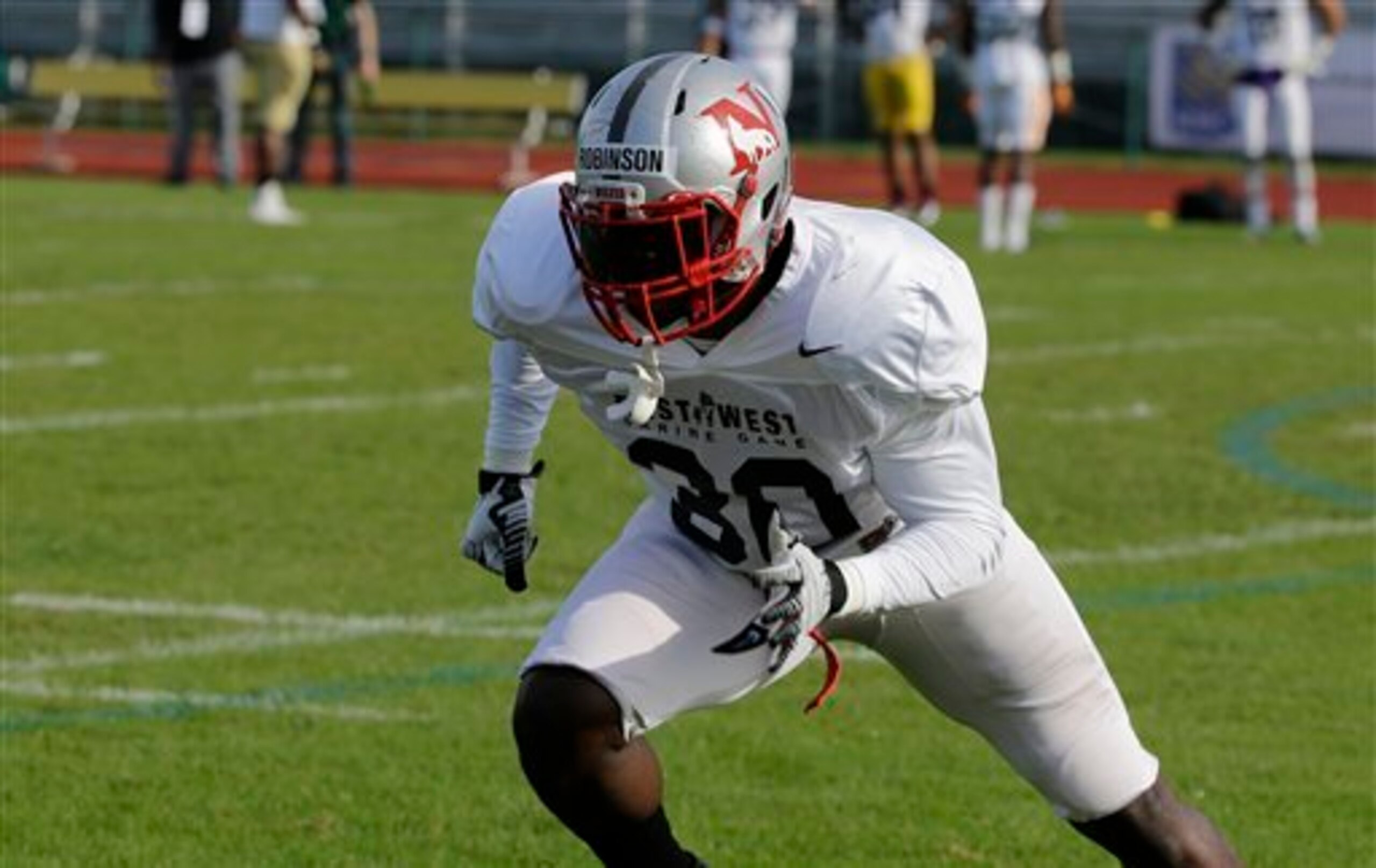
There does not appear to be much draftable talent among off-ball linebackers in this year's crop of small-school prospects. One player from the Division II level that could intrigue NFL teams, however, is Newberry's Edmond Robinson.
One of just two Division II players invited to the NFL Scouting Combine, Robinson took advantage of that opportunity and displayed highly promising physical traits. At 6'3" and 245 pounds with 34-inch arms, Robinson displayed very good all-around athleticism in Indianapolis, including one of the fastest 40-yard dash times (4.61 seconds) among linebackers.
Robinson also had an opportunity to showcase his talent at this year's East-West Shrine Game, where he demonstrated his ability to match up against tight ends in coverage. His measurables give one reason to believe that he should continue to take on coverage responsibilities for an NFL defense.
Very much a raw project, Robinson is not a draftable player for what he is right now, but he may be drafted because of what he could become in the future.
If Robinson can bulk up and add strength, he could develop into a versatile chess piece who can play everywhere from the edge to dropping back like a safety. His traits make him a player that coaches will want to have the chance to develop, and if he gets that chance, he could end up emerging as a diamond from the rough.
Honorable Mention: Nick Dzubnar, Cal Poly
CB: Tray Walker, Texas Southern
11 of 14By rule, each of the NFL's 32 teams is allowed to host 30 prospects for official predraft visits. According to SB Nation's draft visit tracker, at least 13 teams have decided to use one of those visits to host Texas Southern cornerback Tray Walker, making him one of the busiest prospects in the weeks leading up to the draft.
The biggest reason for that might be his height. Having measured in at 6'2" and 187 pounds at his pro day, according to NFL.com's Gil Brandt, Walker has the length that is being increasingly coveted by NFL teams—yet remains hard to find—at the cornerback position.
Walker uses his length well, as he plays with physicality in press coverage, and he is a good athlete for his size. All of those traits make him worth the second looks he is getting, while he has also demonstrated ball skills, as he recorded nine interceptions in his four-year collegiate career.
For Walker to realize his potential, his technique will have to come a long way. He was not a shutdown cornerback for the Tigers, and he needs to improve at utilizing his hips and feet to get himself in proper coverage positions. He will need to bulk up to remain effective in press coverage against NFL receivers, and a lack of recovery speed leaves him susceptible to getting burned.
In spite of his flaws, Walker appears to be well on his way to being drafted, considering the predraft attention he is getting. He has a frame that most cornerbacks in the class cannot match, and his physical makeup gives him something to build on as a developmental project.
Honorable Mention: Tye Smith, Towson; Imoan Claiborne, Northwestern State
S: Jaquiski Tartt, Samford
12 of 14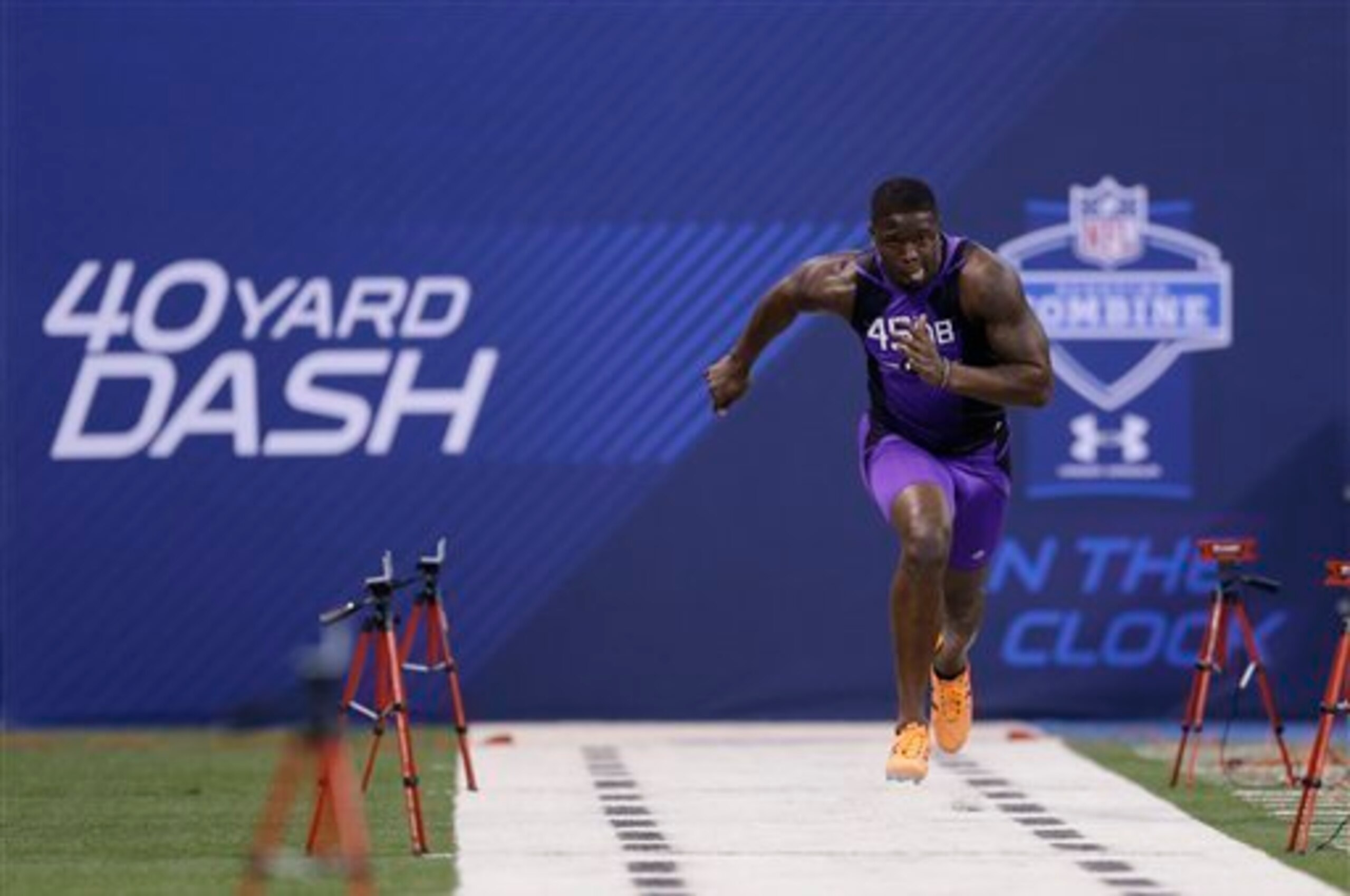
In a draft class that is not teeming with highly regarded safety prospects, Jaquiski Tartt is very much in play to be one of the first players drafted at the position.
A big safety at 6'1" and 221 pounds, Tartt is a hard hitter who projects best as an in-the-box enforcer at strong safety. With that being said, he also exhibits the overall athleticism and coverage ability to drop back into center field and play as a free safety as needed.
Tartt, a three-time AP All-American (first team in 2012, second team in 2013 and 2014), finished his four-year Samford career with 277 total tackles, six interceptions and 20 pass breakups. He might not be regarded as a ball hawk, but he has the ability to make difference-making plays on the back end.
As noted by Bleacher Report's Matt Bowen, Tartt also has the traits to be "an absolute stud on special teams."
Tartt is an aggressive player on the field, and that can work against him at times. He needs to take better angles to the ball in run support and prove that he can consistently handle coverage responsibilities over the middle.
What teams will like with Tartt is that he is a player who consistently plays fast. If he shores up his technique, he has all the tools to be a quality starting safety in the NFL.
Honorable Mention: Tevin McDonald, Eastern Washington; Dean Marlowe, James Madison
K: Tom Obarski, Concordia-St. Paul
13 of 14In a draft class that does not have any outstanding kicking prospects, Tom Obarski has as much a chance of being selected as anyone else at his position.
A strong-legged place-kicker, Obarski has 10 of the 11 longest kicks—including five from more than 50 yards—in program history for Concordia-St. Paul, a Division II school. Obarski also holds his school's record for career field goals made with 44 out of 63 total attempts.
While Obarski had some inconsistency in his first three years kicking for the Golden Bears, he had an excellent senior season. He made 18 of his 21 field-goal attempts in 2014, including nine out of 10 attempts from 40 yards or more, and earned first-team Division II All-American honors from the American Football Coaches Association.
In his biggest chance to showcase his kicking talent—the 2015 Senior Bowl—he faltered, as he made just two of his four field-goal attempts in the game. Just the fact that he was one of the two kickers selected to participate, however, is an indicator that he is one of the best kicking prospects in this year's draft.
Regardless of whether Obarski is a late-round pick or an undrafted free agent, he should get a shot to compete for a kicking job in training camp. His strong leg could enable him to be an asset for an NFL team on both field goals and kickoffs, but he will have to prove himself this summer.
P: Kyle Loomis, Portland State
14 of 14A 27-year-old Army veteran, Kyle Loomis has taken an unusual path to emerging as an NFL draft prospect. After punting at Oregon State in 2006, Loomis stepped away from the game for seven years before returning to college football in 2013, this time at Portland State, where he emerged as one of college football's best punters in the past two years.
Over the course of his two seasons with the Vikings, Loomis averaged more than 46 yards per punt. Among his 131 total punts, Loomis had 48 punts of 50 yards or more and downed 50 punts inside the opponent's 20-yard line.
Like Tom Obarski, Kyle Loomis earned an opportunity to participate as a specialist in the 2015 Senior Bowl, in part because there are no likely draft picks among his large-school counterparts at the position. His only punt in that game was a 47-yard effort, downed at the opponent's 9-yard line.
Loomis' age could deter teams from drafting him, but age is not nearly as significant a factor for punters as it is for other football positions.
Most likely, Loomis will go undrafted, but he'll have a legitimate chance to win a punting job in an NFL team's training camp. Should he stick around on an NFL roster, Loomis will certainly have one of the league's most unlikely journeys to football success.
All measurables courtesy of NFL.com unless otherwise noted.
Dan Hope is an NFL/NFL draft Featured Columnist for Bleacher Report.
.jpg?w=2560)
.jpg?w=2560 "Cardinals Giants Football")






