

Texas Football: Will QB Decision Make or Break Charlie Strong's Second Season?
Texas head coach Charlie Strong doesn't sound too worried about his quarterback situation. Whether he actually is or not is probably something only he and a select few know, but to the masses, he sounds confident.
Following the Longhorns' spring game on April 18, Strong said junior and incumbent starter Tyrone Swoopes has the edge over redshirt freshman Jerrod Heard in the quarterback battle. That competition has been ongoing throughout spring and will continue into preseason camp. Though Swoopes is the No. 1 guy for now, word from Strong last week was that Heard was "closing the gap" on Swoopes, per 247Sports' Jeff Howe.
TOP NEWS

Unranked CFB teams cause chaos in Week 8

More top teams upset and more takeaways from CFB Week 8

Arch Outduels Chambliss 😈
During a Tuesday teleconference with reporters, Strong noted that he wasn't exactly losing sleep over the lack of a surefire starter.
In some ways, that's to be expected. Plenty of other programs are in similar situations with no starting quarterback named exiting spring. That does not, however, mean Strong doesn't have a crucial decision ahead of him.
Put simply, the importance of having a quality quarterback in the Big 12 can't be stressed enough. Yes, quarterbacks often get more praise and blame than they deserve, but there is an influence the position has on team success in the conference.
Let's start inward and work our way out. The Longhorns can't be as inefficient as they were a year ago on offense. The results could be even worse than 6-7 if that happens again.
| Category | Stats | Big 12 Rank (Out of 10) |
| Scoring Offense | 21.4 PPG | 9th |
| Passing Offense | 199.9 YPG | 10th |
| Rushing Offense | 137.4 YPG | 6th |
| Total Offense | 337.3 YPG | 9th |
Texas has moved to a more wide-open offense that should appeal to in-state recruits and put players in open-field situations in which they can make plays. While a solid running game can be part of that philosophy, good quarterback play is important as well. That's something Texas hasn't had in almost six years.
It's bad enough that the flagship program in one of the most talent-rich areas in the country can't produce on offense, but it's even worse that Texas has missed out on several quarterback recruits who have gone on to have success elsewhere. All the while, the Horns have never quite recovered from putting all their eggs in the Garrett Gilbert basket.
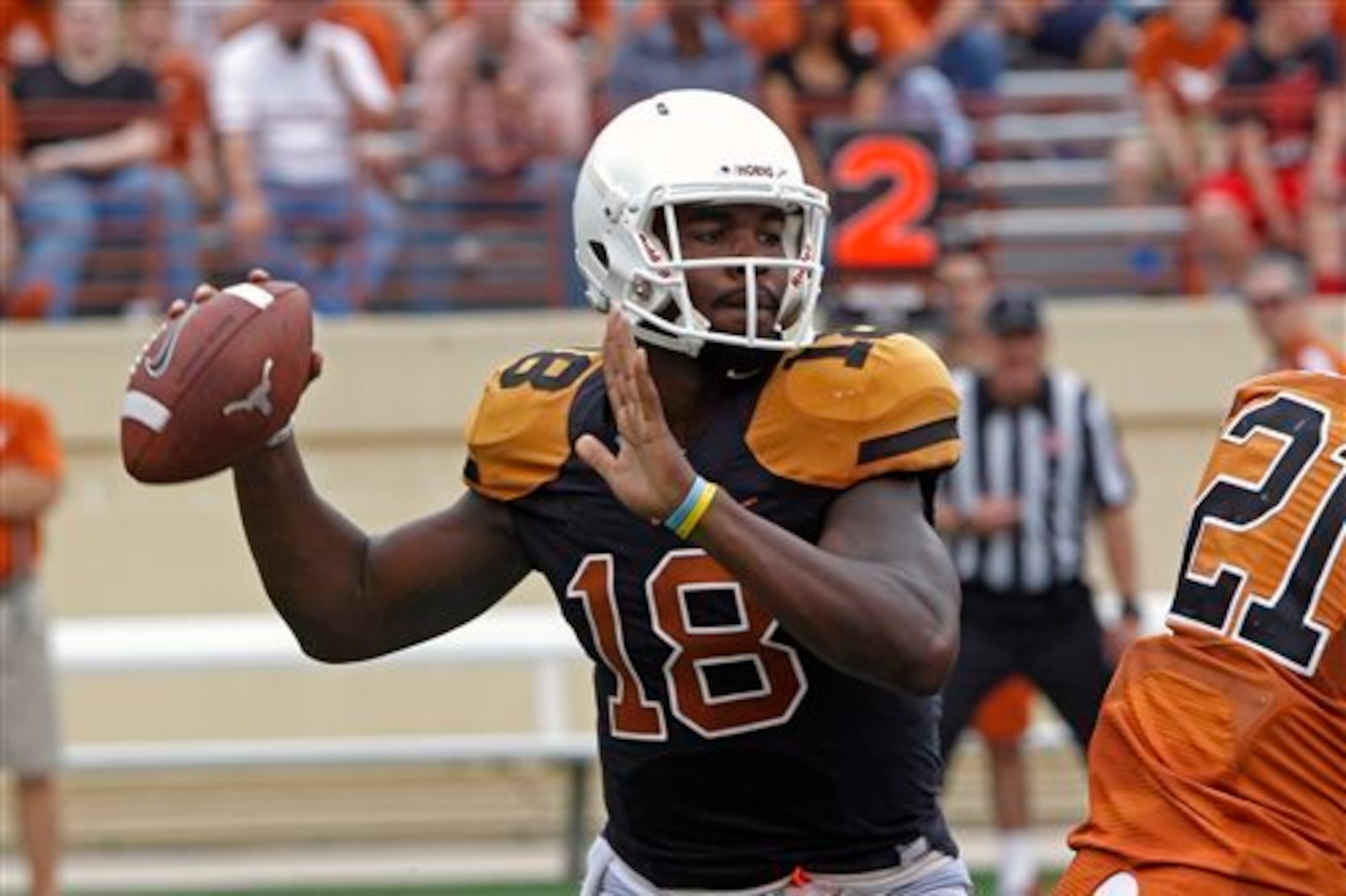
It's no secret that Texas won six games and became bowl-eligible last year because of its defense. Guys like defensive end Cedric Reed, defensive tackle Malcom Brown, linebacker Jordan Hicks and cornerback Quandre Diggs always had talent, but now they had a coaching staff that put them in positions to be successful.
Those impact players are gone, which means a new crop of defenders will have to pick up the slack. If Swoopes or Heard still can't move the sticks, trying to recover is going to be brutal for the defense. Three times last year—against BYU, Baylor and Oklahoma—Texas entered halftime down by no more than seven points. And lost all three games.
Another loss, to Kansas State, was a 13-point halftime deficit. That's not great but not insurmountable either. A fifth loss against UCLA actually saw the Horns up at halftime.
The defense did the best it could, but even the best players can only do so much in bad situations. It's tough to imagine putting up the same fight for as long.
At this point in time, Strong feels his team could achieve a greater level of success if either Swoopes or Heard improves to game manager status. The concern is whether Swoopes or Heard can be more.
To be fair, the term "game manager" has taken on a negative connotation. It conjures up visions of someone who hands the ball off 40 times a game, doesn't put up flashy numbers but doesn't make a lot of mistakes either.
That certainly can be the case, but it doesn't have to be either. A game manager can move the offense effectively with his arm and legs, make great throws and protect the football. It doesn't have to be a detriment.
The latter description is probably more along the lines of what Strong meant. There's still an important question, though: Is having a game manager as a quarterback enough to win the Big 12, let alone a shot at a national championship?
Sweeping narratives can be tired and out-of-date. The idea that the SEC is the only conference with fast athletes isn't true, just as it's true that the Big Ten isn't full of players running a five-second 40-yard dash.
That said, there's some truth to the notion that the Big 12 is a quarterback conference. At the very least, history shows that if you want to have a shot at winning the Big 12, you need a top-end quarterback starting.
Below is a list of every Big 12 champion (and divisional champion back in the day when the conference had, you know, 12 teams) since 2008 and all their respective starting quarterbacks.
| Year | Big 12 Champ | Quarterback(s) |
| 2014 | Baylor, TCU | Bryce Petty (3,855 yards, 29 TDs), Trevone Boykin (3,901 yards, 33 TDs) |
| 2013 | Baylor | Bryce Petty (4,200 yards, 32 TDs) |
| 2012 | Kansas State, Oklahoma | Collin Klein (2,646 yards, 16 TDs), Landry Jones (4,272 yards, 30 TDs) |
| 2011 | Oklahoma State | Brandon Weeden (4,727 yards, 37 TDs) |
| 2010 | Oklahoma | Landry Jones (4,718 yards 38 TDs) |
| 2009 | Texas | Colt McCoy (3,521 yards, 27 TDs) |
| 2008 | Oklahoma | Sam Bradford (4,720 yards, 50 TDs) |
(*Note: Collin Klein also had 925 yards and 23 touchdowns rushing in 2012.)
As you can see, game managers are nowhere to be found. In 2006, Oklahoma's Paul Thompson, who went back and forth between quarterback and receiver, was the closest thing a Big 12 conference champion has come to a game manager in a long time.
Having a game manager as a quarterback just isn't going to get the job done.
To be clear, Strong is a smart, outstanding coach, and there's still plenty of time for him to turn Texas back into a national contender. However, one of the knocks on him was whether Texas could succeed with his style of football.
After all, some of the best defensive minds in the Big 12, namely TCU head coach Gary Patterson and Oklahoma head coach Bob Stoops, found success through innovative offensive hires and great quarterback play. There's nothing to say Strong can't do the same.
If history is to repeat itself, a game manager might get Texas back to bowl game and maybe upset a better team. One won't, however, win the Longhorns a Big 12 title or get them to the playoff.
And that's what Strong was hired to do. That might not happen in Year 2, but it will have to happen eventually.
Ben Kercheval is a lead writer for college football. All quotes cited unless obtained firsthand. All stats courtesy of cfbstats.com.



.jpg?w=2560 "5 Teams Eyeing Jonathan Taylor")
.jpg?w=2560 "Mahomes Told Teammate to Leave Meeting")

.jpg?w=2560 "NFL investigating Eagles")
.jpg?w=2560 "Jonathan Taylor Landing Spots 📍")
