What's Keeping the New York Rangers from the Stanley Cup?
It's been a memorable season for the New York Rangers, to say the least.
After all, capturing the President's Trophy as the best regular-season hockey team is no small feat. The Rangers themselves will tell you that, as it's only the third time in team history they've claimed such an honor. In doing so, they also managed to set the franchise record for points during the regular season with 113.
This was accomplished in spite of numerous injuries throughout the year, including losing all-world goaltender Henrik Lundqvist for nearly two months to a vascular injury. Many speculated the Rangers would be headed for dark days without their star netminder, yet here we are on the eve of the Stanley Cup playoffs, and the Rangers are at the top of the heap.
TOP NEWS
Best NHL Heritage Classic Jerseys 📋
Teams That Need Goalie Trade💡
Hellebuyck Trade Takeaways 📊
So no reason to worry, right?
Not exactly.
You see, for all of their accomplishments and persistence throughout the season, the Rangers, like many other teams, remain flawed. Perhaps not fatally, but enough to possibly throw a wrench into any pre-emptive plans for a parade down the Canyon of Heroes come June.
One of the biggest remaining issues with the Rangers, as any fan who's watched a game within the last 10 years will tell you, is the power play, or lack thereof.
Their power-play percentage was a paltry 16.8 percent during the regular season, placing them squarely in the bottom third of the league. And while scoring as a whole was down throughout the NHL this year, the Rangers managed to finish well below the league average of 18.6 percent.
Not being able to score with a man (or more) advantage has been the Achilles' heel of this team for some time. This is a fact not lost on head coach Alain Vigneault, who made as much clear in an interview with Brett Cyrgalis of the New York Post after a home loss to Washington recently:
"“It’s not nearly good enough, without a doubt,” coach Alain Vigneault said after Sunday’s 0-for-5 performance over 7:21 of man-advantage time during a 5-2 loss to the Capitals at the Garden. “We’re going to take a look at some tape and make the adjustments we need to make.”
"
Part of this decade-long problem would be solved if the Rangers could get any sort of special teams production from defenseman Keith Yandle, who was brought here just before the trade deadline to save an ailing power play.
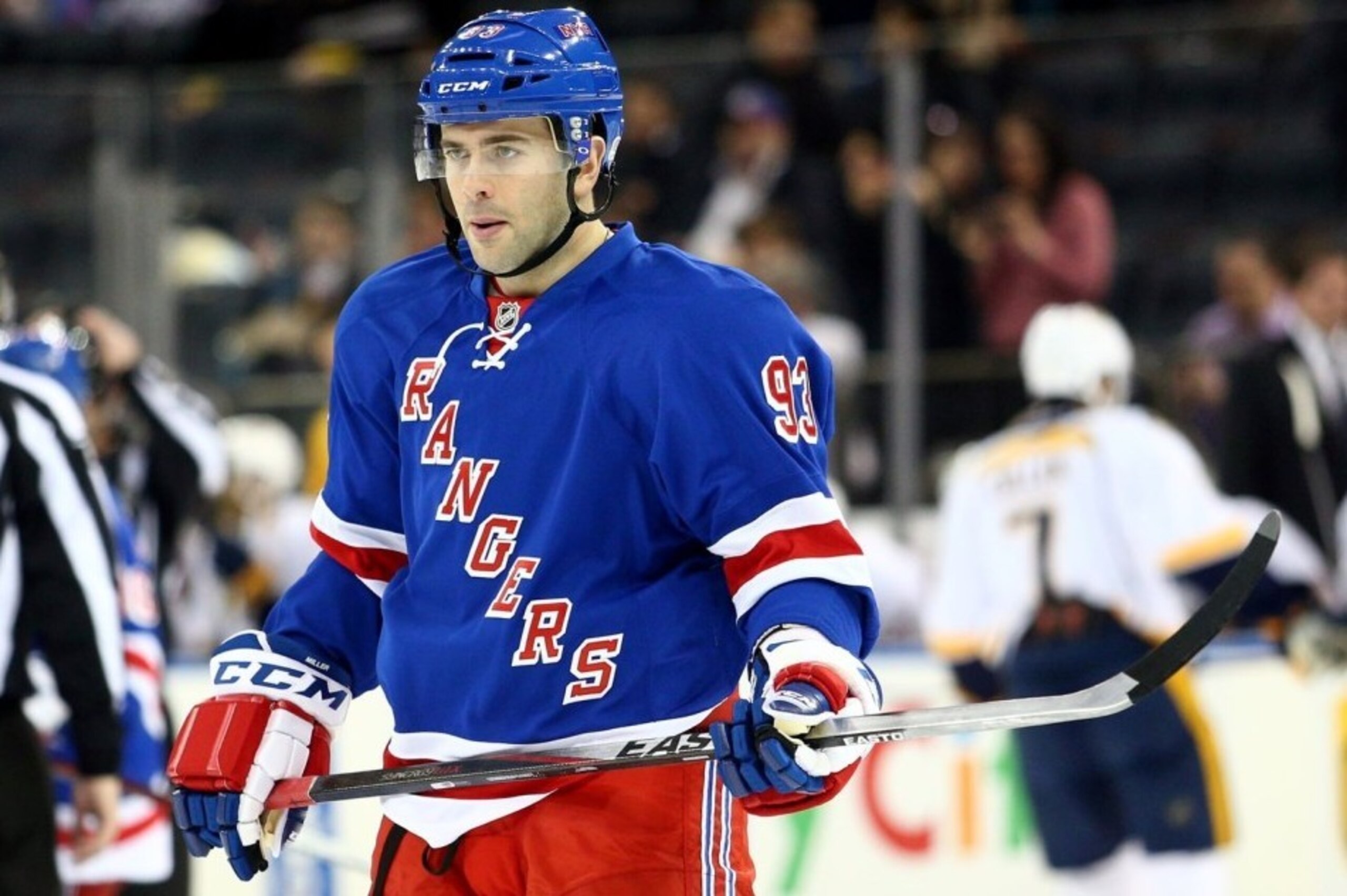
Yandle's 27 power-play assists were tops in the league among defensemen; however, 24 of them came while he was still with Arizona. That, coupled with the disappearance of Dan Boyle on special teams, may end up costing the Rangers as they progress deeper into the playoffs.
Remember how maddening last year's Stanley Cup Final was if you were a Rangers fan?
New York managed to convert only two of 22 power-play opportunities against the Kings. Four out of the five games ended up being one-goal affairs, so it's logical to think that even a small improvement would have done them wonders.
The inability to convert on the power play isn't the only longstanding problem facing this year's team.
Faceoffs, more specifically winning them, have been a season-long dark spot up and down the roster. Many will have you believe that faceoff percentage is a flawed stat with no direct correlation to wins and losses, but diving deeper will illustrate why it will inevitably be a problem as the Rangers progress through the postseason.
It's not so much that the Rangers are bad at winning draws, it's really a matter of how bad they are.
Ending the regular season, New York was 28th in overall faceoff percentage at 46.7 percent. Only Vancouver and Buffalo managed to post worse numbers.
Neither Derick Brassard nor Derek Stepan posted a faceoff number over 50 percent. Brassard managed 48.8 percent, while Stepan only won 44.1 percent of his draws.
This could be especially problematic for the Rangers on their way to the Final.
All of their Eastern Conference competitors can boast a top-nine center with at least a 50 percent faceoff percentage. And while fourth-line center Dominic Moore won more than his fair share of starts (54.1 percent), it's foolish to think he'll be logging minutes against the likes of Pavel Datsyuk and Nicklas Backstrom in the playoffs.
Now, I'm sure anyone with any sort of hockey knowledge is reading this thinking, "Who cares? They had the most points in the league. They keep winning. Why does any of this matter?"
What matters is that recent history is against the Rangers, at least in this regard.
Going back to the 2009-10 season, no Stanley Cup-winning team has ever finished lower than 11th overall in faceoff percentage. As a matter of fact, four out of the five teams that won the Cup placed in the top 10 overall during the regular season. Last year's Stanley Cup-winning Kings team was third in the league at 52.8 percent.
In order to exercise the demons from seasons past, the Rangers will need to find a way to address two glaring issues that have plagued the team throughout the course of the year.
Is it an impossible task? No, and the Rangers can count their blessings as they prepare for a first-round matchup with the Pittsburgh Penguins. They're (almost) completely healthy for the first time this year. They're playing, arguably, the best hockey in the league heading into the playoffs. But they'll need to be at their absolute best if they're to overcome these roadblocks on their way to their first Stanley Cup Final victory in over 20 years.
All statistics via NHL.com.
.jpg?w=2560 "NHL Trade Grades Connor Hellebuyck")
.jpg?w=2560 "Mahomes Told Teammate to Leave Meeting")
.jpg?w=2560 "5 Teams Eyeing Jonathan Taylor")


.jpg?w=2560 "NFL investigating Eagles")
.jpg?w=2560 "Jonathan Taylor Landing Spots 📍")