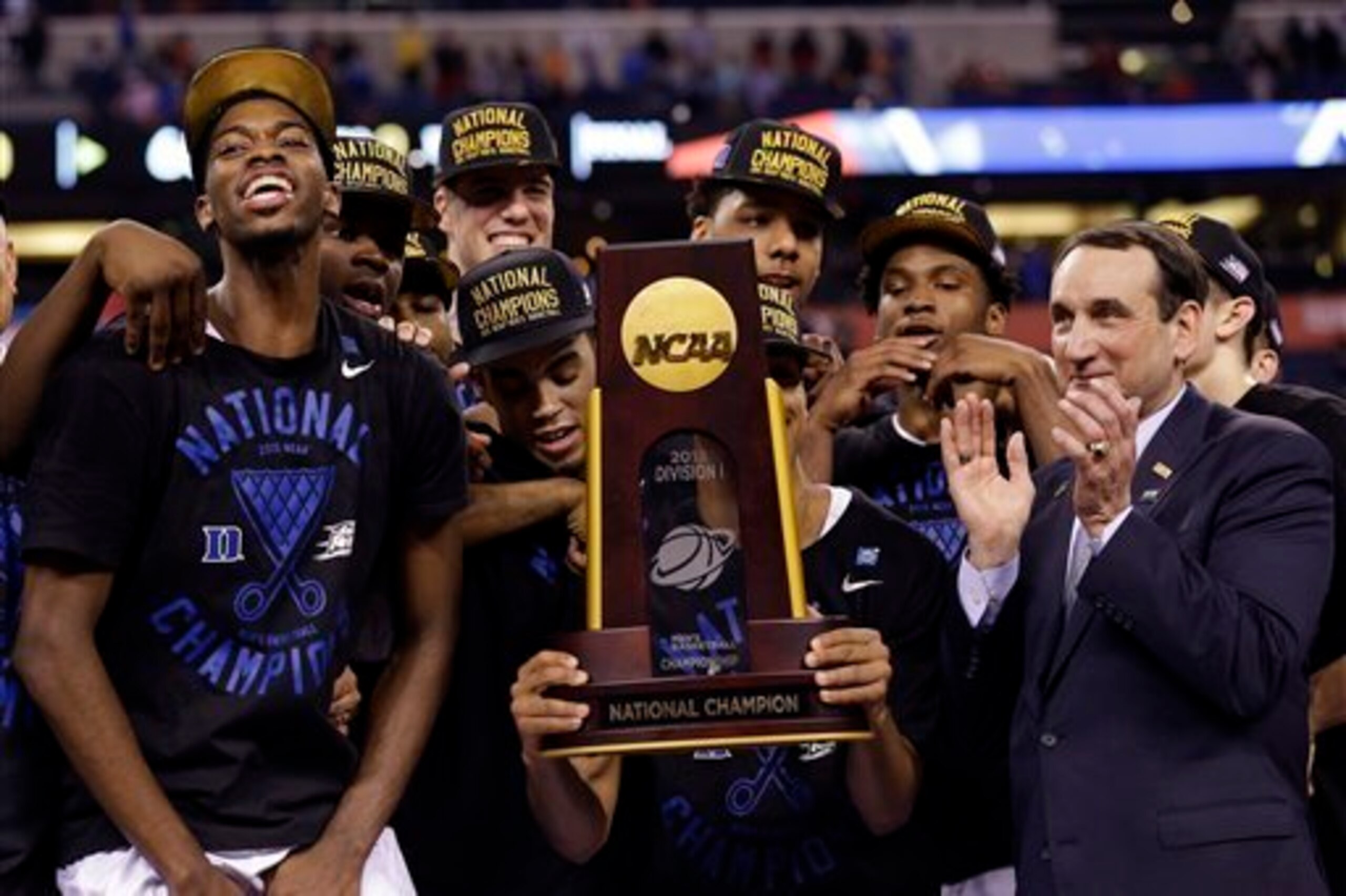


The Duke Blue Devils are your 2015 national champions, but how does this year's team stack up against Mike Krzyzewski's four previous championship teams?
Throughout his 35 years at Duke, Coach K has compiled some incredible rosters. For at least one week in each of the last 18 seasons, the Blue Devils have been ranked in the top five of the AP Poll. They have been to 31 of the last 32 NCAA tournaments, including 12 Final Four appearances.
Ranking Krzyzewski's teams from top to bottom is the equivalent of creating a hierarchy of Baskin-Robbins' 31 original flavors—even the worst one is still pretty incredible. Limit the ranking to just the five title teams, and it gets even harder to distinguish between greatness and extra greatness.
But that didn't stop us from trying.
When someone finally builds a time machine and we get a chance to have all five of these teams play each other in a round-robin tournament, here's the order in which we think they'll finish.
Statistics on the following slides courtesy of Sports-Reference.com and GoDuke.com
5. 2010 National Champions
1 of 5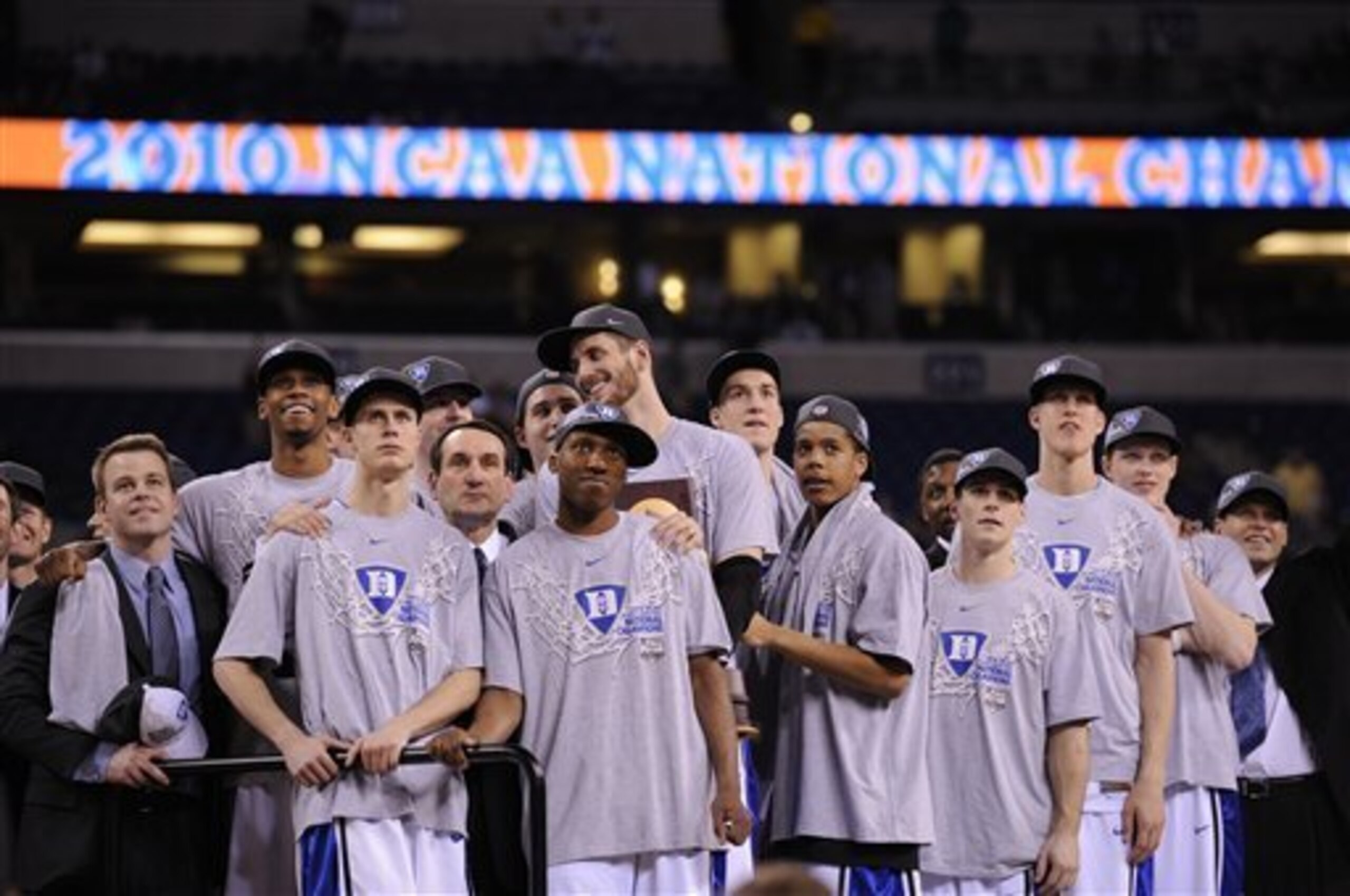
Star Power
It's pretty hard to pick one star when the Blue Devils had three players who averaged between 17.4 and 18.2 points per game. Nolan Smith was an outstanding guard, and Kyle Singler was the stretch 4 who Duke always seems to have, but how about Jon Scheyer seamlessly transitioning from shooting guard to point guard as a senior? He led the team in points, steals and assists, registering a 2.98 assist-to-turnover ratio.
Clutch Factor
For the vast majority of his college career, Brian Zoubek had two left feet and bricks for hands. Then in the latter half of the 2009-10 season, the 7'1" senior suddenly became unstoppable. He even led the nation in offensive rebounding percentage, according to KenPom.com. Once thought to be a career bench guy, Zoubek averaged 7.3 points and 9.8 rebounds per game in the tournament.
The Case For
This team played outstanding perimeter defense. On average, opponents shot just 4-of-14 from three-point range over the course of the season. The Blue Devils also forced 14.3 turnovers per game, thereby not only contesting shots but keeping a ton of them from even happening. They held their six tournament opponents to 56.8 points per game.
The Case Against
This was a three-man show. Plain and simple. Zoubek was a big contributor late in the season and into the tournament, but he was the team's fourth-best scorer at 5.6 points per game. It was really just Scheyer, Singler, Smith and a bunch of role players. Put this team up against either of the other four more complete teams, and the 2010 team might get blown out.
Why They're Here
With all due respect to a championship team, good luck finding anyone that wouldn't rank this as Mike Krzyzewski's fifth-best title roster. They didn't face a single No. 1 seed yet still struggled early with Purdue and Baylor before coming about two inches away from being beaten in the championship game by Gordon Hayward and Butler.
4. 1991 National Champions
2 of 5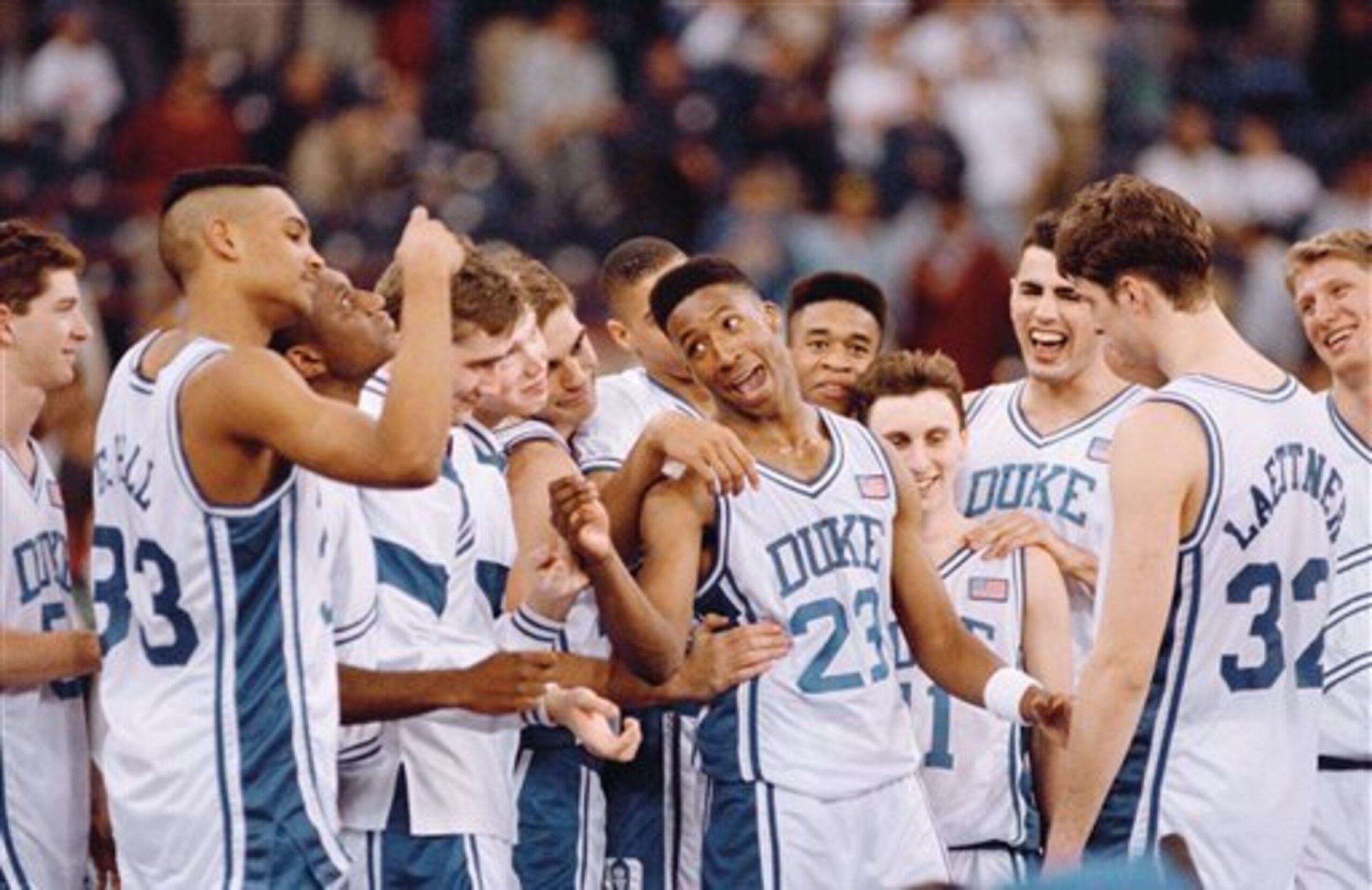
Star Power
Long before "The Shot," Christian Laettner was already the king of Durham. He led this team in points, rebounds, steals and blocks—and he was at least 27 percent better than second place in each of those categories. He had a pretty great supporting cast. Bobby Hurley, Grant Hill, Thomas Hill and Bill McCaffrey each averaged at least 11 points per game. But this team never happens without Laettner.
Clutch Factor
It wasn't exactly Shaka Smart's "HAVOC," but Duke's defensive intensity was impressive. The Blue Devils averaged 9.3 steals per game en route to the 1991 title. Granted, the pace of play was much faster back then. Using the generally accepted formula for calculating possessions (FGA - OR + TO + [0.475 * FTA]), an average Duke game in 1990-91 featured 79 possessions. That comes out to a steal rate of 11.8 percent, which played a big factor in their average margin of victory of 14.3 points per game.
The Case For
Duke did the unthinkable and beat the previously unbeaten Runnin' Rebels. Jerry Tarkanian's team made a mockery of the regular season, averaging 103.0 points per game and limiting opponents to 73.5 points in their 27 games before the start of the Big West conference tournament. Coincidentally, 103-73 was the score by which UNLV beat Duke in the 1990 national championship game.
But the Dukies didn't back down from the 34-0 giants, beating perhaps the greatest team of the past 40 years in the Final Four before also beating Kansas to win the title.
The Case Against
They weren't even a No. 1 seed, and outside of running into UNLV, the Blue Devils had a very favorable path to the championship, avoiding all other No. 1 and No. 2 seeds. In their final game before the tournament, they were beaten by North Carolina by 22 points.
Why They're Here
You never forget your first, but it doesn't necessarily make it your best. Duke had an impressive run through the 1991 tournament. There's no denying that. But the Blue Devils weren't nearly as good in 1990-91 as they were for the repeat in 1991-92.
3. 2015 National Champions
3 of 5
Star Power
On the other four teams, impact freshmen were almost nowhere to be found. Grant Hill was the exception to that rule, but even at that, he was only the fifth-highest scorer on the 1991 team.
In 2015, though, freshmen ruled the roost. Jahlil Okafor, Justise Winslow and Tyus Jones were three of Duke's four leading scorers this season, even though it was their first (and perhaps only) season of college hoops. Okafor and Jones were solid all season long, but the team found an extra gear when Winslow became a reliable contributor over the final two-plus months.
Clutch Factor
It took a few months and a couple of ugly losses, but defense is what transformed Duke from a very good team to a championship-caliber team. The Blue Devils limited their tournament opponents to 56.3 points per game. They switched ball screens like crazy yet Winslow always seemed close enough to the action to alter shots before crashing the defensive glass.
The Case For
The Blue Devils did have some bad losses this year, but they didn't exactly fluke their way through the regular season. They won road games against Wisconsin, Virginia, Louisville and North Carolina. And though they lost two of their three games against Notre Dame, the one win came by a 30-point margin. When they played up to their full potential, they were almost unbeatable.
The Case Against
They didn't win the ACC regular-season or conference-tournament title. Each of the other four teams listed here at least won a share of the regular-season title, and three of them won the conference tournament. Also, similar to the 1991 team, the 2015 team only really faced one elite opponent in the tournament. (Apologies to Gonzaga.)
Why They're Here
In terms of pure, NBA-ready talent, this might be Mike Krzyzewski's best roster ever. Perhaps Hill and Bobby Hurley would have outstanding professional careers were it not for injuries, but Okafor, Winslow and Jones simply seem destined for a few NBA All-Star Games. Because they're so young, this team wouldn't be nearly as polished and cohesive as the more veteran ones, but that wouldn't stop it from potentially beating the other four title teams.


2. 1992 National Champions
4 of 5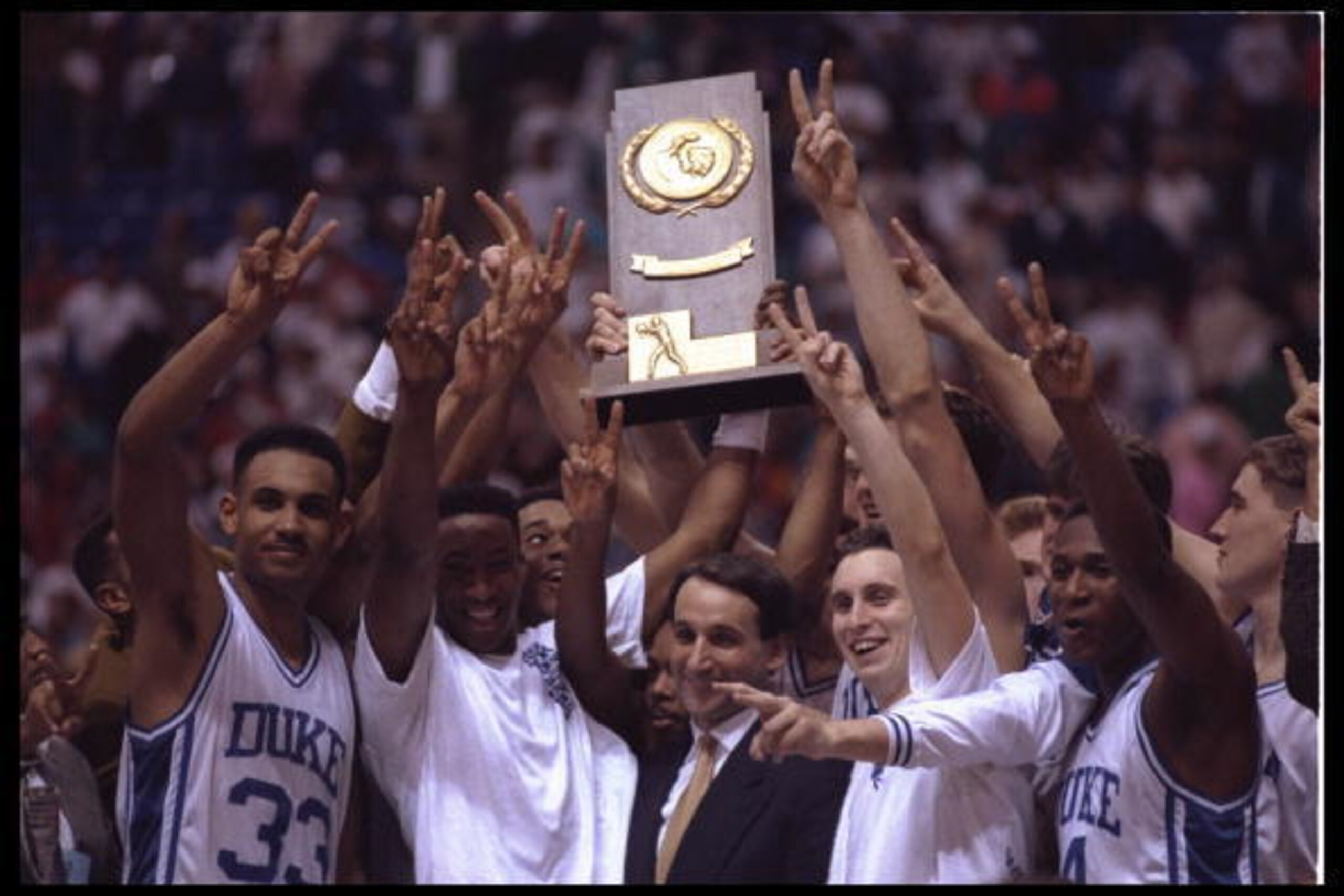
Star Power
As was the case in 1991, Christian Laettner was the star in 1992—but even more so as a senior. He averaged 21.5 points and 7.9 rebounds per game, shot 55.7 percent from three-point range and is still the most hated player in college basketball history.
Clutch Factor
Laettner was the horse, but Bobby Hurley was the jockey. He was named the Most Outstanding Player of the 1992 tournament thanks to a 26-point effort in the Final Four. Over the course of the season, he averaged 13.2 points and 7.6 assists per contest.
The Case For
Duke simply scored at will. As a team, the Blue Devils shot 53.6 percent from the field, 43.4 percent from three-point range and 74.8 percent from the free-throw line. Using the aforementioned possessions formula, we find that Duke averaged 73.9 possessions per game. At 88.0 points per game, that comes out to 1.19 points per possession. Not quite as ridiculous as Wisconsin's 2014-15 offensive efficiency (1.21 PPP, per KenPom.com) but still pretty incredible and the main reason they were so tough to beat.
The Case Against
They needed to make one of the most miraculous shots in NCAA tournament history just to make the Final Four and had to storm back from a second-half deficit to beat Indiana in the Final Four. Wins are wins, but it's hard to make a case for this title team as Coach K's best when it struggled that much against a pair of No. 2 seeds and only played one other game all year against a team that earned a No. 1 or No. 2 seed (a 10-point win over UCLA).
Why They're Here
All five of the primary starters on this year's team started at least 10 games on the 1991 title team. They were one year older, wiser and better than Coach K's first title team. But they weren't nearly as dominant in the tournament as his best team.
1. 2001 National Champions
5 of 5
Star Power
It wasn't a particularly deep team, but all five starters on this roster were special. Nate James averaged 12.3 points per game but was only the fifth-most reliable scorer, as Jay Williams (21.6 PPG) and Shane Battier (19.9 PPG) led the way. Throw in Mike Dunleavy (12.6 PPG) and Carlos Boozer (13.3 PPG), and it's hard to believe this team was beaten four times during the season.
Clutch Factor
The Blue Devils made three-pointers at a higher percentage in 1992, but they only attempted 19 percent of their shots from beyond the arc that year. In 2001, they averaged 10.4 made triples per game as 41.8 percent of their field-goal attempts came from downtown, forever cementing the narrative of Duke as a team that lives and dies by the three.
They only shot 34.3 percent from three-point range in the tournament, but they still averaged 86.8 points per game thanks to 29.2 three-point attempts per night.
The Case For
Duke won each of its six tournament games by a margin of at least 10 points and had an average margin of victory of 20.2 points over the course of the season. The 2000-01 Blue Devils didn't mess around. They just kept shooting and scoring until you cried "Uncle!"
The Case Against
Duke played four games against Maryland in 2000-01—including one in the ACC tournament and another in the Final Four—and each and every one of those games was a classic. It makes it difficult to argue that this was Coach K's best team ever when Gary Williams had an 11-loss team that repeatedly hung with them.
Why They're Here
Christian Laettner is the best player in Duke history, but this was the best team that Coach K ever led to a national championship. And here's a scary thought: If they hadn't left early for the NBA, Elton Brand would have been a senior and Corey Maggette would have been a junior on this roster.
As is, it's Krzyzewski's best team. If players had stayed for four years like they were less than a decade prior, it might have been the best team in college basketball history.
Kerry Miller covers college basketball for Bleacher Report. You can follow him on Twitter @kerrancejames.
.jpg?w=2560 "Titans Colts Football")
.jpg?w=2560 "Chiefs Giants Football")



.jpg?w=2560 "NFL investigating Eagles")
.jpg?w=2560 "Jonathan Taylor Landing Spots 📍")
