Rugby Perspective: Do Pads and Helmets Increase Concussion Risk to NFL Players ?
The retirement of San Francisco 49ers linebacker Chris Borland at the age of 24 has already left its mark. Inevitably, the debate over what this means for the future of the NFL and player safety has well and truly kicked off.
There is no reason why safety concerns should mean the end of football. However, they do perhaps indicate that practices and rules may need some tweaking in order for the NFL to keep up with the current societal environment.
Coming from a rugby background, this is an interesting scenario to me. The problem left by concussions has been a big one in both rugby union and rugby league in recent years. Just as in the NFL, though, it is one that has not been solved despite steps being taken to protect players as much as possible.
TOP NEWS

NFL Season Shaping Up To Be Unpredictable 🗣️
.jpg?w=2560 "Texans Titans Football")
Cam Ward Says He's Not A Loser
.jpg?w=2560)
Texans Trade for MHJ
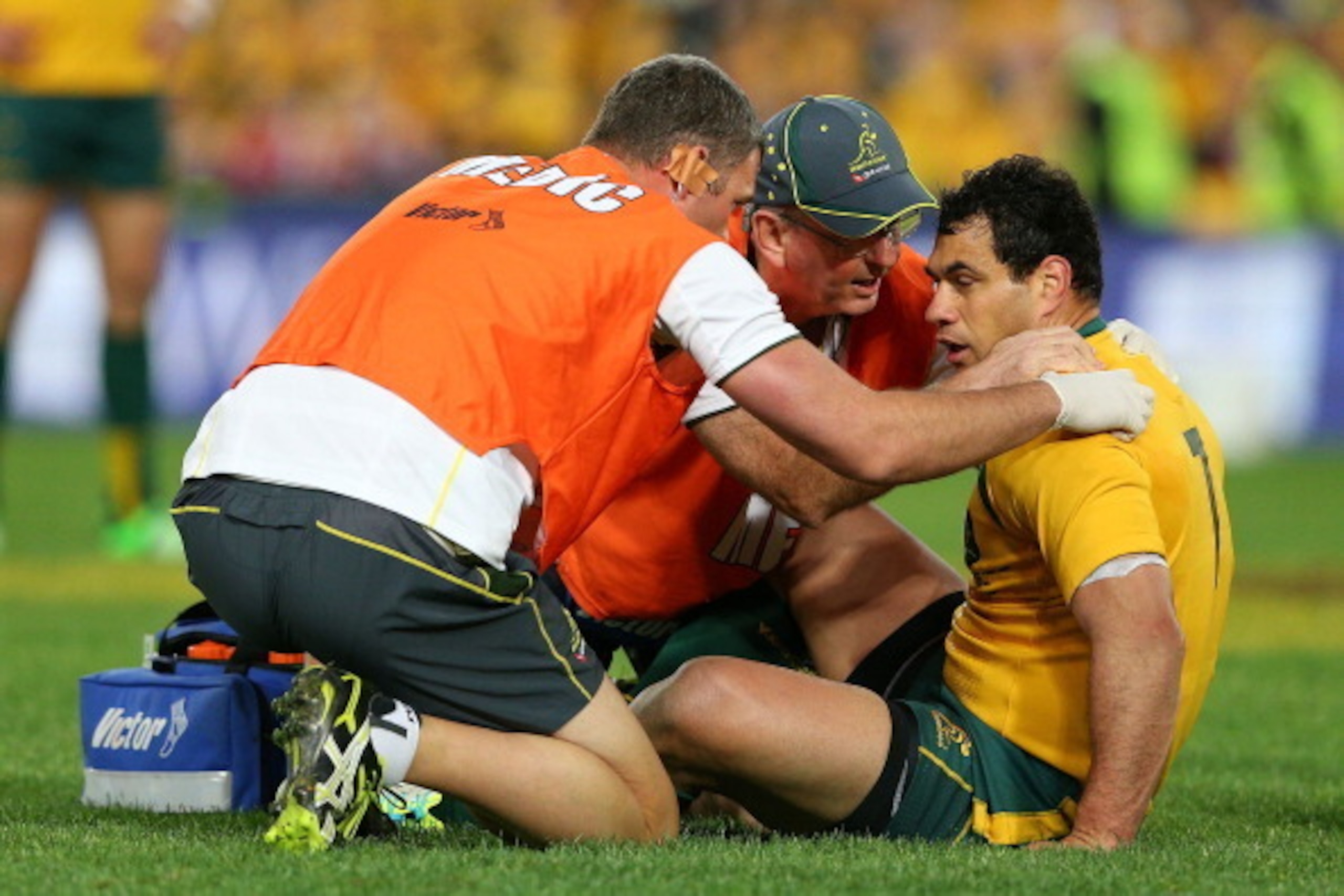
In a contact sport, head injury is an inevitable risk. You know that when you sign up for it. No one is forcing you to play, and there has to be some level of self-responsibility surrounding that. You can do things to minimize the risk, though, and each of rugby and football has its own way of doing this.
American football, rugby union and rugby league are three vastly different games. There is no point comparing them in that way.
However, as contact sports that all involve tackling and putting the head in harm's way, there are things that each can learn from the others.
One of the key differences between football and the two rugby codes comes in the level of protective gear that each sport allows. While football players are decked out in large pads and hard helmets, rugby players wear minimal to no padding on their shoulders, a mouth guard and perhaps a thin helmet.
At first glance, it would seem football players are the ones better protected. Maybe they are, but you have to consider the consequences of wearing all of this gear.
Generally speaking, the more protective gear a player wears, the more fearlessness and recklessness he will possess when engaging in contact. You are far more likely to have a feeling of invincibility when wearing pads and a helmet than when you are not.
Consequently, you'll find that football players tend to throw themselves into contact with less regard for self-preservation, whether it be in blocking or tackling.
You do not get this so much in rugby. While the players still hit hard and throw themselves into contact, the technique in which they do so minimizes bodily harm.
The classic rugby tackle that is taught right through the age-grades is a simple one: go low, hit with the shoulder, keep your head up and to the side or back of the opponent, grab with your arms and hands, and then get back to your feet and try to steal the ball.
This technique is taught not only because it is effective in terms of bringing players to the ground, but also because it protects the head. When players do receive head knocks in rugby games, more often than not, it is because they get their heads in the wrong place in the tackle and cop a knee.
The head is exposed, as is the whole body, so it is not just a case of tackling hard—you also have to tackle smart. There is no point in throwing yourself at an opponent and copping a knee to the head, as there is a mandatory concussion test for anyone who has received a head knock, and you are no good to your team off the field.
It is sometimes said that it would be dangerous for football to be played without pads and that the collisions are too forceful. Perhaps that is true—the stop-start nature of football allows players to hit hard through only having to perform short bursts of activity with regular breaks rather than the continuous nature of rugby, which makes it more of a long grind.
However, one must ask the question of whether football players would still throw themselves at their opponents in the same way if they were not wearing all of their protection.
Put them out on the field with the same level of protective gear that rugby players wear. Would there be a change in the technique and level of contact that players would be prepared to use? It is quite possible.
It is not to suggest that this is the right way to do things. But it makes for interesting thinking.
Seattle Seahawks head coach Pete Carroll produced a video last year detailing a tackling technique far more similar to that which is seen in rugby. He dubbed it "shoulder tackling," in which the goal is to get the head out of the way, suggesting that the technique should be able to be performed in t-shirts and shorts.
Undoubtedly, it is a positive move, and while it seemed that the players were, at times, still getting their heads in what rugby would consider the "wrong position," it beats leading with the head by a long shot.
The comment regarding being able to practice the technique without helmets and pads on is key. In this, players are more exposed to copping knocks, but the fact that they are still prepared to tackle with that technique indicates that there is a lower level of recklessness in it.
If all games were played under these conditions, with no pads or helmets, perhaps it would lead to this technique becoming something of a necessity, rather than simply a good practice.
It is something that is not likely to happen any time soon, but it is perhaps something that the NFL could learn from both codes of rugby. Are the pads and helmets really helping, or are they indeed part of the problem?
If it led to a safer technique which minimized head injury, perhaps the NFL could put a stop from players like Borland retiring for fear of head injury in the future.
.jpg?w=2560 "Broncos Chargers Football")
.jpg?w=2560 "Cardinals Giants Football")