

NFL Combine 2015: Brent Sobleski's Day 6 Notebook
INDIANAPOLIS — Bleacher Report NFL draft analyst Brent Sobleski brought his trusty notebook to cover the NFL combine. Find out what he jotted down during the sixth and final day of the event.
Byron Jones Jumps into the Conversation

.jpg?w=2560 "Rams Eagles Football")

There are "workout warriors," and then there is Connecticut cornerback Byron Jones.
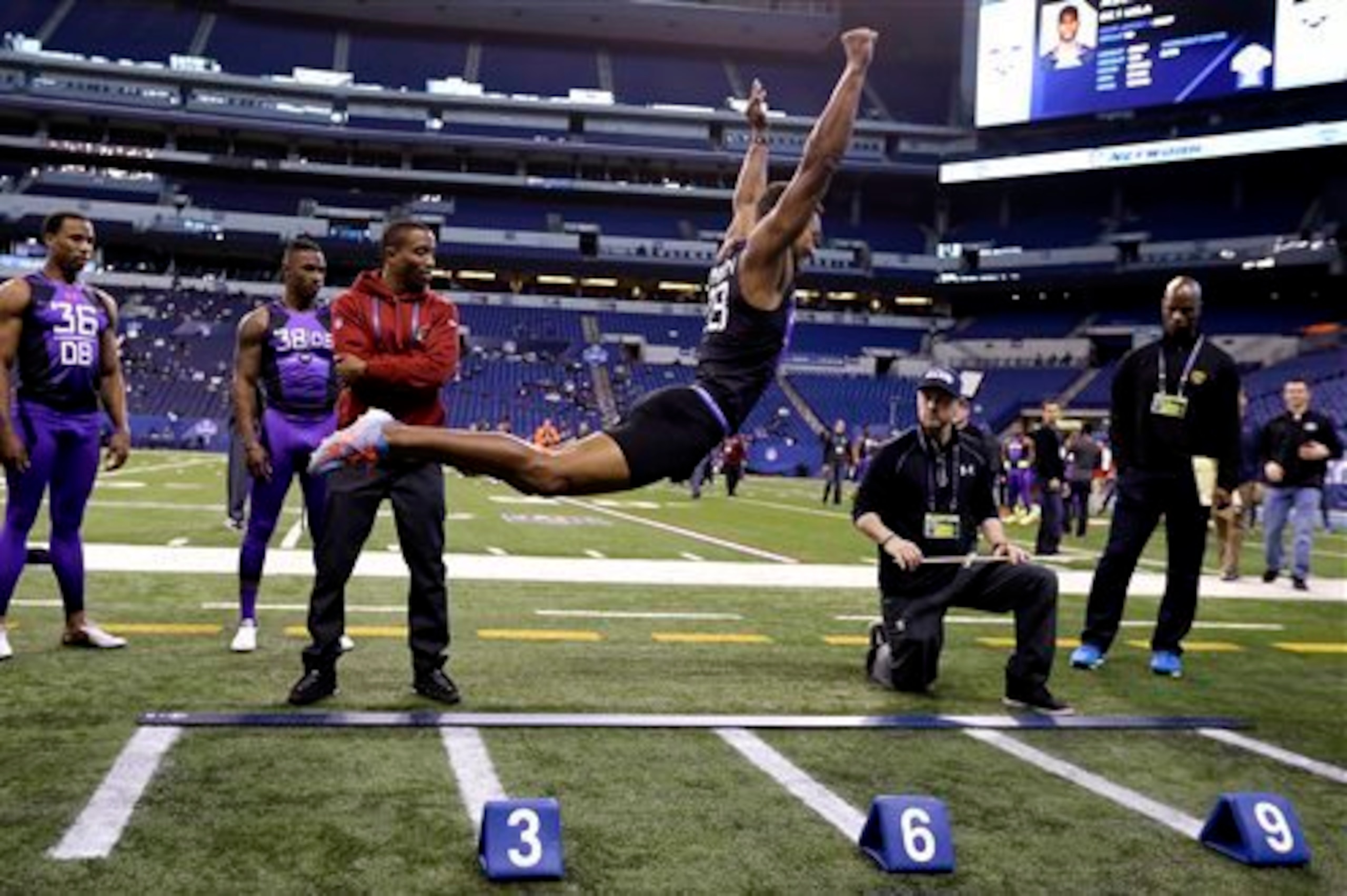
To say Jones posted eye-popping numbers would be an understatement, and he didn't even complete a full workout.
Two numbers were all that was needed to fully appreciate how athletic the 6'1", 199-pounder really is:
- Broad jump: 12'3"
- Vertical jump: 44.5"
One tweet perfectly illustrated the magnitude of Jones' astounding broad jump:
His vertical wasn't too shabby either after finishing only half an inch behind Georgia's Chris Conley for the best effort of any player in Indianapolis.
Jones didn't do anything else from a workout perspective, but it was enough to set the NFL abuzz.
For a player who wasn't necessarily considered an early-round prospect, there is no bigger compliment than completing a combine performance that forces scouts and NFL executives to go back to the tape and see if a tremendous workout translates to on-field play, as Bleacher Report's Chris Simms noted in the below video.
It doesn't for many, but Jones isn't a typical case. The Connecticut product isn't just a tremendous athlete; he's a legitimate cornerback prospect.
The reason he didn't participate in the rest of the combine was due to a shoulder injury he suffered against the East Carolina Pirates on Oct. 23. Jones recently started to participate in offseason workouts just a few weeks ago.
Once teams rewatch a few UConn games, they'll see a long, press cornerback who's not as stiff in the hips as expected. For certain teams—like the Seattle Seahawks, for example—this would be a perfect fit for their scheme. Franchises are now searching for bigger cornerbacks with more length and physicality at the line of scrimmage.
During his 39 starts with the program, Jones' play proved to be inconsistent, but he displayed enough upside to be selected at some point before the third day of the NFL draft. His measurements at the combine were merely the catalyst to a bigger conversation about his overall potential.
Trae Waynes Stakes Claim as Top CB
While watching the NFL combine, a little voice should be overheard in the back of your head constantly nagging you to remember, "It's only part of the equation. The fate of these prospects won't be decided by what happens in Indianapolis."
This is entirely true.
However, certain players who entered the weekend with similar grades relative to their contemporaries are presented with an opportunity to separate themselves from the pack.
Michigan State cornerback Trae Waynes was a perfect example.
This year's cornerback class doesn't possess the same depth overall when compared to last year's. Five cornerbacks were chosen in the first round of the 2014 draft.
Currently, only one cornerback is considered a lock for the first round. Waynes moved to the head of the class with an outstanding combine performance.
The Michigan State product dazzled with an official 4.31-second 40-yard dash. Waynes' primary competition as the top cornerback, Washington's Marcus Peters, didn't perform nearly as well.
| Player | Height | Weight | Bench | 40-yard dash | Vertical | Broad | 3-cone |
| Waynes | 6'0" | 186 | 19 | 4.31 | 38" | 10'2" | 7.06 |
| Peters | 6'0" | 197 | 17 | 4.53 | 37.5" | 10'1" | 7.08 |
With Peters, who already had off-the-field concerns entering the week, now in the rearview mirror, Waynes solidified his status as the top cornerback and a potential top-15 selection.
Not only will Waynes be compared to his draft classmates, but a former teammate as well. Former Michigan State Spartans cornerback Darqueze Dennard was a first-round selection last year after he won the Thorpe Award as the nation's top defensive back.
The difference between these two, though, was clearly evident once Waynes went through position drills.
The incoming cornerback is far more fluid in his lower body, and his ability to glide through the on-field portion of the combine workout was merely confirmation of where he stands in this class and as an overall talent.
Jalen Collins May End Up as a First-Round Surprise

When a class isn't considered particularly strong at one position, players with upside and a little bit of the unknown factor start to tantalize.
Enter LSU's Jalen Collins.
Collins is a bit of an enigma, and his workout Sunday proved exactly why. Physically, the LSU defensive back fits all the criteria to become a first-round draft pick and the top cornerback for an NFL franchise. He stands 6'1" and weighs 203 pounds. He also ran a 4.48-second 40-yard dash and finished with a strong 6.77-second performance in the three-cone drill, which determines a prospect's ability to change direction.
Throughout his workout, Collins was a little high in his backpedal, but he easily transitioned through his turn like one would expect from this caliber of athlete.
So, why did he only start 10 games for the Tigers? And why did he decide to enter the draft in the first place? Collins gave a fairly straightforward answer to the latter question, as quoted by Nick Underhill of The Advocate:
"I just felt like this was the best opportunity for me to maximize on the draft. I didn’t want to risk getting hurt."
Those same questions are exactly what NFL talent evaluators will be asking themselves after a top-notch workout in Indianapolis.
Collins is clearly talented, but he's raw. A team late in the first round with needs throughout its secondary and a patient coaching staff will seriously consider this cornerback in the opening frame.
Also on Day 6

- Alabama's Landon Collins confirmed he is the draft's top safety prospect. The position itself is relatively barren beyond the former member of the Crimson Tide, but he is clearly a first-round prospect. And his availability could be pushed closer to the top 10 overall due to scarcity. Landon Collins is an intimidating strong safety who provides extra value because he also played nickel corner and free safety during his three years in Tuscaloosa. As the ball drills proved in Indianapolis, though, Collins isn't at his best when asked to be the last line of defense. However, he appeared far more fluid than expected during the individual portions and ran an impressive 4.53-second 40-yard dash. At 6'0" and 228 pounds, Collins is the type of tone-setter teams prefer with more than enough athleticism to not be a liability in coverage.
- The search for the draft's No. 2 safety then comes into question. Two players with opposite skill sets certainly made their case at the combine. The first was Samford's Jaquiski Tartt. Like Collins, Tartt is a physically imposing safety at 6'1" and 221 pounds. Not only does he look the part, but he ran really well (4.53-second 40-yard dash) too. Tartt won't be mistaken for the Seahawks' Earl Thomas, but he showed the potential to be a strong in-the-box safety. Tartt simply continues to impress during the draft process—first at the Senior Bowl and then the combine.
- The second safety claims the completely opposite skill set of Tartt. Arizona State's Damarious Randall is a smooth operator as a true free safety. Teams in search of a safety who can cover sideline to sideline will place Randall much higher on their board than others. At 5'11" and 196 pounds, Randall can be considered somewhat on the small side of the spectrum. What he lacks in size, though, he clearly makes up for in quickness. Randall finished among the top 10 defensive backs in all of the speed drills, except for the three-cone drill, where he tied for 11th. Not only was his 40-yard dash (4.46) impressive, but the safety posted strong change-of-direction times. His times in the three-cone drill (6.83) and short shuttle (4.07) were top-three performances at his position. There is no question that Randall can cover space in the secondary.
- A former safety turned cornerback, Utah's Eric Rowe continued his offseason ascension. Rowe played three years at safety before finally converting to cornerback. The former Ute proved he belonged at the position during the Senior Bowl, and he continued a strong offseason with a surprising combine workout. At 6'1" and 205 pounds, Rowe finished among the top 10 defensive backs in every single measurement at the combine besides the 60-yard shuttle. His 4.45-second 40-yard dash proves he has the top-end speed necessary to run with NFL receivers, plus his three-cone (6.70) and short shuttle (3.97) show he's quick enough to handle smaller targets.
- Another larger cornerback who impressed at the Senior Bowl was Miami's Ladarius Gunter. The Miami (Florida) product played exceptionally well in Mobile, but his overall athleticism didn't translate during combine drills. Not only did Gunter run poorly during his 40-yard dash (4.69), but he didn't show the ability to really unlock his hips and turn through his backpedal. While the second round was once a possibility for Gunter, he'll likely find himself in the mid-rounds after such an underwhelming performance.
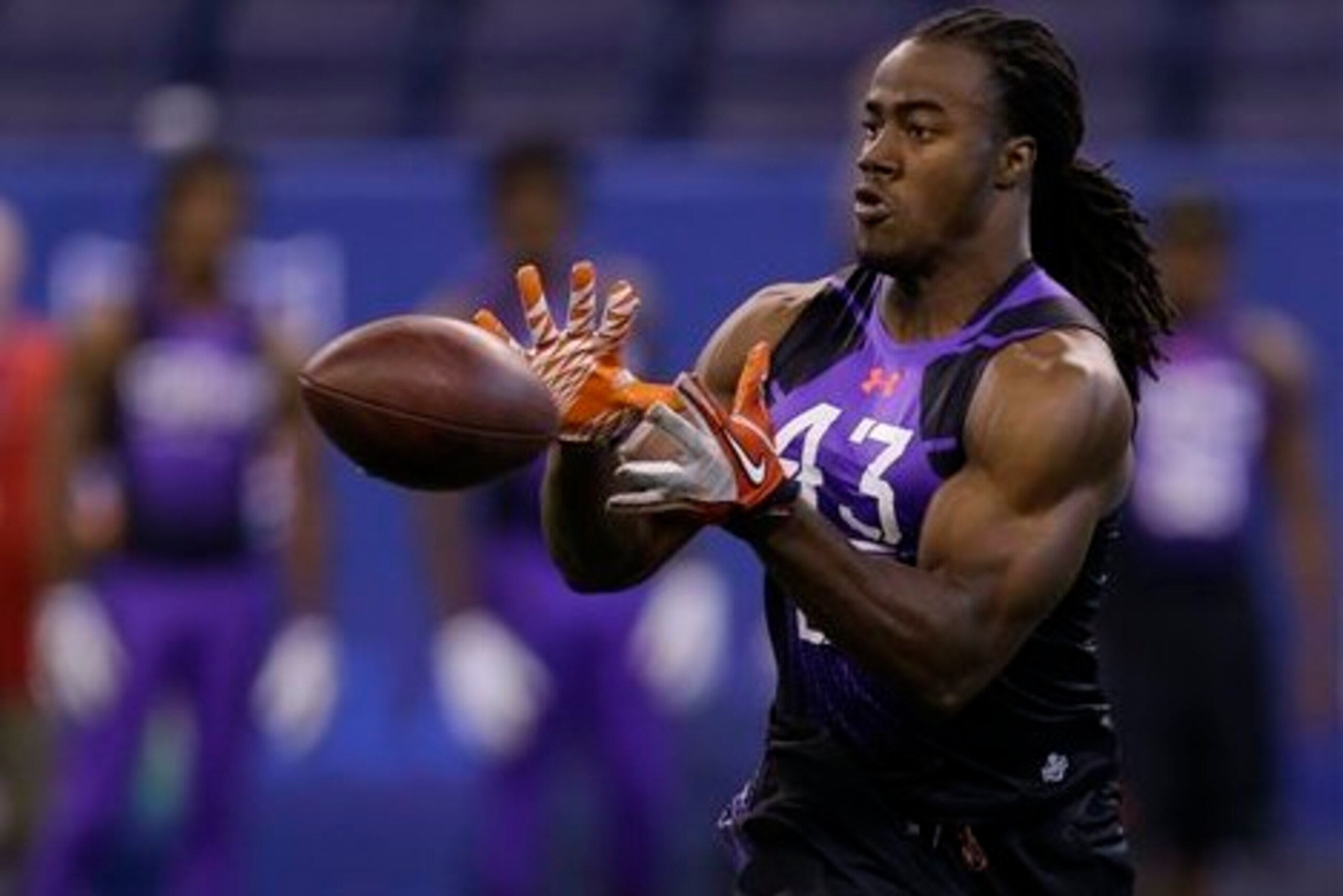
- USC's Josh Shaw, on the other hand, proved to be far more athletic than expected. There were lingering questions about whether Shaw (6'0", 201 lbs) should convert to safety because he's stiff in the hips. He still might. But he mitigated some concerns with a strong 4.44-second 40-yard dash. However, there is still an off-the-field incident during Shaw's senior season that teams can't ignore.
- While the league is trending toward bigger receivers, there is still value in sub-5'11" cornerbacks. Two in particular stood out throughout Monday's workout. Ole Miss' Senquez Golson and Oregon State's Steven Nelson will automatically be cast as nickel corners, and there is nothing wrong with those projections. In today's NFL, nickel corners are essentially starters due to the preponderance of three-wide receiver sets. Golson displays tremendous ball skills—he finished second at the FBS level with 10 interceptions—and no cornerback at the combine opened his hips and ran quite like the former Rebel. Nelson, meanwhile, put together a strong overall workout, including a 4.49-second 40-yard dash.
- Something must be in the water in Fort Worth, Texas. A poor workout from TCU linebacker Paul Dawson on Sunday turned heads. Unfortunately, he wasn't the only TCU product to disappoint. Safety Chris Hackett and cornerback Kevin White ran poor 40-yard dashes. White suffered a tweaked right hamstring to excuse his time (4.63), but Hackett really struggled throughout all of the drills. The early entrant ran an abysmal 4.81-second 40-yard dash, and then he looked very stiff during the position-specific portion of the workout. TCU's pro day will be a must-see event for NFL teams for all the wrong reasons.
- Oregon's Troy Hill is a perfect example why you shouldn't put too much stock in the raw athletic numbers in determining whether a player performed well at the combine. A 4.55-second 40-yard dash isn't exactly a good time for a 5'10", 182-pound cornerback. However, Hill was one of the most fluid athletes on the field once the defensive backs competed in position-specific drills. The former Duck showed really loose hips to turn and run. Not all top cornerbacks have elite top-end speed. The Cleveland Browns' Joe Haden serves as proof. But he wins consistently due to his lower-body flexibility and ability to drive on the football. Hill isn't in Haden's class, but he showed some of the traits that will allow him to play and potentially excel at the NFL level.
- One of the best performances among the group was saved for last. Florida State's Ronald Darby flew around the field in Lucas Oil Stadium. Darby participated in both football and track during his time with the Seminoles. His speed was evident with a 4.38-second 40-yard dash. He also delivered with a 41.5" vertical jump. Teams saw how easily everything came to Darby during his workout, and they will start to wonder why he didn't completely dominate. At times, teams simply weren't throwing in his direction. Other times, he didn't trust his technique even though his closing speed is more than enough to run with any wide receiver. Darby is a very talented but unpolished prospect. His workout in Indianapolis may have helped him solidify second-round status, though.
Brent Sobleski covers the NFL draft for Bleacher Report. Follow him on Twitter.
.jpg?w=2560 "Texans-Mixon Released Football")
.jpg?w=2560 "Grading WWE Raw 🔠")


.jpg?w=2560 "Bijan's INSANE 1st Half 🤩")
