Vikings Defense Finding Success by Limiting Big Plays
The Minnesota Vikings defense has become one of the team’s most promising components over the course of the 2014 season. Mike Zimmer’s work with the youthful unit deserves significant praise. The schematics of his defense have given it more than a fighting chance.
One of the defense’s defining qualities is its ability to limit big plays. Its stinginess has kept almost every one of Minnesota’s games close, even when the offense sputtered mightily.
Sporting Charts counts plays of 25 or more yards as big plays, of which Zimmer’s defense has allowed 25, good for a No. 13 ranking.
TOP NEWS
.jpg?w=2560 "Titans Giants Football")
OBJ Calls Out Giants After Release
Lamar Jackson Day-to-Day

Live Live: Updates from every NFL game
Josh Robinson has tried his hardest to make the number more modest than it should be, though. On numerous occasions this season, the vertically challenged cornerback was in position to make plays on deep throws but lost out to much taller receivers. The secondary’s early-season breakdowns, when it was working out the kinks of a new scheme, also fail to flatter the defense.
Schematically speaking, the Vikings are able to limit big plays through the air quite effectively.
The success Zimmer’s unit had last week against a cannon-armed quarterback in Matthew Stafford and two explosive receivers is evidence of that. Mike Wobschall of Vikings.com gives the telling statistic:
"2. #Vikings DEF showed up vs. Stafford and his explosive weapons. DET had just 1 play of 20+ yds.
— Mike Wobschall (@wobby) December 15, 2014"
With a 25-yard threshold, the Detroit Lions failed to achieve a single big play. The only play over 20 yards went for 23 and came from a four-yard toss over the middle to Calvin Johnson that turned into a big gainer due to a well-executed pick on Xavier Rhodes. In Minnesota’s first bout with Detroit back in Week 5, Stafford’s longest connection was for only 15 yards.
The Green Bay game in Week 12 followed a similar pattern. Despite being one of the most explosive offenses in the league, Aaron Rodgers and the Green Bay Packers’ two largest gains through the air netted only 34 and 29 yards, respectively.
Drew Brees was not particularly successful deep either, though he did take advantage of a coverage bust for a 34-yard touchdown in Week 4.
Those mistakes are becoming less frequent, and when Robinson is holding up his end of the deal, Minnesota's defense forces teams to go on long drives and convert third downs. The schematics of it are sound.
Zimmer’s defense is noted for its aggressiveness in coverage, relying on its cornerbacks in man coverage and its attacking mentality at the line of scrimmage on crucial downs. It doesn’t utilize shells over the top with multiple safeties very often and stays away from Cover 2, so why can’t opponents capitalize with big plays?
A little disguising allows the Vikings defense to have its cake and eat it too.
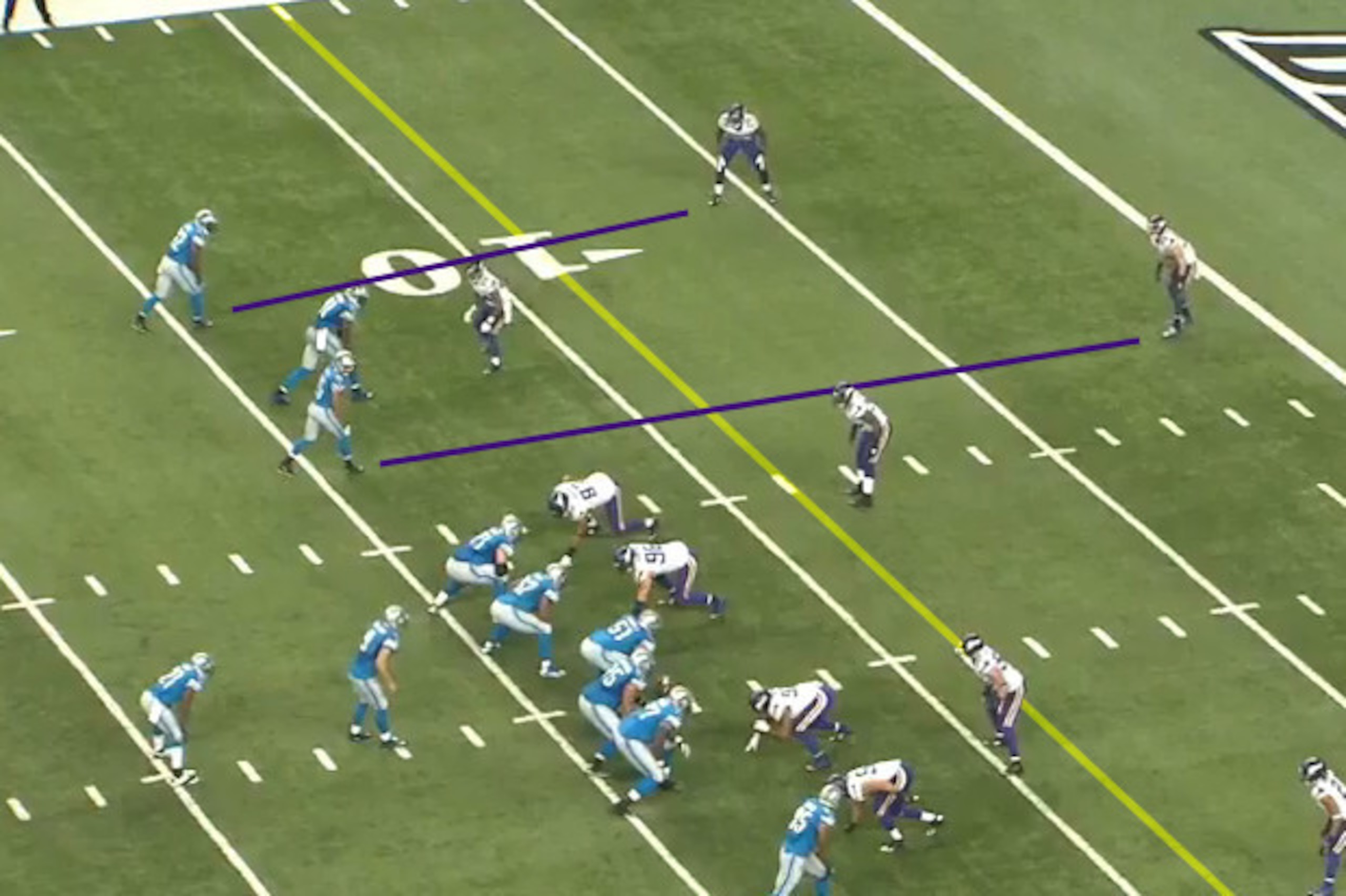
As with all things Mike Zimmer, it begins before the snap. The Lions are facing 3rd-and-4, hardly a massive distance to gain. Even so, Minnesota sinks off with both Xavier Rhodes and Andrew Sendejo, giving Detroit acres of space seemingly.
Simple calculation tells Stafford and the Lions to either audible into a quick screen or stay in a screen already called.

Before the snap, Minnesota’s alignment looks like a defensive miscalculation. Instead, Zimmer is basically goading the Lions into throwing underneath. Should they comply, his defenders are prepared.
Sendejo is immediately driving forward at the snap, anticipating Stafford’s move. Once Golden Tate catches the underneath throw, Sendejo and Gerald Hodges immediately swarm him.
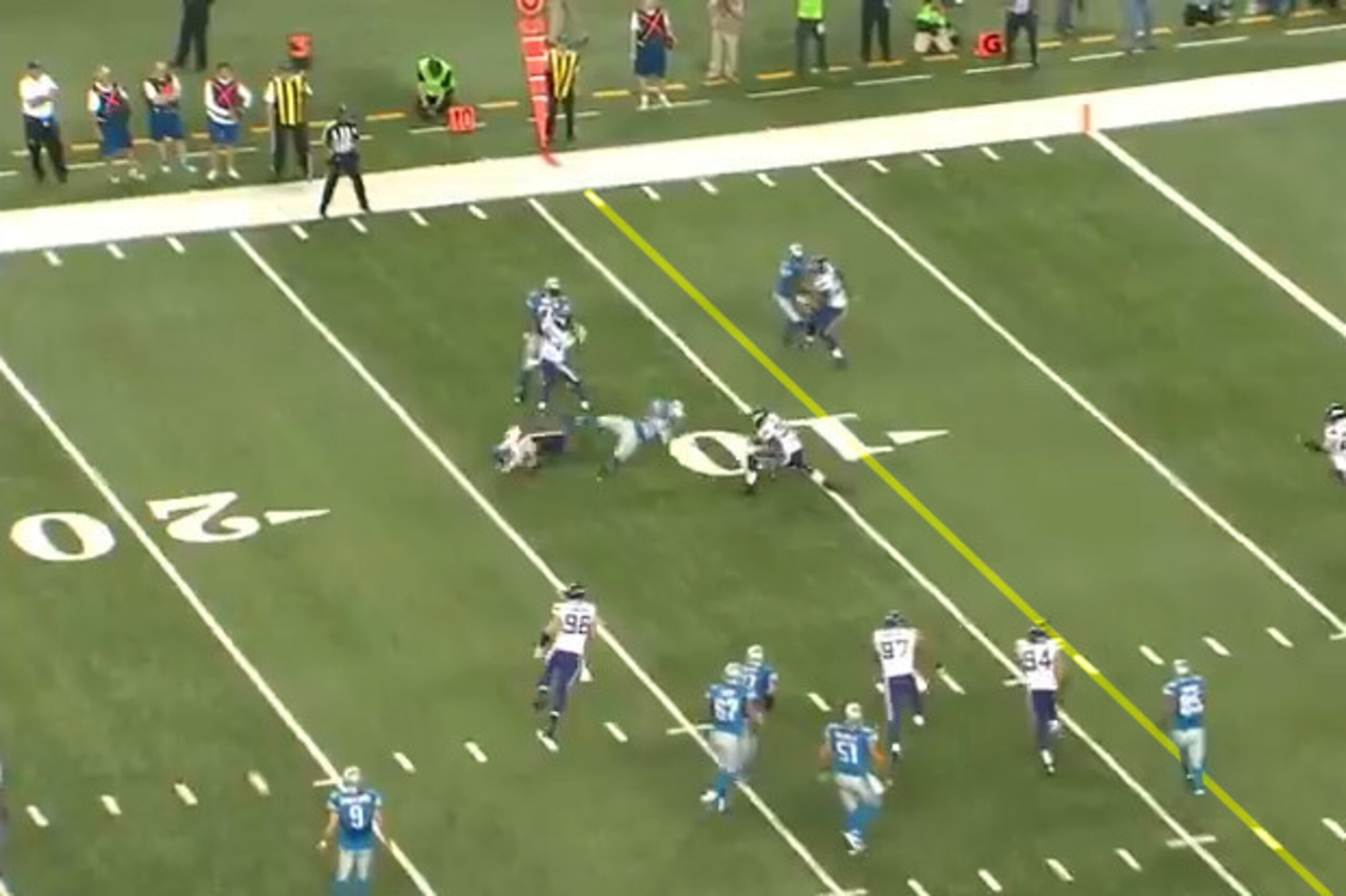
Detroit is forced to settle for a field goal without giving other receivers a chance to get open. Zimmer urged the Lions to throw underneath instead of testing his defense down the field, thus limiting big-play potential and getting his defense off the field in the red zone.
The first example is one where Minnesota manipulates the offense to throw underneath by giving space. Zimmer will also achieve the same result by taking the opposite approach, overwhelming offenses at the line of scrimmage.
His trademark double A-gap pressure tips the first domino.
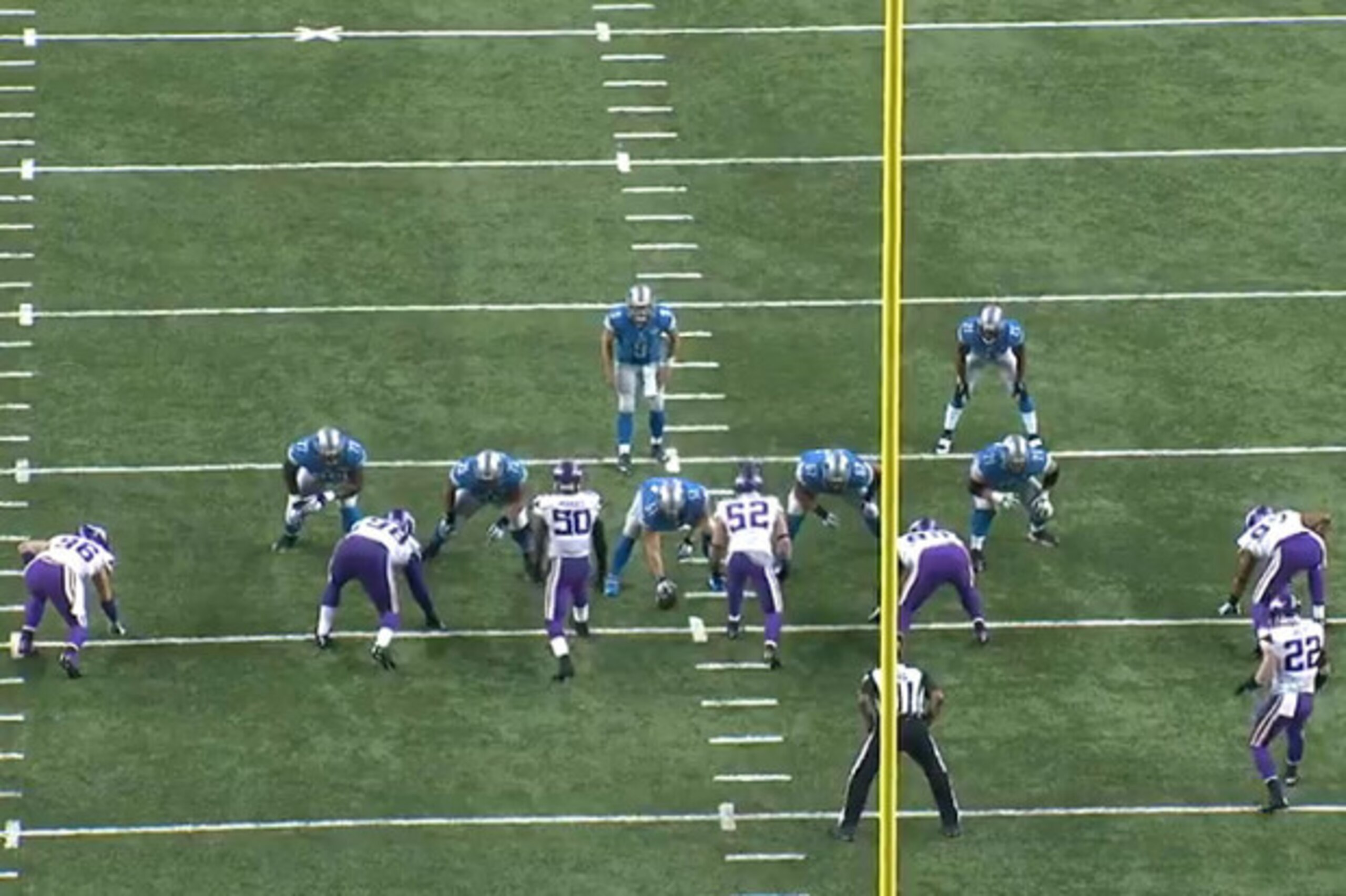
By putting six possible rushers on the line of scrimmage against five Detroit blockers (Reggie Bush swings out), the Lions must anticipate a free rusher. Stafford is hurried into a hot read, not able to let his receivers attack coverage down the field.
Minnesota actually drops Everson Griffen and Chad Greenway into coverage, brining only four rushers and not sacrificing coverage numbers.
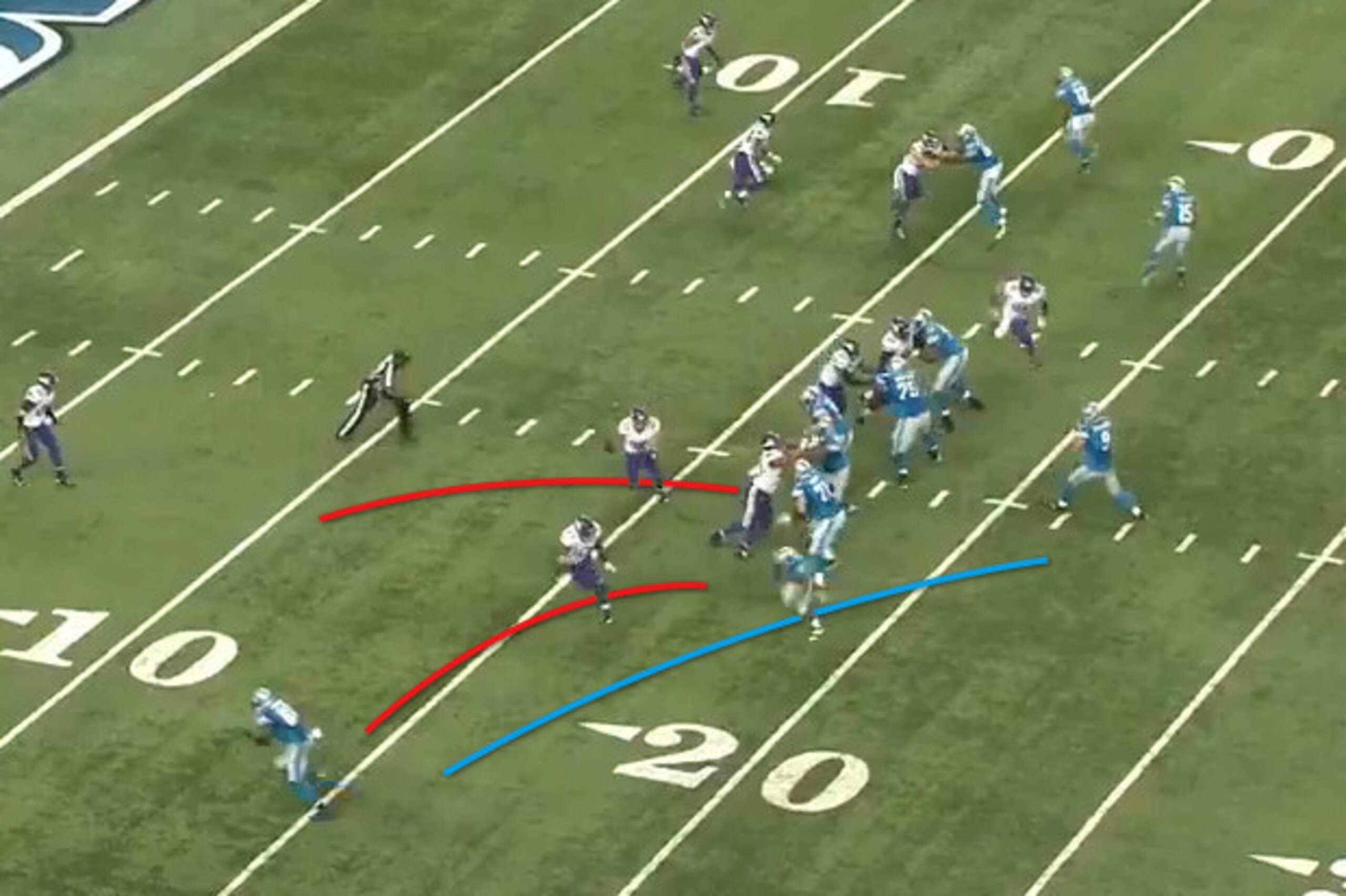
Detroit’s play looks familiar. Stafford has the receiver screen to Tate as an option and also the quick throw to Bush on the opposite side, the one he decides upon.
Griffen drops into coverage right over top of Bush immediately. He even has help behind him in Greenway. Stafford has no other options after he chooses to throw the hot read to Bush, though, because the Vikings have a free rusher. If he comes off Bush, he gets planted into the turf.

Stafford throws, Bush bobbles the pass and the Lions are ultimately fortunate that Griffen wasn’t running in the opposite direction with the ball when all was said and done.
Both plays steered the Lions into underneath throws. On top of that, Zimmer’s schematics put defenders in position to make tackles in space, limiting Detroit’s ability to net big yardage at once.
Failing to sack Stafford on the day would not have sounded like an avenue to success for Minnesota’s defense before the game. The usage of pre-snap positioning to force Stafford into quick, underneath throws with limited-yardage potential was actually what shut down Detroit’s offense, though.
Instead of Johnson and Tate terrorizing the Vikings with downfield passes, the Lions were relegated to a nickle-and-dime approach.
Stafford was kept upright, but only by the strings that were attached to Zimmer’s fingers. On numerous occasions, he really was Minnesota’s puppet.
Week 15’s defensive success is one more feather in the cap of the first-year head coach. Without the likes of Sharrif Floyd, Anthony Barr and Robert Blanton in the lineup, Minnesota was still able to hold down an explosive Detroit offense.
The unit's success over the course of 2014 follows a similar script quite often. With a No. 26 ranking in completion percentage and a No. 15 ranking in yards per attempt, Minnesota's strategy is quite clear.
Zimmer has not reinvented the wheel, but his defense has found a way to limit big plays. In doing so, the Vikings have been competitive against some of the league's best quarterbacks.
Statistics via ESPN.com unless noted otherwise.



.jpg?w=2560 "Saquon Out for Game")